

A criticism, a political headline, a family role, or a passing mood can suddenly seem to occupy the whole of reality. Even a sacred form can become an object of rivalry rather than a doorway to the sacred. Vedantic inquiry begins at precisely that moment, when an appearance has become more absolute in your mind than it is in fact.
If you have been told to seek the cause behind forms, you may wonder whether Vedanta expects you to dismiss the world, your body, your duties, or the deity you worship. It does not. The practical task is to see a form accurately, trace its dependence, and stop asking it to provide an unchanging identity. You can then honor the form without being imprisoned by it.
The cause is not merely an earlier event

In ordinary speech, a cause is something that happened before an effect. You ask what caused an argument, why a project failed, or which action produced a result. Those are necessary empirical questions, but Vedantic inquiry goes deeper. It asks what a present form depends upon for its existence and intelligibility.
Advaita Vedanta uses karana, cause, in this deeper sense. Brahman is not simply the first item in a long sequence of cosmic events. Brahman is the non-contingent ground because of which names, forms, experiences, and sequences can appear at all. The movement from names and forms toward their unchanging ground is therefore an inquiry into dependence, not a search for a remote event in the past.
The traditional clay-pot example makes the direction of inquiry concrete. A pot has a name, a shape, and a use. It can hold water, be bought, be broken, and be replaced. Yet you cannot separate the pot from clay and still have a pot. Clay, by contrast, does not depend on that particular shape; it can appear as a bowl, a tile, or an unformed lump. The pot is not nothing, but its reality is borrowed from what constitutes it.
The same reasoning applies to gold and ornaments or water and waves. A necklace can be melted while gold remains. A wave rises and falls without creating or destroying water. Name, boundary, and function change; the underlying basis does not change in the same way.
Do not push these metaphors beyond their purpose. Clay, gold, and water are still objects of experience, whereas Brahman is not another subtle object hidden behind visible ones. The metaphors teach an asymmetry: the form depends on its basis, while the basis does not depend on that particular form. Once you see that, the next question is not, What finer object lies underneath? It is, What is required for any object, material, thought, or absence to be known?
This is where inquiry turns from the seen to the seer. Every object is revealed in awareness. A sensation, memory, judgment, and image of yourself can each be noticed. Awareness is not noticed in the same way as one more item among them; its presence is evident through the fact that experience is known. Advaita calls it self-luminous because another act of awareness is not required to reveal awareness.
Appearance is dependent, not disposable

The word maya is often reduced to the slogan that everything is an illusion. That reading is too crude to guide a life. A dependent appearance can be fully consequential within experience even though it is not metaphysically independent. A promise matters. A lie harms trust. Hunger requires food. Your duties do not disappear because their names and circumstances change.
Vedanta protects this distinction through two orders of reality. Vyavaharika is the empirical order in which bodies, relationships, causes, choices, and consequences function. Paramarthika is the ultimate standpoint from which no finite form possesses independent, self-standing being. These are not two unrelated worlds. They are two registers in which the same experience is assessed.
You can apply both registers whenever a situation becomes consuming:
- At the empirical level, ask what the situation requires. If criticism is accurate, correct the error. If you caused harm, acknowledge it. If a duty is yours, perform it carefully.
- At the ultimate level, ask what you have made absolute. A mistake is an event and may carry consequences, but it is not the whole truth of what you are. A role is useful, but it cannot provide an unchanging self.
This double vision prevents two opposite errors. The first is reification: treating a passing form as final reality. The second is denial: using non-dual language to evade ordinary responsibility. Vedantic discernment asks you to loosen identification while becoming more exact about action, not less.
Bhagavad Gita 2.16 distinguishes what does not endure from the Real that does not cease to be. That teaching is an ontological discipline, not permission to call inconvenient consequences unreal. Likewise, the declarations of Chandogya Upanishad 6.2.1 and 3.14.1 – the One without a second and all this as Brahman – do not make every form functionally or ethically interchangeable. A truthful word and a lie remain different within lived dharma.
A useful rule follows: never use the ultimate standpoint to cancel an empirical obligation. Use it to release false identification while you meet the obligation more cleanly.
A repeatable inquiry from object to awareness
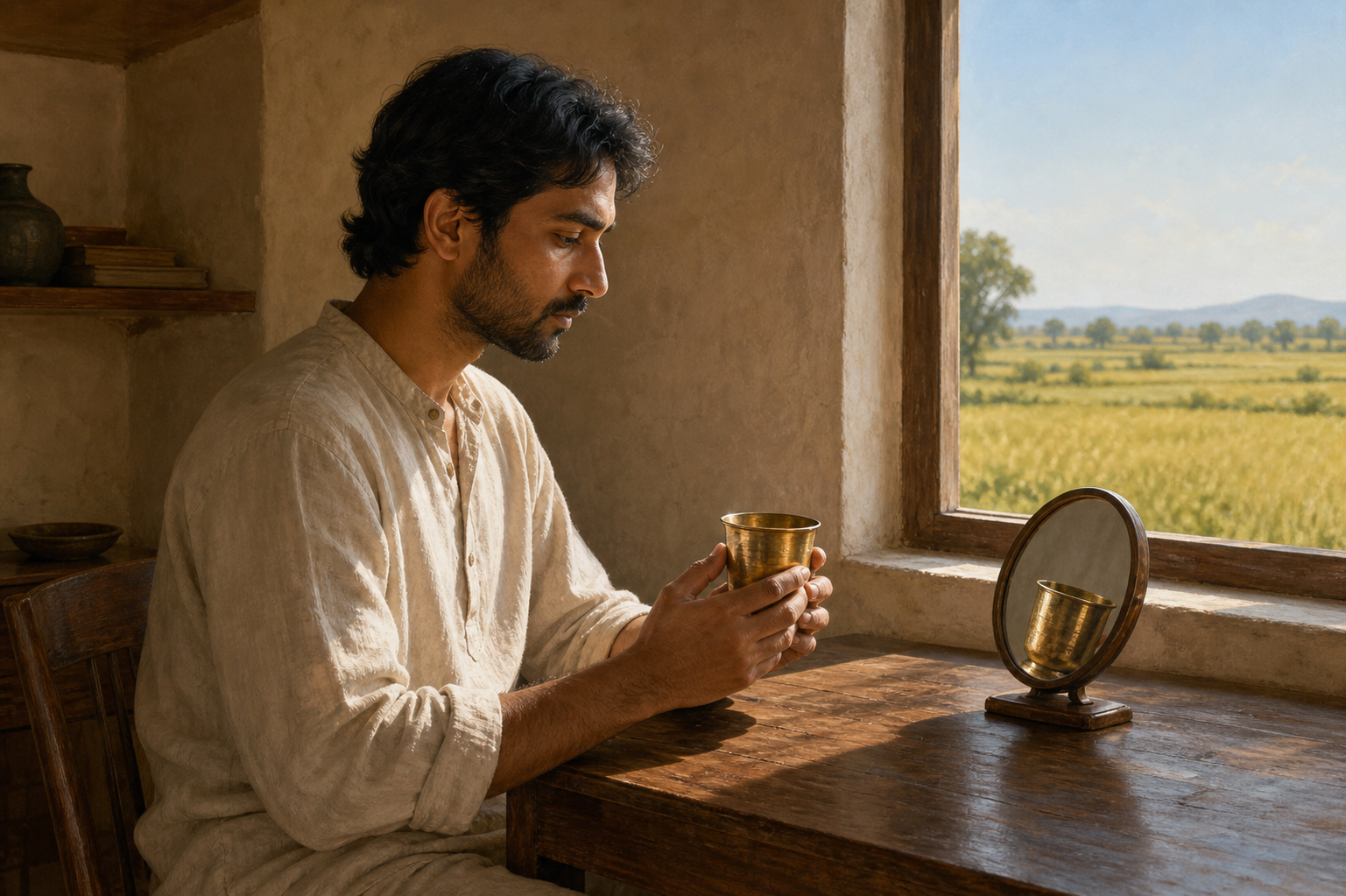
Vedantic inquiry is not won by repeating a conclusion such as I am Brahman. A memorized answer can remain another thought with which the mind identifies. Jnana Yoga therefore proceeds through sravana, accurate reception of the teaching; manana, reasoned examination of doubt; and nididhyasana, sustained assimilation. Each stage corrects a different failure: misunderstanding, unresolved contradiction, and habitual misidentification.
Use the following sequence with an ordinary object or a manageable recurring reaction. Begin where attention is steady enough to investigate rather than with the most overwhelming event in your life.
- Name the appearance precisely. Instead of saying, Everything is wrong, identify what is actually present: a bodily contraction, an image of a future outcome, a remembered sentence, or a fear of losing status.
- Separate name, form, and function. Ask which label has been applied, which observable features support it, and what practical function the thing performs. This prevents the label from swallowing the experience.
- Trace its dependencies. An emotion depends on sensations, thoughts, memory, and attention. A social identity depends on recognition, convention, and circumstance. A ritual object depends on material, consecrated use, and the consciousness that encounters it.
- Notice that each dependency is also known. The body is experienced through changing sensations. Vitality is experienced as energy or fatigue. Thoughts and moods appear and pass. Judgments are observed. Even quietness or bliss can become an object of recollection.
- Ask what knows the changes. Do not rush to answer with a spiritual phrase. Any sentence that appears is itself a known thought. Turn attention toward the fact of knowing rather than toward a mental picture of a knower.
- Apply neti neti. The method of not this, not this does not declare the body or mind nonexistent. It denies that any finite, changing, observable item exhausts the Self. Whatever comes and goes cannot be the unchanging ground in the same manner in which it appears.
- Return to the required action. After inquiry, send the correction, complete the duty, continue the conversation, or perform the worship. The practical test is whether identification has loosened enough for action to become less defensive and more lucid.
The five-sheath analysis from the Taittiriya Upanishad gives this process a finer map. The annamaya sheath is physical; pranamaya is vital; manomaya is mental; vijnanamaya is intellectual; and anandamaya is associated with causal quiet or bliss. You need not despise any sheath. You examine each as something known and therefore not an adequate final definition of the knower.
A common subtle error occurs at the witness stage. The mind creates an image of a detached observer sitting somewhere behind experience and then calls that observer the Self. But an imagined observer is also an appearance. Sakshi-bhava, the witness stance, is useful because it interrupts immediate identification; it is a bridge, not a new personality to defend.
Do not grade the inquiry by whether thought stopped or a special sensation appeared. Thoughts, stillness, expansion, and bliss are all experiences that begin and end. A more reliable test is whether you can distinguish the changing content of experience from the knowing in which it appears, and whether that distinction reduces compulsion when you re-enter action.
Let sacred forms become transparent rather than expendable
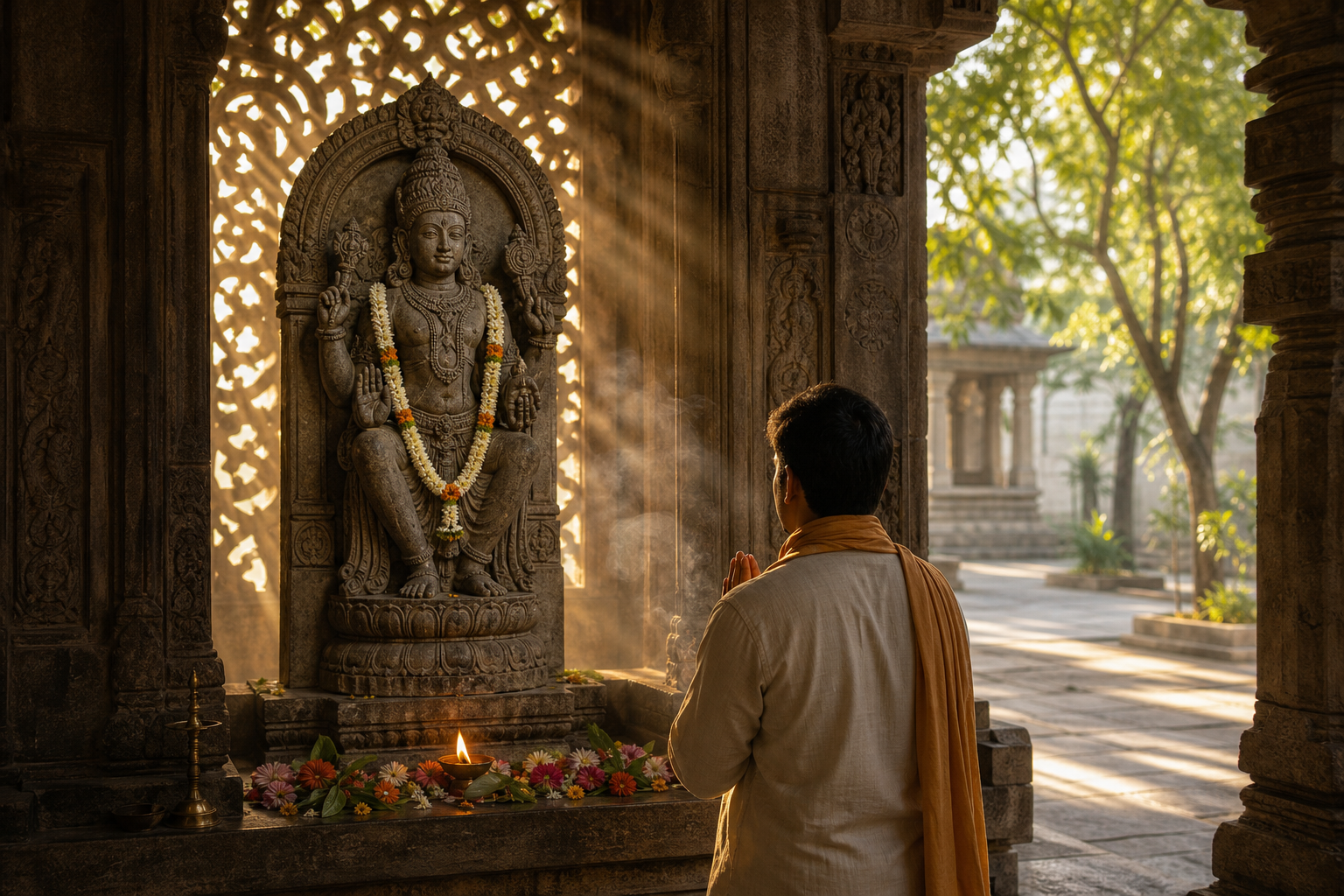
Hearing about the formless can tempt a seeker to discard images, mantra, puja, temple practice, or sectarian identity prematurely. That usually replaces a devotional form with an intellectual one. The concept of formlessness can be clung to as rigidly as any visible symbol.
The Hindu principle of Ishta-devata offers a more mature relationship with form. A chosen form gives affection and attention a stable direction suited to the seeker’s disposition. Shiva, Vishnu, Devi, or another sacred manifestation need not compete for metaphysical territory. The form gathers the heart so that devotion can become interior remembrance.
The movement from saguna, the Divine approached through attributes, toward recognition of nirguna, the reality not confined by attributes, does not require contempt for saguna worship. A devotee may continue puja after grasping its deeper orientation. The difference is that the image is no longer treated as a boundary around the Divine. It reveals a presence it does not exhaust.
You can test whether a form is functioning as a means or becoming an endpoint:
- After worship, can you remain attentive when the visible ritual ends?
- Can you honor another devotee’s chosen form without feeling that yours has been diminished?
- Does mantra or kirtan reduce scattered attention, or has repetition become mechanical display?
- Does devotion make duty and service more dependable, or does it provide an excuse to neglect them?
- When an outcome differs from your preference, can reverence remain without turning into bargaining or resentment?
The same criterion clarifies the major yogic approaches. Jnana uses teaching and discrimination to expose misidentification. Bhakti concentrates feeling through sacred form and redirects it toward inner presence. Raja Yoga steadies the modifications of mind through withdrawal, concentration, and meditation so that inquiry is not continually displaced by distraction. Karma Yoga turns ordinary action into practice by separating careful effort from possessive attachment to results.
Non-attachment to results does not mean refusing to plan, measure, or learn. Decide what dharma requires, define the work as clearly as you can, act competently, and assess the result. Release the additional claim that a favorable result must complete you or that an unfavorable one can diminish the ground of your being.
Avoid the conclusions that imitate realization
Vedantic language is easy to repeat before its distinctions have been digested. Watch for these mistakes, especially when inquiry begins changing how you understand familiar practices.
- Calling the world nonexistent. Appearance is dependent, not useless. If a conclusion makes you careless about truth, duty, or harm, empirical and ultimate levels have been confused.
- Turning awareness into a subtle object. A light, inner space, bodily expansion, or peaceful mood may accompany contemplation, but each is known and changeable. None is automatically Brahman.
- Equating mental blankness with realization. Raja Yoga can quiet the mind, and quietness can support discrimination. Yet a blank state that begins and ends is still an appearance. Ask what knew both thought and quiet.
- Using witness language to become emotionally remote. Freedom from identification is not indifference. If the witness stance weakens compassion or accountability, it has become another defensive role.
- Abandoning a sacred form to perform sophistication. The relevant question is not whether a practice looks elementary or advanced. Ask whether it concentrates attention, loosens possessiveness, and points beyond its own boundary.
- Claiming every Dharmic tradition teaches identical metaphysics. Shared disciplines do not erase real doctrinal differences. Buddhist dependent origination, emptiness, and anatta analyze the absence of independent self-existence. Jaina anekantavada and qualified predication restrain one-sided claims through the analysis of substance, qualities, and modes. Sikh teaching centers on Ik Onkar, the formless One, approached through remembrance and expressed through service. These paths can illuminate the danger of fixation without being relabeled as Advaita.
That final distinction matters in dialogue. You can recognize a shared discipline – refine attention, loosen clinging, and live ethically – without claiming that Brahman, emptiness, the Jaina account of reality, and Ik Onkar are interchangeable terms. Intellectual humility is part of the inquiry because a doctrine can become another name-and-form with which the ego seeks security.
Key takeaways
- In Advaita, the cause behind forms is the ever-present ground of appearance, not merely the first event in a temporal chain.
- A form can be empirically valid and ethically consequential without possessing independent or ultimate reality.
- Neti neti removes exclusive identification; it does not deny the body, mind, world, or duties.
- Sacred forms serve inquiry when they concentrate attention and reveal a reality they do not claim to exhaust.
- Stillness and witness-consciousness are useful stages, but no passing experience should be mistaken for the unchanging ground.
- The clearest practical sign of discernment is less fixation joined to more responsible action.
The next time an appearance feels final, pause before obeying that feeling. Identify its name, form, function, and dependencies. Notice that all of them are known. Then ask what action dharma requires without turning the event into an identity. That small but exact movement – from an absolute appearance to an examined one – is where Vedantic inquiry becomes lived freedom.