
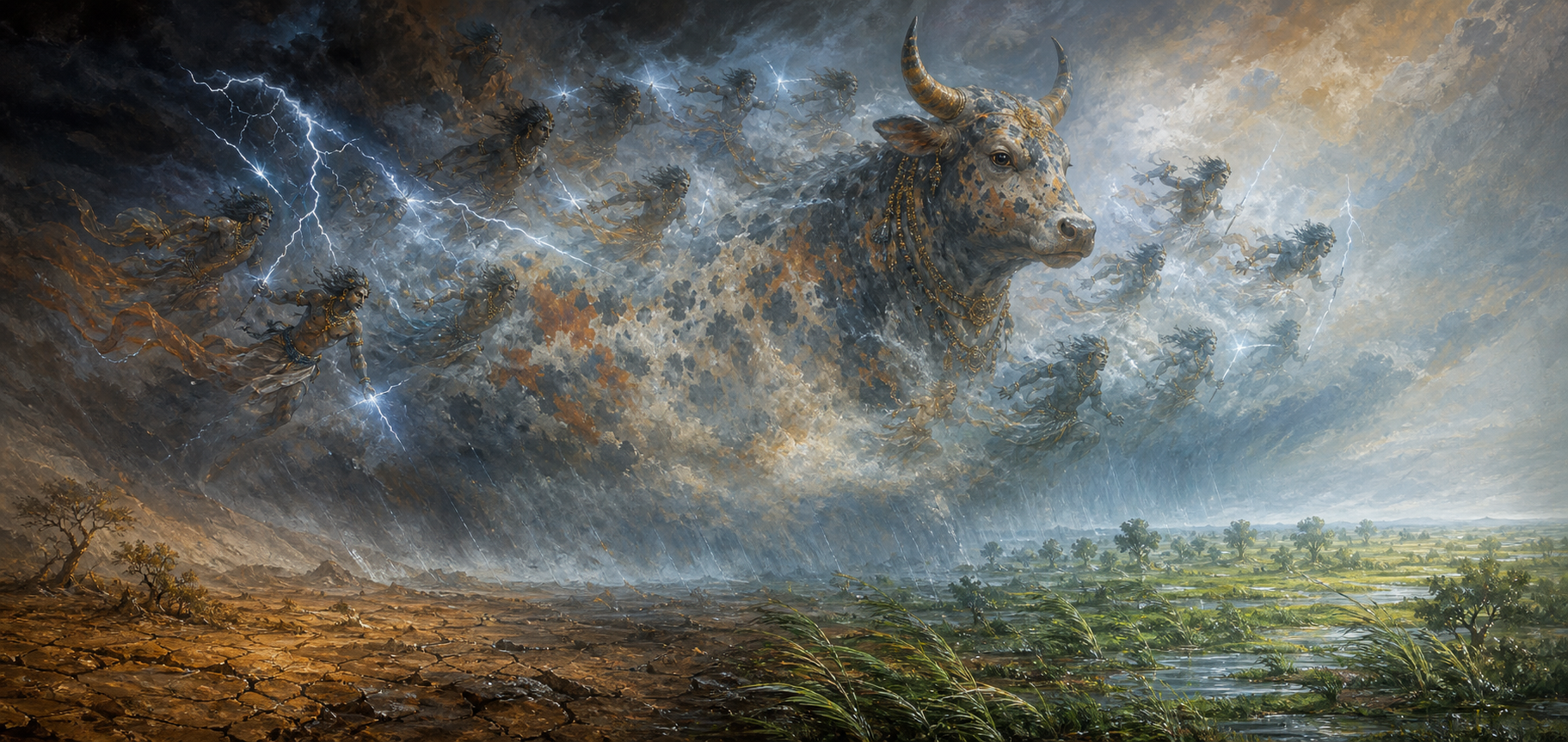
You may meet Prishni in a translation as a cow, a cloud, the earth, a goddess, or simply the mother of the Maruts. If you try to choose one of those identities and discard the rest, the Rigvedic image becomes more confusing, not less.
A better reading moves through layers. Begin with what Prishni’s name lets you see, follow her relationship with the Maruts, and then place that family within the full movement of a storm: darkness and radiance, danger and rain, disturbance and renewed life. This approach keeps the poetry concrete while allowing its cosmological meaning to unfold.
Start with the speckled name

The Sanskrit adjective pṛśni means speckled, dappled, or variegated. Vedic language can apply it to cattle, clouds, and at times the earth. That range is not a defect that must be corrected. It is the first interpretive clue.
Picture a sky before rain. It is rarely a uniform sheet of grey. Dark cloud banks overlap with pale openings, moving shadows, and sudden light. Now picture a dappled cow, whose milk sustains the household, or soil receiving the water from which herbs and crops rise. The visible pattern changes, but the underlying movement remains: a many-coloured bearer releases nourishment.
This is why translating Prishni with one English noun can clarify one line while obscuring the larger symbol. Cow brings maternity and nourishment forward. Cloud makes the atmospheric scene immediate. Earth emphasizes reception, fertility, and growth. Retaining the name Prishni preserves all three possibilities but may hide them from a reader who does not know its literal sense.
When you encounter the name, write speckled or variegated beside it before deciding what physical form is intended. Then ask three questions. What in the scene is visibly mottled? What is being generated or nourished? Which meaning becomes strongest because of the surrounding action? That procedure is more reliable than asking which single object Prishni really is.
The name also establishes an important limit. Prishni should not be turned immediately into an abstract slogan about diversity. Her variegation belongs first to an observed world of hide, cloud, light, rain, and living ground. The philosophical meaning grows from that sensory field.
Read the divine family as a map of forces
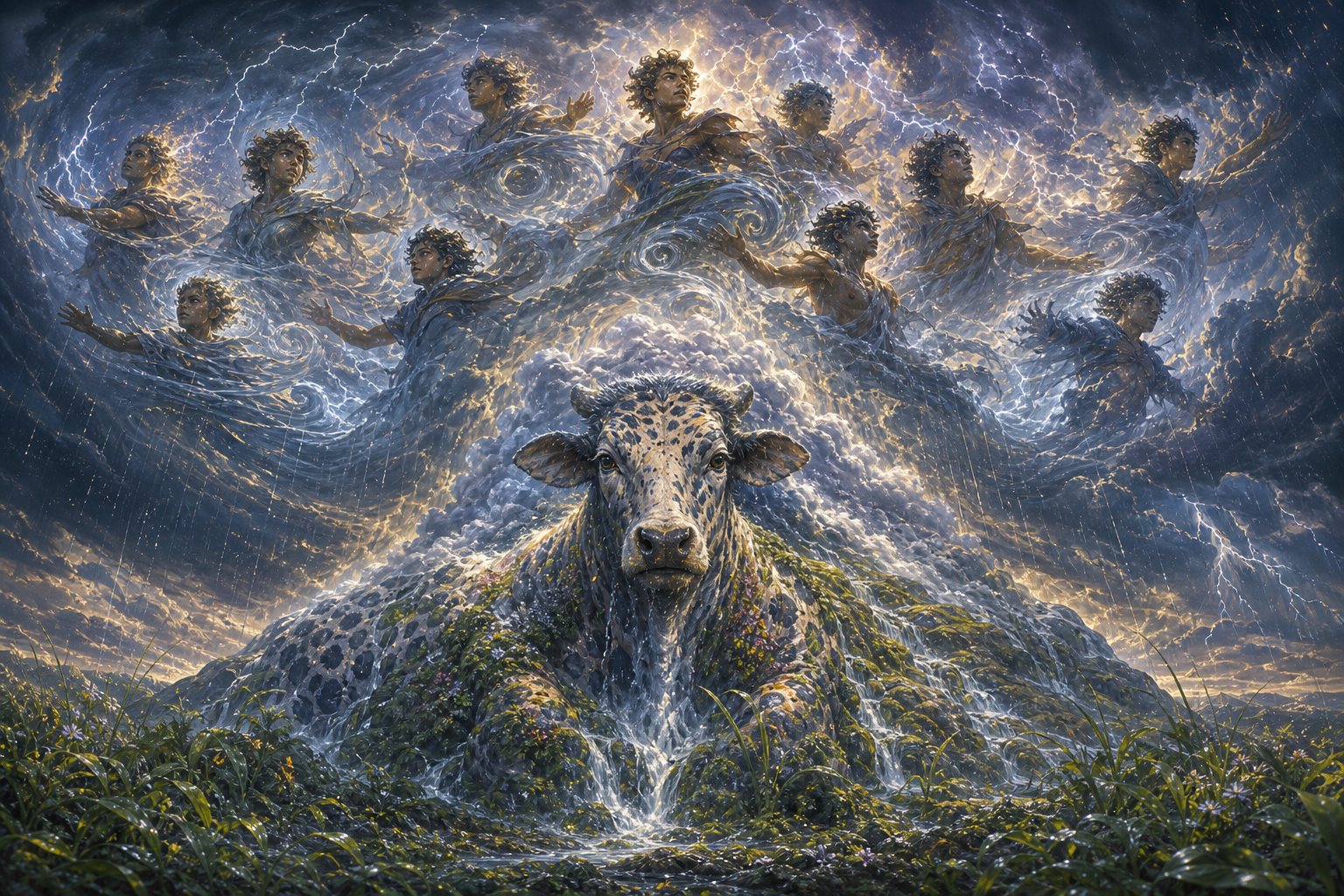
Prishni becomes cosmologically intelligible through her children. She is the mother of the Maruts, the radiant and fearsome storm-host associated with wind, rain, atmospheric violence, and the renewal that follows it. Their birth from a speckled mother turns the mottled sky into a generative field rather than a passive background.
| Figure | Relationship | Work within the image | Reading caution |
|---|---|---|---|
| Prishni | Mother of the Maruts | The variegated matrix from which storm-power emerges | Do not reduce her to only a cow, cloud, earth, or fixed human-shaped deity |
| Maruts | Children of Prishni; also connected with Rudra | The moving storm-host that shakes, brightens, waters, and quickens life | Do not treat them as merely destructive because their violence also belongs to renewal |
| Rudra | Father of the Maruts in several Vedic strands and therefore paired with Prishni | Wild, formidable power joined to healing and the life of herbs | Do not import every feature of later theology into an earlier Vedic relationship |
| Indra | Ally strengthened by the Maruts | Sovereign and martial action supported by the storm-host | Do not confuse alliance with parentage |
This family is not best read as divine biography. It is a relational grammar. Prishni tells you where the storm-host comes from. Rudra gives that host its fearful, untamed, and healing affinity. Indra shows where its force can be directed. The Maruts themselves connect the levels by carrying atmospheric energy into action.
The plural character of the Maruts matters. A storm does not arrive as one isolated event. Wind changes, clouds gather, light flashes, rain falls, vegetation responds, and human activity must adjust. A host is a fitting poetic form for this coordinated multiplicity. Prishni’s motherhood gives unity to it without erasing its many movements.
You can therefore test any interpretation by asking whether it preserves the relationships. A reading of Prishni that has nothing to do with generation will be incomplete. A reading of the Maruts that ignores their atmospheric character will lose the physical scene. A reading of their force that excludes both danger and benefit will flatten the Vedic tension.
Hold terror and nourishment in the same storm
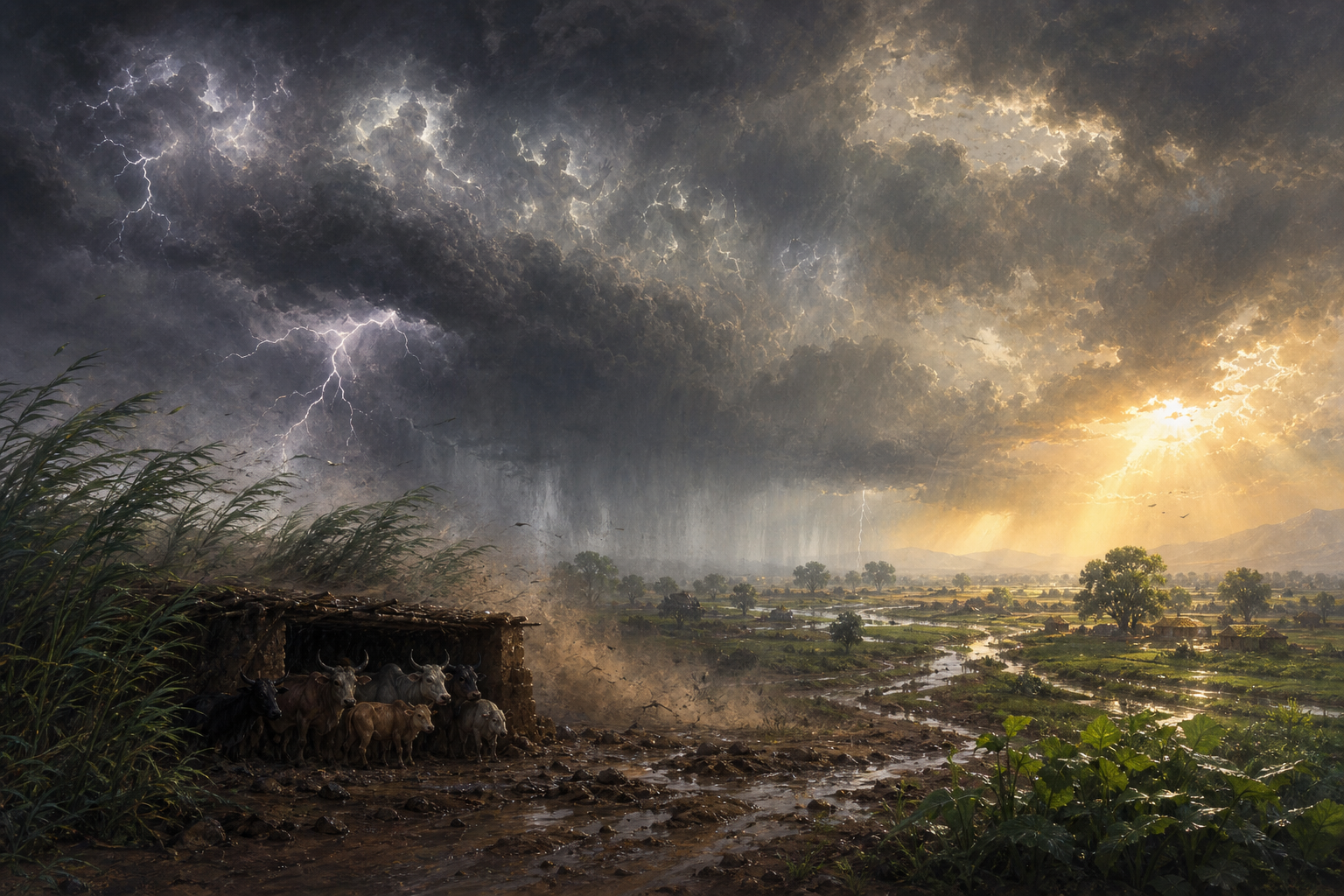
The Maruts are not gentle decorations placed around a rain goddess. They are portrayed as brilliant and formidable, shaking mountains, stirring the atmosphere, quickening herbs, and strengthening Indra. Their power can frighten because the weather they embody can damage, disorient, and overwhelm. Yet the same movement carries the water on which plant, animal, and human life depend.
This double aspect is the centre of the cosmology. The storm is not called good by pretending that it is harmless. Nor is it called evil because it disrupts human plans. It belongs to a larger order in which disturbance can become purification, irrigation, fertility, and restored vitality. Prishni’s motherhood holds those outcomes together: what issues from her is dangerous power, but it is power capable of serving life.
The Vedic idea of ṛta helps you read this without sentimentalizing nature. Cosmic order is not static quietness. It is the right relation among forces, seasons, actions, speech, and their consequences. In the ritual setting, invoking the Maruts seeks power, clarity, and vitality while placing that force in relation to rain, sovereignty, and vāc, or speech. Ritual does not claim to make the storm physically tame. It gives the community a disciplined way to receive, address, and align itself with power greater than itself.
That distinction remains useful outside formal ritual. Romantic language about a beautiful monsoon can hide the storm’s severity; purely fearful language can hide dependence on the rain. A Prishni-centred reading asks you to notice both before drawing a spiritual lesson. Reverence begins with accurate attention.
For an ecological reading, follow the complete sequence rather than stopping at the spectacular sky. Notice the mottled clouds, the force of the wind, the release of water, the response of soil and plants, and the human duties created by dependence on that cycle. Gratitude for rain becomes ethically serious when it encourages care for water, land, vegetation, and the conditions that sustain them.
Use a four-pass method without flattening the text
You do not need to settle every philological question before reading a hymn intelligently. You do need a method that separates what the words show from what you infer. Use these four passes when Prishni or the Maruts appear:
- Read the word. Record the literal force of pṛśni as speckled, dappled, or variegated. If a translation gives only cow or cloud, keep the wider adjective in view.
- Reconstruct the scene. Mark references to brightness, darkness, movement, wind, rain, shaking, plants, cattle, earth, or nourishment. Let the surrounding images determine which register of Prishni is active.
- Map the relationships. Distinguish Prishni as mother, the Maruts as storm-host, Rudra as their paternal connection in several strands, and Indra as the ally they strengthen. Do not merge different roles merely because the figures appear together.
- Ask what is being ordered. Look for the movement from raw force to a life-serving result: rain, vitality, strengthened action, fertile ground, healing vegetation, effective speech, or restored order. This is where the weather image becomes theology.
Three guardrails that prevent common misreadings
First, keep the Rigvedic Prishni of the Maruts distinct from the later narrative of Prishni and Sutapa as parents of Prishni-garbha. The shared name allows a thematic connection through maternity, protection, and divine generation, but it does not make the two narrative settings identical. When teaching them, place each in its own textual context before discussing the resonance.
Second, do not mistake a modern illustration for inherited iconographic certainty. Prishni has no extensive standardized visual corpus comparable to many later deities. A spotted cow, a rain-dark horizon, or mottled cloud bands can serve as honest teaching images, provided you identify them as visual interpretations of Vedic language rather than a single mandatory form.
Third, use comparisons across Dharmic traditions as comparisons, not equations. Prishni’s many-hued field can resonate with Jain Anekantavada, Buddhist attention to patterned emergence, and Sikh reflection on kudrat and hukam. Those resonances can support respectful dialogue, but each concept belongs to its own discipline, vocabulary, and purpose. Understand the Vedic storm image first; compare it only after its particular form is clear.
Turn interpretation into practice
For textual study, take one translation of a Marut hymn and make four columns in your notes: word, visible image, divine relationship, and life-serving effect. Then consult another translation and an indigenous commentarial tradition. If one translation says cow while another retains Prishni, do not choose between them immediately. Check which aspects each rendering reveals and conceals.
For teaching, begin with three images: dappled hide, mottled sky, and rain-receiving earth. Ask learners to identify what joins them before introducing a doctrinal explanation. They will usually see variation, maternity, nourishment, and transformation more readily when the imagery remains visible.
For contemplation, watch the sky before rain without trying to manufacture a mystical experience. Name what is actually present: changes in light, cloud texture, wind, moisture, sound, and the response of plants or animals. Then ask what you depend upon but cannot command, what gift arrives through unsettling change, and what responsible reception of that gift requires. This is a contemporary devotional exercise inspired by the symbolism, not a replacement for a prescribed Vedic rite.
Key takeaways
- Prishni’s name means speckled, dappled, or variegated; keep that visual meaning beside any translation that identifies her as cow, cloud, or earth.
- Her motherhood of the Maruts is the interpretive centre: the variegated sky or cosmic matrix generates the many powers of the storm.
- The Maruts unite fearsome force with beneficial consequence. Their violence cannot be erased, but neither can the rain, vitality, and renewed growth associated with their passage.
- Rudra, Prishni, the Maruts, and Indra perform different relational roles. Keeping parentage, character, action, and alliance distinct prevents mythic genealogy from becoming a blur.
- The later Prishni-garbha narrative should be treated as a related but separate stream of sacred memory.
- Modern images of a spotted cow or mottled sky are useful interpretive aids, not evidence of one fixed canonical iconography.
The next time you meet Prishni, resist the urge to solve her with one noun. Note the speckling, circle what the Maruts do, trace danger into nourishment, and keep each textual layer in its proper place. You will then see what the compressed Vedic image makes possible: the living sky becomes mother, the storm becomes a host, and reverence becomes careful attention to the order that sustains life.