
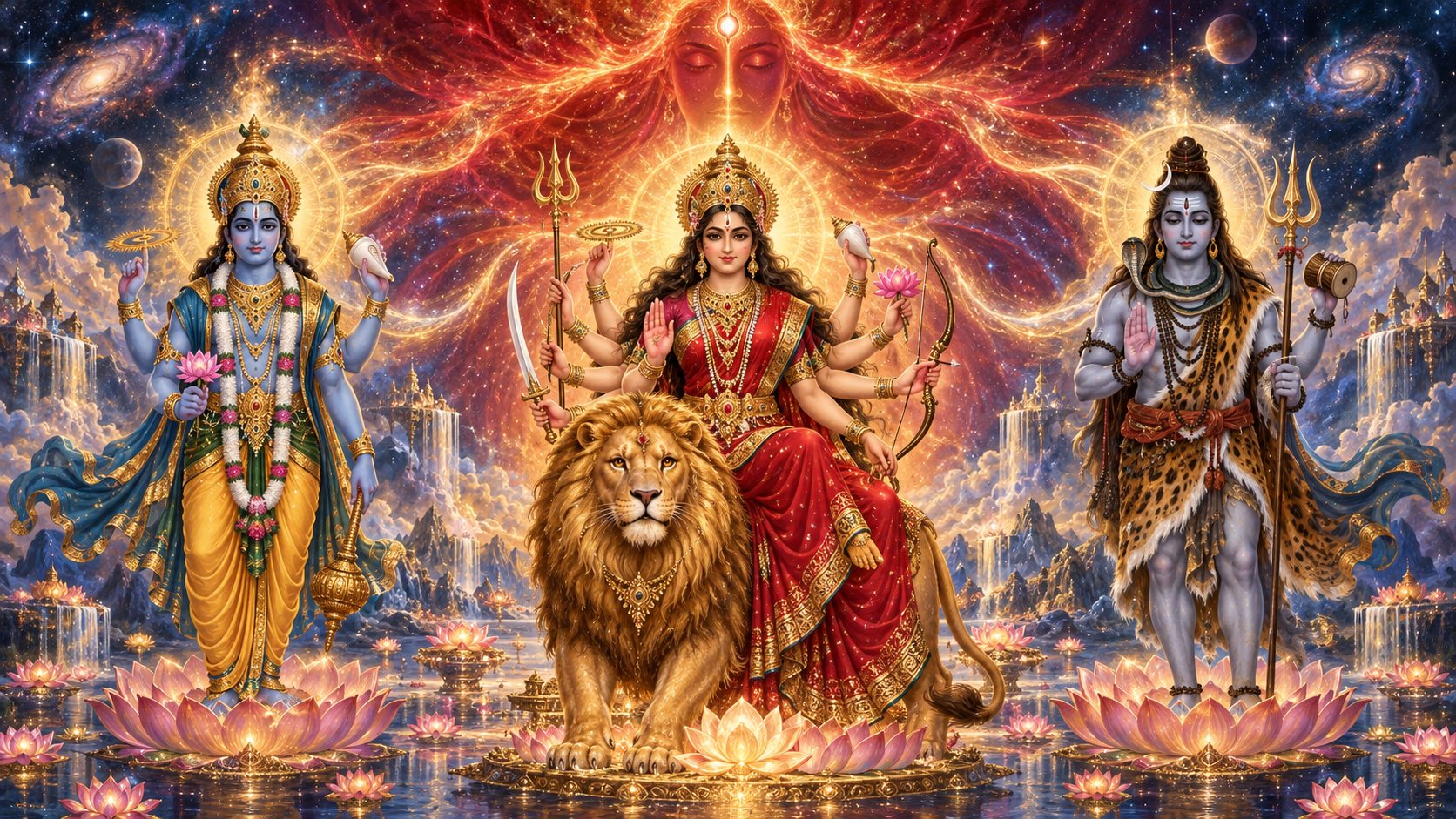
If you have encountered Durga as the Supreme Mother in one setting, Vishnu as the Supreme Being in another, and Shiva as ultimate reality somewhere else, you may wonder whether Hindu traditions are making mutually exclusive claims. The confusion usually comes from combining several theological lenses as though they belonged to one rigid hierarchy.
You can make sense of the Shakta view by separating four things: the ultimate source, the divine form through which that source becomes present, the cosmic functions assigned to particular deities, and the symbols through which a sacred narrative expresses their relationship.
Begin with the Shakta lens, not a universal ranking
A Shakta account begins with the Divine Mother. It does not begin with an independent universe to which a goddess is later added. In the Shakta framework associated with the Yogini Tantra, Adi Shakti is the sole source from which the universe emanates. She is eternal consciousness and energy, manifesting the fundamental powers of creation, preservation, and transformation.
This changes the grammar of the discussion. Shakti is not merely a quantity of energy owned by otherwise self-sufficient gods. She is the primordial reality through which divine agency and the cosmos itself become possible. Vishnu and Shiva therefore appear within her cosmic order, not outside it as competing supreme powers.
That claim belongs to a specifically Shakta perspective. Vaishnava traditions may place Vishnu or one of his forms at the theological centre, while Shaiva traditions may do the same with Shiva. You do not have to erase those differences to understand them. You only have to identify which tradition is speaking before treating the word “supreme” as a universal ranking accepted by every Hindu school.
| Name or image | Role in this Shakta framework | Misreading to avoid |
|---|---|---|
| Adi Shakti | The primordial source of consciousness, energy, and cosmic manifestation | Treating her as merely one deity among several independent equals |
| Durga | The Supreme Mother present in an active and worshipful divine form | Separating her from Adi Shakti as though they were unrelated beings |
| Vishnu | The divine power associated with preservation and, in the relevant symbolism, support for Durga | Assuming that service to the Goddess diminishes Vishnu |
| Shiva | The divine power associated with transformation and participation in Durga’s manifestation | Imagining Shiva and Shakti as isolated or hostile powers |
| Durga’s lion | A narrative and iconographic expression of power placed in the Mother’s service | Reading the image as a sectarian contest with a winner and loser |
Adi Shakti and Durga are source and presence, not rivals
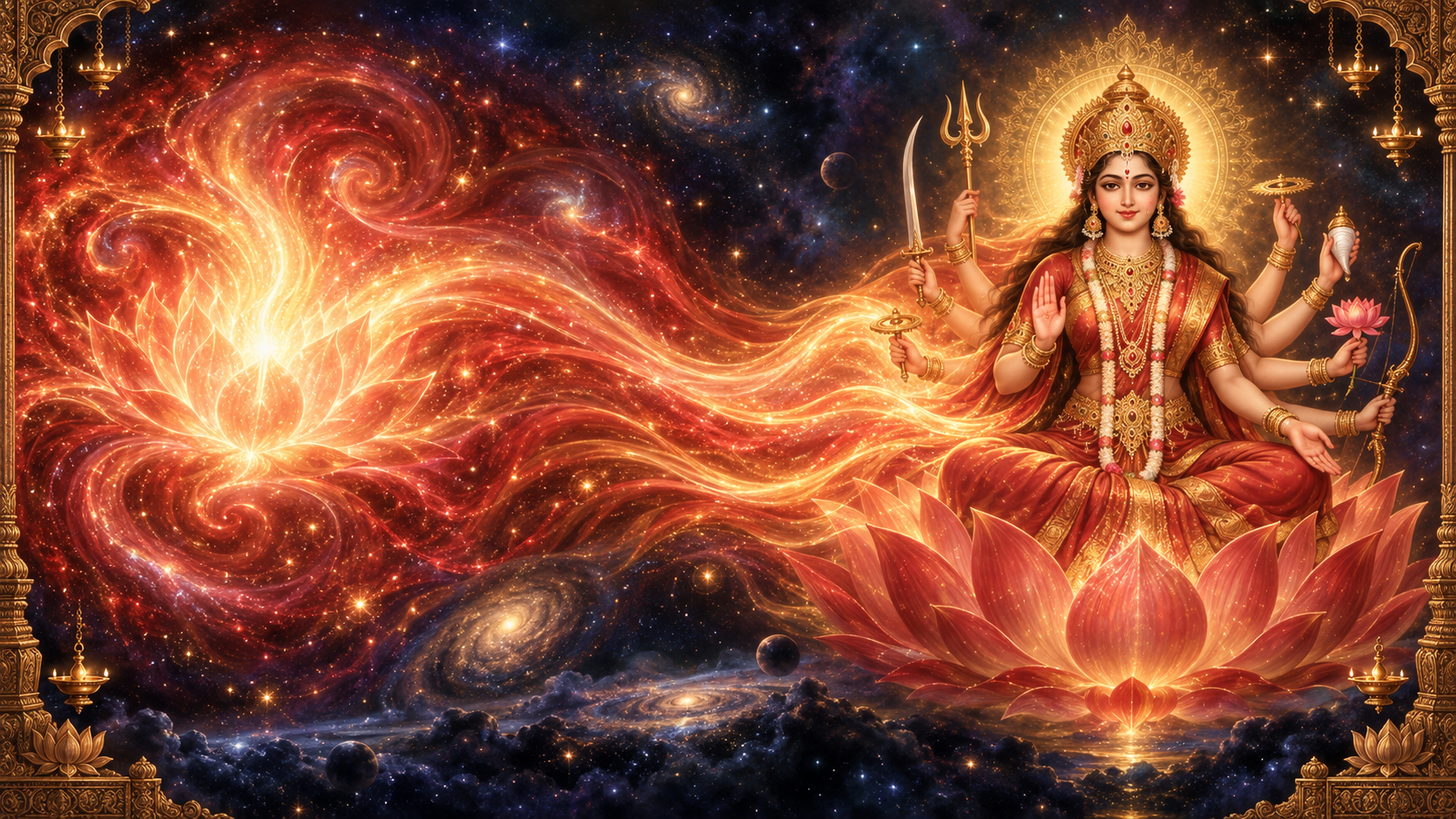
Adi Shakti and Durga should not be placed side by side as two goddesses competing for a higher position. “Adi Shakti” names the primordial Divine Power: the reality from which the cosmos and its governing powers arise. “Durga” names the Mother in a definite form through whom that power becomes present to worship, sacred narrative, and iconography.
The distinction is useful, but it is not an absolute separation. One passage may speak cosmologically of Adi Shakti as the origin of everything. Another may address Durga directly as that very supreme reality. The first emphasizes source; the second emphasizes presence. In devotional language, the accessible form can carry the fullness of the ultimate rather than representing only a small portion of it.
When you encounter either name, ask what work the name is doing. If the passage explains the origin of the universe and its powers, “Adi Shakti” emphasizes primordial reality. If it depicts the Mother acting, protecting, receiving worship, or riding the lion, “Durga” emphasizes manifest presence. If Durga herself is called the ultimate source, the divine form and the cosmic ground have been identified rather than confused.
This prevents a common mistake: turning fluid theological language into an administrative chart. Shakta cosmology is concerned with how the One Power becomes many without ceasing to be one. Its names mark perspectives and relationships, not sealed compartments.
Vishnu and Shiva express powers that originate in Adi Shakti
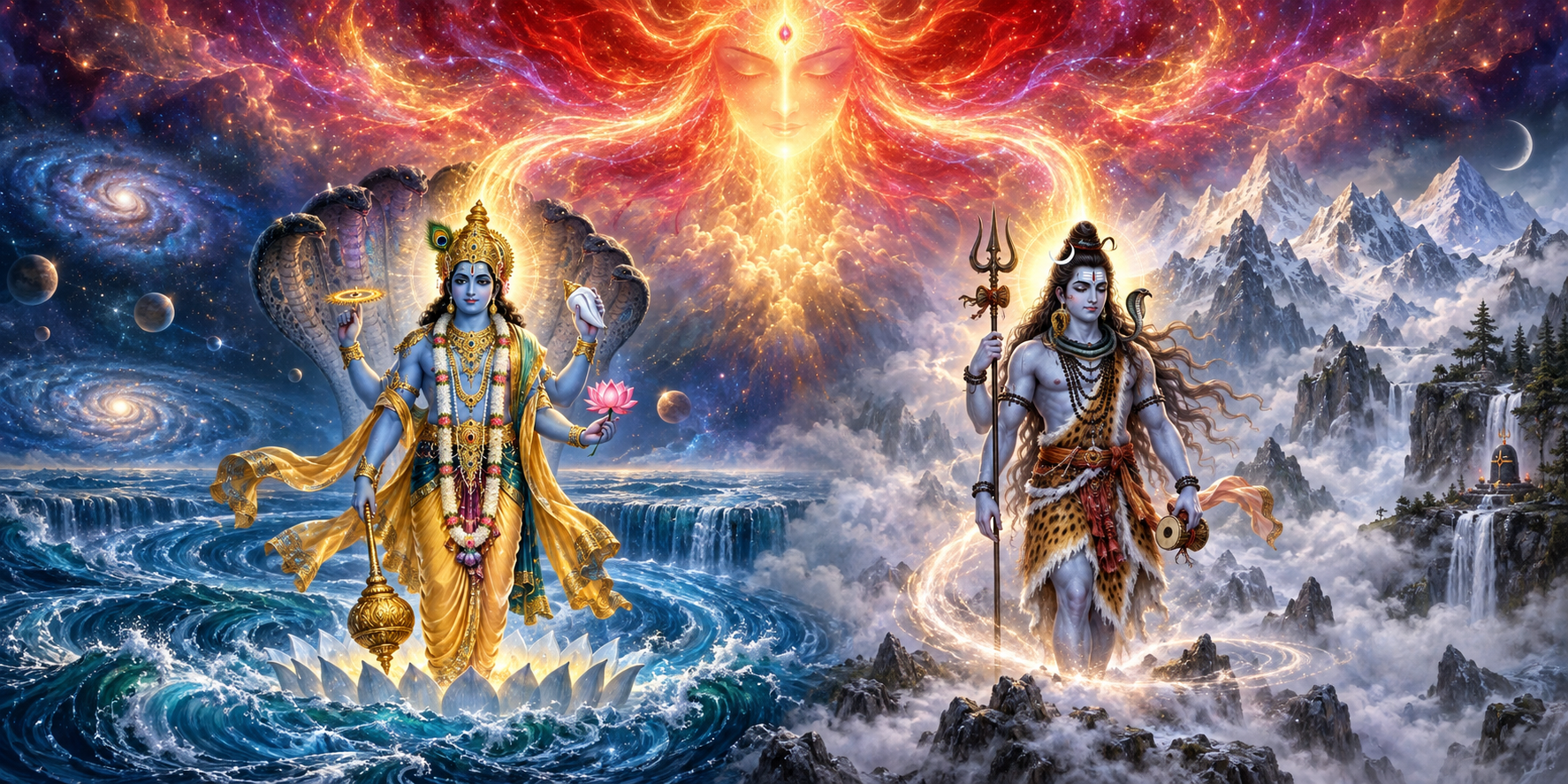
Creation, preservation, and transformation are not three disconnected projects. They are interdependent movements of one cosmos. Creation without preservation would have no continuity. Preservation without transformation would become permanent stagnation. Transformation makes renewed manifestation possible.
The familiar functional pattern associates creation with Brahma, preservation with Vishnu, and transformation or dissolution with Shiva. Although Brahma completes that triad, the relationship of Vishnu and Shiva to Durga raises the sharper interpretive question. Are these great deities independent of the Mother, subordinate employees, or manifestations of her power?
Within this Shakta lens, their powers arise from Adi Shakti and operate within her all-encompassing reality. That does not make Vishnu’s preservation unreal or Shiva’s transformation incidental. It locates both within a deeper unity. A cosmic function can be distinct without being metaphysically separate from its source.
Does that make Vishnu and Shiva subordinate?
In one carefully limited sense, Shakta cosmology gives Adi Shakti ontological priority: she is the source on which the manifested powers depend. But “subordinate” becomes misleading if you hear it as humiliation, rivalry, or reduced sacred worth. Dependence on the supreme reality is also participation in it.
Keep three kinds of relationship separate. Ontological language asks where all being and power originate. Functional language asks which divine activity preserves or transforms the cosmos. Devotional language addresses a chosen form as fully supreme. A statement made on one level does not automatically cancel a statement made on another.
This is why a devotee can honour Vishnu and Shiva while accepting a Mother-centred cosmology. Their participation in Durga’s manifestation expresses coordination among divine powers. It need not be turned into a quarrel among their worshippers.
Vishnu as Durga’s lion expresses shared divine agency
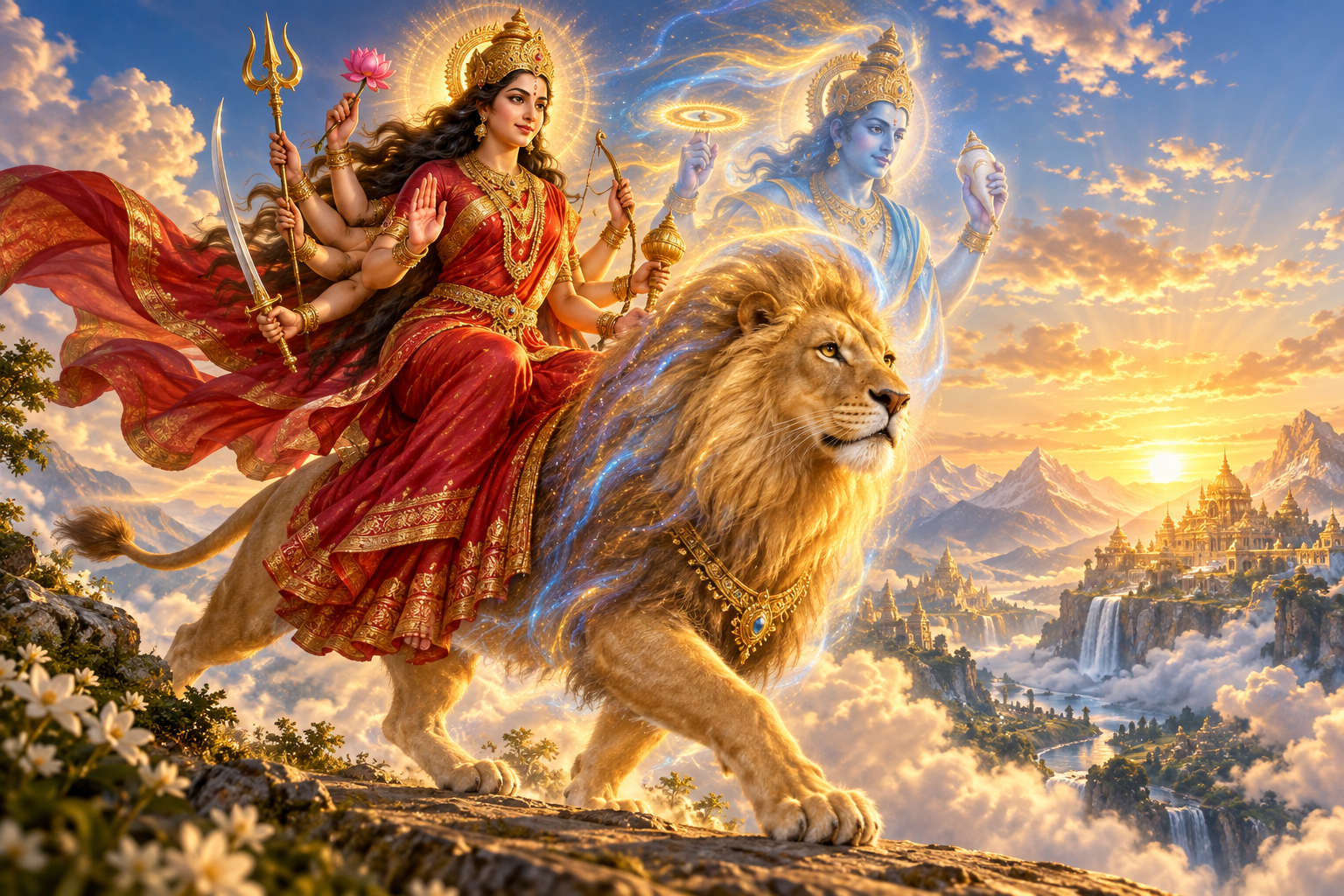
The striking image of Vishnu as the lion of Durga, with Vishnu and Shiva supporting her manifestation, compresses theology into a relationship you can see. The power of preservation and the power of transformation are not absent when Durga acts. They participate in the Mother’s cosmic work.
A modern status-based reading can badly distort this image. If you assume that serving as a vehicle must mean defeat or inferiority, you will miss the theological point. A sacred vehicle can express power, intimacy, availability, and directed action. Vishnu’s association with the lion can therefore be read as preserved divine strength becoming the support of Durga’s manifested action.
Shiva’s participation carries the same larger lesson. Durga’s appearance is not a solitary intervention in a universe divided among rival divine owners. Her manifestation reveals a union of powers whose apparent distinctions remain grounded in Adi Shakti.
When you examine an image or narrative of this kind, notice three things:
- Who acts: Durga appears as the manifest centre of divine action.
- Who supports that action: Vishnu and Shiva participate rather than stand outside the event as competitors.
- What the relationship teaches: preservation, transformation, and the Mother’s power belong to one coordinated cosmic reality.
This reading is more useful than asking which deity has been “demoted.” The image is explaining how divine powers belong together. It is not presenting a secular chain of command.
Key takeaways: use four questions when a passage seems contradictory
- Which theological lens is speaking? A Shakta, Vaishnava, or Shaiva account may place a different divine form at the centre. Identify the lens before comparing claims.
- Is the name identifying the source, a form, or a function? Adi Shakti emphasizes primordial reality, Durga emphasizes the Mother’s manifest presence, and Vishnu and Shiva perform distinguishable cosmic functions.
- Is the statement cosmological, devotional, narrative, or iconographic? “Adi Shakti is the source” and “Vishnu is Durga’s lion” operate in different registers and should not be forced into the same literal category.
- Does hierarchy mean separation? In this Shakta framework, dependence on Adi Shakti means participation in her reality. It does not require hostility toward Vishnu or Shiva.
Apply those questions the next time a temple image, hymn, or sacred account appears to rank the deities differently. Write four short labels in the margin – lens, source, function, symbol – and identify each before drawing a conclusion. You will usually find that the apparent contradiction is a change of perspective, while the deeper subject is the unity of divine power.
References

Leave a Reply
You must be logged in to post a comment.