

If sacred love poetry leaves you unsure whether to read it as romance, symbolism, or prayer, don’t force an immediate choice. Begin by listening to the longing. Then ask what that longing demands from the devotee: possession, participation, surrender, service, or transformation.
This approach helps you recognize what Radha-Krishna and Andal-Ranganatha share without treating them as interchangeable. Both make divine love intimate and consuming. They reach that intensity from different devotional positions, and the difference matters.
Begin with the relationship, not the romantic plot
A modern reader often begins by asking what happened between the lovers. A devotional reader asks a prior question: what way of seeing God becomes possible through this relationship?
That change of question prevents two common mistakes. The first is reducing sacred romance to an extraordinary human love story. The second is draining it of all feeling by calling everything an abstract metaphor. Neither approach is sufficient. The emotional language matters, but its purpose is transformation rather than entertainment.
Within Hindu devotion, passionate and all-consuming love can become a path to the Divine. Romantic language gives that path three qualities that distant religious language can struggle to convey. It makes God personally present, makes the devotee vulnerable, and refuses to confine devotion to a convenient part of life.
Passion alone, however, is not yet bhakti. Desire becomes devotional when it moves away from acquisition and toward presence. The question is no longer, “How can the beloved satisfy me?” It becomes, “How can my whole life become responsive to the beloved?” Keep that distinction in view whenever you encounter longing, separation, beauty, or union in sacred poetry.
Radha-Krishna teaches love as participation, not possession
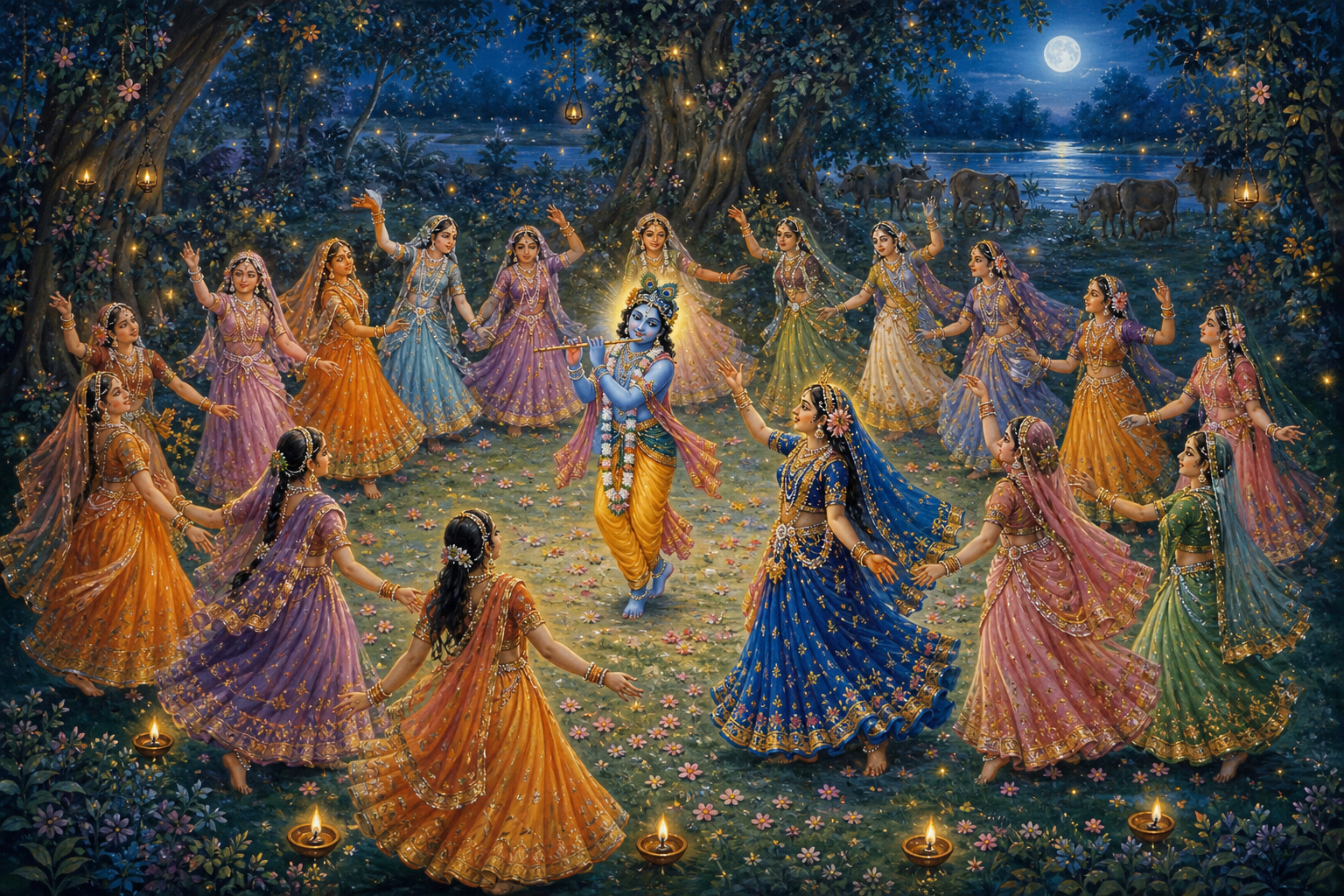
Radha and Krishna appear together in the devotional imagination. Their paired names direct attention away from an isolated seeker trying to obtain a distant deity. Love is encountered as relation, reciprocity, attraction, and delight.
This changes how you read their romance. Krishna is not merely a reward at the end of a successful spiritual effort, and Radha is not an interchangeable admirer. Their relation presents divine love as something into which the devotee seeks entry. You do not stand outside it as a spectator. You train your attention so that the joy of the beloved becomes more important than your urge to control the experience.
Notice what happens when love cannot be possessed. Separation can sharpen remembrance. Uncertainty can expose the demand for control. Delight can loosen the ego’s insistence on being the center of every encounter. The devotional value lies in these movements, not in copying the outward circumstances of a sacred narrative.
That last distinction is essential. Divine romance is not a loophole around dharma, honesty, consent, or responsibility in human relationships. A symbol of unbounded love does not authorize deception or excuse harm. When sacred imagery is used to sanctify appetite while leaving possessiveness untouched, its direction has been reversed.
Use a simple test when contemplating Radha-Krishna: does the practice make you more capable of delighting in another’s good without needing to own it? If it does, romantic language is becoming devotional. If it merely intensifies fantasy, entitlement, or self-importance, return to the relation as an object of reverence rather than treating it as a projection of personal desire.
Andal-Ranganatha teaches longing as self-offering
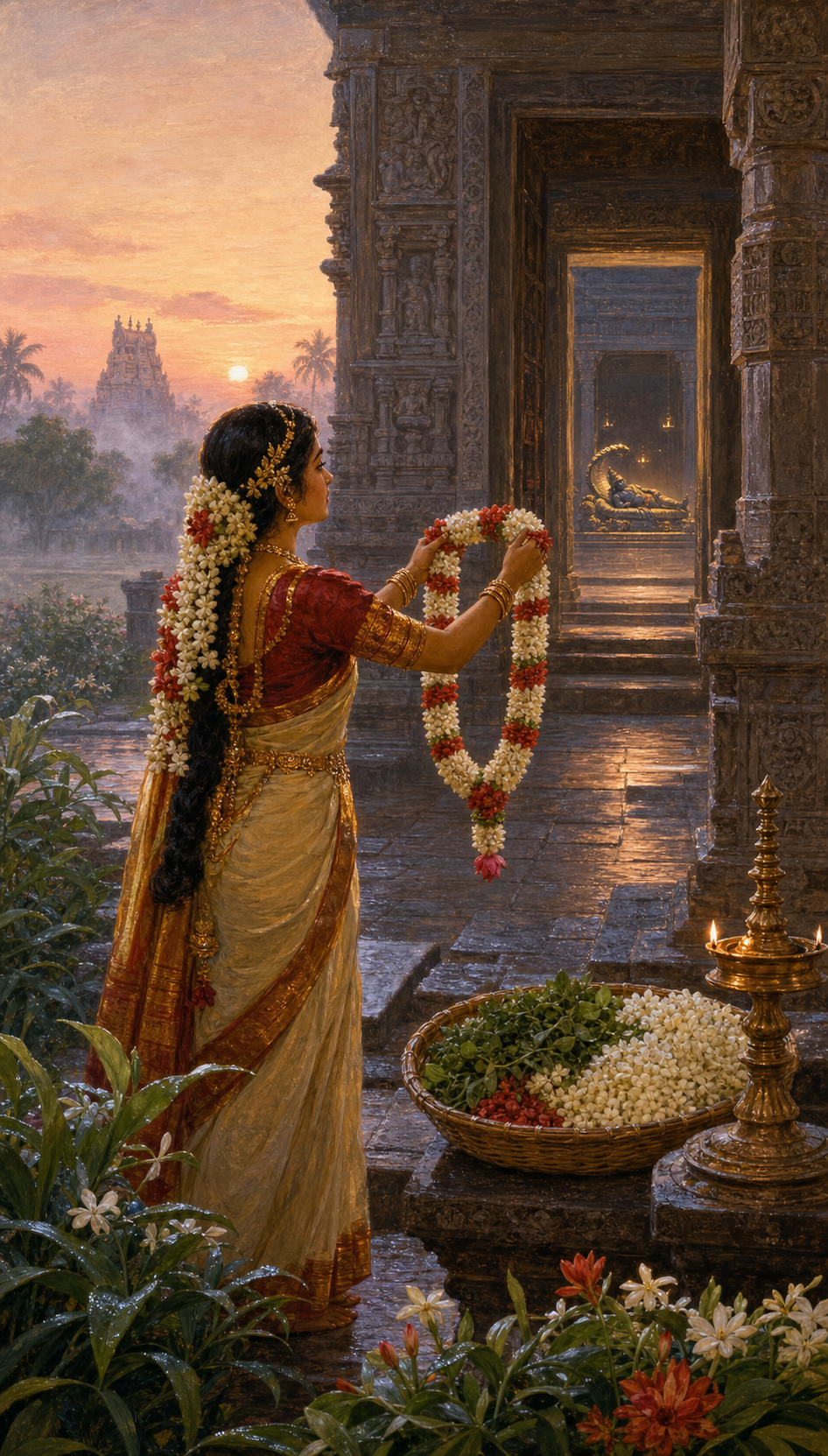
Andal-Ranganatha begins from another devotional angle. Andal’s longing moves toward Ranganatha, and the distance between devotee and Lord remains spiritually productive. Reverence does not disappear, but neither is it allowed to become cold or impersonal. The Divine is addressed as the beloved.
This form of love corrects a familiar weakness in religious life. You may affirm that God exists, perform expected observances, and still keep the Divine at a safe emotional distance. Andal’s devotional posture does not permit that arrangement. Longing brings desire itself into prayer. Nothing central to the heart is left outside the relationship.
Yet this is not a demand that God validate every preference. Self-offering means allowing desire to be purified by the one desired. You bring the whole longing, but you do not dictate the form of its fulfillment. The movement is from “Give me the experience I have imagined” toward “Make me capable of belonging wholly to you.”
That makes apparent absence a field of practice rather than proof that devotion has failed. Longing can deepen fidelity when it produces remembrance, truthful speech, disciplined worship, and service. It becomes self-enclosure when it produces only dramatic feeling. The practical question is therefore not how intensely you feel, but what your feeling is teaching you to offer.
Surrender also needs a clear boundary. Offering yourself to the Divine is not the same as surrendering discernment to a human being who claims spiritual authority. Genuine devotion does not require you to excuse exploitation or abandon moral judgment. Its fruit should be a more truthful life, not greater dependence on another person’s unchecked power.
Hold the likeness without erasing the difference
The two relationships meet in intense, personal bhakti. Both refuse to treat God as a concept that can be acknowledged without being loved. Both use the language of the beloved to gather emotion, imagination, memory, and action around the Divine.
Their devotional perspectives are not identical. Radha-Krishna foregrounds love within the divine relation and invites the devotee into its communion. Andal-Ranganatha foregrounds the devotee’s longing for the Lord and the conversion of that longing into self-offering. One especially challenges possessiveness; the other especially challenges distance. Both can address both problems, but their starting emphases remain distinct.
Comparison is useful when it sharpens attention. It becomes careless when it flattens different devotional grammars into a generic story about romance. If you belong to a particular sampradaya, let its teachings and disciplines guide how you interpret the imagery. You can recognize a shared Dharmic intuition about sacred love without pretending that every tradition makes precisely the same theological claim.
Key takeaways
- Read sacred romance by asking what it transforms, not merely what happens in its narrative.
- Radha-Krishna directs attention toward reciprocity, participation, and delight that does not depend on possession.
- Andal-Ranganatha directs longing toward address, fidelity, and the offering of the self to the Divine.
- Romantic imagery does not suspend dharma or excuse harmful conduct in human relationships.
- Comparison should illuminate each devotional relation’s distinctive emphasis, not erase it.
Turn sacred longing into a disciplined daily practice

You do not need to manufacture an intense mood to learn from either relationship. Begin with the distortion already present in your spiritual life. If God has become an abstraction, practise direct address. If love has become acquisition, practise delight without possession. If longing has become passive, convert it into service.
- Choose one devotional relation for the sitting. Do not rush to blend the two. Give Radha-Krishna or Andal-Ranganatha enough attention for its distinctive movement to become clear.
- Name your actual desire. State it plainly in one sentence. Avoid elevated language that hides what you want, fear, resent, or hope to control.
- Address the Divine as “you.” Offer the desire directly rather than analyzing it from a distance. This turns an idea about devotion into a relationship of response.
- Ask what must change in you. With Radha-Krishna, look especially for possessiveness and the need to remain central. With Andal-Ranganatha, look especially for emotional distance and resistance to self-offering.
- Complete one corresponding act. Keep a neglected promise, perform a needed service, release an attempt to control someone, or give undistracted attention in worship. Let the action be small enough to complete and concrete enough to test.
- Examine the fruit. At the end of the day, ask whether your devotion made you more truthful, attentive, patient, and less possessive. If it only enlarged fantasy or spiritual self-importance, adjust the practice rather than glorifying the intensity.
The next time you encounter either sacred relationship, resist the urge to settle it quickly as biography, metaphor, or romance. Hear the longing, preserve the theological difference, and watch what the love asks the devotee to relinquish. Then carry that demand into one honest action. That is where beautiful devotional language begins to become a path.
References
