
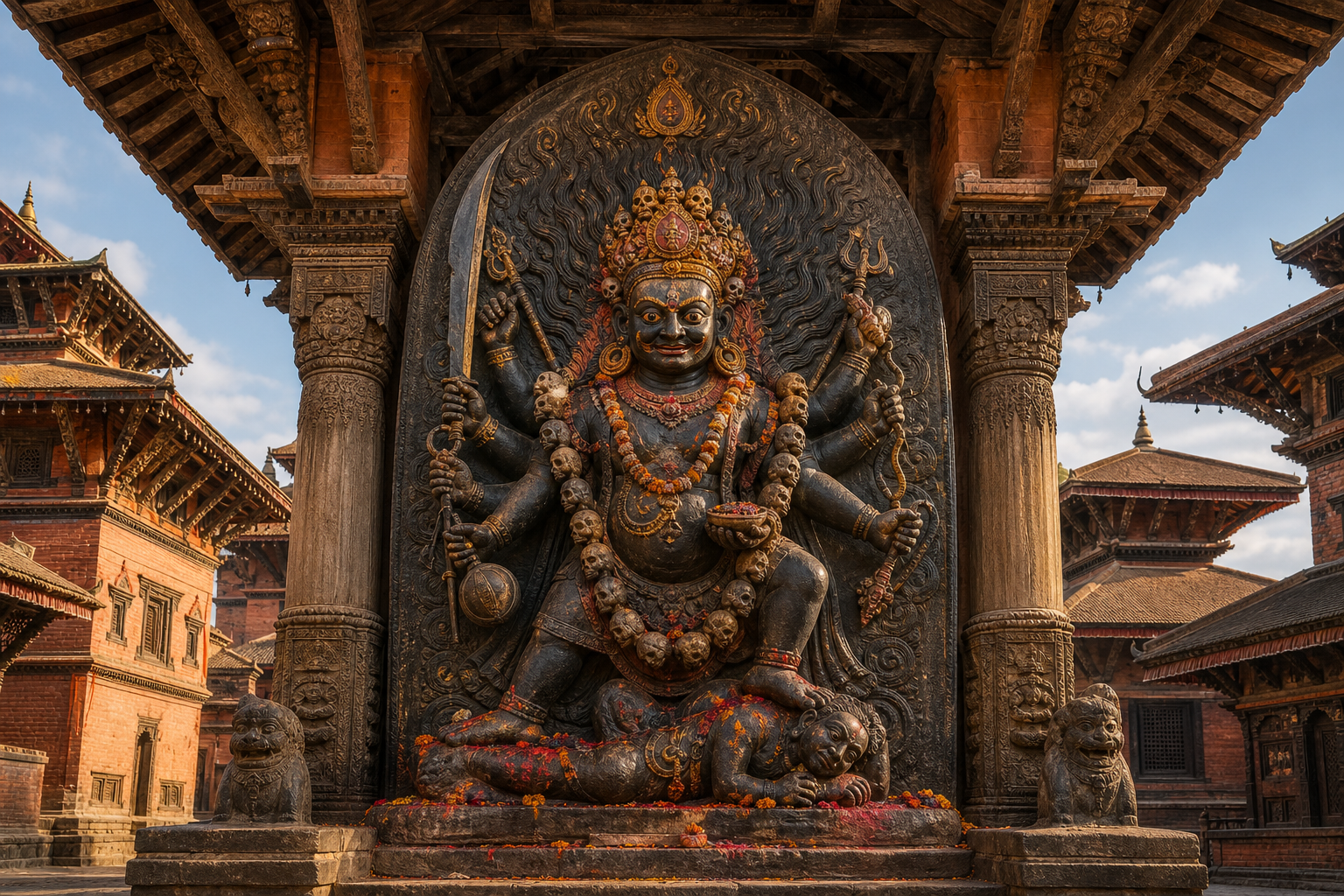
If you are preparing to see Kal Bhairav in Basantapur, the useful question is not simply, “Who is this deity?” It is how you should read a sacred image that appears terrifying but is also remembered for a smile.
The apparent contradiction is the doorway. The colossal form confronts you with death, power and submission; the smile introduces intelligence, restraint and an unexpected human response. Hold those elements together and the vigraha becomes more than an impressive stop in Kathmandu.
Begin with the deity, not the frightening appearance
At the heart of Kathmandu’s Basantapur Durbar Square stands a monumental stone vigraha of Kal Bhairav: six-armed, garlanded with skulls and standing over a prostrate figure. It belongs to the Newar tantric sacred world and presents Bhairav as a fearsome manifestation of Shiva.
That last point prevents the most common misreading. Fearsome does not mean evil in Dharmic iconography. A fierce form can express the force required to confront fear, falsehood, mortality and whatever refuses gentle correction. The terrible appearance is not evidence that the deity is demonic; it is a visual declaration that certain realities cannot be negotiated away.
You should also resist reducing the image to a generic symbol of Shiva. Bhairav traditions occur across South Asia, but this vigraha stands within a specifically Newar tantric setting. Begin with that local identity. A broad pan-Hindu explanation may help you recognise the deity, yet it cannot replace the meanings preserved by the community around Basantapur.
A vigraha is not merely an illustration of an idea. It is a focus of sacred presence and darshana: seeing the deity while placing yourself before the deity’s gaze. If you approach it only as old stone or dramatic public art, you can describe its features and still miss the encounter it was made to create.
Read the iconography from the ground upward
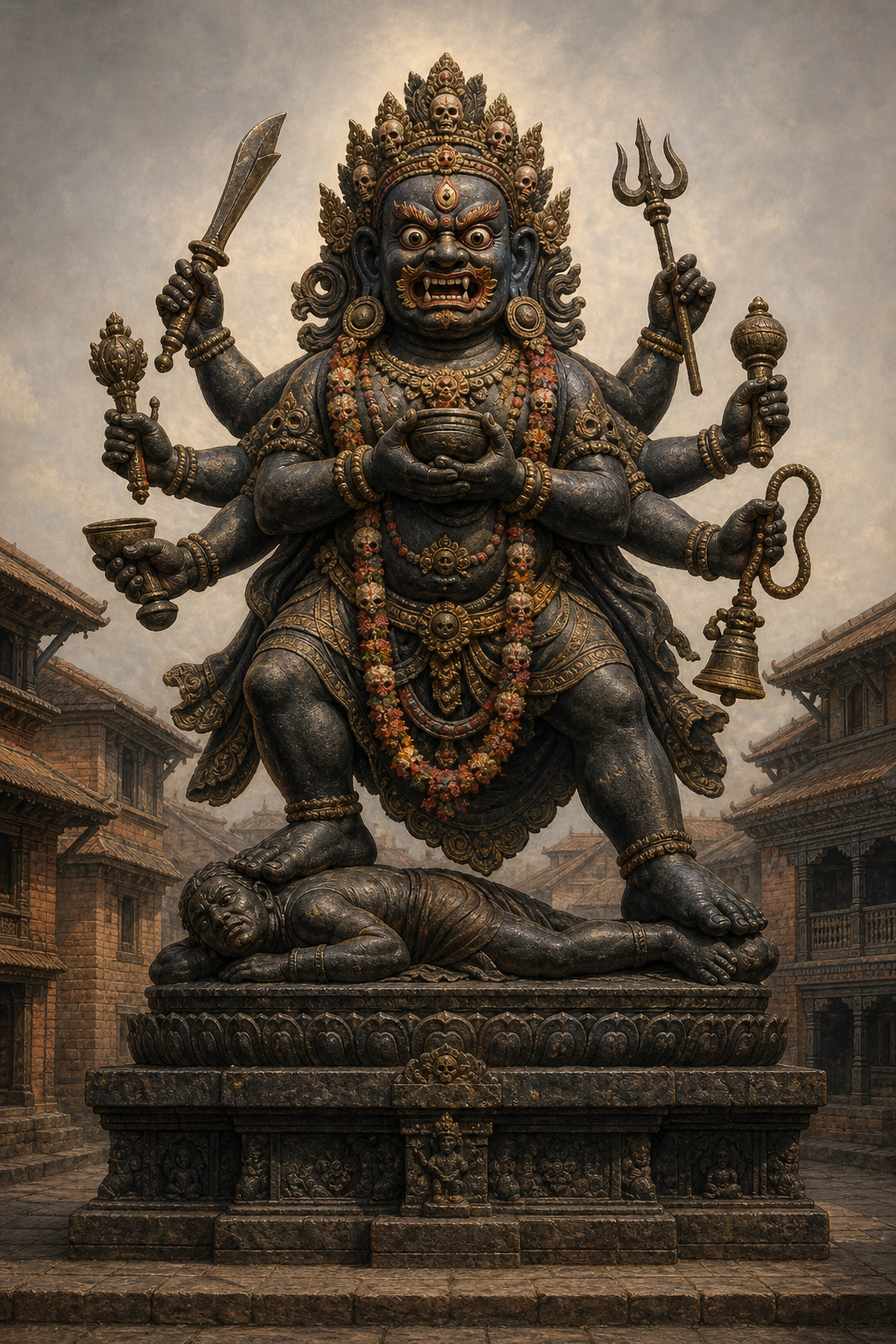
The scale and density of the image can overwhelm your attention. Use a deliberate order instead of trying to absorb everything at once:
- Start with the prostrate figure. Notice that Bhairav’s power is shown as power over something. Do not rush to identify that figure from memory or from a caption about another Bhairav image. Its exact identity requires reliable local explanation. At the level of visual grammar, the placement establishes subjugation: disorder, obstruction or a lower condition has been brought beneath divine authority.
- Move to the stance. The standing deity occupies the dominant vertical position. The composition is not passive. It communicates an active power that has already prevailed rather than a distant god waiting to intervene.
- Count the six arms. Multiple arms in Hindu iconography convey capacities that exceed ordinary human limitation. Before naming implements or gestures, look carefully at what is actually visible. Stone can weather, photographs can reverse details and similar forms can carry different attributes. Record what you see before deciding what it means.
- Look at the skull garland without sensationalising it. Skulls place mortality directly before the viewer. They can be read as reminders that bodily identity, pride and worldly status end. The practical question is not whether the image looks macabre, but why a sacred tradition insists that death must be faced rather than hidden.
- Finish with the face. Only after taking in the dominated figure, forceful stance, many arms and skulls should you examine the expression. This sequence lets you notice why the remembered smile is so striking: it appears within ferocity, not in place of it.
This order also gives you a useful safeguard. Separate observation from interpretation. “The deity has six arms” is an observation. “Each arm means a particular doctrine” is an interpretation that needs support. Keeping those categories distinct protects a living tradition from confident but careless explanation.
Why the smile and the woman’s wit belong together
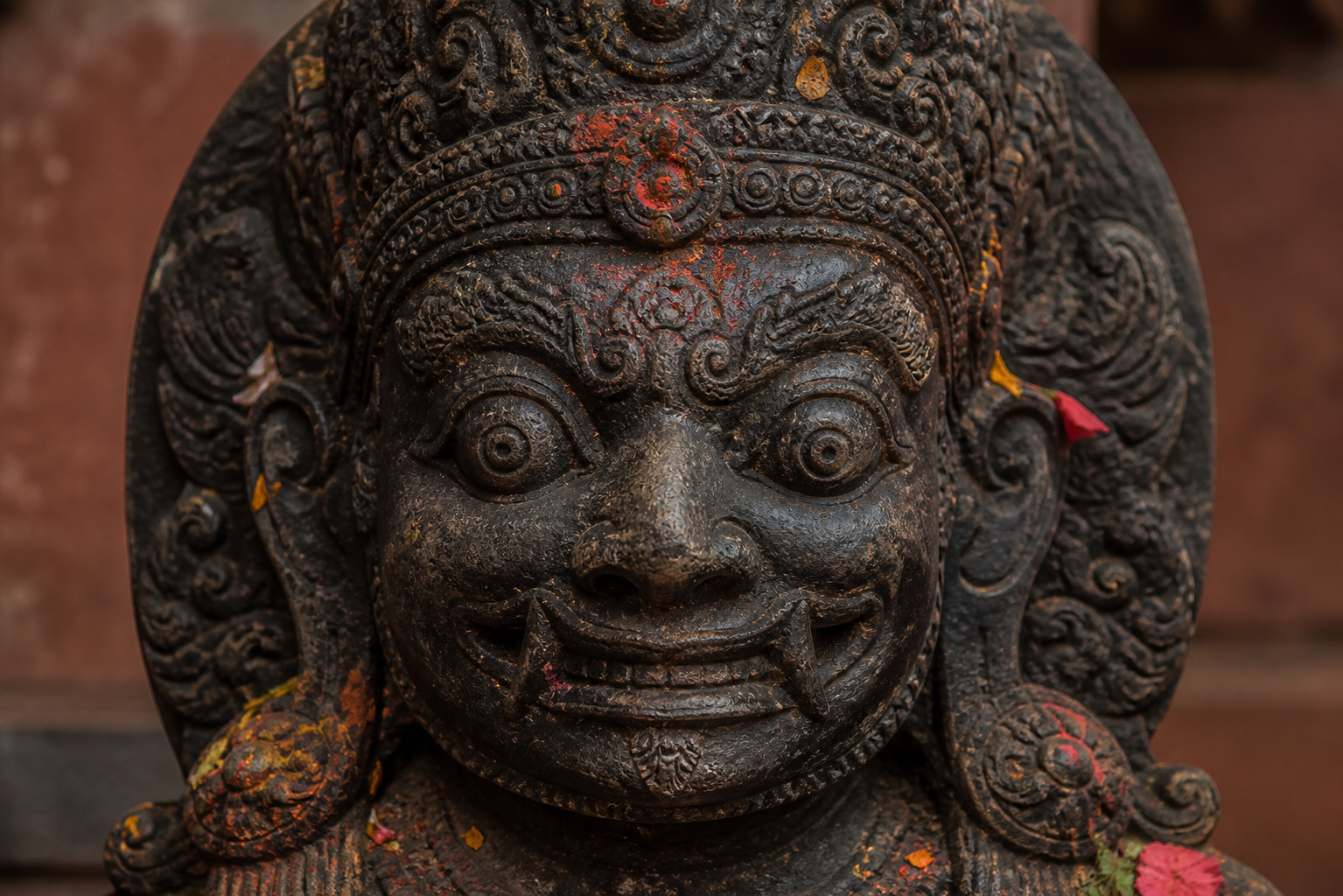
Kal Bhairav of Basantapur is remembered not only through fearsome iconography but through a story in which a woman’s wit is bound to the deity’s smile. That pairing changes how you should understand divine severity.
The smile does not make Bhairav harmless, just as the skulls do not make him cruel. It introduces another kind of power into the scene: intelligence capable of answering an intimidating presence without merely copying its force. The woman matters because the human participant in the telling is not reduced to a silent victim. Her wit becomes part of how the sacred encounter is remembered.
Read the story as a correction to two shallow assumptions. The first is that spiritual authority must always look gentle. Bhairav rejects that. The second is that truth is served only by terror and unquestioning submission. The smile complicates that conclusion. Fierceness can guard what matters while still recognising discernment, verbal skill and presence of mind.
This is also where you should distinguish meaning from chronology. A sacred story can disclose how a community understands a deity without functioning as a dated record of an event. Do not force it into a modern choice between “literal fact” and “mere fiction.” Ask instead what relationship the telling preserves: here, the relationship among formidable authority, truth, human intelligence and a smile that breaks the expected mood.
If a local practitioner or guide tells you a fuller version, listen for the exact reason Bhairav smiles and for what the woman says or does. Those details carry the moral logic. Write down who gave you that version rather than blending it immediately with versions found elsewhere. Oral traditions often remain clearest when their tellers and settings are remembered.
How to approach Kal Bhairav respectfully
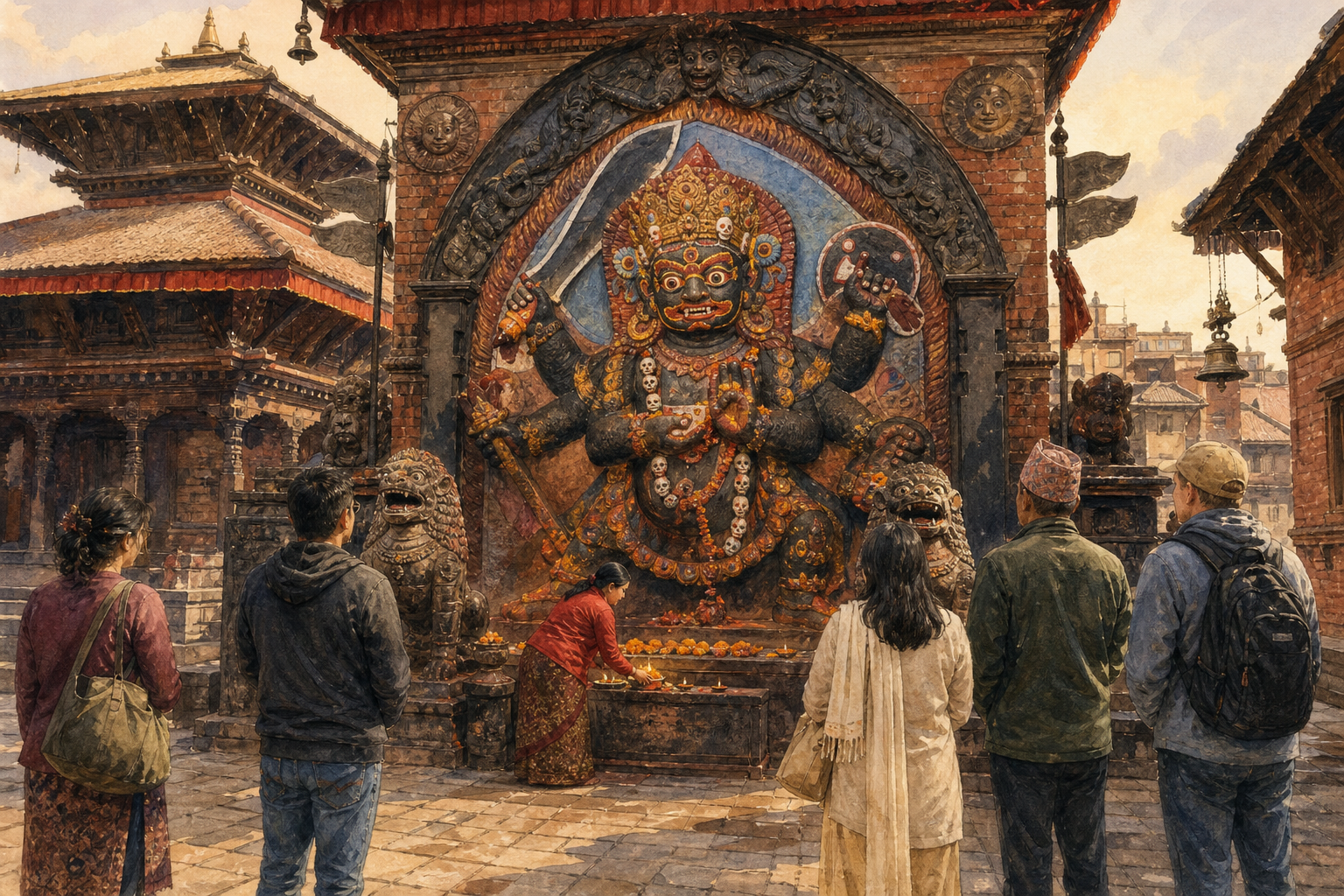
Basantapur is a public heritage setting, but public visibility does not turn a vigraha into a prop. A few concrete choices will change the quality of your visit:
- Pause before taking out your phone. Give the image one uninterrupted minute. Look from the feet upward and notice which feature first creates discomfort, curiosity or reverence.
- Check what is happening around the vigraha. If worship is underway, do not stand between worshippers and the deity, obstruct offerings or treat the moment as a performance arranged for visitors.
- Follow local instructions about photography and access. Being able to see a sacred image from a square does not automatically grant permission to touch it, handle offerings or photograph every ritual action.
- Use a simple gesture if it belongs to your practice. A quiet namaskar is sufficient. You do not need to imitate tantric rites, repeat unfamiliar mantras or perform an elaborate act copied from someone else.
- Ask a precise question. “What does the smile mean in the Basantapur tradition?” invites local knowledge. “Why do people worship this angry god?” begins by imposing a misunderstanding.
- Do not pose against the violence of the composition. Treating the skulls or prostrate figure as exotic scenery converts sacred symbols into spectacle. If you make an image, let the vigraha remain the subject.
- Record three kinds of notes separately. Mark what you personally observed, what a local person explained and what you inferred. That small discipline prevents your interpretation from later becoming a false claim about the tradition.
You do not have to be a devotee to behave with care. Respect begins with recognising that the image continues to carry sacred meaning for other people. Nor does reverence require pretending certainty. It is more honest to leave an attribute unidentified than to attach a polished but unreliable explanation to it.
Key takeaways
- Kal Bhairav is a fierce manifestation of Shiva, not an evil figure disguised as a deity.
- The Basantapur vigraha should be read within its Newar tantric context, not only through generic descriptions of Bhairav.
- Its six arms, skull garland, commanding stance and prostrate figure form a visual language of superhuman capacity, mortality and mastery.
- The remembered smile and the wit of a woman prevent fierceness from being mistaken for mindless rage.
- During a visit, observe before photographing, respect active worship and verify exact iconographic meanings locally.
- Keep observation, explanation and personal interpretation separate when you describe what you saw.
When you finally stand before Kal Bhairav, carry one question rather than a ready-made verdict: what truth becomes harder to avoid under this gaze? Look slowly, ask locally and let the unexpected smile stop you from giving the fearsome form an easy answer.
References
