
If you have encountered Nalini Kant Bhattasali only as a name in a footnote, you do not need another ceremonial list of honorifics. You need to know why his life matters, what can be stated securely, and how his example can change the way you approach Bengal’s cultural inheritance.
His career brought history, archaeology, art, coins and writing into the same field of attention. That combination gives you more than a biography. It offers a disciplined way to study heritage without separating devotion from evidence or reducing a civilization to isolated objects.
Begin with the verified outline, not the legend
Nalini Kant Bhattasali lived from 1888 to 1947 and worked as an archaeologist, art historian, numismatist and writer. He was born on January 24, 1888, in Nayananda village in the Munshiganj subdivision of Dacca District. He graduated from Dacca College in 1909 and obtained a master’s degree in history in 1912. In that same year, his original research concerned King Lakshmanasena of Bengal and His Era.
Keep that compact chronology intact when you introduce him. Do not modernize historical place names silently, and do not turn occupational titles into claims about particular discoveries. If you add a present-day location for a reader’s convenience, place it after the historical designation and identify it as present-day geography. The distinction prevents a modern map from being projected backward onto a historical life.
The same discipline applies to accomplishments. Being an archaeologist does not, by itself, prove that a person excavated a specific site. Being a numismatist does not identify which coins that person examined. Attach a discovery, catalogue, institutional position or publication to Bhattasali only when you can verify that exact connection. Reverence does not require embellishment.
His four fields give you four ways to read Bengal
Bhattasali’s range matters because cultural heritage is not one kind of evidence. A sculpture, a coin, a historical name and an argument about chronology answer different questions. When they are collapsed into a single story, attractive assumptions can begin to look like established history.
You can use the four fields associated with him as a practical checklist:
- Archaeology: Ask what the physical object is, where it was found, what was found with it and whether its original setting is known. An object removed from its context can still be beautiful, but it carries less historical information.
- Art history: Examine form, material, workmanship, symbols and changes in style. Description should come before interpretation. First record what is visible; then ask what it may mean.
- Numismatics: Read coins as compact historical records. Names, titles, scripts, symbols, metal and place of discovery can support different claims, but no single feature should be made to prove everything at once.
- Historical writing: Turn observations into an argument whose evidence another reader can inspect. A confident narrative is not a substitute for a traceable chain from object or text to conclusion.
This does not mean Bhattasali necessarily applied every question above in every undertaking. It means his combination of disciplines shows you what to look for. When you encounter a claim about ancient or medieval Bengal, identify whether it rests on material context, visual comparison, coinage, written testimony or a later interpretation. If the evidence type is never made clear, treat the claim as provisional.
Let Lakshmanasena open a historical question, not close one
The wording of Bhattasali’s early subject is revealing: it joins a named king to an era. That distinction is useful. A ruler’s biography asks what one person did; a study of an era asks how a larger historical setting should be reconstructed. The second question demands more than a sequence of royal names.
If you pursue Bhattasali’s Lakshmanasena research, use this reading sequence:
- Verify the bibliographic identity. Confirm the exact title, author form, date and edition from a catalogue record or title page before repeating a citation.
- Write down the central claim. Reduce each major conclusion to one sentence. If you cannot state the claim without adding your own assumptions, return to the relevant passage.
- Label each kind of evidence. Mark whether a conclusion depends on a text, coin, object, visual comparison or chronological inference.
- Separate ruler from era. Do not assume that evidence dated to a reign describes the whole society of that period, or that every cultural object can be explained through the ruler alone.
- Keep uncertainty visible. Record whether a date or identification is explicit, inferred or disputed. Later retellings often erase those distinctions.
This method protects you from two opposite mistakes. One is to accept an old scholarly conclusion merely because it is old. The other is to dismiss earlier scholarship merely because terminology or historical interpretation has changed. Read the evidence, retain what remains demonstrable and identify what needs re-examination.
Turn admiration into practical preservation
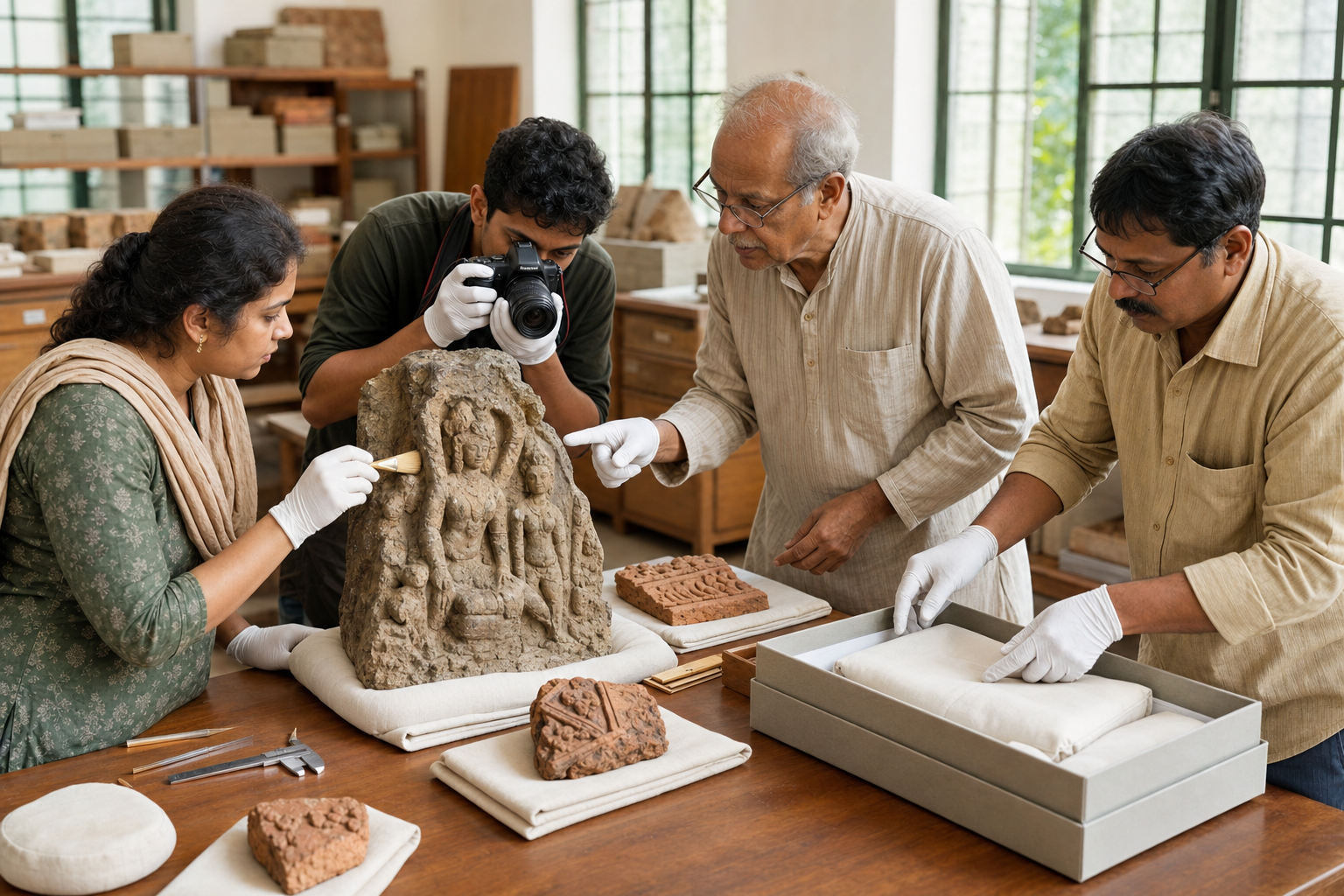
A tribute becomes culturally useful when it improves the record. Students, temple communities, local history groups and family custodians can all do this work, even without running a museum or excavation.
- For students: Build a one-page chronology containing only verified dates and institutions. Put unresolved claims in a separate section headed “Questions,” so they are not repeated later as facts.
- For writers and editors: Keep fact, inference and appreciation distinct. A birth date is a fact; an interpretation of a scholarly career is an inference; calling that career important is an editorial judgement. Readers should be able to tell which is which.
- For local custodians: Photograph an object from several angles, record its measurements, material, present location and any accompanying label, and preserve the oldest known information about where it came from. Do not clean a coin, sculpture or old document to improve a photograph. Abrasion, chemicals and improvised repairs can permanently remove evidence; consult a trained conservator when intervention is necessary.
- For cultural organizations: Digitize labels, catalogues and out-of-print material with searchable text as well as page images. Retain original spellings in the transcription, while adding modern terms in separate notes.
- For public commemorations: Display a short verified timeline beside any tribute. Give visitors a reading path or catalogue reference so that remembrance leads to further inquiry.
The basic unit of preservation is not praise. It is a record that another person can verify, correct and extend. That is how cultural memory survives beyond the enthusiasm of one generation.
A Dharmic standard for cultural memory
For a Dharmic audience, truthfulness is not a restraint placed upon reverence. It is part of reverence. Satya asks us not to promote an unverified achievement merely because it supports a welcome narrative. Seva asks us to do the slower work of cataloguing, transcribing, conserving and teaching.
This standard is especially important when writing about Bengal. Cultural advocacy loses credibility when every uncertainty is treated as an attack and every correction as disloyalty. A stronger civilizational confidence can say, “This much is established, this is a reasonable interpretation, and this still needs proof.” Such clarity makes a heritage claim more durable, not less Dharmic.
Bhattasali’s multidisciplinary identity also warns against treating heritage as decoration. An image may carry an artistic history; a coin may preserve political language; a place name may retain an older geography; and a scholarly argument may connect them. Your responsibility is to keep those layers available rather than flattening them into a slogan.
Key takeaways
- Remember Bhattasali through his specific disciplines and verified chronology, not through inflated claims.
- Use archaeology, art history, numismatics and historical writing as separate but complementary lenses.
- Preserve historical place names and distinguish them clearly from present-day geographic labels.
- Mark facts, inferences and unresolved questions separately whenever you write or teach.
- Make commemoration productive by creating records, transcriptions, catalogues and reading paths that others can inspect.
If you want to begin now, create a one-page Bhattasali file with the verified chronology above, its citation and a separate list of unanswered questions. Make the bibliographic trail for King Lakshmanasena of Bengal and His Era your next task. One careful record is a better offering to cultural memory than another unsupported legend.