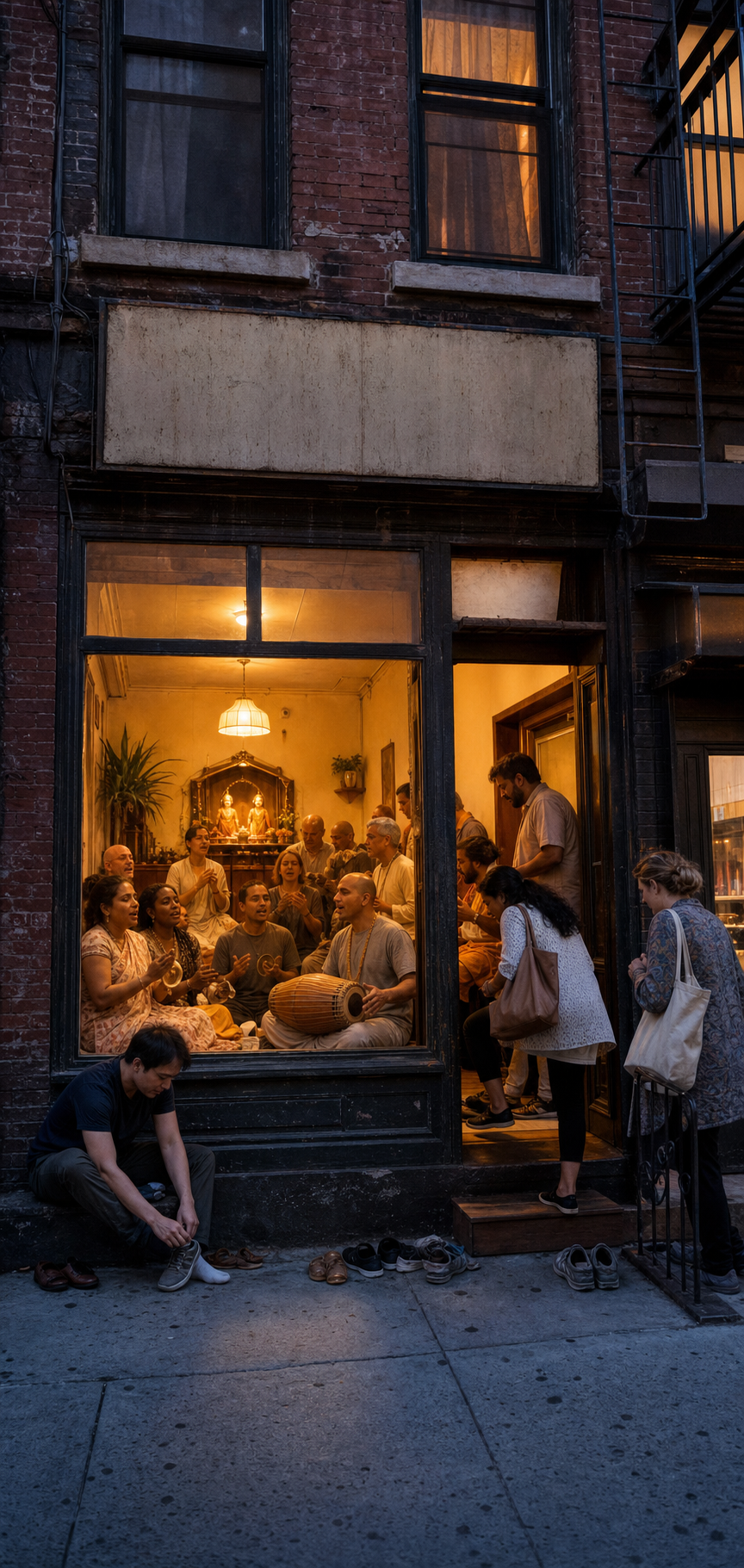
If your picture of ISKCON begins with a large temple, a crowded festival, or a livestream watched from another country, 26 Second Avenue can look too modest to explain a worldwide movement. For this anniversary, that modest scale is precisely the point. The storefront brings you close to the people, practices, and acts of service from which the movement grew.
The eight-day observance from 6 to 13 July did more than mark sixty years. It reunited early disciples, returned sacred objects to the founding space, and repeated a devotional rhythm that remains usable now. Whether you intend to watch the recordings, visit the address, or organize a local commemoration, the anniversary gives you a clear question to carry: which parts of ISKCON’s beginning should we preserve by practising them, rather than merely remembering them?
The storefront preserves a scale that success can obscure
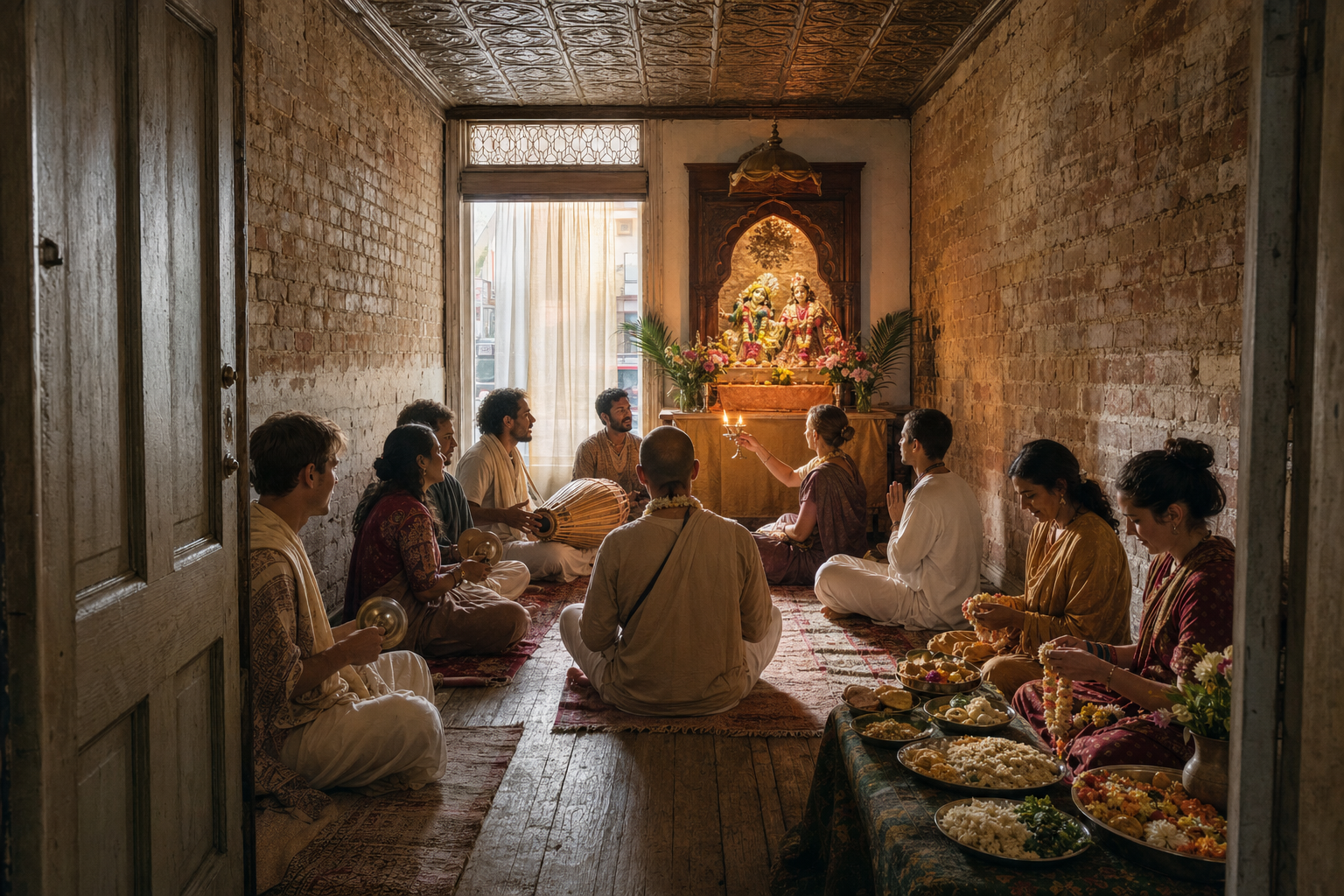
At 26 Second Avenue, the physical scale tells part of the history. A storefront can hold only so many people. It does not separate the teacher from the congregation through distance, and it leaves little room for spectatorship. You enter a shared space in which hearing, chanting, serving, and receiving prasadam happen close together.
That intimacy remained visible during the anniversary. Seating was so limited that many people stood outside and followed the broadcasts on their phones. A program featuring Radhanath Swami had to be moved to the Bhakti Center to accommodate the audience. The logistical problem also revealed something worth noticing: an origin site cannot simply be enlarged without losing the scale that makes it historically instructive.
If you visit 26 Second Avenue, do not judge it by the standards of a modern temple complex. Read it through three layers:
- Place: Notice the short physical route between the storefront and Tompkins Square Park. The anniversary renewed that connection through daily harinam.
- Persons: Remember that the movement began through relationships between Srila Prabhupada and people who heard him, served with him, and learned to carry the practice forward.
- Practice: Look for the recurring sequence of public chanting, congregational kirtan, remembrance, and prasadam. The address matters because these activities took root there.
This approach prevents two common misreadings. The storefront is neither an ordinary commercial address made interesting only by hindsight nor a relic whose value lies solely in its age. It is a place where spiritual instruction became a repeatable community life.
The anniversary renewed a living devotional pattern
The opening ceremony joined ribbon-cutting with the breaking of coconuts, auspicious mantras, and a sacred yajna. That combination is instructive. The organizers reopened a historic public space while placing the occasion within a Dharmic ritual frame. Institutional memory and sacred observance were not treated as separate concerns.
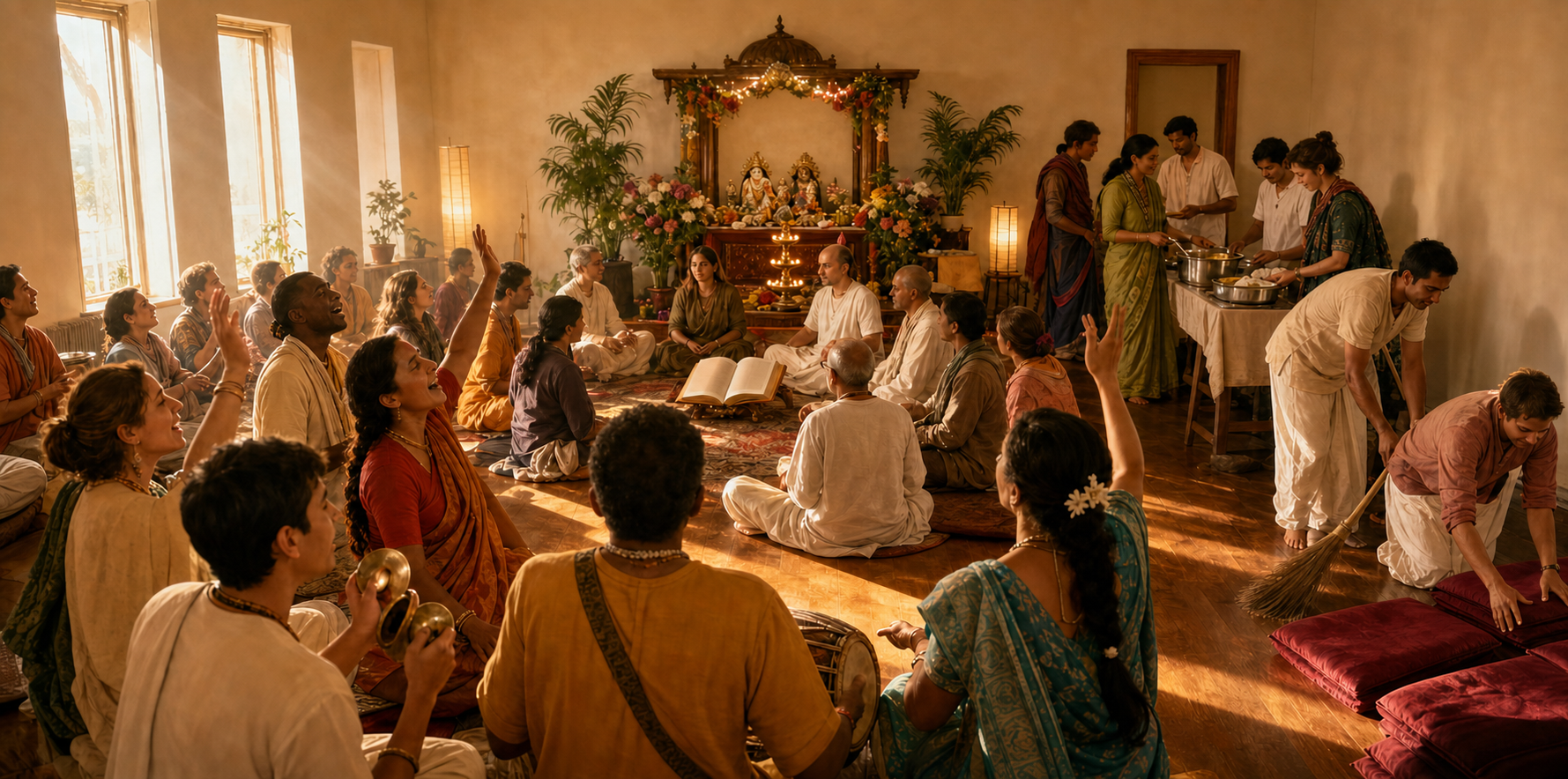
The daily program then followed a consistent rhythm: harinam to Tompkins Square Park, evening kirtan and memories, and prasadam. Each part performed a different function:
- Carry the holy name into public space. Harinam turns devotion outward. It does not require a person to enter a temple before encountering the practice.
- Gather to chant and hear. Kirtan gives the assembly a shared act, while memories connect that act to the people who sustained it in the early years.
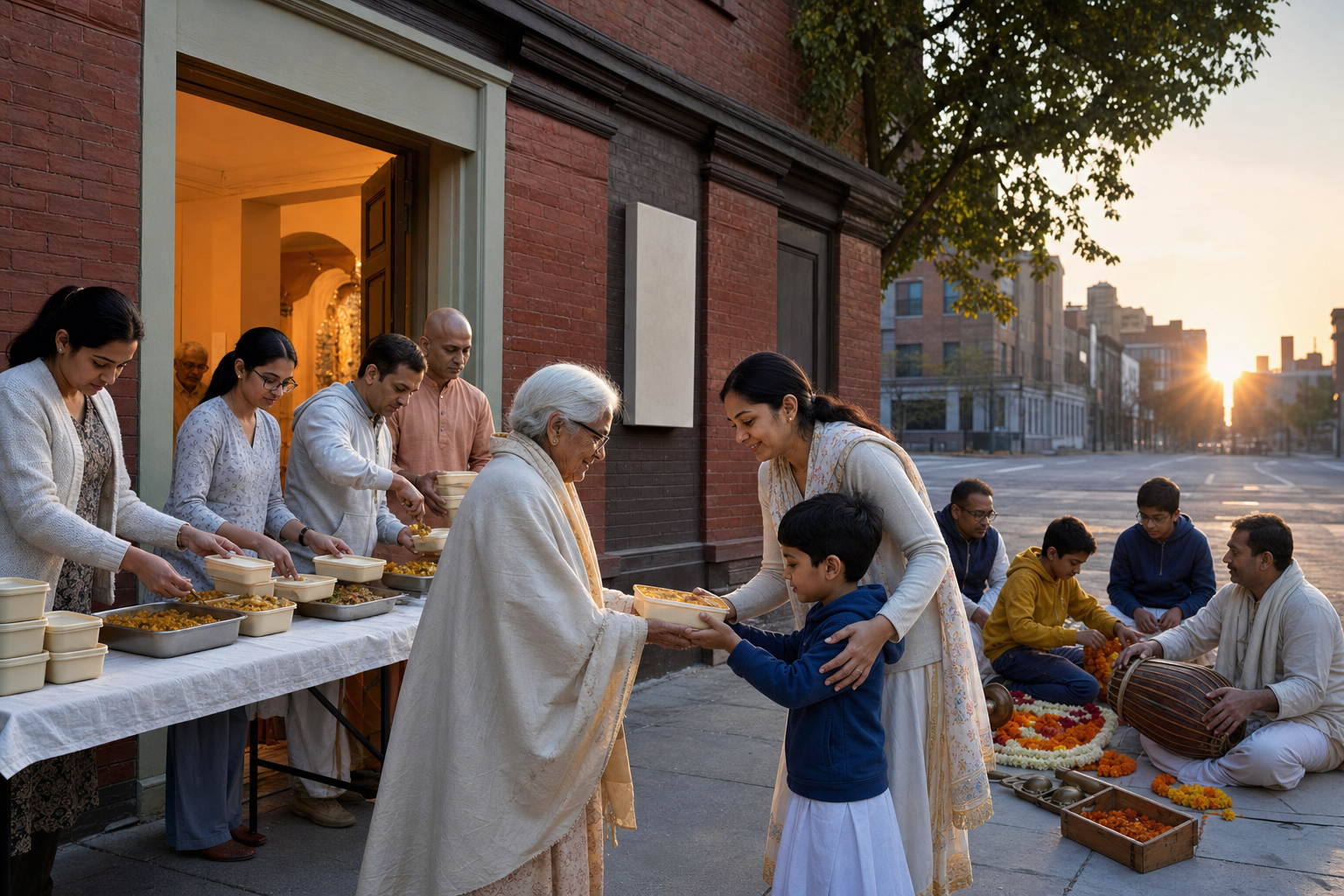
- Complete the gathering through prasadam. Sacred food makes hospitality part of spiritual life. The program ends not with an audience dispersing from a performance, but with people receiving and sharing grace together.
The traditional Sunday Feast made this pattern especially tangible. Paneer, puri, sweet rice, pakoras, and other preparations were served in remembrance of the original Sunday Feast at the storefront. The menu matters less as culinary nostalgia than as evidence of a durable method: welcome people, give them an opportunity to chant and hear, and let spiritual hospitality complete the encounter.
If you are planning a local observance, keep those three functions intact before adding elaborate production. Include an outward-facing devotional act where local conditions permit, a period of attentive hearing and kirtan, and properly prepared prasadam. A commemoration that only talks about the past risks making devotees into spectators. A commemoration that renews the founding practices lets the past continue to form the present.
Witnesses and sacred objects preserve different kinds of memory
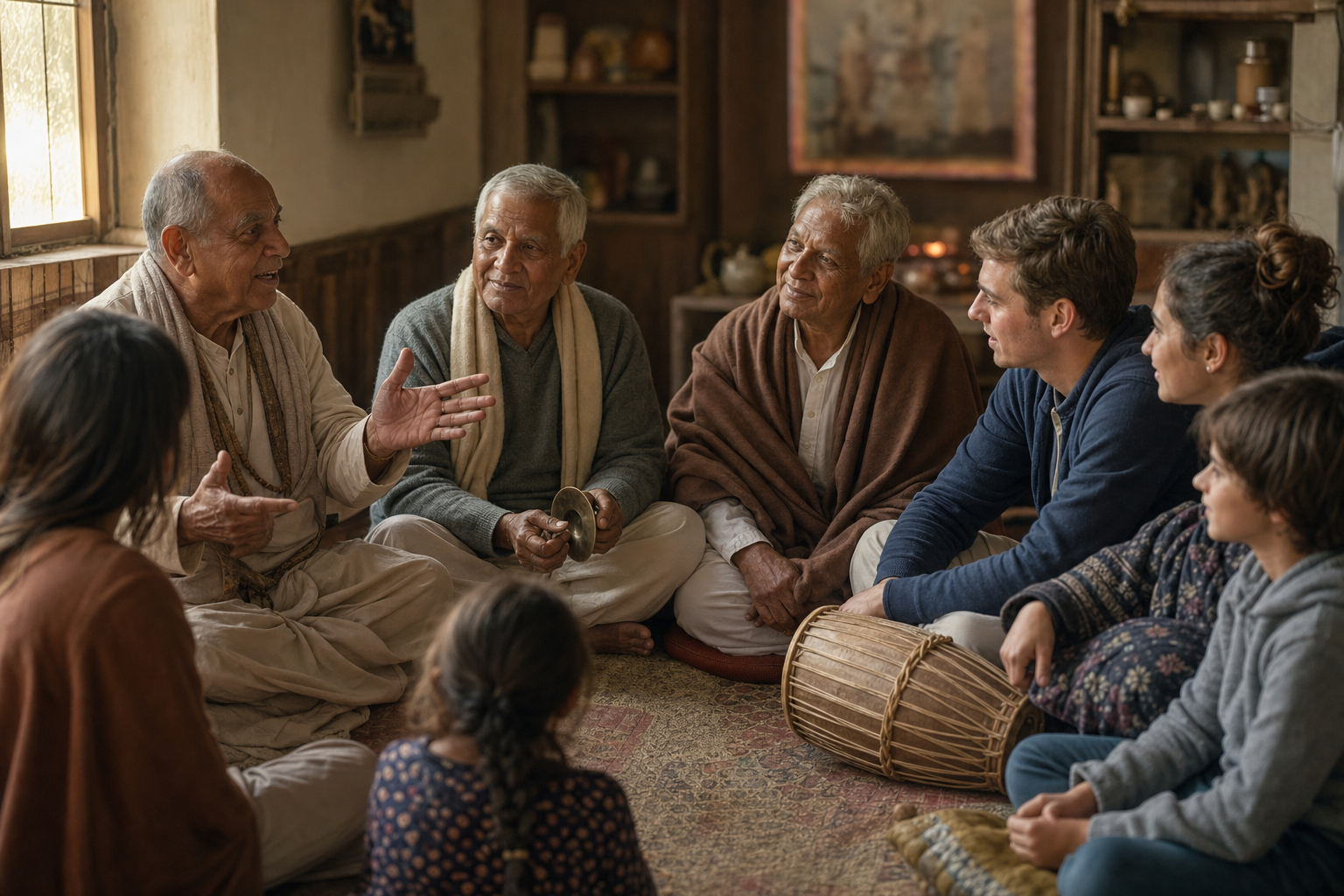
More than twenty disciples of Srila Prabhupada attended the celebration. Some, including Jadurani devi dasi, returned to 26 Second Avenue after many years and met godbrothers and godsisters at the place where their shared service began. Their presence gave the anniversary something that an exhibition alone cannot provide: living memories voiced by people who participated in the movement’s early life.
The sacred objects supplied another form of continuity. The original Radha-Krishna Deities worshipped and installed at the storefront by Srila Prabhupada made a special appearance. The shoes he wore when he first arrived in the United States in 1965 were also brought from ISKCON New York for the occasion.
Objects and testimony should not be asked to do the same work. The Deities and shoes establish material continuity with Srila Prabhupada’s presence and worship. The disciples’ memories supply human context: what service felt like, which instructions shaped them, and how a small community learned to continue. The anniversary became most informative where those two forms of memory met ongoing practice.
You can use the same distinction when watching the archived sessions. Keep notes under three questions:
- What did Srila Prabhupada personally establish, teach, worship, or ask others to do?
- Which practices did the early community repeat until they became part of ISKCON’s recognizable life?
- What can your family, temple, or study group faithfully continue without pretending to recreate 1960s New York?
The open-top sacred-places bus tour, guided by Rama Raya dasa, added geography to those memories. A theatrical production directed by Yadunath dasa depicted ISKCON’s incorporation. Together, these formats connected biography, place, and institution. When teaching younger devotees, that combination is more useful than presenting a bare timeline: show where an event occurred, who carried responsibility, what was done there, and what followed from it.
You can enter the anniversary even if you missed the gathering
The storefront’s limited capacity did not make the anniversary inaccessible. Every program was livestreamed, and the recordings were preserved on the 26 2nd Avenue YouTube channel. That archive gives you a better option than trying to absorb eight days of material without a plan.
- Begin with the opening ceremony. Watch how the historic storefront, Vedic observance, and community welcome were joined. This establishes the tone of the commemoration.
- Prioritize the disciple-memory sessions. Write down the speaker’s name, the event being remembered, the service involved, and the practical principle you hear. This keeps personal testimony from dissolving into a general impression.
- Follow the sacred geography. Use the bus-tour program to connect 26 Second Avenue with the New York locations associated with Srila Prabhupada’s first days there.
- Watch the incorporation drama as institutional history. Pay attention to the transition from a gathering around a teacher to an organized movement capable of carrying responsibility beyond one room.
- Finish with practice. After watching, hold kirtan, discuss one specific lesson, and share prasadam. The archive becomes spiritually useful when it leads back to devotional action.
Search YouTube for the exact channel name ISKCON 26 2nd Avenue Matchless Gifts. For program notices connected with the historic site, the listed Instagram account is @26_2nd_avenue_matchless_gifts_, while Facebook carries 26 2nd Avenue Bhakti Yoga Official Programs. Using the exact names matters because broad searches for ISKCON anniversary material can bury the storefront’s own recordings beneath unrelated results.
Key takeaways: how to judge a meaningful commemoration
The 60th anniversary offers a practical test for future ISKCON observances. Before you support, attend, or organize one, ask whether it meets these four criteria:
- Is Srila Prabhupada’s role unmistakable? The founder-acharya should not become a ceremonial name detached from the worship, instruction, and service he established.
- Does remembrance lead into practice? Harinam, kirtan, hearing, and prasadam should be more than decorative references in a stage program.
- Are early voices preserved carefully? Named testimony, recorded in context, gives future generations something more reliable than an anonymous anecdote.
- Can people beyond the room participate later? Livestreaming answers the immediate capacity problem; a well-kept archive turns a temporary event into a resource for teaching and devotional study.
Choose one anniversary recording this week. Note one concrete practice or instruction, discuss it with another devotee, and put it into service locally. That is the most fitting way to approach 26 Second Avenue: not as a small room left behind by a large movement, but as a founding pattern that can still be renewed wherever sincere hearing, chanting, service, and prasadam come together.