
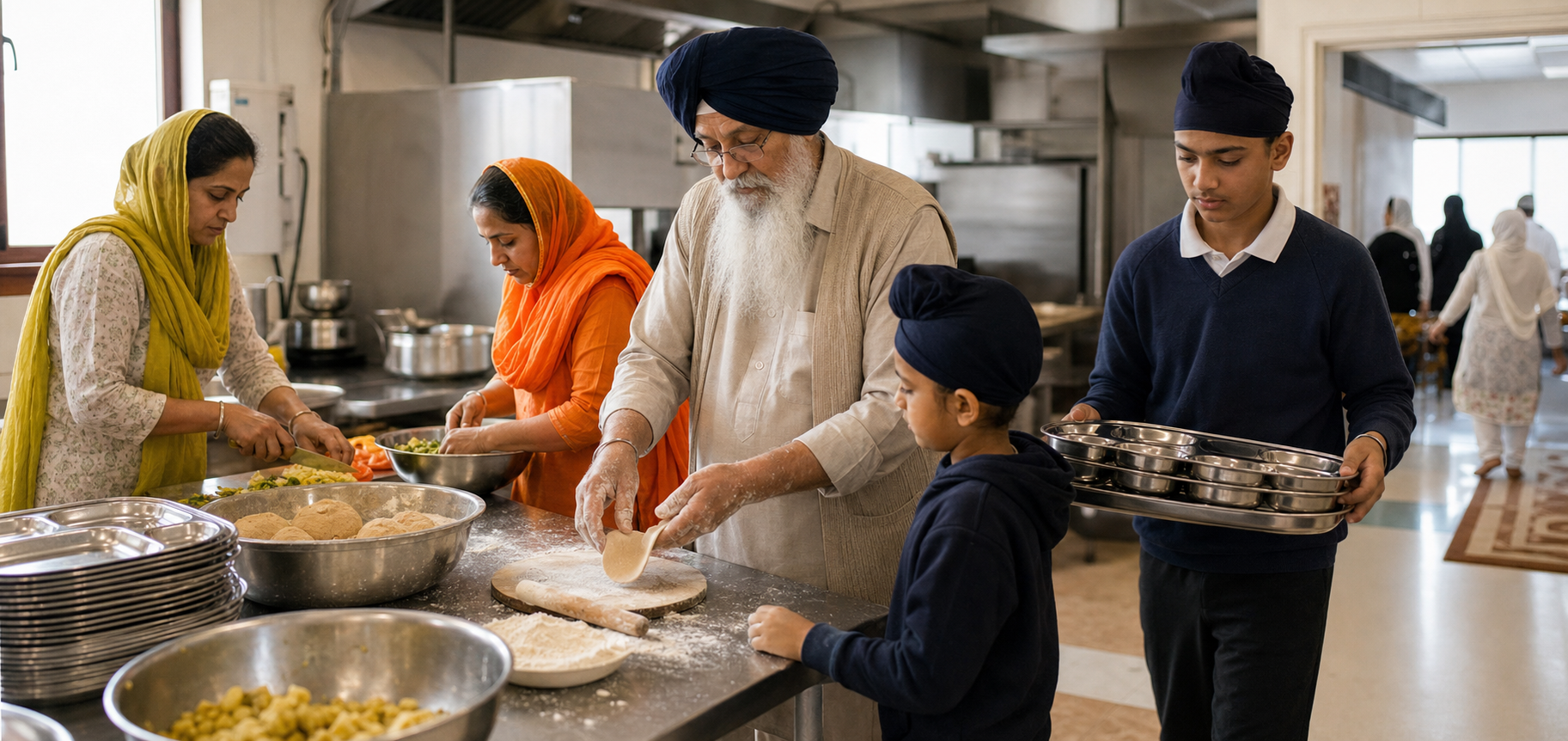
You can get every doctrinal label right and still give a thin account of Sikh life. A lesson may name the Guru Granth Sahib, the Five Ks, langar and the Khalsa yet leave the learner unable to see how faith is formed in a kitchen, tested in a classroom, voiced through kirtan or practised beside others in a gurdwara.
If you teach Sikhism, write about the Sikh diaspora or prepare public material about the tradition, Eleanor Nesbitt offers a practical correction. Study what Sikhs are taught, but also examine how teaching becomes language, discipline, service, memory and belonging. That shift produces a fuller account without reducing Sikhism either to a rulebook or to a collection of personal opinions.
Keep normative teaching, daily practice and personal voice distinct
Lived Sikh studies does not place everyday experience above the Guru, scripture or established discipline. Nor does it assume that whatever an individual happens to do defines Sikhism. Its strength lies in examining the relationship among three different kinds of evidence:
- Normative teaching: the guidance associated with the Guru Granth Sahib, the Rehat Maryada, the Khalsa and community institutions.
- Enacted practice: what happens through recitation, kirtan, seva, langar, sangat participation, family devotion and the wearing of Sikh identity markers.
- Personal interpretation: how a child, parent, teacher or community member explains the meaning of those practices in a particular setting.
These layers belong together, but they are not interchangeable. A community code cannot tell you everything about a pupil’s encounter with a school uniform policy. One family’s routine cannot establish what all Sikhs do. A textbook definition of seva cannot show how someone learns to serve without seeking status.
This distinction immediately improves your writing. When a sentence begins with a sweeping claim such as ‘Sikhs believe’ or ‘Sikhs always,’ stop and identify its basis. Is it describing a theological commitment, an institutional expectation, an observed practice or one person’s explanation? If you cannot tell, the sentence is probably too broad.
The same test prevents sacred and communal practices from becoming classroom curiosities. Instead of presenting langar merely as a free meal, trace how participation can teach humility, generosity and shared responsibility. Do not treat kirtan as a musical accessory; ask how engagement with shabad connects textual authority, devotion and moral attention. Do not display the Five Ks as five isolated objects; explain how visible identity can carry discipline, belonging and an ethical claim upon the wearer.
A useful question for every term in your lesson or essay is therefore not only ‘What does it mean?’ but also ‘What does it ask a person to do, notice or become?’ That second question is where lived religion begins to reveal its value.
Follow Sikh formation through home, school and gurdwara
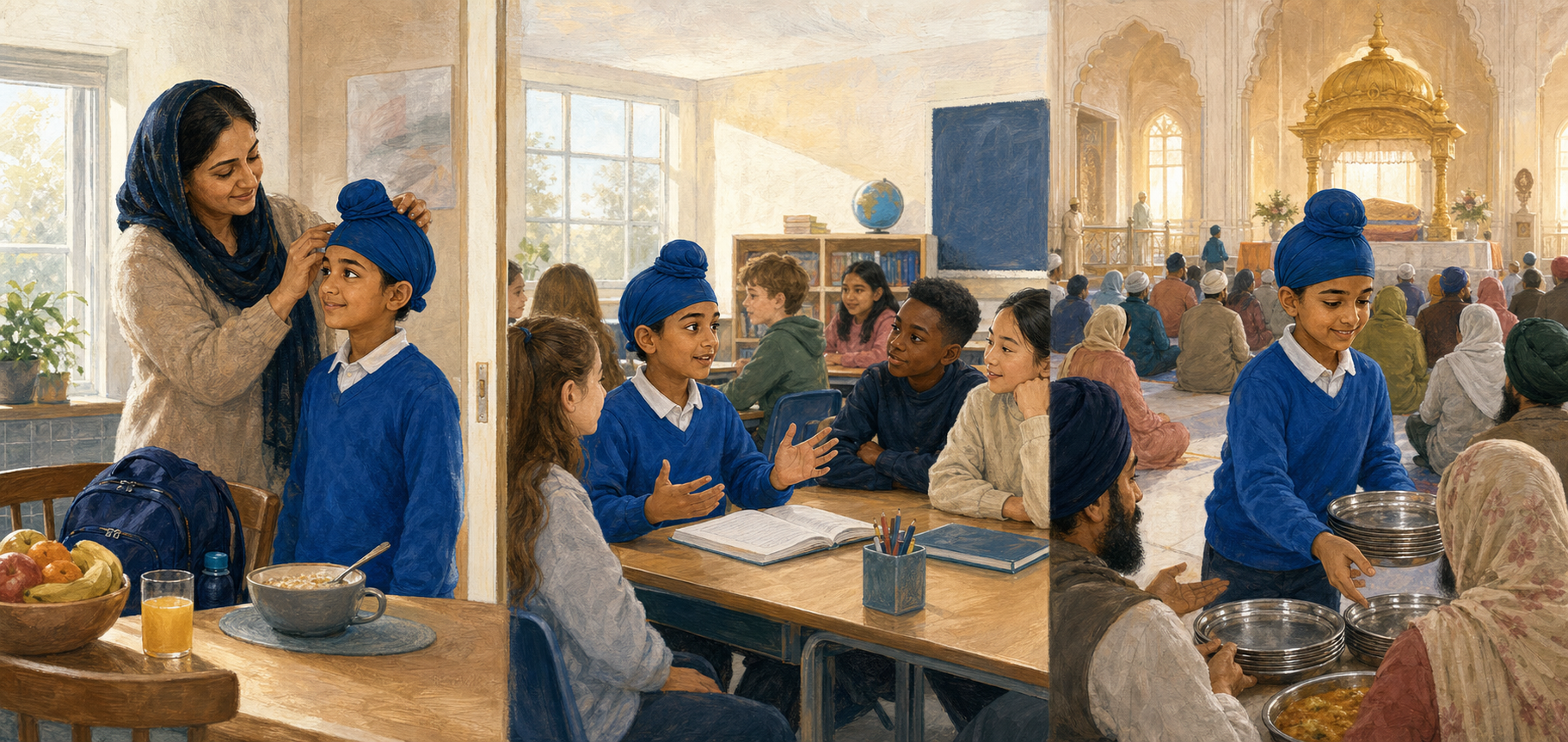
No single setting contains the whole of Sikh formation. Nesbitt’s multi-sited approach follows religious learning across homes, schools and gurdwaras, allowing the same value or practice to appear in different forms. If you examine only the gurdwara, you may miss the daily work of family transmission. If you examine only school materials, you may mistake public explanation for the tradition as it is lived.
- At home, notice how family example, Punjabi and English, recitation of the Mool Mantar, passages from Japji Sahib and ordinary routines combine. Religious learning may be textual, oral and relational at the same time.
- At the gurdwara, follow the movement between Punjabi classes, Gurmukhi reading, sangat, shabad kirtan and hands-on seva in the langar hall. The building is not merely a place where previously learned beliefs are expressed; it can function as a living curriculum.
- At school, examine how Sikh pupils meet institutional categories. Lessons, uniform rules and decisions involving the kara or kirpan influence whether Sikh commitments are recognised accurately or treated as unfamiliar exceptions.
You can turn this into a simple planning exercise. Choose one concept, such as seva, and trace it through all three settings. Ask where a young person first hears the word, who models it, which action gives it substance, which language is used to explain it and whether its meaning changes when it enters a classroom. Repeat the exercise with kirtan, the kara or hukam. The resulting map will be more informative than a list of definitions because it shows how knowledge travels.
Children’s voices matter especially here. Adults can describe what they hope children are learning, but that is not the same as hearing how children understand a family prayer, a Punjabi class or a visible article of faith. Concrete prompts work better than asking a child for an abstract definition. Ask what happens when the family arrives at the gurdwara, which part the child joins, what is difficult to explain at school or when a particular word is used at home.
Language deserves the same care. Gurmukhi literacy, Punjabi speech, English explanation and transliteration do different work. A learner may participate confidently while still developing textual literacy, or know a practice through English before learning its Punjabi name. Editorial choices also matter: whether you translate hukam, retain kirtan as a familiar term or gloss langar only as communal food can enlarge or narrow the learner’s understanding.
Do not make fluency in one language your test of authenticity. Record which word a person uses, preserve the Sikh term where it carries meaning that English cannot hold neatly, and explain it in context. This keeps accessibility from turning into conceptual loss.
Turn representation, interpretation and reflexivity into a workflow
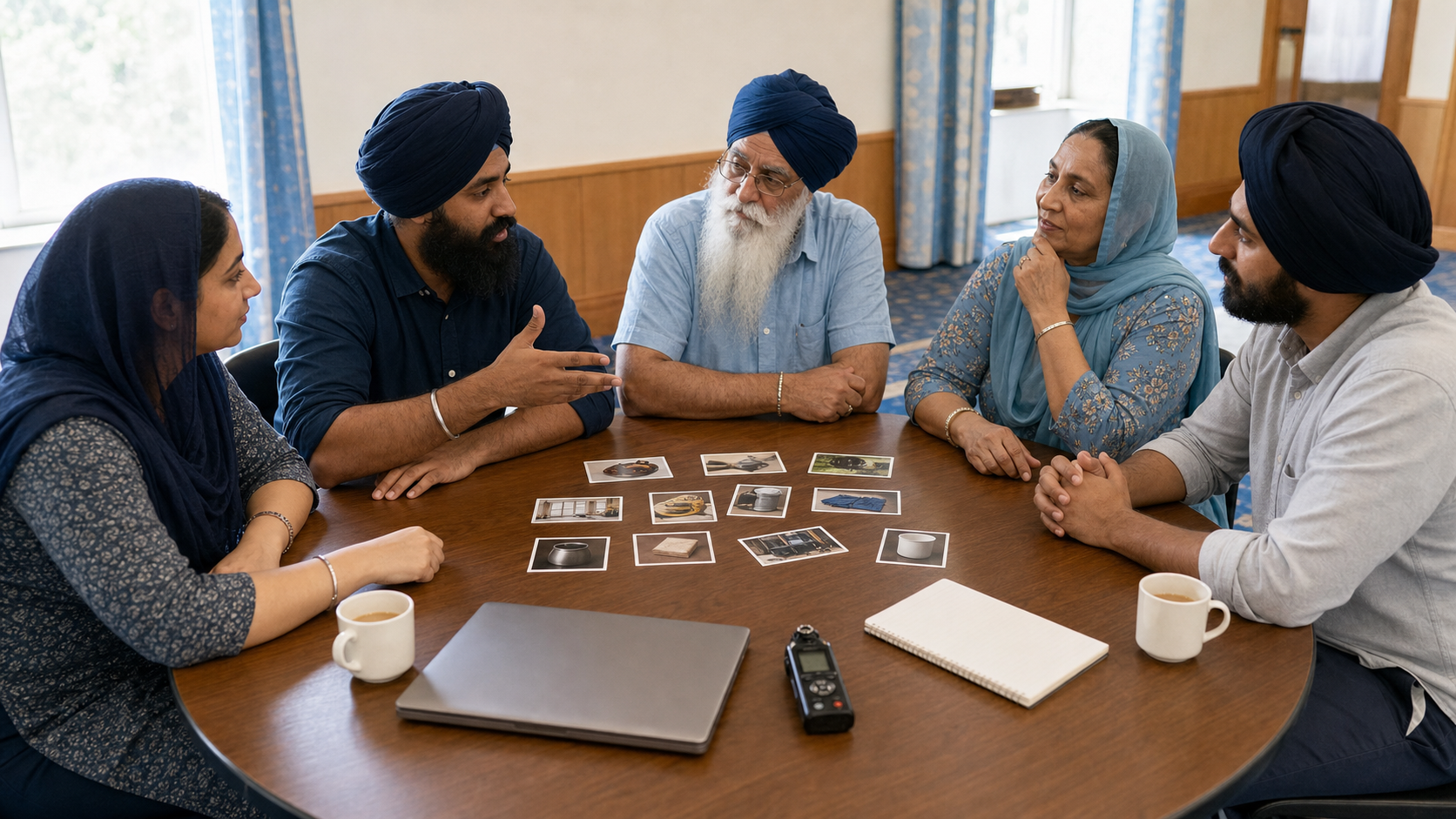
The interpretive approach associated with the University of Warwick’s Religions and Education Research Unit can be made practical through three linked duties: represent Sikh life fairly, interpret what practices mean in context and examine the assumptions you bring to the task. None of the three can safely be omitted.
- Define the scope. State whether you are discussing a normative Sikh teaching, a particular family, a gurdwara programme, British Sikh pupils or a wider diaspora pattern. A narrow claim with a visible boundary is more trustworthy than a universal claim built from one setting.
- Gather different forms of evidence. Bring observation, participant explanation, textual teaching and relevant educational material into conversation. When they differ, keep the difference visible rather than forcing agreement.
- Use emic language. Record the terms people use for their own practices, then explain them for outsiders. Translation should open a door without quietly replacing the community’s categories with the observer’s.
- Separate description from inference. First say what happened or what a participant explained. Then identify your interpretation of its significance. This prevents the observer’s theory from being mistaken for a Sikh person’s own account.
- Check the representation with the people affected. For a lesson, exhibition or public-service resource, consult Sikh community representatives and pilot the material with Sikh learners where possible. Ask what is inaccurate, what is missing and which wording creates a stereotype.
- Audit your assumptions. Notice whether you expect religion to reside mainly in private belief, formal worship, scripture, ethnicity or visible symbols. Sikh life may cross all those categories without fitting neatly inside any one of them.
Triangulation is not a hunt for a single account that cancels every other one. It helps you determine what kind of claim each piece of evidence can support. A classroom interview may reveal how a pupil explains the kara to peers. Gurdwara observation may show how seva is organised. The Guru Granth Sahib provides an authoritative textual horizon. Each illuminates something different.
This workflow also protects against tokenism. One highly visible person should not be made to represent an entire community. One gurdwara should not stand for every gurdwara. One textbook photograph should not become evidence of universal practice. Variation by family, generation, language, initiation, locality and institutional setting is not noise to remove; it is part of what must be understood.
Use lived Sikh studies to deepen Dharmic dialogue, not flatten it
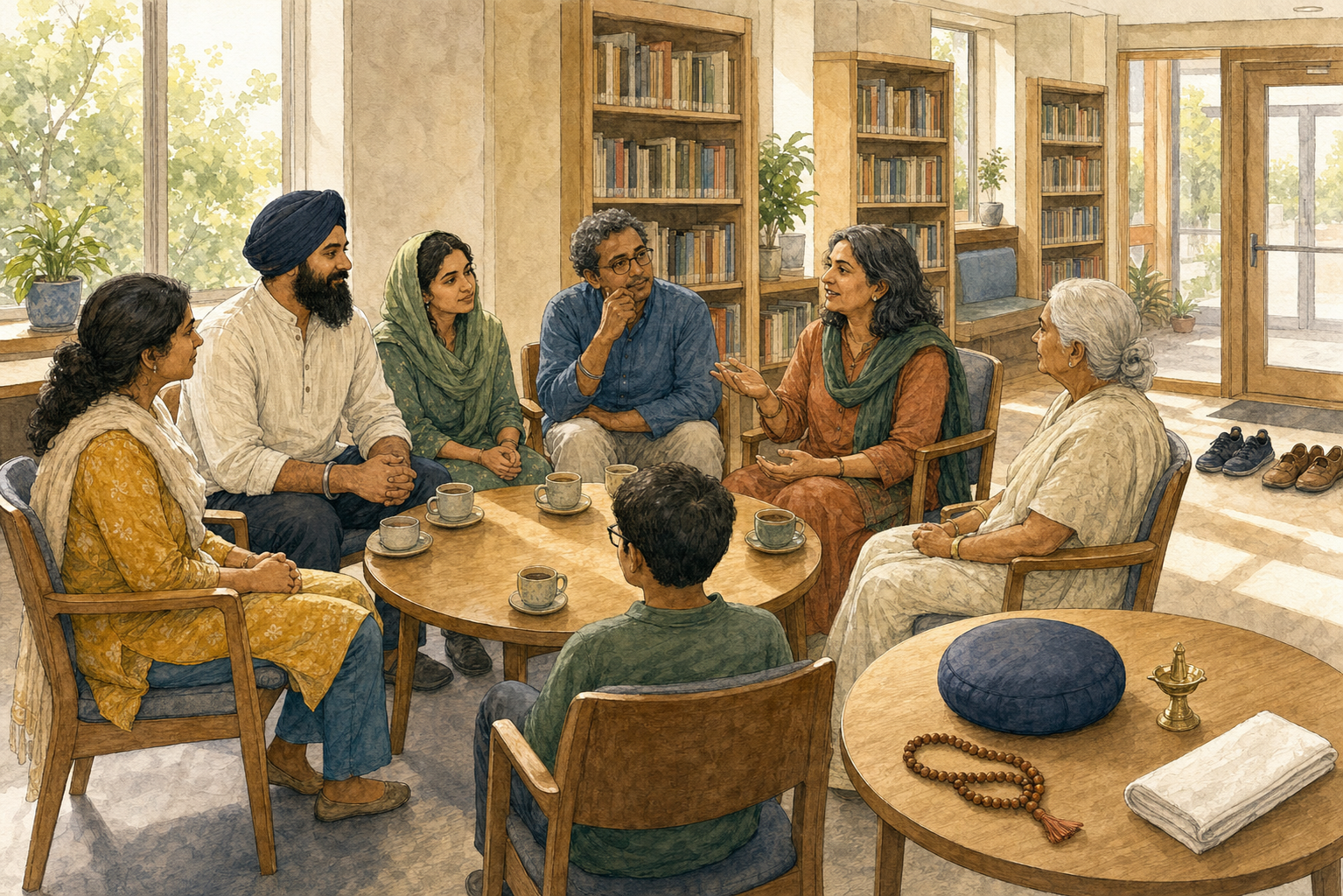
Readers concerned with the wider Dharmic world may recognise ethical bridges among Sikh, Hindu, Buddhist and Jain traditions. Service, compassion, hospitality, disciplined conduct and responsibility toward others can create meaningful points of encounter. But a shared ethical concern does not prove that different traditions mean the same thing, derive it from the same authority or embody it through identical institutions.
Lived study gives you a better basis for dialogue than a list of supposedly equivalent doctrines. Begin with a concrete practice. Observe who participates, what words are spoken, which authority is invoked, what relationship is formed and what obligation continues afterward. You can then recognise a genuine convergence without erasing the Guru Granth Sahib’s primacy, the Khalsa’s distinct discipline or Sikh historical memory.
This approach corrects four common mistakes:
- Museum Sikhism reduces a living tradition to objects, dates and vocabulary. Restore the relationship among symbol, practice, community and ethical formation.
- Average-Sikh language treats diversity as deviation from an imagined norm. Specify who, where and under what circumstances instead.
- Diaspora-as-dilution assumes that change means loss. British-born Sikhs may sustain continuity through new forms of youth kirtan, seva, peer organisation and participation in Amrit Sanchar while negotiating family, school and online environments.
- Dharmic-unity language mistakes kinship for sameness. Build solidarity through accurate knowledge and shared action while allowing each lineage to name its own sources, boundaries and commitments.
That last distinction matters. Respectful comparison does not require placing Sikhism inside a generic container and sanding away everything distinctive. Nor does protecting distinctiveness require denying civilisational relationships or shared moral concerns. The harder and more fruitful task is to hold connection and difference together.
Generational change deserves the same balance. A young Sikh’s use of online space or English explanation is not, by itself, evidence of weakened commitment. Neither is inherited practice automatically evidence of deep understanding. Look for what is being transmitted, how it is interpreted and which disciplined actions sustain it. Continuity can involve creative translation without becoming incoherence.
Key takeaways
- Do not choose between doctrine and daily life. Examine how authoritative teaching, community institutions and personal experience interact.
- Trace one Sikh concept across home, school, gurdwara and, where relevant, peer or online settings.
- Ask children and families concrete questions about actions, words and situations instead of relying only on adult definitions.
- Preserve Punjabi and Gurmukhi terms when translation would narrow their meaning, then explain them in accessible context.
- Test every claim for scope: identify whether it describes a norm, an observed practice, a participant’s voice or your interpretation.
- In Dharmic dialogue, recognise shared values through lived practice while naming distinct authorities, histories and disciplines.
Before you publish your next lesson, essay or display, mark each substantive sentence with four possible labels: norm, enacted practice, participant voice or interpretation. Any paragraph carrying only one label needs another layer. Add the missing voice, setting or authority, and you will be much closer to representing Sikh life whole.