
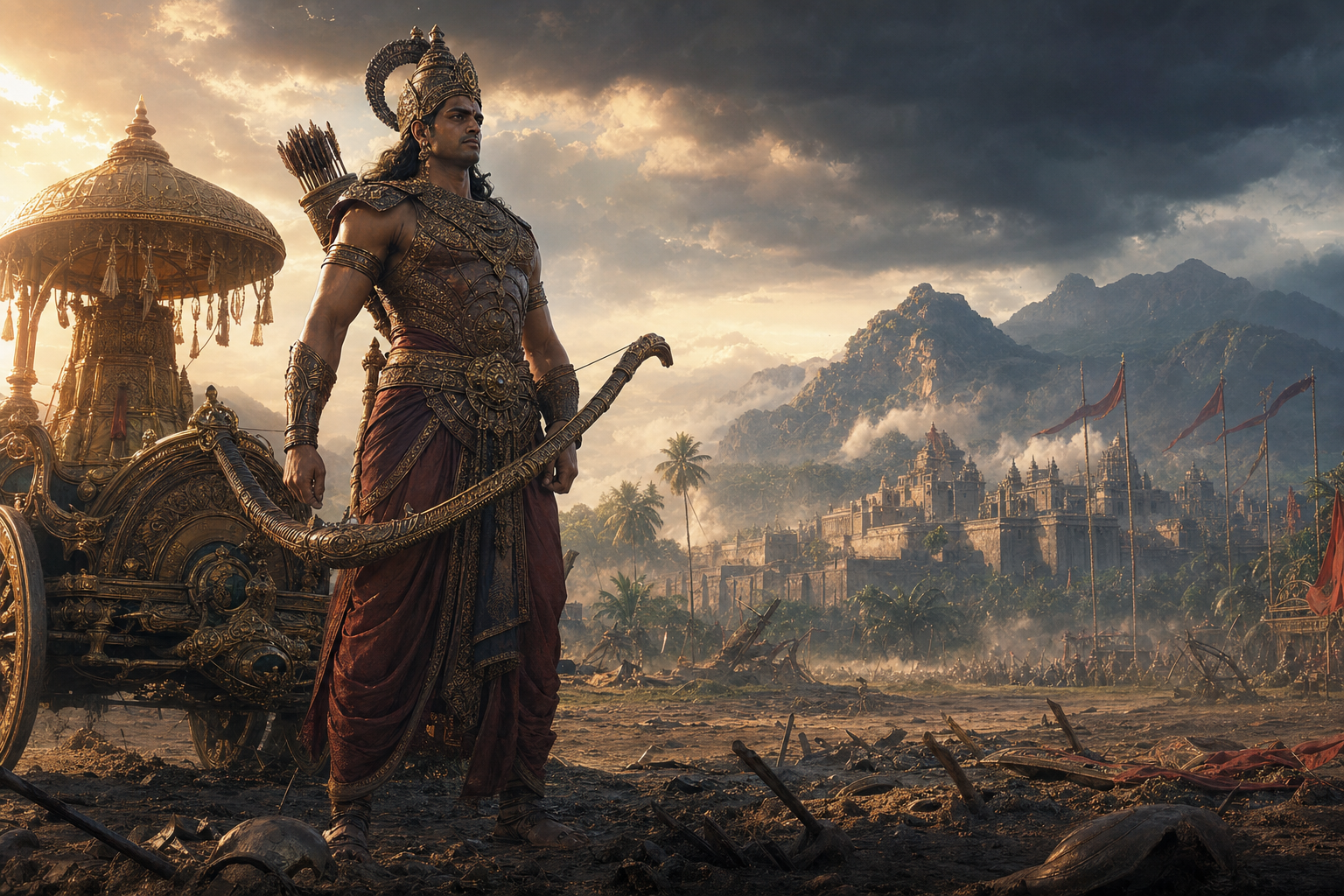
If you are trying to decide whether Atikaya should be remembered as a villain, a tragic hero, or an honorable warrior, resist the shortcut. He serves Ravana, yet his courage and discipline are real. The useful question is not whether valor cancels adharma. It is what becomes of genuine excellence when it is pledged to an unrighteous cause.
Atikaya’s brief but consequential appearance gives you a practical way to read the Ramayana’s enemies without romanticizing them or stripping them of dignity. It also teaches a discipline needed whenever an ancient narrative accumulates regional variations and modern psychological interpretations: distinguish what the narrative establishes from what later readers reasonably infer.
Start with the stable narrative, not the embellishments
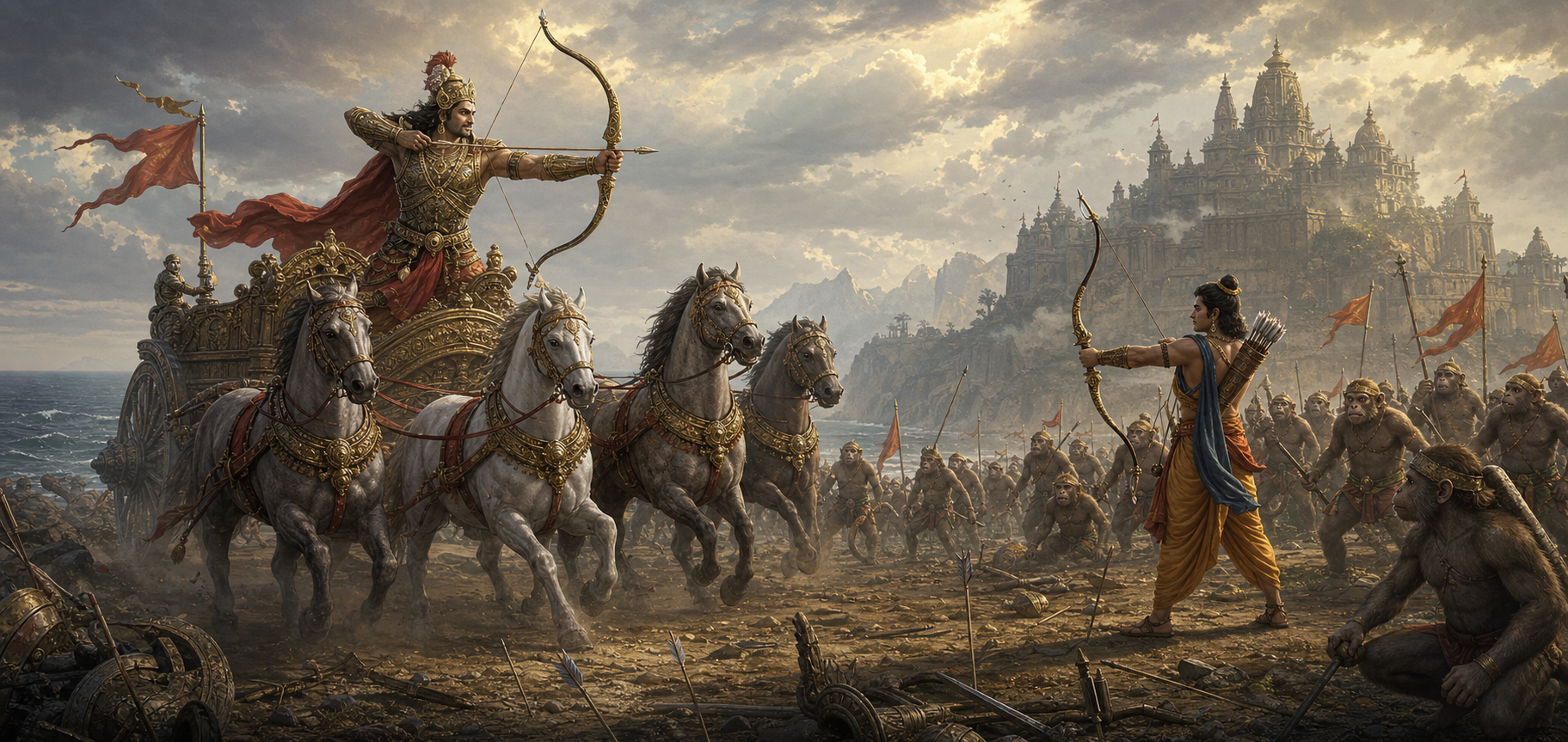
Atikaya enters the Yuddha Kanda as a son of Ravana and an elite archer, not as an anonymous soldier. He possesses unusual protection, understands the deployment and countering of astras, and proves too formidable for ordinary attacks. The broadly transmitted narrative core includes his confrontation with Lakshmana, Vibhishana’s crucial counsel, and Lakshmana’s use of the Brahmastra. Atikaya consequently falls to an opponent who must combine ability, disciplined invocation, and accurate intelligence to defeat him.
That baseline supports a firm conclusion: Atikaya is a major warrior whose defeat carries narrative weight. It does not establish every detail commonly attached to him. His mother’s precise identity, her position within Ravana’s household, the provenance of his armor, and the circumstances of particular divine gifts vary among recensions and regional retellings. Some traditions identify his mother as Dhanyamalini, while interpretations built around her status can make Atikaya appear marginal within the royal family. Those strands belong to his reception, but they should not be presented as equally explicit in every Ramayana.
A useful reading habit is to assign each claim about Atikaya to one of four levels:
- Narrative bedrock: Atikaya is Ravana’s son, a formidable archer, Lakshmana’s opponent, and a warrior whose protection requires an extraordinary response.
- Transmitted variation: a detail preserved in some recensions or vernacular traditions but not constant across the Ramayana tradition.
- Ethical inference: a conclusion drawn from Atikaya’s allegiance, conduct, choices, and fate.
- Modern reception: a psychological or symbolic reading that speaks powerfully to present-day readers without becoming a newly invented textual fact.
This classification does two things at once. It protects textual integrity, and it lets regional creativity retain its legitimate place. You do not have to dismiss a later telling merely because it expands a sparse episode. You only need to identify what kind of claim you are making.
Valor does not settle the question of dharma
Atikaya is compelling because the Ramayana does not require every opponent of Rama to be cowardly, incompetent, or contemptible. His confidence rests on training and demonstrated power. He meets Lakshmana as a serious practitioner of kshatra-dharma, and his death retains the gravity accorded to a great warrior.
That respect is not an acquittal. Courage describes how a person faces danger. Dharma also asks why the danger is being faced, whom the action protects, and what order it sustains. A person can display admirable self-command while serving a sovereign whose cause is unjust. The epic can therefore honor Atikaya’s martial excellence while judging the allegiance through which that excellence operates.
When you evaluate a warrior in an itihasa, ask three separate questions rather than forcing everything into the labels of hero and villain:
- What cause does the warrior serve? Skill acquires moral direction from the end toward which it is applied.
- How does the warrior conduct himself? Courage, restraint, truthfulness, and respect for the conditions of combat remain morally significant, even on the losing side.
- Does loyalty leave room for viveka? Filial affection and royal obligation are genuine duties, but neither makes moral discernment unnecessary.
Atikaya’s tragedy emerges from the distance between those answers. His ability is exceptional. His loyalty appears resolute. Yet both are committed to Ravana’s side of the war. Loyalty can explain the decision without making it righteous, just as a righteous victory need not erase the defeated warrior’s human worth.
This distinction matters beyond epic warfare. If a parent, leader, institution, or community asks for your loyalty, sincerity alone cannot certify the request. Ask what your competence will enable. If your best qualities are being used to shield misconduct, obedience may preserve belonging while damaging dharma. Atikaya warns you not to confuse the intensity of a commitment with the justice of its object.
The Brahmastra episode is about disciplined power
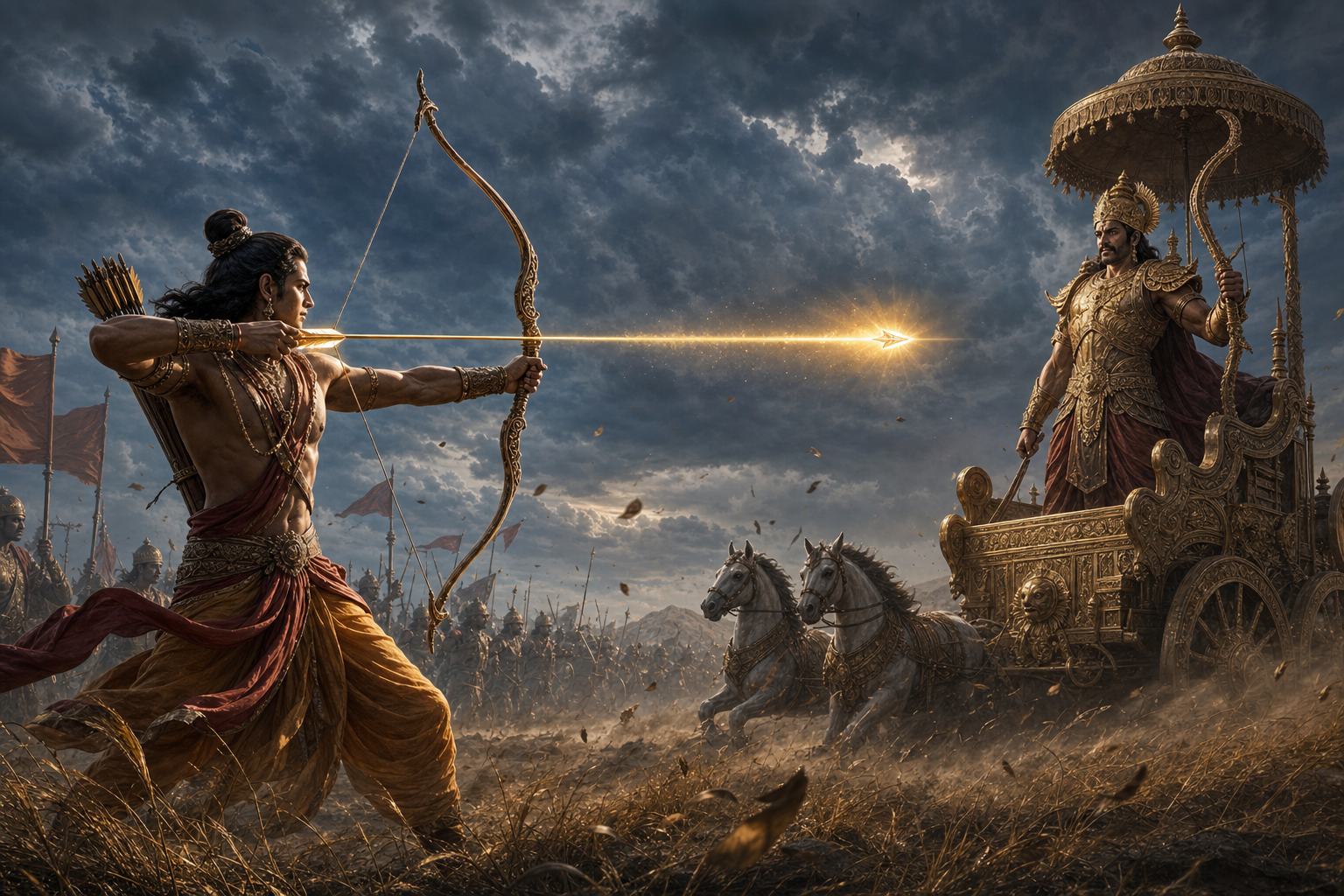
Ordinary attacks cannot overcome Atikaya’s protection. Vibhishana recognizes the problem and tells Lakshmana that a divinely empowered astra is required. Lakshmana then invokes the Brahmastra with the knowledge and discipline appropriate to it. The sequence matters: observation comes before counsel, counsel before escalation, and qualified action before victory.
The episode should not be reduced to the idea that a stronger weapon wins. Astra-vidya involves the ability to recognize weapons, counter them, invoke them correctly, and exercise the self-command their use demands. Possessing exceptional force is not the same as having moral permission to deploy it casually.
Lakshmana’s decision offers four tests for the ethical use of power:
- Knowledge: understand the actual obstacle before acting. Vibhishana’s intelligence prevents futile repetition.
- Necessity: extraordinary force becomes relevant only after ordinary means prove inadequate against Atikaya’s protection.
- Competence: the person acting must possess the training and concentration needed to control what is invoked.
- Purpose: power must answer the requirements of dharma-yuddha, not anger, vanity, or the desire to display superiority.
These are ethical principles drawn from the narrative, not a claim that celestial astras can be mapped mechanically onto modern weapons. The epic operates within its own theological and martial world. Its discipline of judgment, however, remains recognizable. Before using your strongest available lever, whether authority, public rebuke, or formal escalation, determine whether you understand the problem, whether a lesser response can work, and whether you can control the consequences.
Vibhishana’s role adds another lesson. Lakshmana’s strength is necessary but insufficient until informed by someone who understands Atikaya’s protection. Competent counsel is not a concession of weakness. In dharmic action, the willingness to receive accurate guidance can be as decisive as the power to act.
Belonging is a compelling lens, but not a settled biography
Many readers recognize something painfully familiar in Atikaya: a gifted son entering danger under the gaze of a powerful father and an exacting royal household. Later traditions that place him outside Mandodari’s principal lineage can intensify that impression. Ravana’s court also contains the overwhelming reputation of Indrajit, making it easy to imagine another son seeking distinction through battlefield achievement.
The interpretation is plausible and emotionally fruitful. It is not the same as an explicit confession from Atikaya that he fights to earn paternal approval. The difference matters. Once an inferred motive is repeated as biography, a subtle character becomes a modern psychological case assembled from narrative silence.
You can use the belonging interpretation responsibly by applying three checks:
- Identify the observable action. Atikaya enters combat, displays extraordinary skill, and remains loyal to Ravana’s side.
- Mark what remains unsaid. The stable episode does not provide a complete interior account of his motives.
- State your interpretation conditionally. His conduct can be read as a search for recognition, especially in traditions that emphasize his maternal lineage, but other motives remain possible.
This caution does not weaken the reading. It makes it honest. A responsible interpretation can still help you examine your own loyalties. If approval is offered only when you lend your strongest abilities to a wrong cause, ask what kind of belonging is actually being purchased. Recognition gained through complicity may confirm your usefulness without honoring your deeper worth.
Even Atikaya’s name can serve this reflective purpose. Read symbolically, ati suggests excess and kaya suggests body: a figure of embodied might exceeding its rightful measure. That is an allegorical invitation, not proof of his psychology or a verdict that physical strength is itself corrupt. The problem is power without right orientation, not strength as such.
Four Dharmic lenses, kept distinct
A comparative Dharmic reading becomes vague when Hindu, Buddhist, Jain, and Sikh traditions are treated as interchangeable. Their doctrines and attitudes toward violence are not identical. Atikaya becomes more illuminating when each perspective is allowed to ask its own question.
- A Hindu lens asks whether kshatra-dharma is governed by viveka. Martial ability is honorable when it protects a righteous order; rank, lineage, and command cannot replace discernment.
- A Buddhist lens can examine craving for status, identity, or recognition. This does not assert that Atikaya’s inner motive is known. It asks whether attachment can narrow perception until loyalty feels indistinguishable from necessity.
- A Jain lens foregrounds ahimsa and aparigraha. It keeps the violence of war morally tragic and asks how attachment to power, family, victory, or identity binds participants to harmful action.
- A Sikh lens emphasizes the disciplined saint-soldier who bears arms in defense of justice and the vulnerable, not in service of tyranny. Its central question is not whether strength exists, but whom that strength protects.
These lenses do not produce an artificial doctrinal consensus. They converge more modestly on a limit: power cannot certify its own righteousness. Courage becomes luminous when governed by truth, compassion, restraint, and a just purpose. Without that orientation, even magnificent ability can deepen an unrighteous order.
Key takeaways
- Atikaya is a formidable warrior, not a negligible adversary, but martial greatness does not make Ravana’s cause righteous.
- The Ramayana can honor an opponent’s courage while preserving a clear judgment against the allegiance through which that courage operates.
- The duel with Lakshmana, Vibhishana’s counsel, and the decisive Brahmastra belong to the stable narrative core; several family and armor details vary by tradition.
- The Brahmastra sequence emphasizes knowledge, necessity, competence, counsel, and restraint rather than power used for spectacle.
- The search for paternal recognition is a valuable reception lens when it is identified as interpretation rather than reported as Atikaya’s explicit motive.
When you next encounter Atikaya in a translation, performance, or regional retelling, mark each important claim with four initials: F for stable narrative fact, V for transmitted variation, E for ethical inference, and R for reception. Then complete one sentence: Atikaya is admirable for one quality, accountable for one choice, and tragic because of the distance between them.
If you cannot fill all three spaces without contradiction, stay with the episode a little longer. That discipline lets you condemn adharma without flattening the person caught within it, and honor valor without mistaking it for virtue in full.