
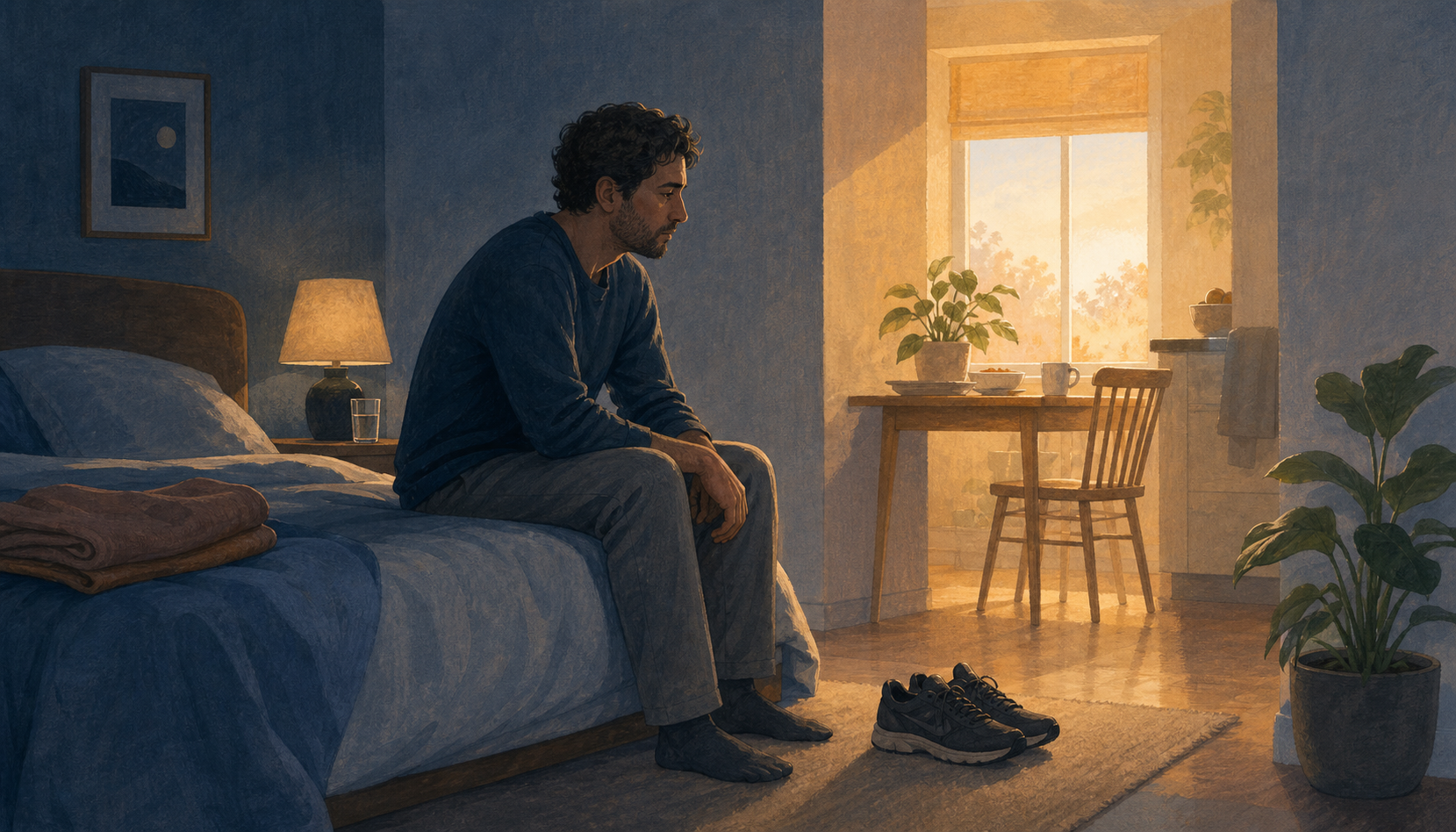
If you wake tired, push through the day, and then feel strangely alert when it is finally time to sleep, more discipline is unlikely to solve the problem. Your body may be carrying a recovery debt that effort keeps concealing.
The way back is not a heroic reset. It is a deliberate reduction in strain, followed by repeatable conditions for sleep, movement, nourishment, and nervous-system regulation. You can begin that process without turning recovery into another performance target.
Before you optimize, make sure burnout is the right frame
Burnout is a useful description of exhaustion shaped by sustained stress. It is not a medical diagnosis, and fatigue alone cannot tell you what is causing it. Sleep disorders, anemia, thyroid problems, infections, medication effects, nutritional deficiencies, chronic pain, and mental-health conditions can overlap with what people casually call burnout.
Seek urgent medical care if exhaustion occurs with chest pain, difficulty breathing, fainting, sudden confusion, a new vision change, or thoughts of harming yourself. Arrange a non-emergency clinical assessment when fatigue is persistent, worsening, unexplained, or interfering with basic daily activities. Self-care should accompany appropriate medical or psychological care, not replace it.
Normal routine tests are reassuring, but they do not measure every part of recovery. A person can have unremarkable laboratory results while still experiencing poor sleep efficiency, elevated resting heart rate during stressful periods, or lower heart-rate variability after late caffeine and evening work. Those patterns do not prove a diagnosis. They do show why your symptoms and daily functioning still deserve attention.
Once urgent and treatable causes are being addressed, it helps to understand what prolonged strain does. Your body continually adjusts to workload, threat, sleep loss, irregular meals, and insufficient rest. When those adjustments remain active for too long, their accumulated cost is called allostatic load. The autonomic nervous system can become biased toward sympathetic activation: your muscles remain braced, breathing becomes shallow, and you feel tired but wired.
At the cellular level, energy depends on mitochondria, adequate nutrients, and coenzymes involved in producing ATP. Chronic stress, restricted sleep, and poor nutrition can make energy production and repair less efficient. That does not mean you need an expensive supplement stack. The practical levers are more ordinary: sufficient sleep opportunity, regular food, manageable movement, morning light, and periods in which the stress response is allowed to settle.
Audit the load before adding more habits
No breathing technique can turn five hours of sleep and fourteen-hour workdays into a sustainable recovery plan. Before adding a meditation app, fitness target, or restrictive diet, inspect the demands that keep removing recovery from your day.
- Is work repeatedly consuming the time you intended to sleep?
- Are you reachable by email or messaging throughout the evening?
- Do you skip meals, eat while working, or rely on caffeine to replace food and rest?
- Does every free period become a place for errands, domestic work, or unfinished administration?
- Do you rest only after your body forces you to stop?
If the answer is yes, the first intervention is a boundary, not a wellness accessory. That may mean ending evening work, declining an additional obligation, protecting a meal break, discussing workload with a manager, or asking family members to redistribute tasks. A routine cannot restore you if the conditions that exhausted you remain untouched.
Build a day that gives your physiology reliable signals

Recovery becomes easier when the body receives consistent cues about when to wake, move, eat, work, and sleep. You do not need to install every habit at once. Begin with the part of the day that is most repeatable, then let consistency do more work than intensity.
Morning: anchor the body clock
Keep your waking time reasonably consistent and go outdoors within the first hour after waking. Morning light helps anchor the circadian system, which coordinates alertness during the day and sleepiness later. Outdoor light is useful even when the sky is overcast.
If your capacity allows, add a phone-free walk of about thirty minutes, ideally before prolonged screen exposure. Regular low-to-moderate movement supports circulation, insulin sensitivity, brain health, and mitochondrial renewal. Keep the pace comfortable enough that the walk leaves you clearer rather than depleted. If thirty minutes aggravates symptoms, choose a gentler and shorter outing instead of treating the target as a test of character.
Workday: interrupt accumulated arousal
Many people wait for a long break that never arrives. Micro-rest works with the day you actually have. After roughly sixty to ninety minutes of concentrated work, take two minutes to stand, change posture, relax your jaw, lower your shoulders, and let your gaze move away from the task.
For screen-heavy work, use the 20-20-20 pattern: after twenty minutes of near focus, look at something about twenty feet away for twenty seconds. It is a small interruption, but it prevents another layer of visual and muscular tension from accumulating unnoticed.
Do not use these pauses to check another feed. The purpose is to remove input briefly. A window, corridor, balcony, or quiet corner is enough.
Food: steady energy instead of chasing stimulation
A recovery diet does not need to be punitive. Build ordinary meals around vegetables, legumes, intact whole grains, nuts, seeds, olive oil, herbs, spices, and colorful fruits. Distribute protein across meals rather than leaving nearly all of it for dinner. Drink enough water, and obtain minerals such as potassium and magnesium through suitable foods when possible.
Reduce added sugar and alcohol if they are producing energy swings or disrupting sleep. Set a caffeine cutoff by early afternoon. Caffeine can make an exhausted nervous system feel temporarily functional while extending arousal into the period in which it needs to wind down.
If you have diabetes, kidney disease, a history of disordered eating, food allergies, pregnancy-related needs, or another condition affected by diet, use individualized guidance from an appropriate clinician or dietitian. Burnout recovery is not a reason to begin aggressive fasting or restriction.
Evening: protect the opportunity to sleep
Choose a repeatable sleep and waking schedule. For many adults, protecting an eight-hour sleep opportunity is a reasonable starting experiment, although sleep needs differ with age, health, and life stage. An eight-hour opportunity means time reserved for sleep, not a demand that you must be unconscious for every minute.
Lower the intensity of evening light, stop work messages from following you into bed, and keep the bedroom cool and dark. These changes give the circadian system a coherent sequence: light and movement after waking, declining stimulation before sleep.
Sleep supports memory, immune function, insulin sensitivity, mood regulation, neural waste clearance, and mitochondrial maintenance. If you consistently allow enough time for sleep but remain awake for long periods, wake gasping, snore heavily, or stay profoundly sleepy during the day, discuss that pattern with a qualified professional rather than simply extending your time in bed.
Use Dharmic practice for attention, not spiritual bypassing

Dharmic traditions have long treated disciplined attention as a practice rather than a mood. Hindu dhyana, Buddhist anapanasati, Jain Preksha-dhyana, and Sikh simran or naam jap are not interchangeable systems; each belongs to a distinct path and carries its own meaning. Yet each can give a practitioner a structured way to stop scattering attention and notice what the body is doing.
This matters because you may not notice chronic activation while you are busy. Five quiet minutes can reveal a clenched jaw, lifted shoulders, shallow breathing, a racing pulse, or the fact that you have not tasted the meal in front of you. Awareness does not fix the problem by itself. It tells you where intervention is needed.
A five-minute settling practice
- Sit in a supported position and put the phone out of reach.
- Notice the contact of your feet, legs, or seat with the surface beneath you.
- Check your forehead, jaw, shoulders, abdomen, and hands without forcing them to relax.
- If it feels comfortable, inhale gently for four seconds and exhale for six seconds. Keep the breath quiet and diaphragmatic rather than unusually deep.
- At the end, identify one bodily need you can answer: water, food, movement, a boundary, quieter surroundings, or sleep.
A four-second inhale followed by a six-second exhale produces about six breaths per minute, within the slow-breathing range used to support parasympathetic regulation through baroreflex and vagal pathways. The longer exhalation should feel easy. If it causes dizziness, air hunger, panic, or strain, return to natural breathing.
For a brief surge of acute tension, one or two short nasal inhales followed by a long, unforced exhale can help interrupt the pattern. It is a momentary tool, not a replacement for sleep, treatment, or a reduction in workload.
If focusing on breath intensifies anxiety or brings up traumatic memories, use an external anchor instead: feel your feet, listen to nearby sounds, look at a stable object, or walk slowly. A mental-health professional familiar with trauma can help you choose a safer practice.
The Dharmic principle that matters most here is abhyasa: steady practice. Five minutes kept daily is more useful than an ambitious session performed only when you are already overwhelmed. But spiritual discipline must not become a way to tolerate exploitation, deny illness, or blame yourself for a nervous system responding normally to excessive demands.
Track patterns without turning recovery into another exam

Burnout makes memory unreliable in a particular way: a difficult day can make the entire week seem difficult, while a productive day can hide the cost that appears the following morning. A simple two-week log can separate repeated patterns from impressions.
- Record approximate sleep and waking times, along with whether sleep felt restorative.
- Note whether you received outdoor light and gentle movement after waking.
- Record the timing of your last caffeine and any late evening email or screen-heavy work.
- Note skipped meals, long gaps between meals, alcohol, and obvious hydration problems.
- Write down physical signals such as jaw tension, shallow breathing, headaches, heaviness, or feeling wired at bedtime.
- If you already use a wearable, record trends in resting heart rate, HRV, and sleep timing without treating its estimates as a diagnosis.
Look for associations that repeat. Perhaps bedtime becomes later after evening email, sleep feels poorer after late caffeine, or morning energy is steadier after an outdoor walk and regular meal. An association is a clue, not proof of cause. Use it to choose the smallest change worth testing.
Compare wearable measurements only with your own usual range and interpret them alongside how you feel. Resting heart rate and HRV can change with illness, exercise, hydration, medication, alcohol, sleep, and many other factors. A low readiness score does not diagnose burnout, and a favorable score does not overrule serious symptoms.
Progress may first appear as a quieter transition into sleep, more stable energy, a less clenched body, or greater awareness of fatigue before collapse. If symptoms worsen or remain functionally disabling despite a consistent recovery pattern, return to clinical assessment and reconsider the demands surrounding you. The missing intervention may be medical care, psychological support, workload change, or all three.
Key takeaways
- Treat persistent fatigue as information, not a character judgment, while remembering that burnout is not a medical diagnosis.
- Seek appropriate care for alarming, worsening, unexplained, or disabling symptoms; do not let normal routine tests invalidate what you are experiencing.
- Reduce the demand that created the recovery debt. No wellness practice can compensate indefinitely for severe sleep loss and unbounded work.
- Anchor the day with consistent waking, outdoor light within an hour, tolerable movement, regular meals, an early-afternoon caffeine cutoff, and a protected sleep opportunity.
- Use two-minute work breaks and the 20-20-20 pattern to prevent strain from accumulating unnoticed.
- Practice five minutes of attentive stillness or gentle slow breathing, but do not use spiritual practice to avoid medical care or necessary structural change.
- Track trends for two weeks, then act on repeated patterns rather than single wearable scores or one unusually difficult day.
Choose one boundary you can keep for the next two weeks. Put it into tomorrow’s schedule before another obligation claims the space. Recovery becomes physiological when rest stops being an intention and becomes a condition your body can repeatedly experience.
References
