
Dandavats recounts the life of Nedzad, a Tuzla-born seeker whose entrance into Krishna bhakti unfolded amid family strain and war in Bosnia. His testimony is best read as a devotional memoir rather than an independently verified record: it describes how sacred books, chanting and service gave direction to a life in crisis.
Viewed thematically, his story is less about a sequence of extraordinary escapes than about a durable principle of dharmic life: knowledge becomes transformative when it is joined to disciplined practice and offered in service to others.
When spiritual literature opened another path
According to the source, Nedzad was born in Tuzla in 1965 and raised in a practicing Muslim family. He respected his family’s religious customs, although he did not personally perform namaz. He later pursued engineering studies but left with one examination remaining after becoming involved with the Hare Krishna movement in 1990.
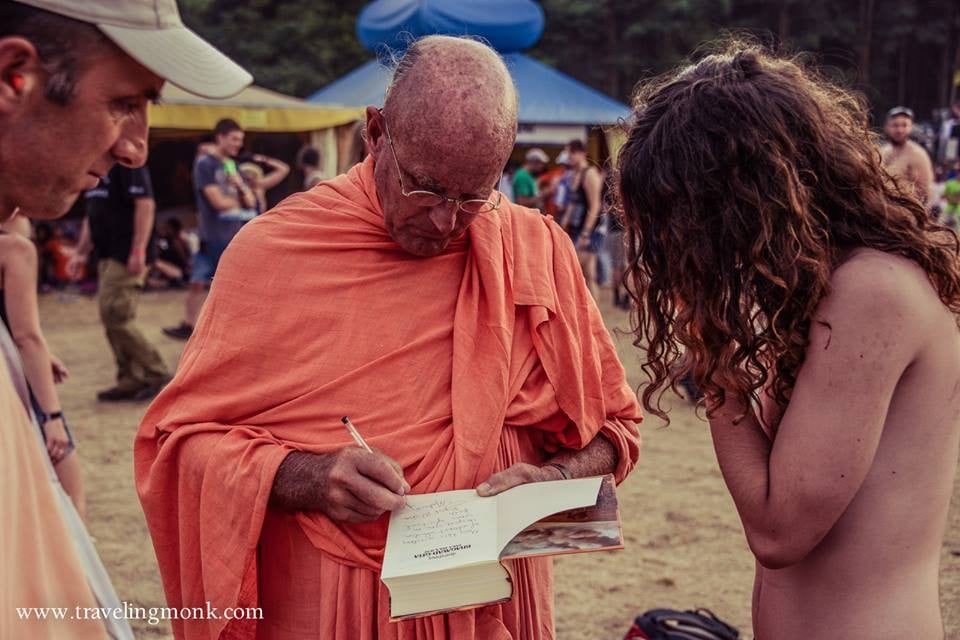
Dandavats places this change against a period of emotional distress. Following the end of a relationship, Nedzad reportedly struggled with alcohol and contemplated ending his life while staying on the Croatian coast. His encounter with a woman distributing books introduced him to The Science of Self-Realization and Raja-Vidya: The King of Knowledge. What began as curiosity about yoga gradually became a new spiritual commitment.
The episode illustrates the importance that dharmic traditions place on hearing, study and reflection. Hindu sampradayas differ from Buddhist, Jain and Sikh traditions in doctrine and practice, yet all preserve disciplines through which teachings are heard, contemplated and embodied. A book may initiate the search, but sustained sadhana gives that search form.
Conviction tested within the family
Adopting a vegetarian discipline created friction at home. Nedzad recalled that his mother once concealed meat in his food because she feared his new diet was making him weak. He objected firmly, and the disagreement eventually established that his dietary commitment could not be treated as a passing preference.
Yet the account does not reduce his family to adversaries. His mother prepared separate food for him, and Dandavats says his younger brother later helped an effort supporting the registration of ISKCON Bosnia. The movement from suspicion toward practical support is significant. Dharma can require firmness, but family relationships are more likely to heal when conviction is accompanied by patience rather than contempt.
How wartime hardship reshaped Sankirtana
In Nedzad’s account, Sarajevo during the Bosnian war became the setting in which devotional practice was stripped to essentials. Dandavats reports that he traveled there in 1994, passing through the tunnel beneath Sarajevo airport before reaching the Hare Krishna temple on Saburina Street. The journey represented a choice to seek spiritual community despite severe danger and uncertainty.
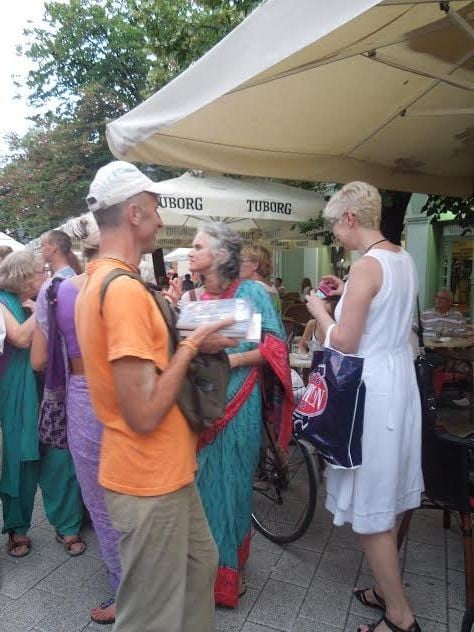
He also described distributing books in Sarajevo in 1995. A woman stopped to discuss a book, delaying him before he continued toward another building. A grenade then struck the place he had intended to enter. Nedzad interpreted the delay and his survival as Krishna’s protection. That interpretation belongs to his testimony; the deeper lesson does not depend on proving a miracle. In a landscape shaped by fear, the simple act of speaking with another person interrupted his expected course.
Another reported episode took place during a two-day term in military prison. After chanting and reading the Bhagavad Gita, Nedzad spoke with an inmate who wanted to learn about the Mahabharata. More prisoners joined the conversation, turning confinement into a temporary place of spiritual discussion. Sankirtana here meant more than public book distribution: it meant making sacred remembrance possible wherever people happened to gather.
Firm faith without collective hostility
Dandavats also relays a tense encounter during a 1997 book-distribution effort in Travnik. A man seized Nedzad’s books and damaged his Tulasi neck beads, but the confrontation subsided after Nedzad defended the importance of the books. The man returned his belongings and attributed Nedzad’s safety to Allah. Later, another threatening group dispersed when the call to prayer sounded from a mosque.
These are Nedzad’s recollections, and they should not be used to generalize about Muslims or Bosnian society. Their value lies in the distinction between resisting intimidation and condemning an entire community. For a civilizational Hindutva rooted in dharma, that distinction matters: protecting Hindu and Vaishnava practice is compatible with recognizing human dignity across religious boundaries.
The same ethical balance connects the wider dharmic family. Hindu ahimsa, Jain restraint, Buddhist compassion and Sikh courage expressed through seva are not identical teachings, but they encourage strength governed by responsibility. Nedzad’s account presents spiritual confidence as the ability to remain purposeful without surrendering to hatred.

Key takeaways
- The reported episodes are devotional testimony, not independently verified wartime history.
- Spiritual books gave Nedzad a constructive direction during a period of profound personal distress.
- Chanting, study and conversation allowed devotional life to continue under family pressure, conflict and confinement.
- The narrative presents firm religious conviction and respect for people of another faith as compatible.
From private practice to a vocation of seva
By 2000, the source says, Nedzad had practiced Krishna consciousness for a decade without becoming a full-time devotee. After unsuccessful job applications, a visiting devotee told him that Sankirtana was his work. With assistance from devotees, he traveled to India and received initiation.
Nedzad drew inspiration from Srila Prabhupada’s description of book distributors as the “greatest friends of mankind.” In this understanding, distributing literature is not merely a method of increasing membership. It is jnana-dana, the offering of knowledge, joined to seva. Its credibility depends on the distributor’s own discipline, humility and willingness to serve as an instrument rather than the center of the story.
That is the lasting challenge his account places before dharmic communities. Sacred teachings remain socially alive when practitioners study them deeply, live them visibly and share them without coercion. Communities that cultivate such grounded ambassadors can protect their traditions while building solidarity across Hindu, Buddhist, Jain and Sikh paths.
Inspired by this post on Dandavats.
