
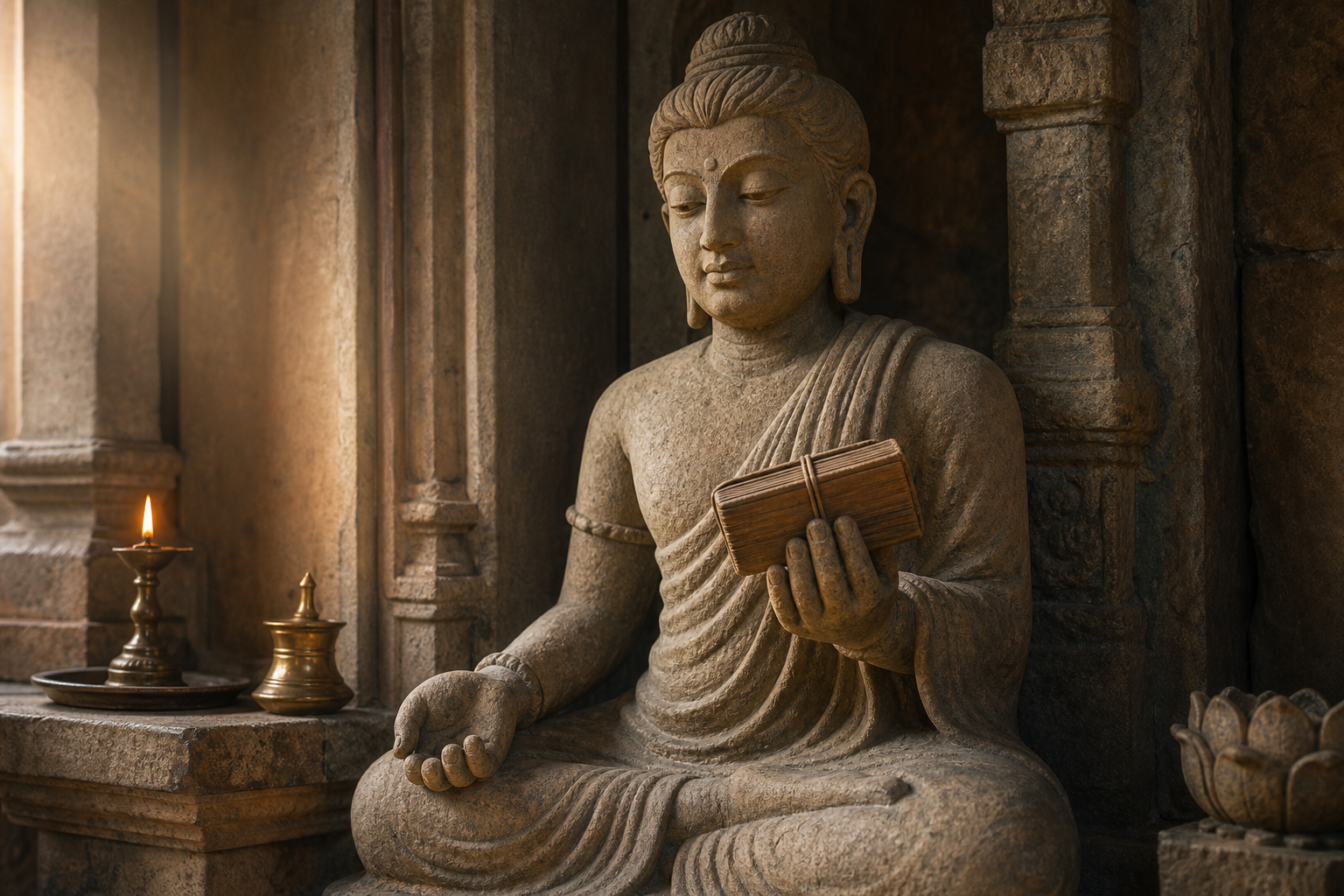
When a sacred figure holds a book in Hindu sculpture, the object contributes to the figure’s spiritual identity. According to Hindu Blog, the pustaka represents a relationship with transcendent knowledge and can identify its bearer as a guardian, teacher, or embodiment of sacred learning.
The available source excerpt is brief and ends before completing its discussion of the word’s derivation. It supplies no named sculptures, dates, regions, or artistic schools. A careful interpretation must therefore focus on the meaning the source does establish without inventing a catalogue of examples.
The book signifies a responsibility toward knowledge
The pustaka does not merely suggest that its bearer can read. In the interpretation reported by Hindu Blog, it expresses a deeper relationship between sacred authority and knowledge. The figure may preserve wisdom, transmit it to others, or personify it so completely that learning becomes part of the figure’s divine character.
These roles are related but not identical. A custodian protects a tradition from loss. A transmitter carries it into another generation. An embodiment makes an abstract principle visible. By gathering these possibilities into one compact emblem, the sculptor turns knowledge into something a worshipper or visitor can recognize before any verbal explanation is offered.
Why context still matters when reading the pustaka
Iconographic attributes should not be interpreted in isolation. The identity and significance of a sculpted figure are ordinarily clarified by the full composition: posture, gesture, accompanying objects, setting, and the conventions of the community that created or worships the image. An inscription or established temple tradition, when available, can provide further guidance.
This contextual method prevents a plausible symbolic reading from becoming an unsupported claim. The presence of a pustaka supports an association with sacred learning, but the supplied source does not justify assigning every book-bearing figure the same name, doctrine, or historical period. Responsible interpretation respects both the symbol’s broad meaning and the distinctiveness of each work.
Key takeaways
- In Hindu sacred art, the pustaka functions as an emblem of transcendent knowledge.
- Its bearer may be presented as a custodian, transmitter, or embodiment of learning.
- The surrounding iconographic context remains essential for identifying a particular figure.
- The source excerpt does not provide enough information for claims about specific sculptures, dates, or etymology.
A shared Dharmic ethic of preserving wisdom
The pustaka discussed here belongs specifically to the vocabulary of Hindu sacred art, yet the responsibility it evokes has wider Dharmic resonance. Hindu, Buddhist, Jain, and Sikh traditions remain doctrinally distinct, but each recognizes that wisdom must be received, studied, preserved, and passed onward through disciplined communities. The common thread is not a single theology; it is reverence for knowledge as an inheritance that also creates obligations.
This shared ethic offers a constructive foundation for Dharmic unity. Civilizational confidence need not flatten different sampradayas or deny their unique teachings. It can instead protect the plural institutions, teachers, texts, languages, and artistic traditions through which knowledge remains alive. In that sense, the pustaka is not only an attribute in stone: it is a quiet appeal for cultural stewardship.
Future encounters with book-bearing Hindu sculptures can begin with a better question: what relationship between wisdom, authority, and transmission has the artist made visible?
Inspired by this post on Hindu Blog.
