
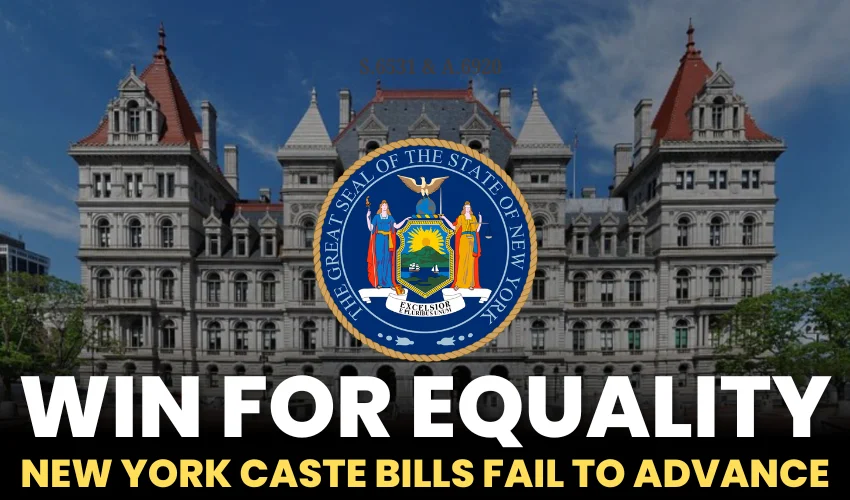
Two New York proposals that would have added caste as a protected category under the state’s Human Rights Law did not advance during the legislative session described by the Coalition of Hindus of North America (CoHNA). The organization welcomed the outcome while arguing that the bills risked profiling Hindu, Indian and South Asian New Yorkers.
The episode raises a question larger than any single bill: how can government confront real discrimination without assigning inherited identities or collective suspicion to an entire community?
Key takeaways
- CoHNA reported that Senate Bill S.6531 and Assembly Bill A.6920 did not advance in the session covered by its June 5, 2026 statement.
- The organization opposed caste-specific language while affirming that caste-based mistreatment should not be tolerated.
- Its central concern was that caste terminology could operate as a coded classification of Hindus, Indians and South Asians.
- The debate shows why civil-rights policy needs neutral wording, evidence, due process and consultation with the people it may affect.
What the legislative outcome does and does not mean
According to CoHNA, the two bills had been under consideration since 2025 but failed to move forward in the legislative session addressed by its statement. The proposals sought to name caste expressly within New York’s anti-discrimination framework.
Non-advancement means that these particular measures did not produce the proposed change during that session. It does not permanently settle the policy debate, establish a judicial precedent or prevent similar language from returning in another form. CoHNA’s position is that existing protections already prohibit the underlying mistreatment without introducing a new demographic label.
The civil-rights dispute centered on classification
CoHNA did not frame its opposition as acceptance of discrimination. Instead, it argued that the word caste is not socially neutral in the United States because public discussion often associates it primarily with Hindu and Indian communities. On that reasoning, a law intended to protect individuals could also encourage officials, employers or institutions to view people of certain backgrounds as presumptive members of a hierarchy.
This distinction matters. A rule can condemn unequal treatment while still being examined for whether its language burdens one religion or ethnicity disproportionately. The source does not present the bill sponsors’ arguments or a complete legislative record, so their motives and responses cannot be assessed from this material alone.
A Dharmic approach to civil rights should protect every person from demonstrable harm while refusing to reduce Hindus, Buddhists, Jains, Sikhs or any other community to an inherited stereotype. Unity does not require denying social problems; it requires addressing them without treating ancestry as evidence of guilt.
Grassroots participation brought internal diversity forward
CoHNA says its campaign included dozens of meetings with New York legislators, including the sponsors, and enabled hundreds of residents to contact assembly members and state senators. It also reports that a memorandum presenting legal and constitutional concerns was distributed to all 213 members of the state Assembly and Senate.
The organization especially emphasized participation by its Dalit and Bahujan leaders. Sudha Jagannathan, identified as CoHNA’s director of government relations and a Bahujan Hindu, objected to having her identity used against the culture and traditions from which she draws strength. That testimony challenges the assumption that people placed within the same social category necessarily share one political interpretation of it.
Evidence claims deserve careful, source-aware reading
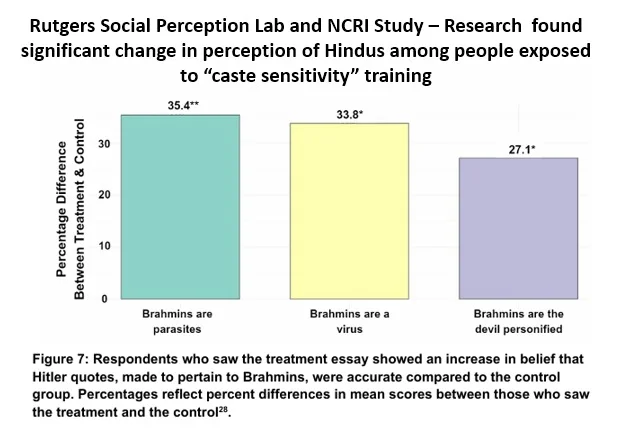
To support its warning about unintended effects, CoHNA cited a 2024 study associated with the Rutgers University Social Perception Lab and the Network Contagion Research Institute. The organization interpreted the research as showing that institutional discussion or training about caste could increase hostility toward Hindus and Indian Americans, including greater agreement with rhetoric it characterized as Hitler-like.
CoHNA also presented the California litigation involving Sundar Iyer as a cautionary example. Its statement says authorities assigned religious and caste identities to an atheist based on his background, and that claims against the two Indian-origin Cisco supervisors were later withdrawn with prejudice. The organization further asserted that systemic caste discrimination in the United States has not been proved despite years of investigation and allegations.
These are claims and interpretations made in an advocacy statement, not independent findings established by this article. Serious policy analysis would need to examine the study, court record, bill text and competing testimony directly before reaching broader conclusions.
A constructive standard for future policymaking
Future proposals should begin with equal dignity and observable conduct. Definitions should be clear, protections should apply consistently across communities, and enforcement should preserve due process rather than invite officials to infer religion or social status from names, appearance or ancestry.
Consultation must also reflect the diversity within Hindu society and across the wider Dharmic family. Dalit, Bahujan and other voices should be heard directly, without any faction being treated as the sole representative of complex traditions.
The New York bills may have stopped for that session, but the underlying responsibility remains: oppose discrimination firmly while ensuring that the remedy does not manufacture a new form of profiling.
Inspired by this post on CoHNA.
