
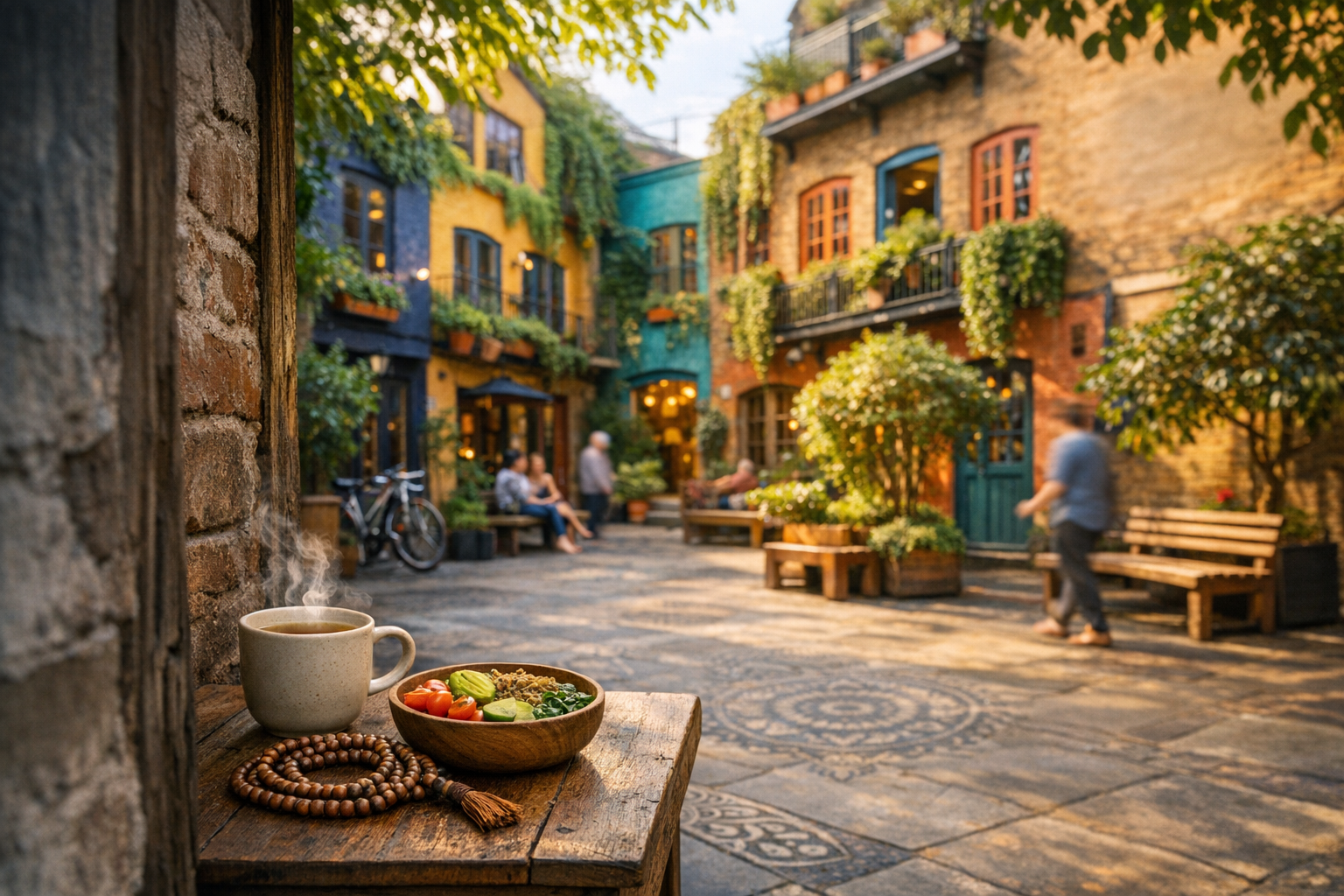
London’s West End can feel relentless, especially around Covent Garden, where retail, theatre, and tourism converge. Yet a short turn from the bustle reveals Neal’s Yard a compact, multi‑hued courtyard that consistently offers a tactile sense of respite for residents, workers, and visitors seeking a few grounded minutes between commitments.
Urbanists often describe such micro-courtyards as threshold oases: narrow ingress, sudden expansion, softened acoustics, and human-scale textures combine to downshift the nervous system. In Neal’s Yard, vividly painted façades, climbing greenery, and the aroma of herbal teas and spice-forward vegetarian kitchens create a sensory palette aligned with Ayurveda- and Yoga-inspired wellness culture that has long taken root in London.
The phrase ‘From Navadvipa to Neal’s Yard’ evokes a deeper cultural journey. Navadvipa, the historic learning center in Bengal associated with Gaudiya Vaishnavism and Chaitanya Mahaprabhu’s kirtan tradition, represents a living lineage of devotion, scholarship, and compassionate practice. That lineage, carried globally by the Hare Krishna Movement (ISKCON), finds contemporary expression in London’s multicultural streets, linking South Asian sacred geographies with West End everyday life.
Public festivals such as the London Rathayatra regularly bring joyful kirtan into central London, modeling an inclusive ethos that resonates across dharmic traditions Hinduism, Buddhism, Jainism, and Sikhism. The emphasis on non-harm (ahimsa), mindfulness, seva, and community meals mirrors values visible around Neal’s Yard, where plant-forward menus, contemplative pauses, and neighborly exchange feel natural rather than exceptional.
Environmental psychology helps explain why this courtyard feels restorative. According to Attention Restoration Theory, four cues promote mental recovery: being away, fascination, extent, and compatibility. Neal’s Yard delivers each in sequence the turn away from Covent Garden’s high arousal acts as ‘being away’; color and craft details provide gentle fascination; the layered alleys and balconies lend a sense of extent; and car-free seating and friendly sightlines create compatibility with casual rest, mindful breathing, or quiet conversation.
Simple, tradition-agnostic practices make the most of this liminal pause. A 3–5 minute breath routine (box breathing or gentle nadi shodhana), a short metta reflection directed toward all passersby, a few beads of silent japa, or a brief walking meditation along the courtyard’s edge can re-regulate attention and mood. These micro-sadhanas are small, respectful, and consistent with dharmic principles shared across Hindu, Buddhist, Jain, and Sikh lineages.
Design details further support calm. The courtyard’s enclosure moderates wind and glare, potted trees and vines introduce biophilic cues, and textured paving dampens harsh footfall echoes. Wayfinding shifts from the West End’s long visual corridors to a node-like space in Kevin Lynch’s terms, a move from path to node producing a psychological threshold where the body intuitively slows.
Neal’s Yard’s contemporary character also reflects a 1970s regeneration that championed wholefoods, creative enterprise, and community health. That history dovetails with London’s long engagement with Yoga classes, Ayurveda-informed herbalism, and mindful living practices embraced by people of many backgrounds without diminishing their own faith traditions. The result is less a marketplace trend than a durable civic habit of care.
Practical etiquette keeps the space welcoming. Visiting during late morning or late afternoon avoids peak congestion; keeping voices low, stepping aside for photos, and packing out any waste align with ahimsa and seva in everyday form. For those moving between meetings or performances in Covent Garden, five quiet minutes here can function as a reset that requires no gear, purchase, or performance.
Seen this way, the arc from Navadvipa to Neal’s Yard is not merely geographic; it is a throughline of dharmic calm carried into urban modernity. In a few square meters, London demonstrates how Hindu bhakti, Buddhist mindfulness, Jain non-violence, and Sikh service can coexist as complementary dispositions in public space. The West End’s pace does not disappear; it simply becomes easier to meet it with steadiness, clarity, and a renewed capacity for compassionate action.
Inspired by this post on Dandavats.
