
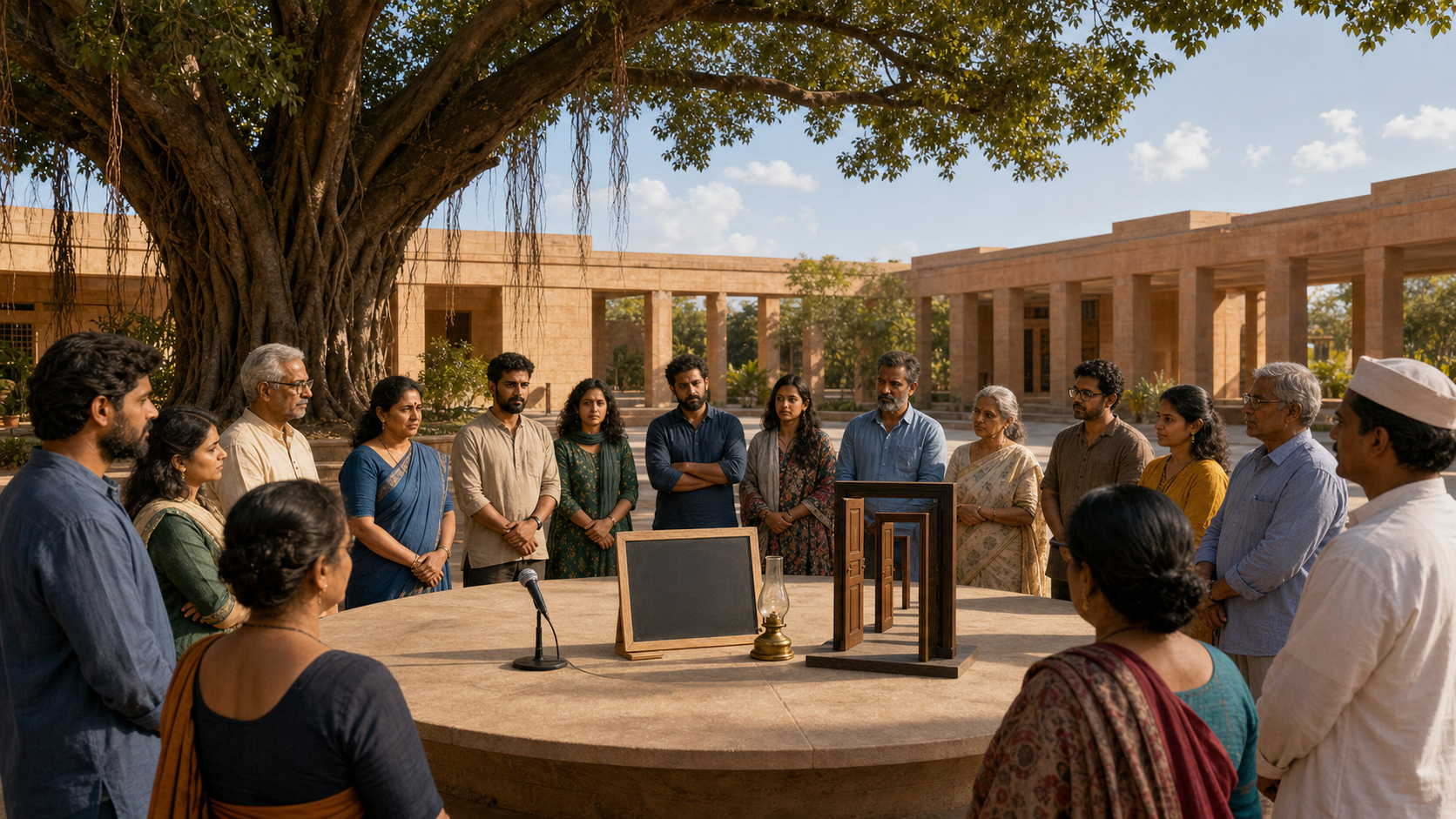
A comedian is accused of insulting the sacred. A government funds lessons inside a religious institution. A family changes its religious identity. Before you have the full facts, someone asks you to choose a side.
You do not have to choose between defending Dharma and defending constitutional liberty. A better response begins by identifying the right at stake, testing the evidence, and demanding the narrowest remedy that can address the actual harm. That discipline protects Hindu interests more reliably than outrage that changes its principles whenever the community labels change.
Begin with the person and the right, not the community label

Pluralism does not require you to believe that every religious claim is equally true, every practice is equally wise, or every criticism is offensive. It is a civic arrangement for living with deep disagreement without turning every disagreement into domination. Communities retain their convictions. Individuals retain their conscience. The state retains a duty to protect public order through lawful and proportionate means.
India’s constitutional framework protects several interests that can collide. Article 19(1)(a) protects citizens’ freedom of speech and expression, while Article 19(2) permits reasonable restrictions on specified grounds, including public order, decency, and morality. Article 25 protects freedom of conscience and the freedom to profess, practise, and propagate religion, subject to public order, morality, and health.
Neither provision is a slogan that decides a dispute by itself. Speech protection does not turn deliberate incitement into harmless commentary. Religious freedom does not protect conversion by force, fraud, or undue influence. Public order does not give a hostile crowd an automatic veto. Hurt feelings can be morally serious without establishing a criminal offence.
When you encounter a religious controversy, name the action before naming the community. Was there criticism, ridicule, incitement, discrimination, coercion, public funding, voluntary religious choice, or a credible threat of violence? Those are different acts. Combining them under labels such as “anti-Hindu,” “communal,” or “secular” may intensify allegiance while concealing the question that must actually be answered.
- Identify the individual freedom involved: expression, conscience, worship, education, association, or personal safety.
- Identify the alleged harm: offence, reputational injury, unequal treatment, coercion, incitement, financial misuse, or an imminent breach of peace.
- Ask who is responding: another citizen, a religious body, an employer, a venue, the police, or a court. Their powers and responsibilities are not interchangeable.
- State a rule you would accept if the religious identities were reversed. If the rule changes with the identity, it is partisanship rather than principle.
This sequence will not eliminate disagreement. It will show you what the disagreement is really about.
Demand evidence, then choose the narrowest effective remedy

Religious disputes now often reach the public through a clipped video, an unattributed screenshot, or a second-hand description of a ceremony. Speed changes the order of judgment: the punishment is demanded first, while context is treated as an excuse to be examined later. Reverse that order.
For disputed speech, obtain the complete recording or transcript. Note the exact words, the surrounding argument, the audience, the speaker’s pattern of conduct, and any subsequent clarification. For a religious change, speak privately with the adult concerned and look for evidence of free choice rather than relying on an organizer’s declaration. For public funding, read the eligibility conditions, permitted uses, allocation method, and utilization records before treating the name of the institution as proof either of discrimination or of public benefit.
Indian jurisprudence supplies useful boundaries. Ramji Lal Modi v. State of Uttar Pradesh (1957) upheld the provision historically used against deliberate and malicious acts intended to outrage religious feelings, with deliberateness and malice doing essential work. S. Rangarajan v. P. Jagjivan Ram (1989) required a proximate connection to a real danger rather than a speculative fear of disturbance. Shreya Singhal v. Union of India (2015) distinguished discussion and advocacy from incitement. Amish Devgan v. Union of India (2020) reinforced the importance of intent, context, and likely impact.
These principles make a complaint the beginning of an inquiry, not proof of guilt. They also prevent “public order” from becoming a reward for whoever threatens the greatest disruption. Officials must assess the threatened conduct and the original expression separately. Otherwise, people willing to use intimidation acquire more practical power than peaceful citizens.
A proportionate response normally moves through a ladder. Start with more speech: publish the full context, correct a false claim, make a reasoned objection, request an apology, or organize a peaceful boycott. Where an event presents a manageable risk, consider a content advisory, a limited set change, trained moderation, a grievance channel, or additional security. Postponement or cancellation should require a stronger, documented reason. Criminal proceedings belong at the far end, where the applicable legal elements and evidence support them.
The ladder is not a command to tolerate deliberate degradation or threats. It is a way to match power to harm. If the first response to every offence is a ban, the state becomes an arbiter of acceptable theology and satire. If every act is dismissed as mere expression, targeted intimidation and malicious provocation go unanswered. Proportionality avoids both failures.
Apply the same standard to funding, speech, and conversion

Abstract commitments become credible only when they survive difficult cases. Three recurring controversies show how to apply the framework without treating any community as automatically innocent or suspect.
Public money for religiously affiliated education
Maharashtra approved a total grant of Rs 50 lakh for 308 madrasas across 21 districts under the Dr. Zakir Hussain Madrasa Modernisation Scheme. An even division would be approximately Rs 16,200 per madrasa, although actual disbursement may differ by need, eligibility, and readiness.
The useful question is not simply, “Why is a religious institution receiving money?” Ask what the money buys, who qualifies, what comparable institutions can access, and what results must be shown. Mathematics, science, languages, foundational literacy, and digital skills serve a public educational purpose even when taught inside a community institution. Adding those subjects need not displace religious instruction.
A supporter of the scheme should still demand an allocation formula, permitted-cost list, basic utilization certificates, teacher-training records, and periodic learning checks. A critic should compare the program with the treatment of similarly situated institutions rather than inferring favoritism solely from the beneficiaries’ religion. Give priority to measurable educational need, such as first-generation learners, girls with low transition rates, or institutions with severe foundational gaps, and make that priority public.
The amount also matters. An average of roughly Rs 16,200 cannot plausibly finance a sweeping institutional transformation. It may purchase supplementary readers, basic connectivity, learning materials, or a limited remedial program. Judge the grant against that realistic scale. Grand claims of either civilizational danger or comprehensive modernization outrun the figure.
The principle to carry forward is straightforward: religious affiliation should neither disqualify a child from useful education nor exempt an institution from transparent accounting.
Offensive expression and event cancellation
In Hyderabad, a scheduled comedy show was cancelled after complaints that earlier remarks had disrespected Dharma and culture. The limited public details do not establish whether cancellation was contractually chosen, administratively advised, or legally compelled. That uncertainty is itself instructive: you cannot responsibly infer guilt, danger, or state censorship from the word “cancelled” alone.
If sacred figures or symbols have been mocked, believers are entitled to object firmly. Cultural injury should not be trivialized merely because it is difficult to quantify. But the exact objection matters. “This is contemptuous and we will not support it” is a legitimate civic position. “No one may hear it because we threaten disorder” substitutes force for persuasion. A legal allegation requires attention to intent, context, and the relevant threshold; a moral criticism can be broader but should still quote accurately.
Before endorsing a cancellation, ask five concrete questions: Is the complete material available? What exact line or act is objectionable? Does it attack an idea, demean a community, or urge harmful conduct? Is the threatened disorder credible and proximate? Could security, a clarification, a set edit, or postponement address the risk?
Organizers should document why they selected a remedy. A venue may have contractual and safety concerns that differ from a court’s legal analysis. Police may prevent violence without declaring the performer guilty. Community organizations may protest without claiming power to prosecute. Clear roles prevent a precautionary decision from being misrepresented as a judicial verdict.
Artists also bear a responsibility that law cannot fully enforce. Maryada-informed satire can expose hypocrisy, policy failure, or abuses of power without treating the sacred identity of ordinary believers as an easy target. Legal permission is a floor, not a complete account of cultural wisdom.
Conversion, reconversion, and voluntary homecoming
A reported ceremony in Banda on 2 April 2026 was presented as a Muslim family’s voluntary return to the Hindu fold through Vedic rites. Calling a ceremony Ghar Wapsi explains how the receiving community understands it. The name does not, by itself, prove or disprove consent.
Freedom of conscience protects the inward decision that precedes public identity. Rev. Stanislaus v. State of Madhya Pradesh (1977) upheld state authority to prohibit conversion by force, fraud, or undue influence. The corresponding civic principle is that an adult’s genuine religious choice must not be erased because relatives, activists, or officials dislike its direction.
Anyone facilitating a conversion or reconversion should use a consent process stronger than a public declaration on a ceremonial stage:
- Meet the adult privately, without clergy, relatives, activists, or media speaking on the person’s behalf.
- Confirm capacity, understanding, and the freedom to pause or withdraw without social or material penalty.
- Record that no force, fraud, threat, or prohibited inducement shaped the decision.
- Check the current procedure in the applicable state. Prior or post-event declarations may be required, and noncompliance can create legal exposure.
- Keep minors out of the role of adult decision-maker. Questions involving custody, inheritance, names, marriage, or official identity records warrant advice from a lawyer familiar with the state’s current law.
- Offer post-ceremony pastoral support without demanding political participation, publicity, or permanent gratitude.
Vedic rites such as sankalpa, havan, shuddhi, or punyahavacana can express intention and welcome. They do not replace civil procedure. Nor should ritual enthusiasm override privacy. Publishing faces, addresses, children’s identities, or family conflicts can expose participants to retaliation and make later reconsideration more dangerous.
Pew Research Center’s 2021 work on religion in India found limited net religious switching across communities. One reported homecoming therefore should not be inflated into a demographic wave. Treat it as a decision about conscience unless reliable, broader evidence supports a broader conclusion.
A receiving Hindu community proves its confidence through care after the havan: helping the family understand practices, enter temple life, resolve documentation questions, and form ordinary social relationships. Triumph over another community is not the same as welcome into one’s own.
Use a Dharmic standard that survives disagreement
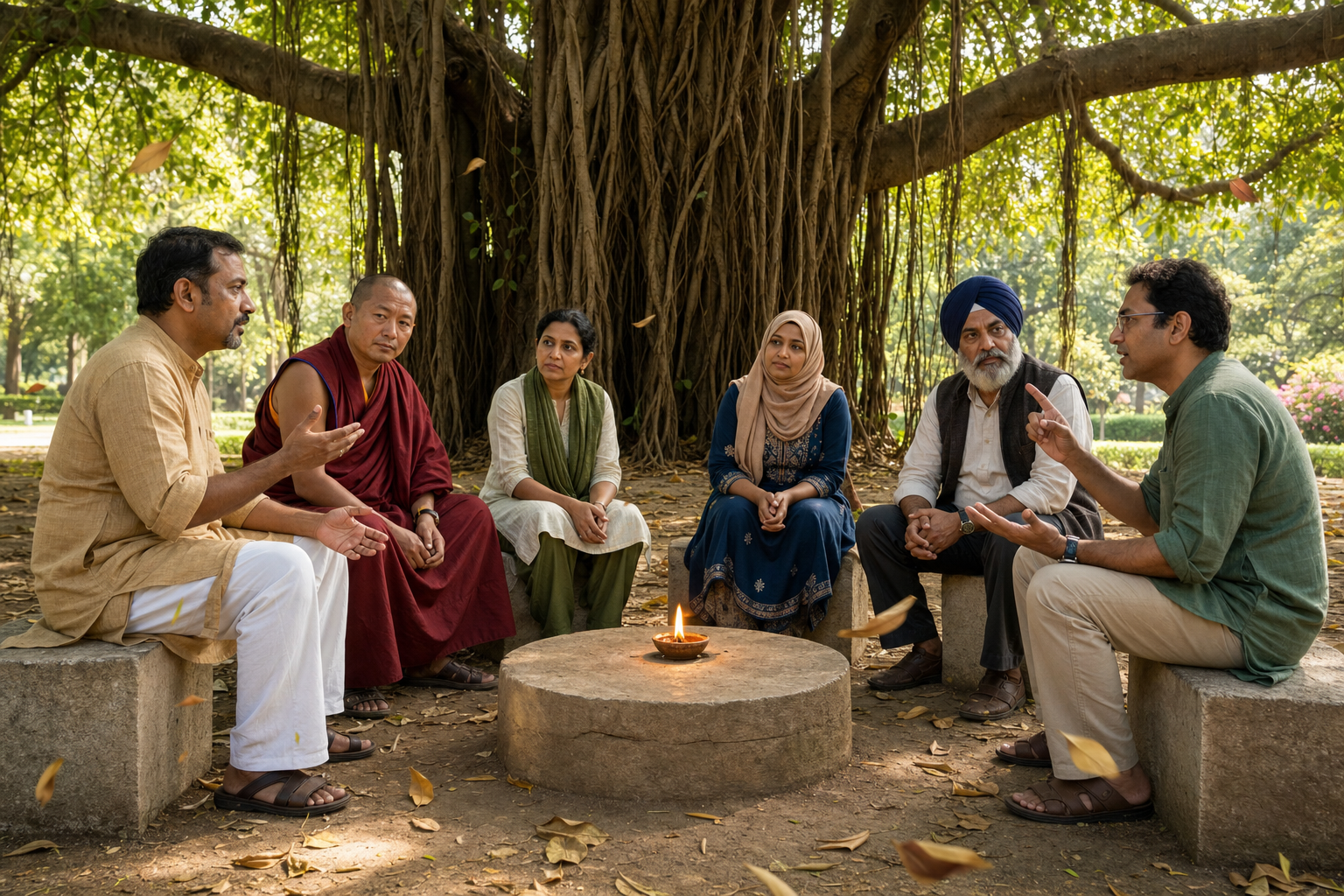
Hindu, Buddhist, Jain, and Sikh traditions are not interchangeable. Their philosophies, disciplines, and institutions differ. Yet ahimsa, satya, karuna, self-restraint, and responsibility offer a shared civic grammar for handling conflict. These values do not require passivity. They govern how power is used.
Satya requires you to verify the full clip, the actual order, the funding conditions, or the participant’s own statement before amplifying a claim. Ahimsa rules out threats and coercion even when the cause is sacred. Karuna makes room for the believer wounded by contempt, the artist facing intimidation, the poor student needing modern skills, and the family navigating a religious change. Maryada asks every actor to recognise limits: expression without deliberate degradation, protest without menace, administration without arbitrariness, and religious welcome without compulsion.
For a pro-Hindu public voice, consistency is a strategic strength. If freedom of conscience protects a voluntary return to Hindu Dharma, it must remain a freedom of conscience rather than a privilege granted only when the destination pleases us. If threats must not silence criticism of Hindu traditions, threats must not silence Hindu criticism either. If religiously affiliated schools receiving public money owe accounts and measurable outcomes, the same standard should follow the money across every community.
Before supporting a ban, prosecution, grant, or public ceremony, write one sentence describing the rule you want applied. Remove all religious labels and read it again. Would you still accept it if the complainant and accused, donor and beneficiary, or convert and receiving faith traded places? This reversal test exposes selective principles quickly.
Consistency does not flatten history or deny that communities carry unequal memories of persecution and denigration. Context can affect the seriousness of harm and the remedy required. It cannot turn coercion into consent, rumor into evidence, or identity into automatic guilt.
Key takeaways
- Classify the conduct before choosing a side: offence, incitement, coercion, unequal treatment, public expenditure, and voluntary religious choice require different tests.
- Protect both expression and sacred dignity by demanding full context, credible evidence, and a remedy proportionate to the actual harm.
- Judge public funding by neutral eligibility, educational purpose, transparent spending, and measurable outcomes rather than by the beneficiary’s religious label alone.
- Treat every conversion or reconversion as a question of adult conscience, lawful procedure, privacy, and freedom from force, fraud, and undue influence.
- Use the reversal test: support only a rule you would accept if the communities exchanged places.
The next controversy will arrive faster than the facts. When it does, pause before forwarding the clip or endorsing the punishment. Find the primary material, name the right, identify the concrete harm, and ask for the narrowest effective response.
That is not neutrality between Dharma and Adharma. It is a disciplined way to defend Dharma without making intimidation, arbitrary power, or selective liberty the price of doing so.
References
- Hindu Jagruti Samiti – Maharashtra’s Rs 50 Lakh Grant to 308 Madrasas: A Bridge-Building Step for Inclusive Education
- Hindu Jagruti Samiti – Hyderabad Cancels Naseef Akhtar Show After Dharma Complaints: Law, Ethics, and the Way Forward
- Hindu Existence – Banda Ghar Wapsi: Voluntary Homecoming, Vedic Rites, and India’s Religious Freedom