
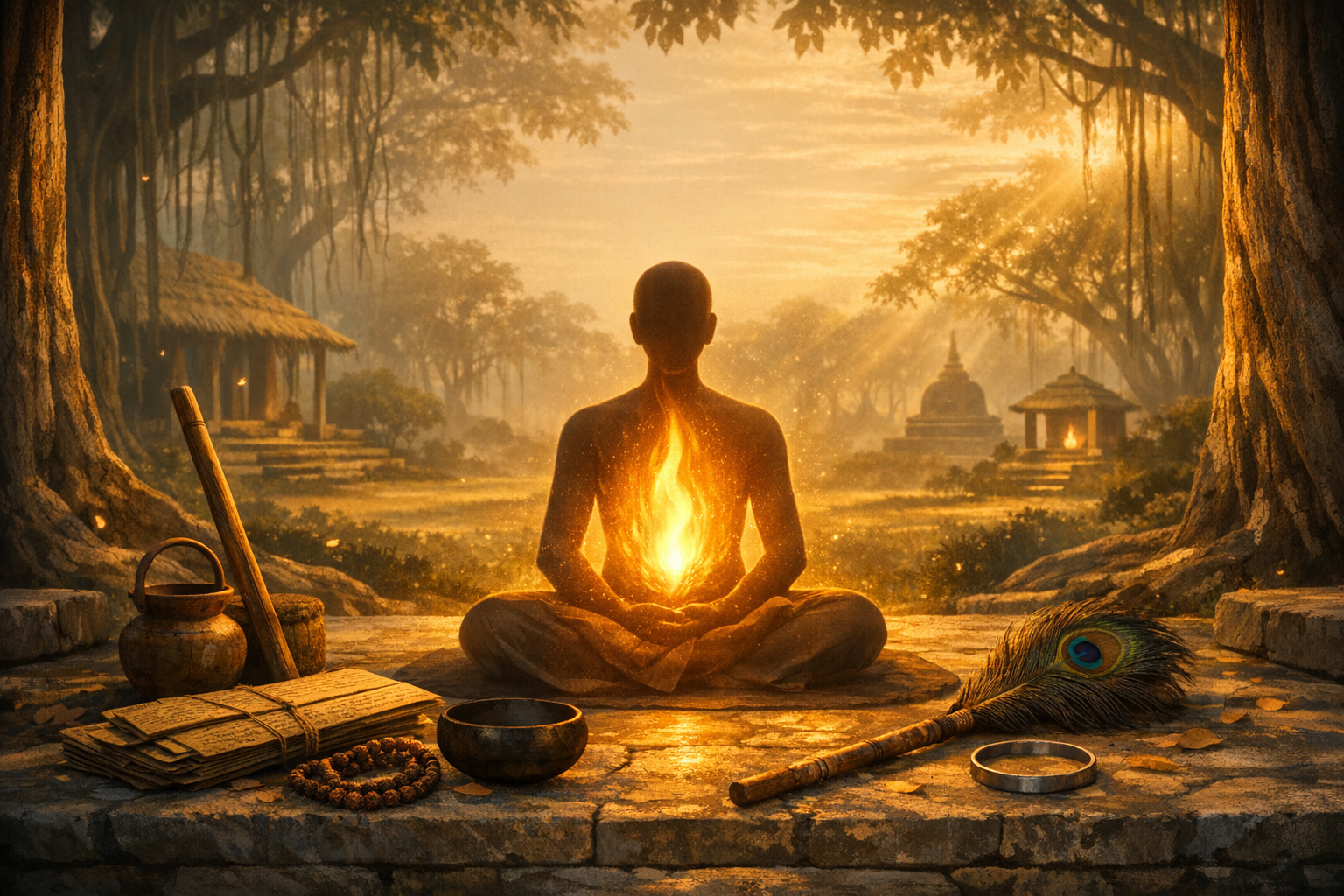
Monasticism, understood as a disciplined vocation oriented toward liberation (mokṣa), has deep and discernible roots in the Vedic and Upanishadic corpus. Far from being a late or external innovation, renunciant archetypes and ideals already appear in the earliest layers of the Vedas and mature into formalized sannyāsa in the Upanishads and Dharmasūtras. Tracing this arc clarifies how monastic life evolved within the Hindu way of life while also resonating across the wider Dharmic family that includes Buddhism, Jainism, and Sikh traditions, thereby underscoring a shared civilizational commitment to wisdom (jñāna), compassion (karuṇā), restraint (dama), and service (seva).
Clarity of terminology is helpful. Vedic and post-Vedic sources variously use muni, yati, parivrājaka, and bhikṣu for renunciants; sannyāsa for formal renunciation; pravrajyā for ‘going forth’; and āśrama for the four-stage life framework (brahmacarya, gṛhastha, vānaprastha, sannyāsa). In Buddhism and Jainism, cognate ideas appear as saṅgha (monastic community), vinaya (discipline), and mahāvrata (great vows), while Sikh history preserves ascetic lineages such as the Udāsī and Nirmalā even as the mainstream ideal emphasizes householding and seva. These terms point to a common Dharmic grammar of disciplined inner transformation.
Early Vedic intimations of renunciation are striking. The Ṛgveda’s Keśin Hymn (10.136) depicts long-haired ascetics whose wind-like movement, inner heat (tapas), and altered states of awareness signal an embodied quest that values restraint, insight, and freedom from possession. Such figures are not social outliers but sacred exemplars who stretch the horizon of what spiritual life can be within a Vedic frame.
The Atharvaveda’s Vratya-sūkta (15) presents a liminal wanderervratyastanding at the threshold of the normative order, radiating a charisma that Vedic society sought to respectfully integrate. Later Śrauta materials speak of the vratya-stoma as a ritual modality for such inclusion. Together, these sources demonstrate that the Vedic world did not merely tolerate itinerant sanctity; it experimented with ways to recognize, regularize, and learn from it.
The Brāhmaṇas and Āraṇyakas amplify this movement inward. While the Brāhmaṇas theorize ritual, the Āraṇyakas cultivate forest reflection and interiorization. The conceptual space for vānaprastha (forest-dwelling) emerges here as a contemplative counterpoint to public ritual life, preparing the ground on which Upanishadic renunciation takes definitive shape.
Upanishadic teaching recasts sacrificial fire as inward illumination. Pivotal declarations align renunciation with realization: tyāgenaike amṛtatvam ānaśuḥ (Kaṭha), parīkṣya lokān karmacitān brāhmaṇo nirvedam āyāt (Muṇḍaka), tad vijñānārthaṁ sa gurum eva abhigacchet samit-pāṇiḥ śrotriyaṁ brahma-niṣṭham (Muṇḍaka), and na ayam ātmā pravacanena labhyo (Muṇḍaka). These passages honor teacher-lineage and disciplined inquiry while affirming that ultimate insight is won less by outward power than by inner surrender and moral clarity.
The Jābāla Upaniṣad is particularly influential in articulating sannyāsa. It allows renunciation at any stageafter study, after householding, or immediately upon awakening to the transient nature of worldly pursuits. This doctrinal flexibility does not dismiss social responsibilities; it recognizes that the ripeness for renunciation is a matter of insight, not merely of age or sequence, thereby validating diverse spiritual itineraries under the larger canopy of Sanātana Dharma.
The Dharmasūtras (notably those attributed to Āpastamba, Gautama, and Baudhāyana) formalize the āśrama system and debate whether the four stages are sequential or alternative life-options. Within these debates, sannyāsa emerges as a legitimate and often exalted vocation. These texts also sketch behavioral codessimplicity of dress, non-accumulation, truthfulness, ahiṁsā, and brahmacaryasignaling a social ethic befitting those who belong to the lineage of knowledge-seeking renunciants.
The corpus often called the Sannyāsa Upaniṣads (e.g., Nārada-Parivrājaka, Paramahaṁsa, Turīyātīta-Avadhūta) expands on initiation (saṁnyāsa-vidhi), typologies (e.g., Kuṭīcaka, Bahūdaka, Haṁsa, Paramahaṁsa), external markers, and interior disciplines. While much of this literature is post-Upanishadic in redactional history, it consolidates a living monastic culture already envisioned by earlier texts and harmonizes it with Vedānta’s inward trajectory.
Renunciate training organizes itself around shared Dharmic virtues. Ethical foundations include the yamas and niyamas (restraint and observances), together with the Vedāntic sādhanacatuṣṭaya (viveka, vairāgya, śamādi-ṣaṭka-sampatti, mumukṣutva). The aim is not mortification for its own sake but stabilization of attention, cultivation of compassion, and steady abidance in the Self (ātman) or ultimate truth (Brahman), expressed variously across the Dharmic spectrum as mokṣa, nirvāṇa, or kevala.
Historically, the śramaṇa milieuencompassing Buddhists, Jains, Ājīvikas, and Vedic renunciantsfunctioned as a shared crucible for experiments in asceticism, meditation, and community life. While doctrinal conclusions differ, the family resemblance is unmistakable: insisting on non-violence, truthfulness, non-stealing, chastity, and non-possession; prioritizing contemplative insight; and creating durable lineages of instruction. Rather than rivalry, the evidence suggests a sustained conversation across Dharmic traditions.
Women are not absent from this story. The Upanishads honor Gargī and Maitreyī as rigorous interlocutors in metaphysical debate, and later Hindu, Buddhist, and Jain histories preserve robust female renunciant lineages (e.g., bhikkhunī and Jain sādhvī communities). The philosophical premisethat ātman is not constrained by genderanchors a tradition in which realization is open to all who embody discipline and discernment.
Socially, the renunciant and the householder are complementary, not antagonistic. The gṛhastha sustains society and supports learning and service; the sannyāsin embodies the civilizational horizon of liberation and ethical universality. Classical literature repeatedly portrays these roles as mutually reinforcingthe two wheels of a cartprotecting both social cohesion and transcendent aspiration.
Institutional forms grow later. Hindu orders such as the Daśanāmī (associated with Ādi Śaṅkara), various Vaiṣṇava and Śaiva maṭhas, and the cosmopolitan missions of the modern period (e.g., the Ramakrishna lineage) systematize teaching, service, and textual study. Buddhist saṅghas and Jain orders perfect elaborate vinaya frameworks, while Sikh history preserves ascetic streams (Udāsī, Nirmalā) alongside the mainstream imperative of engaged, ethical householding and collective service. Across these expressions, the Dharmic synthesis remains: discipline, insight, and compassion in the service of truth.
Monastic communities became guardians of knowledge. Forest hermitages and later monasteries served as hubs for scriptural commentary, debate, and manuscript preservation that benefited the entire subcontinent. The transmission of the Upanishads, Vedānta, Yoga, and allied śāstras owes much to these networks, as do Buddhist Abhidharma and Jain āgamasan interlaced ecology of learning.
Contemporary relevance is unmistakable. Many seekers, householders included, adapt monastic insightsmindfulness, simplicity, moderated consumption, and ethical clarityto meet modern challenges such as distraction, anxiety, and ecological strain. Minimalism, sustained contemplative practice, and service-oriented living echo Upanishadic and śramaṇa values while strengthening social well-being.
The heart of the message is inclusive. Upanishadic flexibility (as in Jābāla) and the Dharmasūtra debates converge on a plural vision: multiple valid pathsstudy, service, ritual, meditation, renunciationleading to a common summit of realization. Jain anekāntavāda (many-sidedness) and Buddhist skillful means (upāya) articulate cognate commitments to plurality, while Sikh praxis integrates contemplation with righteous action (dharam) and seva. This unity in diversity is a hallmark of the Dharmic world.
Common misconceptions merit correction. It is sometimes claimed that monastic life is alien to the Veda or that the Upanishads represent a rupture with earlier tradition. The textual record shows continuity with creative deepening: Vedic archetypes (muni, vratya) and forest reflection (Āraṇyakas) culminate in Upanishadic interiorization, which is then methodized by Dharmasūtras and Sannyāsa Upanishads. The result is evolution without erasure, renewal without repudiation.
Ethically, the renunciant ideal still stabilizes public life. Disciplines like ahiṁsā, satya, and aparigraha temper consumption, encourage honesty in civic institutions, and inspire service work in education, health, and disaster responseareas where Hindu, Buddhist, Jain, and Sikh organizations collaborate and excel. Thus, the monastic horizon fortifies societal resilience even for those who never formally renounce.
Philosophically, the Upanishadic emphasis on direct realization integrates seamlessly with allied Dharmic goalsmokṣa (Hinduism), nirvāṇa (Buddhism), kevala (Jainism), and mukti (Sikh thought). Each tradition refines distinctive metaphysics and practices, yet the family resemblancediscipline, compassion, inner freedomis profound. Recognizing this shared lineage fosters mutual respect and constructive dialogue.
In sum, monasticism in the Vedas and Upanishads arises from early renunciant archetypes, crystallizes into the sannyāsa ideal, and continues to animate a living Dharma that spans Hinduism, Buddhism, Jainism, and Sikhism. Its ethical force and contemplative clarity remain relevant to contemporary seekers and societies alike. Appreciating these roots strengthens unity among Dharmic traditions and clarifies a civilizational vision where inner freedom and social responsibility advance together.
Inspired by this post on Hindu Blog.
