
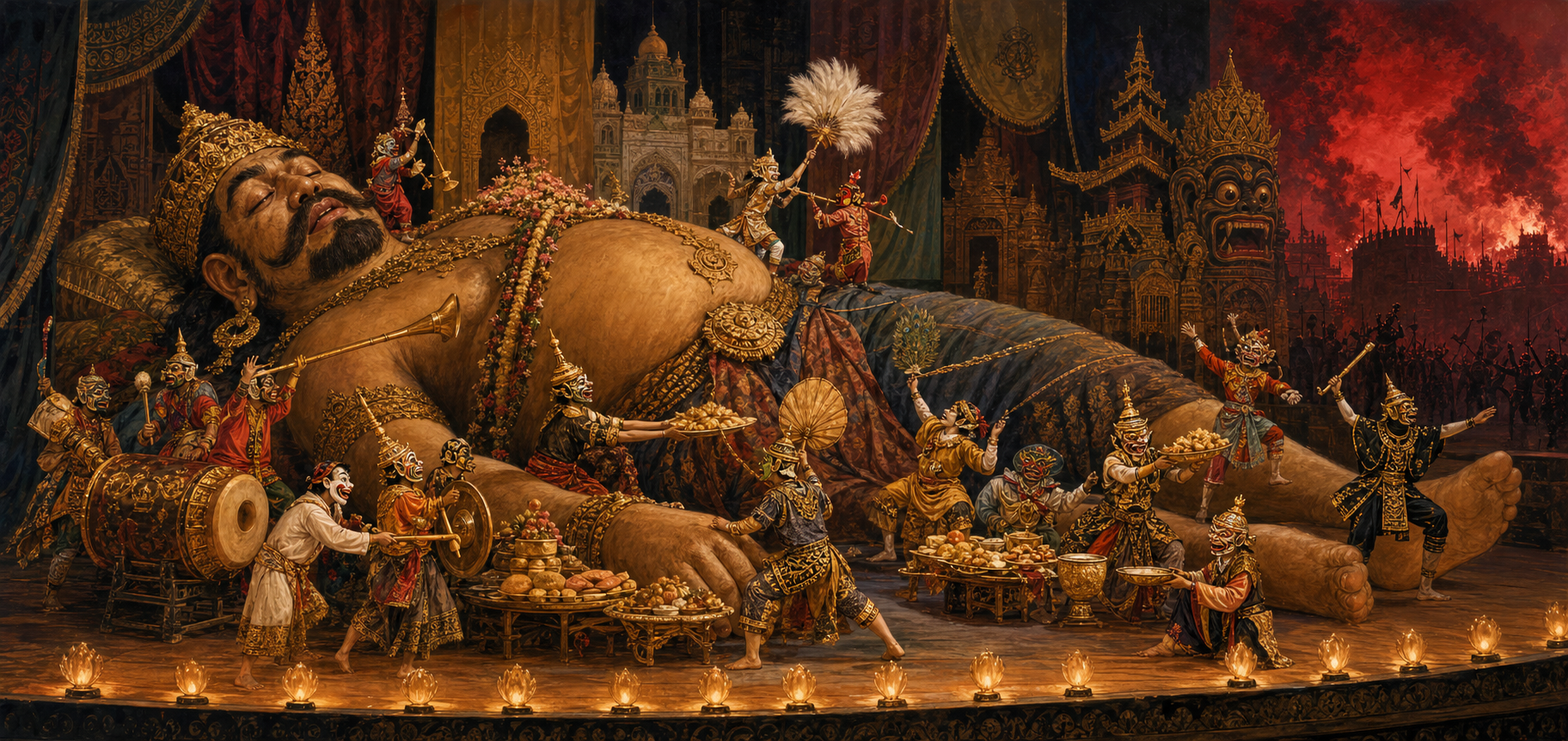
You may remember Kumbhakarna’s awakening as the funny interval before a terrible battle: a gigantic sleeper snores through drums, blows, shouting and mountains of food while Lanka loses patience. If you have wondered why performers place so much laughter beside an approaching death, the answer lies in the scene’s construction. The comedy doesn’t interrupt the Ramayana’s moral purpose. It prepares you to face it.
Watch the order of the failed attempts, notice who is permitted to mock the court, and listen for the moment when Kumbhakarna becomes fully alert. The episode will stop looking like an expendable gag. It will reveal how Asian performance traditions turn scale, rhythm and satire into a difficult inquiry about counsel, loyalty and action under adharma.
The comedy is built as an awakening, not added as decoration
The basic dramatic problem is wonderfully concrete. Ravana needs his formidable brother because the war has reached a crisis, but Kumbhakarna is trapped in an extended sleep. Lanka possesses power, soldiers and royal authority, yet none of them can accomplish the ordinary household task of waking someone up.
That mismatch gives performers room to expand a brief necessity into a comic sequence. Each failure increases both the apparent size of Kumbhakarna and the desperation of Ravana’s court. What begins as inconvenience gradually becomes evidence that Lanka can no longer command the forces on which it depends.
Three recurring devices make the escalation easy to recognise:
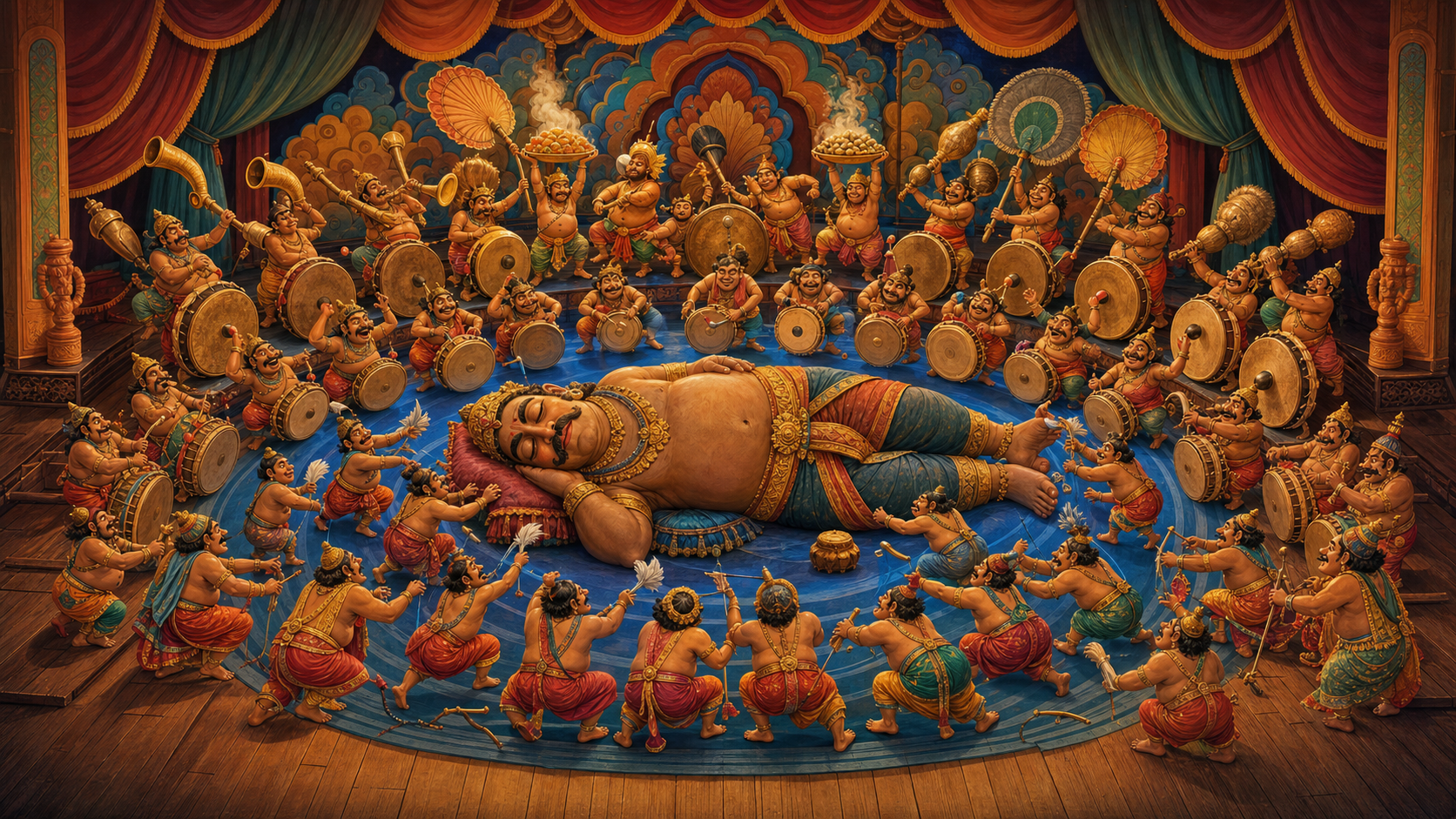
- The body becomes a landscape. A chest can be treated like a drum, ribs like valleys and snores like a windstorm. Attendants appear tiny because the sleeper is staged as a mountain rather than merely a large man.
- Sound becomes an action. Snores establish a pulse; voices, conches, drums and cymbals answer it; successive attempts grow more forceful. The audience hears the awakening approach before the sleeper visibly moves.
- Appetite becomes an alarm. If blows and noise fail, food offers another route to consciousness. The smell and sight of a feast make Kumbhakarna’s enormous appetite part of the stage machinery rather than a detached character description.
The attempts often work through repetition with variation. One method fails, a stronger method fails, and a seemingly excessive method fails or produces an unexpected reaction. This resembles the familiar comic rule of three, but the sequence has narrative force: every repetition delays the warrior whom Lanka urgently needs. When elephants are imagined crossing the sleeper, or an army attacks the problem of one closed pair of eyes, exaggeration measures the severity of Ravana’s predicament.
This is hasya rasa operating inside an arc dominated by raudra and vira – wrath and heroism. The laughter releases pressure, but it also stores energy for the tonal turn. A well-shaped performance observes aucitya, or dramatic propriety: it knows when the joke has completed its work. Once Kumbhakarna sees the situation clearly and speaks about Ravana’s conduct, comic delay must yield to ethical and martial consequence. If you want to judge whether a performance understands the episode, watch that transition more closely than its loudest gag.
One dramatic problem acquires different regional bodies
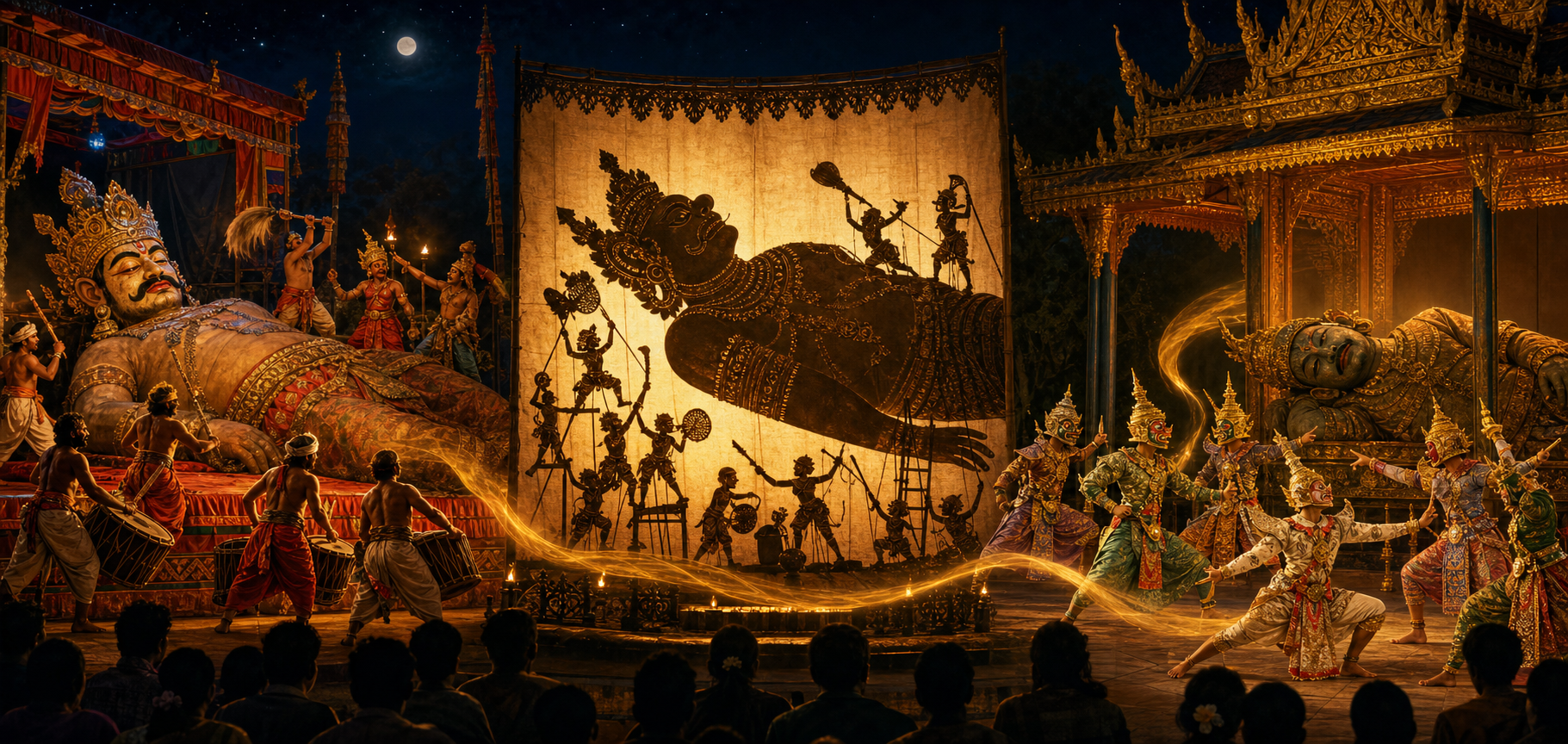
There is no single stage vocabulary for awakening Kumbhakarna. Folk, classical and popular forms solve the same problem through their own strengths. A useful comparison therefore asks what each form makes the audience hear, see and understand. It should not reduce the traditions to a checklist of exotic props.
North Indian Ramlila makes scale communal
In many North Indian Ramlila settings, an oversized cloth or paper-mache body can make Kumbhakarna’s immensity legible from across an open performance ground. Amplified snores supply a rhythm, while attendants generate choreographed confusion around him. The visual joke is immediate: a crowd of active people cannot move one inactive body.
The banter brings that impossible body into everyday experience. Complaints about delayed work, difficult relatives, hunger or the problem of rousing a stubborn sleeper allow children and adults to recognise their own households inside Lanka’s crisis. Topical remarks can also expose courtly incompetence. The epic remains vast, but its people become intelligible.
This domestication has a limit. Kumbhakarna should not remain merely the lazy member of a family. The everyday analogy opens the door; the coming conversation about Ravana’s wrongdoing changes the room. A performance that preserves both movements lets the audience laugh in recognition and then discover that the familiar sleeper is capable of unwelcome moral clarity.
Eastern forms shift the joke into music and movement
Bengali Jatra and village theatre influenced by the Krittivasi Ramayana can enlarge the awakening through songs, verbal play and clowning pairs. In Chhau, the body’s change from sleep to readiness can carry more of the meaning: broad strides, explosive stretches and an immense stylised yawn translate awakening into kinetic exaggeration.
The distinction matters when you watch. In a dialogue-heavy form, listen for who controls the satire and how a joke travels through the crowd. In masked dance, look for changes in weight, direction and tempo. The body that appeared immovable must become a body capable of battle. That transformation, not realistic imitation of sleep, is the dramatic event.
Southern traditions preserve humour beside tragic stature
Within the orbit of the Kamba Ramayanam, Kumbhakarna often retains the stature of a brave figure tragically committed to the wrong side. Terukoothu and Villupaatu can use the awakening to move from entertainment into arguments about counsel, fate and fraternal obligation. The comedy makes the character approachable before his judgement of Ravana makes him morally serious.
Kerala’s forms show how precisely humour can be carried by technique. Kathakali may give Kumbhakarna the chuvanna thadi, or red-beard, presentation associated with ferocity, while timing, percussion and interaction still make room for comedy. Koodiyattam and Chakyar Koothu can employ the vidushaka’s metatheatrical voice to puncture grandeur, translate difficult ideas and connect royal error with the civic world of the audience.
In coastal Karnataka, the Yakshagana prasanga Kumbhakarna Kalaga makes awakening acoustic as well as visual. Chende, cymbals and call-and-response singing build an architecture of noise around the sleeper. Hasyagaras can spar with soldiers and courtiers, while improvised regional idiom and topical humour keep the inherited episode answerable to the people assembled before it.
Java and Thailand translate function rather than copying form
In Javanese wayang kulit, the punakawan figures Semar, Gareng, Petruk and Bagong bring wise comedy and social criticism into epic performance. Their presence in Ramayana cycles creates an interpretive environment in which royal vanity and political folly can be exposed without halting the narrative. The important continuity is not a literal reproduction of a North Indian waking routine. It is the use of comic mediation to let ordinary social intelligence enter a courtly epic.
Thailand’s Ramakien similarly preserves the grandeur of Lanka’s court while allowing courtly jest and masked mime to shape its representation of Kumphakan. Here too, adaptation does not mean loss of a Dharmic centre. Local theatrical language carries the episode because the underlying tension remains legible: power desperately calls on a warrior who can recognise the ruler’s fault but cannot escape the consequences of serving him.
When you compare any two versions, use four questions. Who translates the epic world into the audience’s everyday language? Which sensory channel – speech, music, mask, movement, scale or appetite – drives the awakening? Is the joke aimed at Kumbhakarna, at the helpless attendants, or at Ravana’s failing court? Finally, what exact signal ends the comedy? Those questions reveal adaptation more reliably than counting shared incidents.
The last laugh opens a question about loyalty and adharma
Kumbhakarna’s sleep invites symbolic interpretation. It can resemble tamas, the inertia that resists necessary action, while the confused condition around him can suggest moha, the delusion that prevents clear judgement. His awakening can then evoke viveka, or discernment, and the demand to act when order is under threat. These associations are best treated as interpretive possibilities, not as a rigid code in which every snore has one doctrinal meaning.
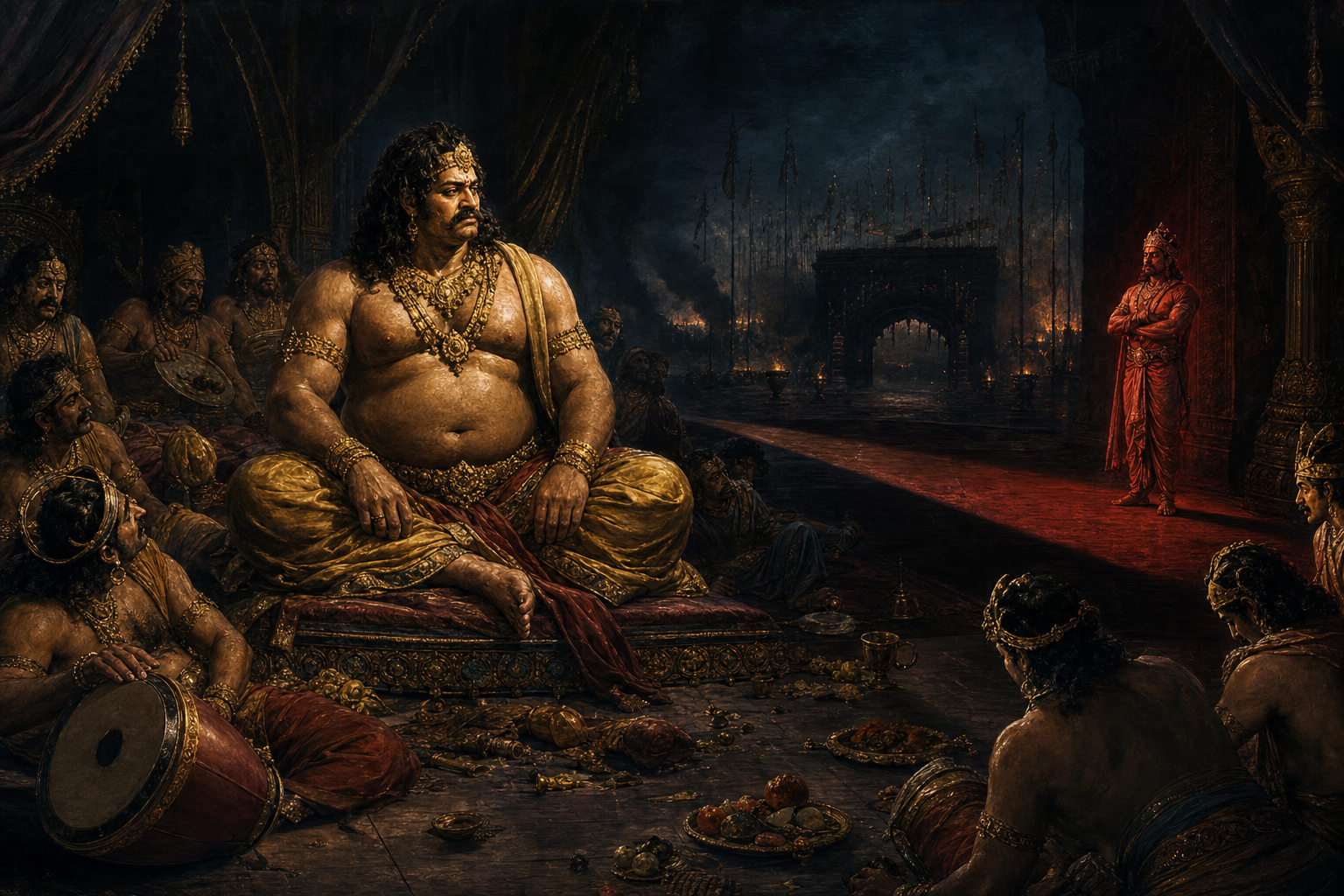
The harder problem begins after physical sleep ends. Kumbhakarna may rebuke Ravana for abducting Sita and recognise that his brother’s decision has brought Lanka toward ruin. Yet he still enters battle out of fraternal obligation. He is awake enough to diagnose the wrong, but not free – or not willing – to withdraw his strength from it.
That distinction keeps the episode from becoming a simple lesson about laziness. Physical awakening, moral recognition and right action are three different achievements. Kumbhakarna reaches the first two; whether his final choice fulfils loyalty, warrior duty or tragic attachment is the question the performance leaves with you.
The comic frame is essential because it humanises him without acquitting him. If he entered only as a monstrous enemy, the audience could dismiss his choice as the predictable behaviour of a rakshasa. After watching servants struggle with his sleep, appetite and temper, spectators recognise ordinary frailties in an extraordinary body. His compromised loyalty then feels uncomfortably close to the excuses human beings make for serving a family, ruler or institution they know to be wrong.
- What is the value of truthful counsel when a ruler has already committed himself to adharma?
- Does courage remain virtuous when it is spent in defence of an unjust cause?
- At what point does loyalty to kin become participation in their wrongdoing?
- Is recognising error enough, or does dharma require refusal and corrective action?
The scene need not give every audience the same answer. Its strength lies in making the conflict visible without flattening Kumbhakarna into either a noble martyr or a ridiculous villain. Humour beside honour permits compassion, judgement and sorrow to coexist.
This method belongs to a wider Dharmic practice of teaching through accessible humour. Buddhist Jataka storytelling, Jain retellings such as the Paumacariya, and Sikh katha can also use wit to lower resistance and sharpen ethical attention. That does not mean these traditions tell an identical Kumbhakarna story. The shared feature is pedagogical: laughter can prepare the mind for a truth that solemn instruction alone might leave at a distance.
A practical way to watch, teach or stage the episode
If you are watching or teaching it
Do not begin and end with the question of whether the scene is funny. Follow its internal movement instead:
- Establish the emergency. Identify what has already gone wrong in Lanka and why Ravana now needs the brother who was allowed to remain asleep. Without that pressure, the waking attempts become detached clowning.
- Track the escalation. Write down each attempt and the sensory channel it uses: voice, percussion, physical force, animal power, food or smell. Notice whether the methods become larger, stranger or more familiar.
- Find the target of the satire. Kumbhakarna’s body may generate the spectacle, but the sharper joke may fall on panicked officials, incompetent courtiers or a ruler who ignored wise counsel until catastrophe.
- Mark the final laugh. Identify the gesture, line or musical change after which the mood turns. That boundary shows how the form manages hasya beside vira and raudra.
- Separate awareness from action. Ask what Kumbhakarna understands once awake, what he tells Ravana, and why his conduct does not fully follow his judgement.
For a classroom or community workshop, divide the scene into three columns: waking device, comic target and ethical effect. A drum may be a waking device; frightened courtiers may be the comic target; exposure of Lanka’s disorder may be the ethical effect. This prevents students from treating humour as an ornament and gives them a precise basis for comparing forms with very different costumes or languages.
A second useful exercise is to stop immediately after Kumbhakarna admonishes Ravana. Ask participants to propose three possible actions: fight for his brother, refuse to fight, or demand a final attempt at restitution. They should defend each choice through dharma rather than personal preference. The purpose is not to rewrite the epic as a better ending. It is to expose the competing duties already present in the performance.
If you are staging it
The sequence does not require an expensive spectacle, but it does require a clear hierarchy of effects. Build it in this order:
- Make scale readable at first sight. One oversized head, hand, belly or sleeping platform can do more than several unrelated decorations. The attendants’ movement should reinforce the chosen illusion.
- Give the snore a repeatable pulse. Let performers and musicians answer it so that sound becomes part of the action. Mere volume tires an audience; a recognisable rhythm creates expectation.
- Design three distinct attempts. Change the method, not just its intensity. A progression from speech to force to appetite gives the audience something to anticipate and lets the final response surprise them.
- Localise the banter with a purpose. A household comparison or topical complaint should expose denial, bureaucracy or bad counsel. Avoid jokes that reduce Kumbhakarna to a body with no later dignity.
- Rehearse the hinge separately. Decide which movement, percussion cue or silence ends the comic mode. Kumbhakarna’s first morally lucid speech needs enough space to alter the audience’s judgement of him.
- Carry the change into posture. The sleeper’s body can begin as landscape, pass through appetite and confusion, and finish as the controlled body of a warrior. That physical journey makes awakening visible even where dialogue is limited.
The governing principle is contrast with continuity. The grave warrior must still feel like the being whose sleep produced laughter, and the comic giant must contain the possibility of the grave warrior. Preserve that continuity and the audience will feel why his decision matters. Break it, and the performance will seem to discard one character and introduce another.
Key takeaways
- The awakening works because failed attempts convert Lanka’s military emergency into escalating physical comedy.
- Scale, rhythm, appetite, mask, movement and improvisation are regional tools serving the same dramatic transition; they are not interchangeable decorations.
- The true tonal hinge arrives when Kumbhakarna moves from bodily consciousness to moral judgement.
- His rebuke of Ravana followed by his decision to fight distinguishes knowing the right from acting on it.
- The best way to compare performances is to identify the waking device, the target of satire and the moment when laughter yields to consequence.
The next time you encounter this episode, resist the urge to treat the noisy beginning as a pause before the important part. Watch for the last laugh and what immediately replaces it. In that turn, a sleeping mountain becomes a mirror: not only for Ravana’s collapsing court, but for anyone who sees adharma clearly and still must decide whether loyalty is an excuse, a duty or a test.
References
