
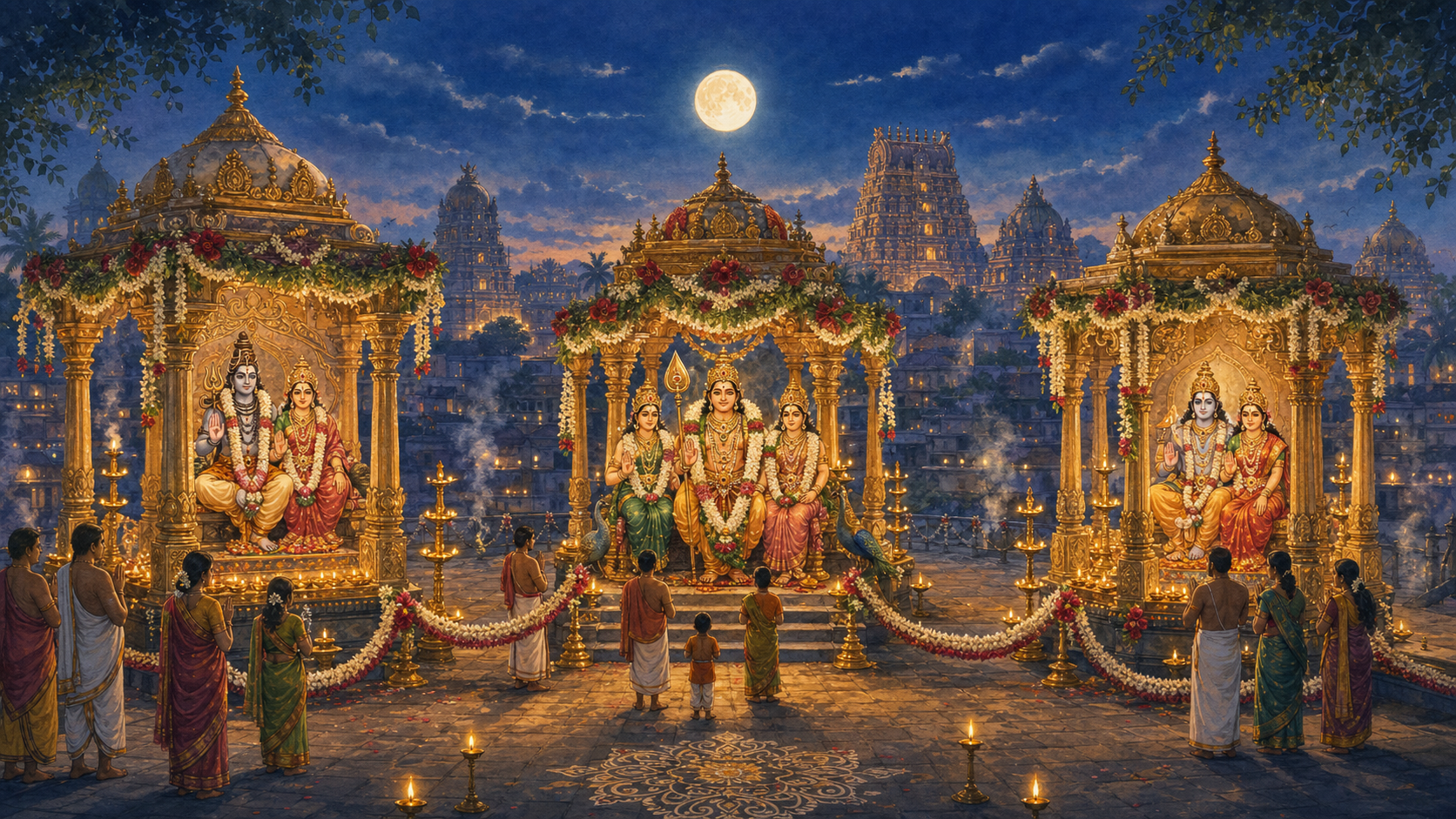
If one temple announces Murugan Kalyanam while another prepares a Shaiva wedding or a Vaishnava serthi sevai, you haven’t found a contradiction. Panguni Uthiram gathers several divine-marriage traditions into one sacred day, but each temple expresses that day through its own deity, lineage, and ritual discipline.
Your first decision is therefore not which marriage is the correct one. It is where you want darshan, which form of devotion speaks to you, and what commitment you will carry home after the celebration ends.
Begin with the bond, not the spectacle
Panguni Uthiram falls in the Tamil month of Panguni, from roughly mid-March to mid-April, when Uthiram Nakshatra coincides with Pournami. This meeting of star and full-moon tithi gives the festival its calendrical identity. The date must still be determined locally because the relevant astronomical periods do not begin and end at the same clock time everywhere.
Traditional Jyotisha associates Uthiram, or Uttara Phalguni, with Aryaman, the Vedic deity connected with friendship, agreements, and social bonds. It is ruled by the Sun, while Pournami brings the nourishing symbolism of the full Moon. The resulting emphasis is not romance without responsibility. It is relationship sanctified by fidelity, hospitality, mutual duty, and care.
That distinction should shape your sankalpa. Instead of asking vaguely for a happy family, name one bond you are prepared to uphold. You might resolve to speak truthfully during conflict, care more reliably for an elder, share a neglected household duty, or help a young couple begin married life with dignity. A vow becomes Dharmic when it asks something of you as well as something from the deity.
Recognise the three major divine-marriage traditions
The divine couples celebrated on Panguni Uthiram are not interchangeable characters in a single pageant. Each union discloses a distinct theological relationship. Knowing which one your temple observes will help you understand the alankaram, hymns, procession, and prayers you encounter.
Shiva and Parvati: consciousness joined with creative power
Shaiva observance remembers the wedding of Shiva and Parvati, also called Girija Kalyanam. The union is commonly contemplated as the inseparability of consciousness and Shakti, the power through which life and creation unfold. It also affirms that the householder path need not stand outside spiritual life. Family obligations can become a field of sadhana when they are governed by restraint, reverence, and service.
If your temple announces Girija Kalyanam, watch how the rite brings ascetic and household ideals together. Let that correct a common mistake: marriage is not made sacred merely by conducting a ceremony. It remains sacred through the daily discipline with which two people protect Dharma in ordinary life.
Murugan and Deivayanai: victory followed by responsibility
Murugan’s marriage to Deivayanai, or Devasena, is especially central at Tirupparankundram near Madurai. The Kanda Puranam, the eminent Tamil retelling associated with the Skanda Purana tradition, preserves the sacred narrative surrounding Murugan’s victories and marriage.
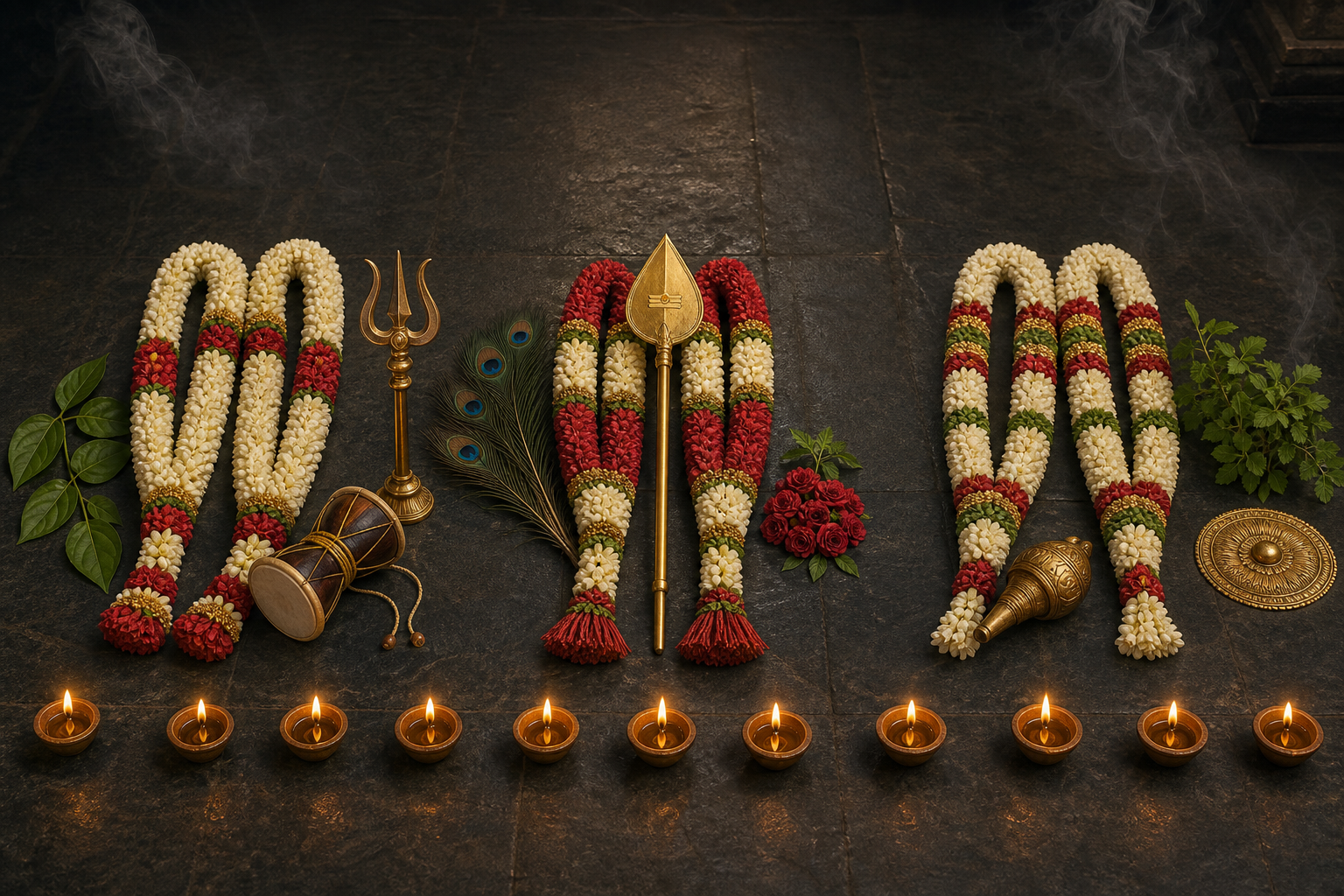
The sequence matters. Murugan’s valour does not end in self-glorification; it is followed by ordered relationship and responsibility. His vel represents jnana-shakti, the clarity that pierces ignorance, while the peacock evokes disciplined splendour rather than uncontrolled pride. For a devotee, the practical question is direct: after overcoming an obstacle, what duty are you now ready to accept?
Other major Murugan kshetras, including Palani, Tiruchendur, Thiruttani, Swamimalai, and Pazhamuthircholai, may mark the day with special abhishekam, alankaram, chariot processions, and the fulfilment of vows. Do not assume that every Murugan temple will reproduce Tirupparankundram’s programme. Read the local schedule before deciding which experience you want.
Ranganathar and Ranganayaki: sovereignty reunited with compassion
At Srirangam, Panguni Uthiram brings the Panguni Brahmotsavam to its emotional culmination through the serthi of Sri Ranganathar and Ranganayaki Thayar. Serthi means being together. The darshan places divine sovereignty beside maternal grace and compassion, showing why authority without tenderness is incomplete.
The programme can include abhishekam, oonjal or swing seva, and kalyanotsavam. If you attend, do not reduce the experience to seeing an ornate pair of utsava murtis. Notice what their togetherness teaches: justice must remain answerable to compassion, and power must make room for grace.
Across these lineages, the ritual grammar often includes sacred bathing, elaborate decoration, an exchange of garlands, the tying of the mangalyam, music, and procession. The shared form does not erase theological difference. You can honour all three traditions while allowing each temple to speak in its own Agamic idiom.
Confirm the local date and programme before travelling
A calendar graphic that gives one festival date for an entire country or diaspora is not enough for planning a temple visit. Panguni Uthiram depends on the local relationship between Purnima tithi and Uthiram Nakshatra. When they do not overlap exactly as a temple requires, one institution may prioritise the nakshatra while another follows the tithi or an established Agamic precedent.
Use this sequence before booking travel or promising family members a particular darshan:
- Consult a Panchang calculated for the temple’s location, not merely for your home city.
- Identify when Purnima tithi prevails locally.
- Check the beginning and ending times of Uthiram Nakshatra.
- Ask which criterion the temple follows when the two periods do not coincide throughout the day.
- Confirm whether the advertised event is kalyanotsavam, serthi sevai, abhishekam, procession, kavadi, or a combination of observances.
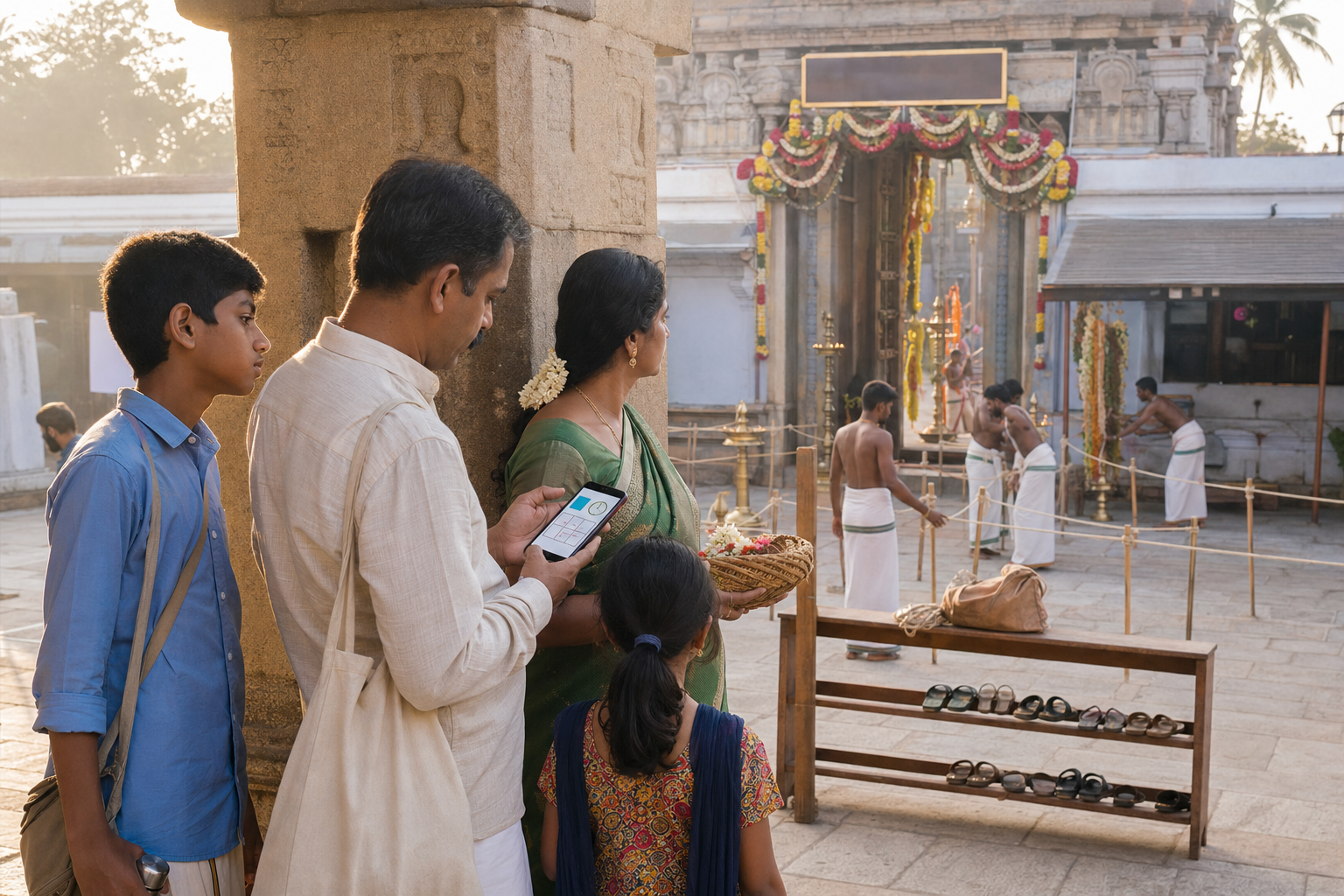
- Check queue arrangements, entry restrictions, dress expectations, and the reporting time for any registered offering.
This is particularly important at Srirangam, Tirupparankundram, Palani, and Tiruchendur, where Panguni Uthiram can bring heavy attendance. Arriving early protects more than your place in a queue. It gives you enough time to enter the temple calmly, follow instructions, and receive darshan without turning a sacred journey into a contest with the crowd.
If travel is not possible, look for a broadcast issued by the temple or its trust. You can make a sankalpa at home, follow the kirtan or kalyanotsavam, and offer prayer without pretending that a screen reproduces physical pilgrimage. Participation can be sincere without being identical.
Build a home observance around a clear sankalpa
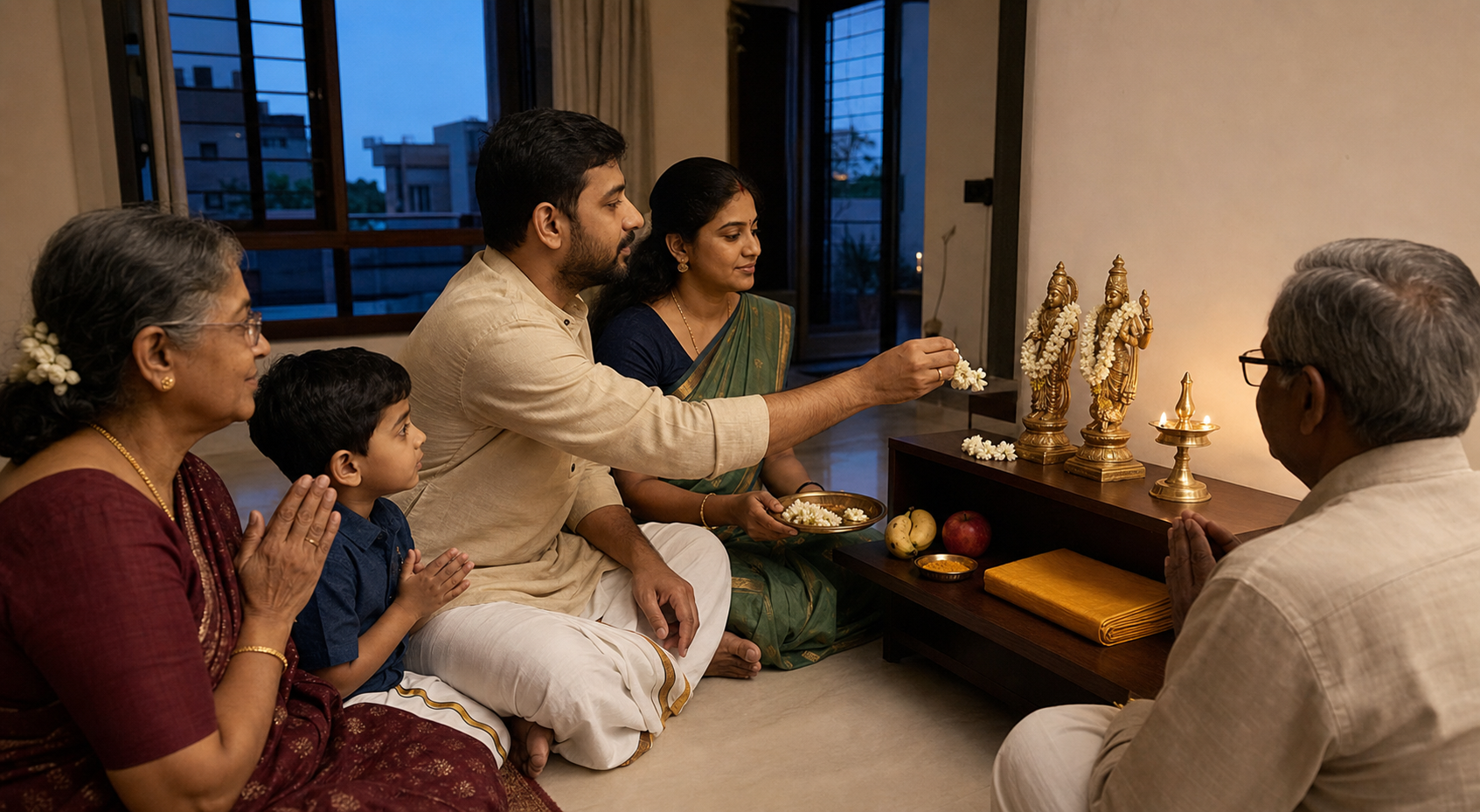
You do not need to imitate a full Agamic kalyanotsavam at home. Temple ritual belongs under the direction of the relevant priests and institutional tradition. A household vrata is better kept simple, attentive, and within the practice your family actually knows.
- Choose the form of the Divine you will worship. This may be Shiva and Parvati, Murugan and Deivayanai, or Ranganathar and Ranganayaki, according to your sampradaya and family custom.
- State one precise sankalpa. Name the relationship or duty you wish to strengthen and the conduct you will undertake.
- Prepare a clean place of worship. Light a lamp and offer flowers, fruit, or another simple sattvic offering appropriate to your custom.
- Recite what you understand. Use a familiar stotra, nama-japa, kirtan, or Murugan hymn from the Tiruppugazh tradition rather than rushing through a long text only for display.
- Keep the vrata with moderation. If your custom includes fasting or a sattvic meal, follow a form suitable for your circumstances. Austerity is not improved by making yourself unsafe.
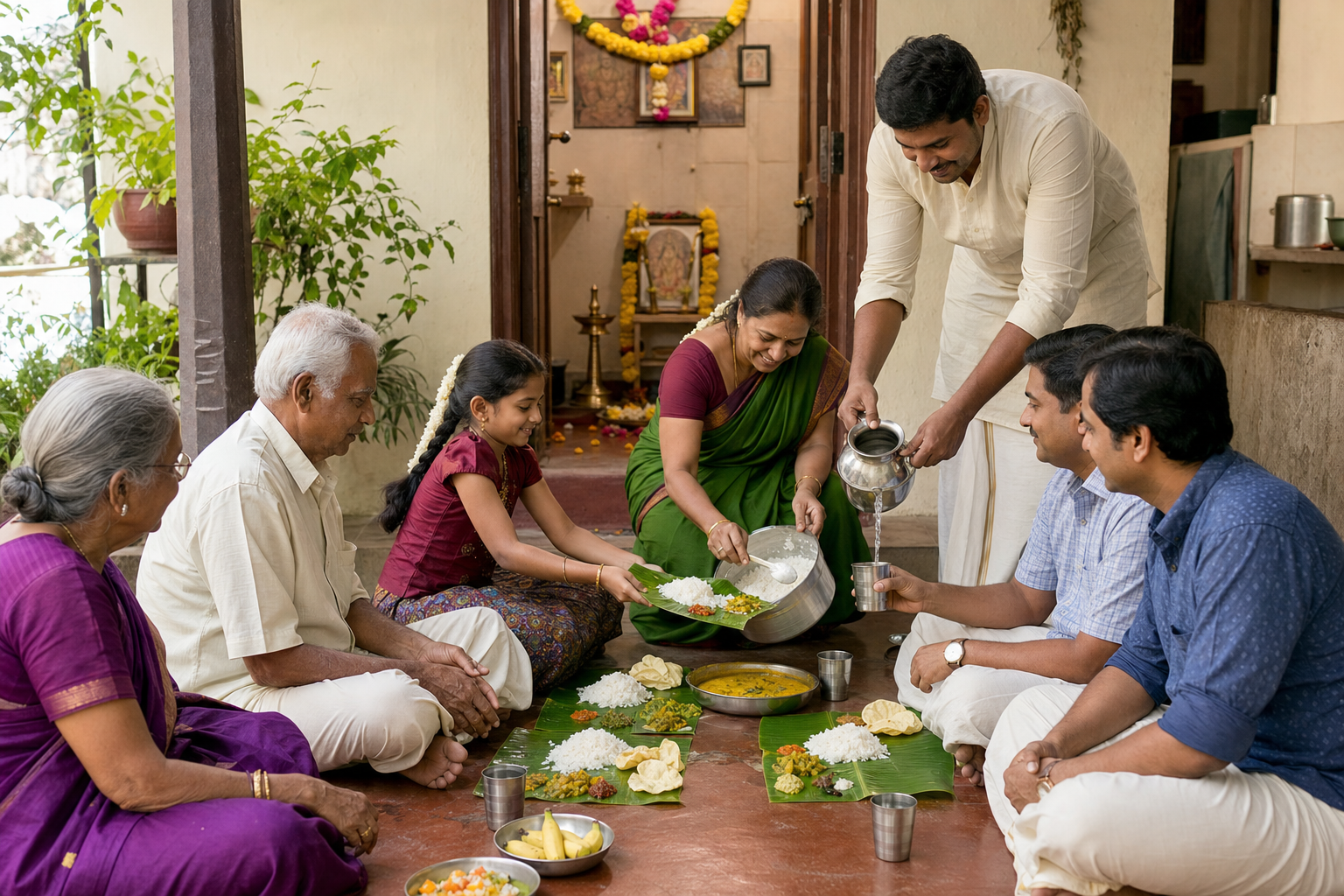
- Complete the observance through giving. Share prasadam, offer annadanam, help a family in need, or support a responsible community initiative.
Couples can use the day to renew their commitment, but the renewal should be more concrete than repeating affectionate words. Each person can name one responsibility they will carry more faithfully during the coming weeks, then invite the blessing of elders where that is healthy and appropriate. This is a contemporary household application of the festival’s ethic, not a replacement for a traditional marriage samskara or temple kalyanotsavam.
Unmarried devotees are not outside the festival. Divine marriage concerns the ordering of many bonds: teacher and student, parent and child, individual and community, power and compassion, knowledge and action. Your sankalpa may therefore concern friendship, family reconciliation, seva, or readiness for future responsibility rather than a request for marriage.
For children, choose one visible ritual and explain its meaning. The garland can represent willing acceptance; abhishekam can teach purification; the mangalyam can open a discussion about enduring obligation; Murugan’s vel can represent clear discernment. One symbol understood well will remain with a child longer than a crowded list of unexplained names.
Kavadi, paal kudam, and other vow-fulfilment practices are prominent in many Tamil communities across Sri Lanka, Malaysia, Singapore, Mauritius, Réunion, and South Africa. Some communities also practise piercing. Do not improvise an invasive austerity or treat pain as proof of superior bhakti. Temple committees increasingly guide devotees toward safe, non-injurious expressions of a vow that preserve devotion while respecting ahimsa and public health. If you are uncertain, seek direction from the temple and choose a symbolic kavadi, prayer, disciplined service, or another non-injurious offering.
Panguni Uthiram also offers a careful way to speak about the wider Dharmic family. Hindu, Buddhist, Jain, and Sikh traditions each preserve distinct doctrines and ritual worlds; they should not be flattened into one theology. Yet the festival’s concern with wisdom joined to compassion, strength restrained by responsibility, and private discipline expressed through service can help you recognise genuine moral kinship without erasing difference.
Key takeaways
- Panguni Uthiram honours several divine unions. Identify the deity and lineage of the temple before assuming what its celebration will include.
- Shiva-Parvati Kalyanam emphasises consciousness and Shakti; Murugan-Deivayanai Kalyanam joins victory to duty; the Srirangam serthi brings sovereignty together with compassion.
- Use a location-specific Panchang and the temple’s own programme because tithi, nakshatra, and institutional practice can produce different local timings.
- A useful household sankalpa names both the blessing you seek and the responsibility you will accept.
- Keep vows proportionate and safe. Symbolic, non-injurious offerings can preserve the devotional core of kavadi and austerity.
- Let worship move outward through prasadam, annadanam, family responsibility, or practical help for someone beginning household life.
Before the festival, do two things: confirm the observance with the temple you intend to follow, and write your sankalpa in one sentence. When Panguni Uthiram arrives, you will know not only which divine marriage you are witnessing, but which bond in your own life you have come prepared to honour.
References
