
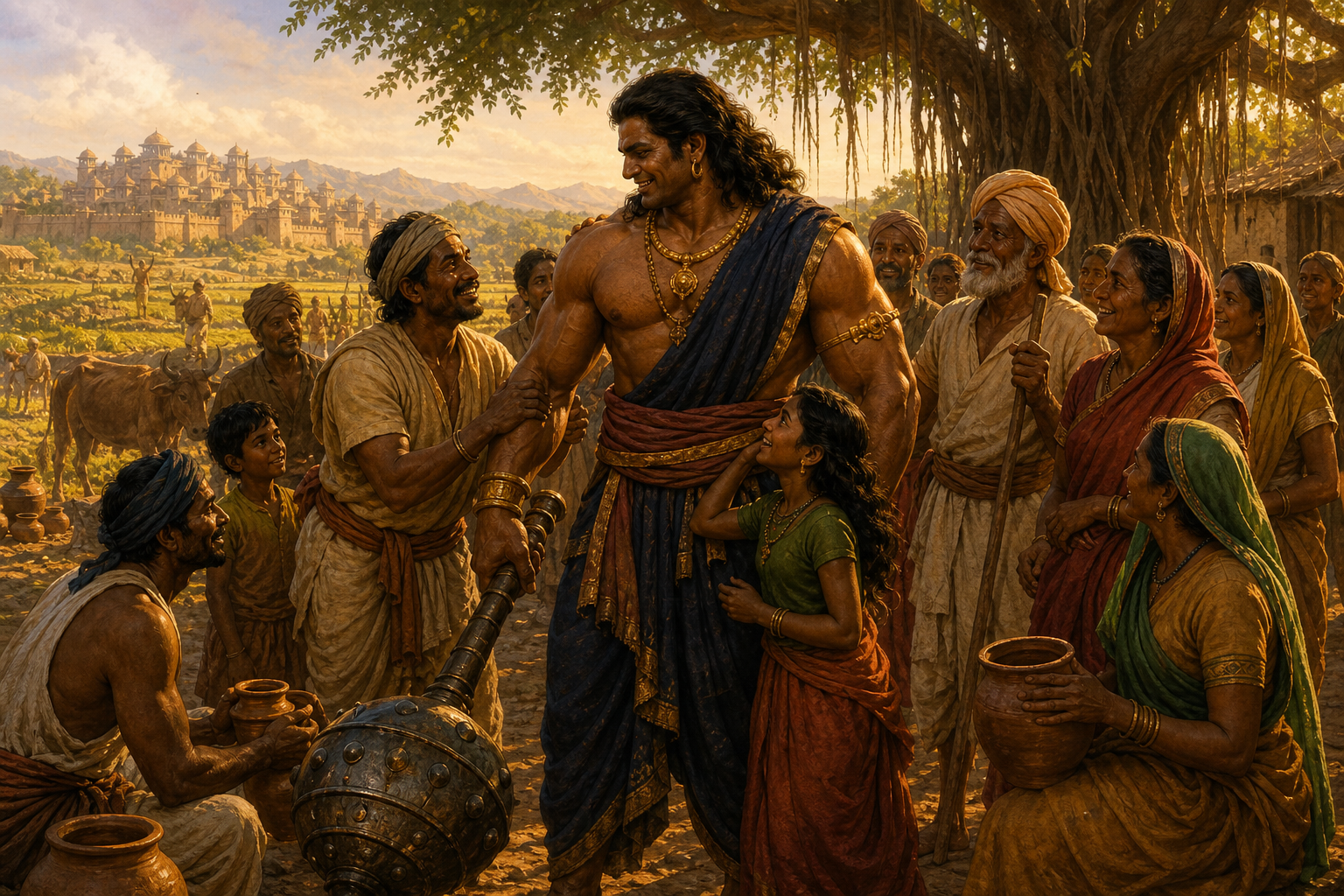
If you have wondered why Bhima is so often felt as the Pandava of the people, start with the kind of response each brother invites. Yudhishthira commands reverence. Arjuna inspires awe. Nakula and Sahadeva attract admiration. Bhima captures ordinary hearts. That is not a lower form of greatness. It is a different bond between hero and listener.
This distinction matters when you read, teach, stage, or retell the Mahabharata. A folk hero need not be the most polished figure or the one held at the greatest distance. He becomes the person through whom courage feels physical, emotion becomes audible, and questions of dharma come close enough to test against daily life.
Folk hero describes nearness, not rank
Calling Bhima a folk hero does not remove him from the Mahabharata or place him beneath its other heroes. The phrase describes a relationship with an audience. Some heroes are approached through reverence. Others are contemplated as models of exceptional skill. A people’s hero feels close enough to be claimed.
Bhima’s presence is difficult to make remote. He is the second-born Pandava, mighty in body and expansive in manner. His strong arm can be seen; his loud laugh can be heard. He does not depend on a veil of refinement to establish his importance. His heroism arrives through the body and occupies the shared world.
That gives you a useful test for any portrayal of Bhima: does it let him remain near, or does it turn him into a spectacle?
- If a retelling presents only displays of strength, Bhima becomes a strongman rather than a folk hero.
- If it polishes away his earthiness, it removes the quality that makes him approachable.
- If it keeps physical power, audible emotion, and plain presence together, you can see why affection gathers around him.
The difference is important. A spectacle is watched from outside. A folk hero allows people to recognize something of themselves, even when his capacity is far beyond theirs.
The brothers reveal four different kinds of greatness
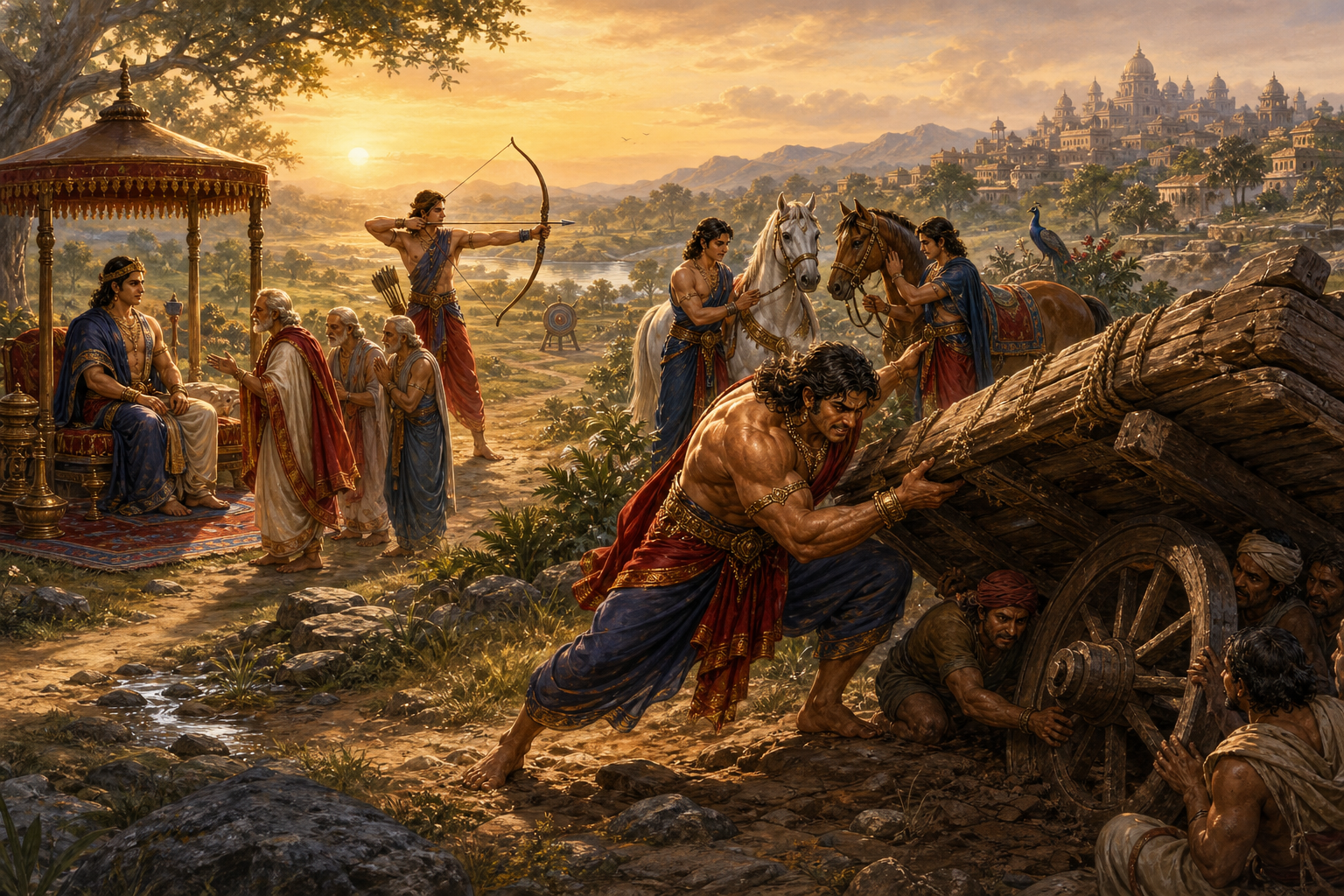
Bhima’s popular appeal becomes clearer when you resist turning the Pandavas into a simple ranking. The brothers do not need to produce the same emotional response. Their differences give the epic more than one language of heroism.
| Brother or brothers | Response they invite | What to notice |
|---|---|---|
| Yudhishthira | Reverence | Authority can place a figure above the audience and create moral distance. |
| Arjuna | Awe | Exceptional ability can make a figure admirable precisely because he seems uncommon. |
| Nakula and Sahadeva | Admiration | Attention rests on qualities worthy of appreciative regard. |
| Bhima | Heartfelt attachment | Embodied presence makes the heroic figure feel nearer to ordinary life. |
This is not a scoreboard. Reverence, awe, admiration, and affection are not interchangeable prizes. They are different ways an audience encounters greatness. Bhima matters because the Mahabharata has room for the hero you love as well as the hero before whom you stand in wonder.
When you introduce the brothers to a child, a new reader, or a discussion group, do not begin with “Who is the greatest?” Ask instead, “How does each brother make you feel?” That question reveals why Bhima can command popular loyalty without requiring the others to become smaller.
Bhima’s earthiness makes moral power visible
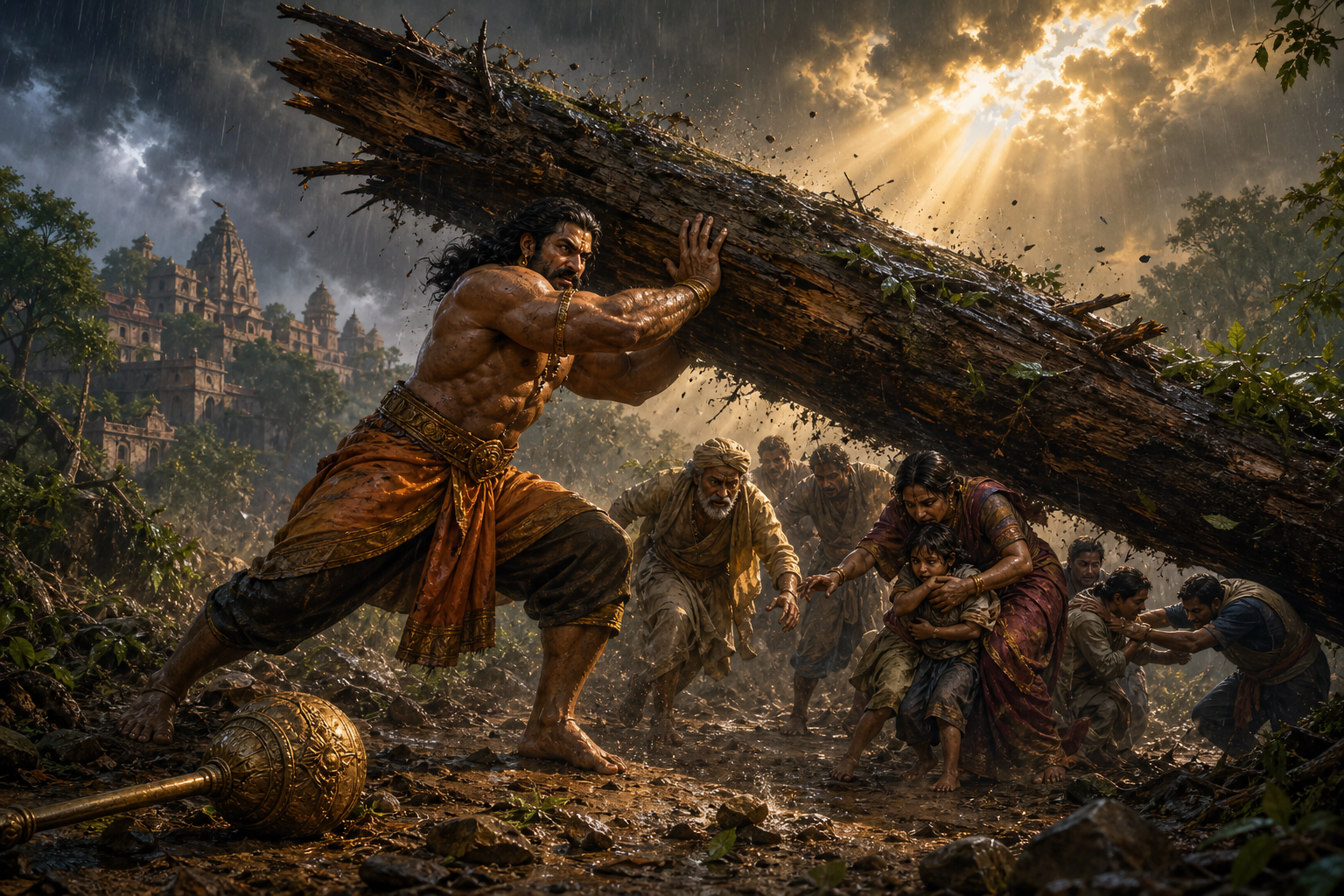
Earthiness is not the opposite of sacredness. It means that a figure remains connected to bodily presence, open emotion, and recognizable human temperament. Bhima is not wrapped in silk-like sophistication. His power is immediate, and his laughter refuses concealment.
This openness creates moral visibility. A distant hero can remain an ideal. An earthy hero must be judged in motion: what does his power serve, what does his emotional force reveal, and what happens to the people around him? You are not asked merely to admire strength. You are invited to examine strength at work.
Three common reductions get in the way:
- Bluntness is not automatically righteousness. A visible impulse may be easier to understand, but it still has to be measured against dharma and consequence.
- Physicality is not moral inferiority. Treating bodily power as crude merely replaces one shallow judgment with another.
- Popular affection is not simplistic. Ordinary listeners can value a hero because his capacities, feelings, and tensions are legible rather than hidden behind polish.
The better question is not whether Bhima is a flawless ideal. It is what becomes visible about dharma when immense power belongs to someone emotionally recognizable. That question preserves both his greatness and his humanity.
Key takeaways for reading Bhima
- “Folk hero” describes Bhima’s closeness to an audience, not a lower place in the Mahabharata.
- His appeal becomes clearest beside his brothers: reverence, awe, admiration, and affection are distinct responses to distinct forms of greatness.
- His mighty arm and loud laugh belong to one public, embodied presence. Isolating the muscle flattens the character.
- Earthiness is neither automatic virtue nor automatic vice. Ask what power serves and what consequences follow.
- A strong retelling allows Bhima to be extraordinary without making him emotionally inaccessible.
Put this lens to work in the next retelling
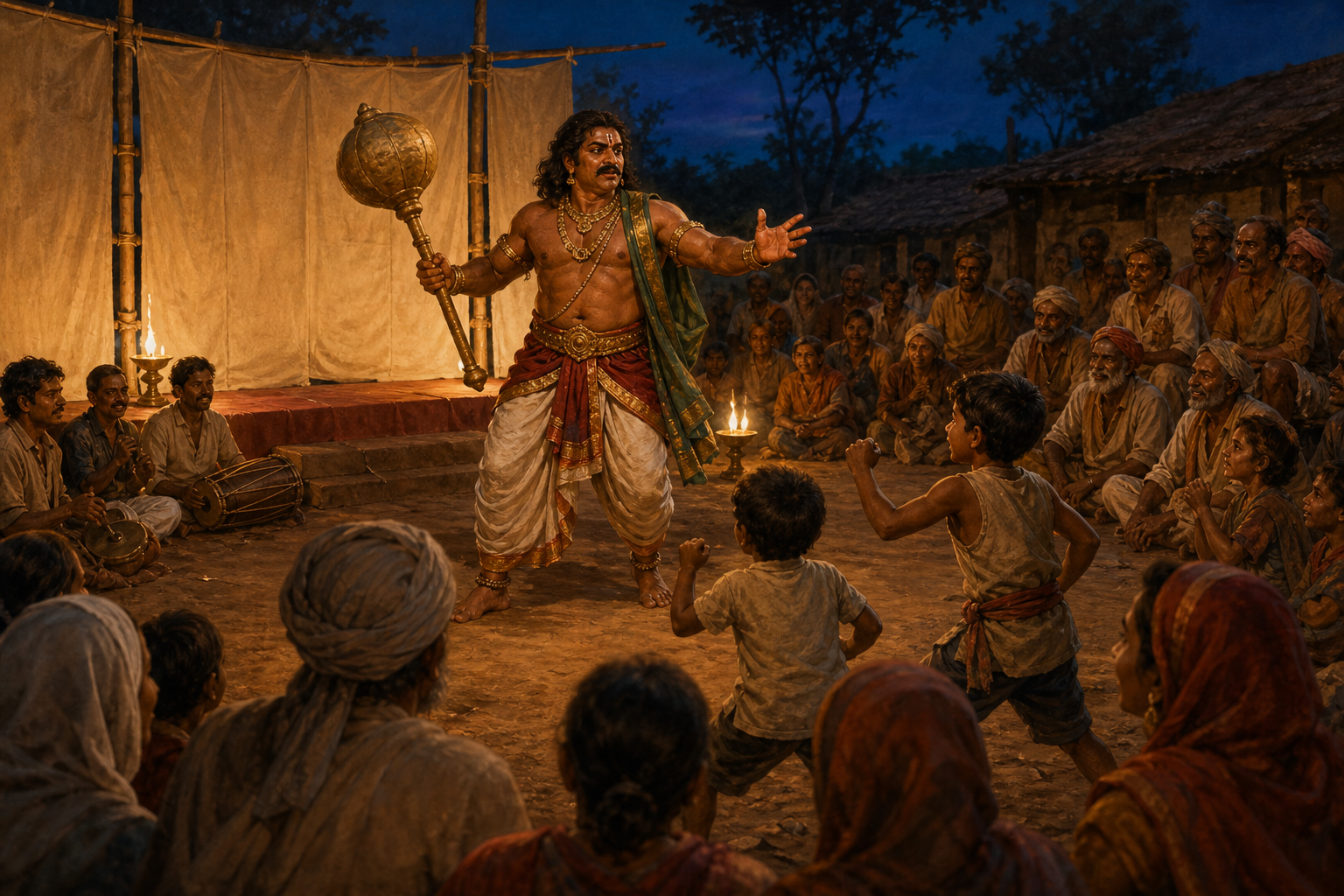
Whether you are reading a translation, watching a performance, hearing an oral narration, or preparing your own lesson, use this five-part check:
- Name the audience response. Does this Bhima inspire affection, fear, amusement, awe, or only amazement at his strength?
- Mark how his presence is created. Notice the treatment of body, voice, laughter, movement, and polish. Separate what the scene actually presents from what an adaptation adds.
- Ask what the strength is for. Power becomes morally meaningful through its object, restraint, and consequences, not through size alone.
- Compare one brother. Place Bhima beside Yudhishthira, Arjuna, Nakula, or Sahadeva in the same retelling. The contrast will show whether the storyteller understands Bhima’s distinctive appeal.
- Inspect the end of the scene. If every appearance ends with applause for force, the portrayal is probably flattening him. Look for the human or moral meaning left after the display.
For a family or reading-group conversation, try three questions: Which Pandava feels closest to you? Which one do you admire most? Are they the same person? The answers usually expose the difference between excellence viewed from afar and heroism held near the heart.
The next time Bhima enters a story, do not begin by asking whether he is the best Pandava. Watch what happens to the distance between the epic and its listeners. If that distance suddenly closes, you have found the source of his folk power.
References
