
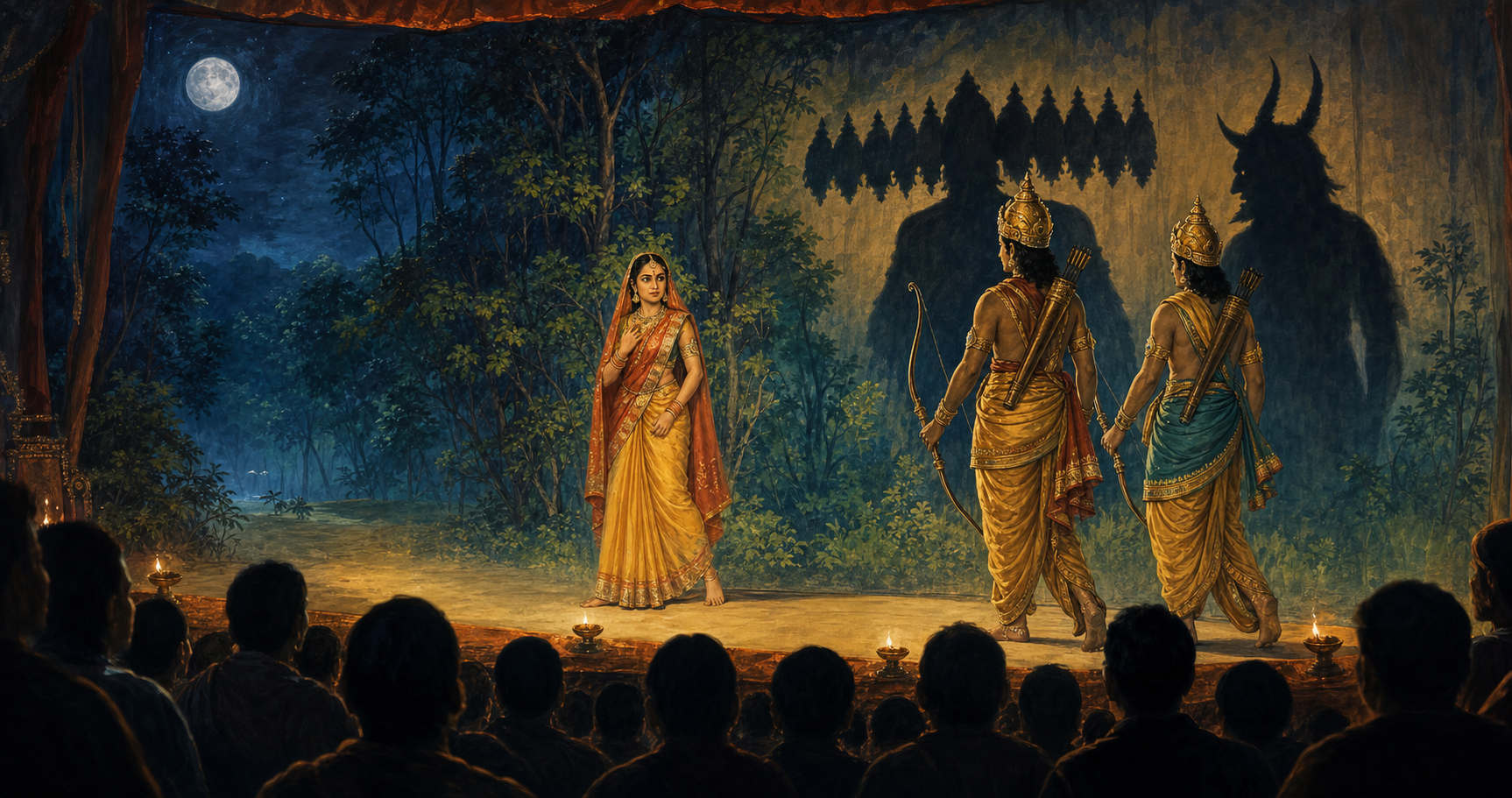
If you have seen a stage scene in which figures resembling Rama and Lakshmana approach Sita, only to be revealed as Ravana, Maricha, or demonic illusions, you may wonder whether the episode is scriptural or a later invention. The precise answer is that it belongs to the wider, living Ramayana tradition, but it is not the abduction sequence found in Valmiki’s Ramayana.
That distinction lets you take regional tellings seriously without attributing every remembered scene to the Sanskrit narrative. It also opens the deeper question these performances want you to face: how do you recognize dharma when adharma has learned to copy its face, voice, and signs?
Begin with what happens in Valmiki’s forest narrative
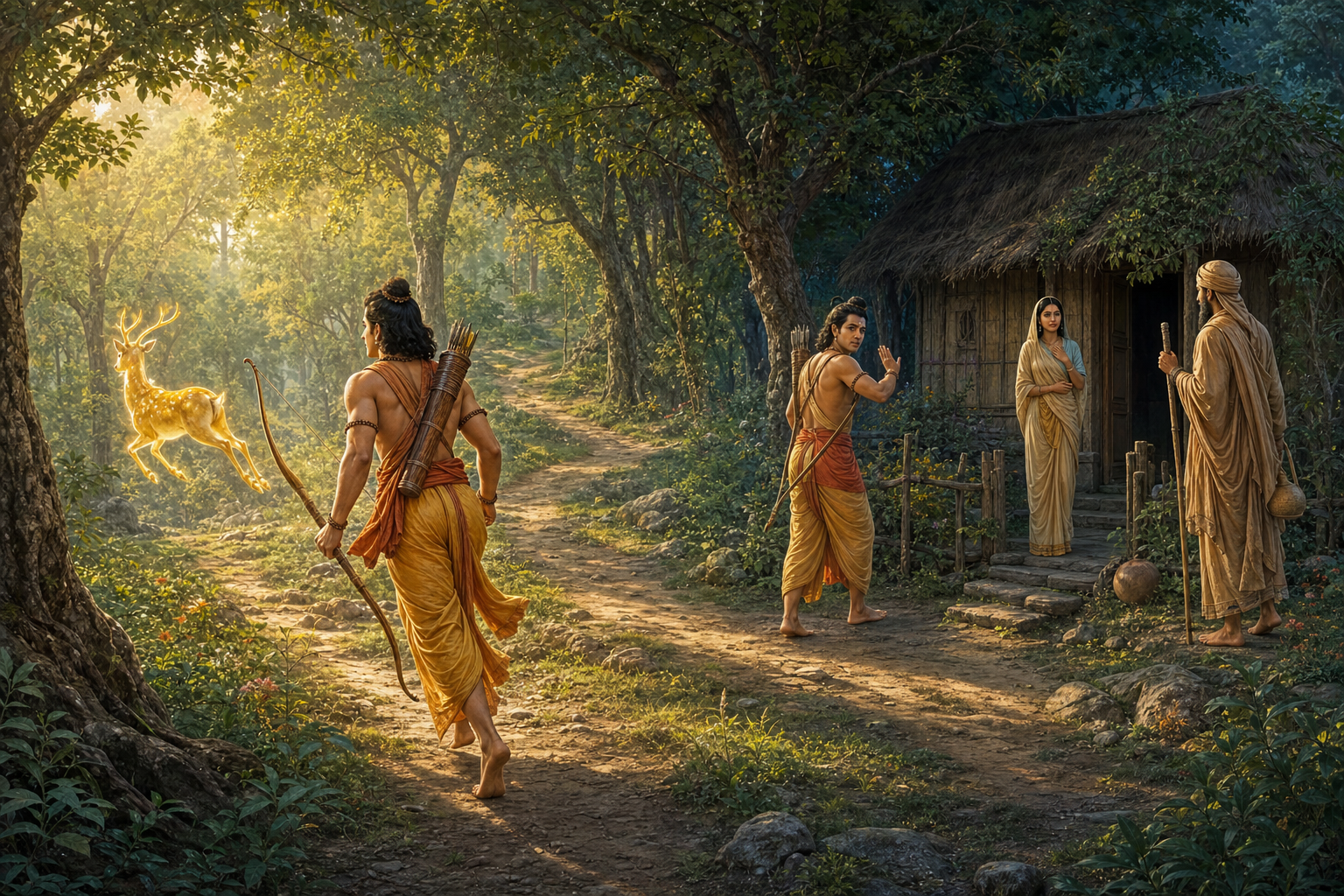
In the Aranya Kanda of Valmiki’s Ramayana, Maricha becomes the golden deer and draws Rama away from the forest dwelling. After Rama strikes him, Maricha imitates Rama’s voice and calls to Lakshmana. Sita hears what seems to be her husband’s cry of distress and insists that Lakshmana go to him.
Ravana arrives after Lakshmana leaves. His disguise is that of a mendicant brahmana, not Rama or Lakshmana. He exploits the obligation to receive an ascetic visitor, reveals himself, and abducts Sita. The deception therefore has several carefully ordered parts: an alluring animal form, separation of the protectors, imitation of a trusted voice, and abuse of a sacred social role.
The famous Lakshmana-rekha is also absent from this Valmiki sequence. Its place in popular memory comes from later retellings and performances that make the threshold itself morally and visually important. A remembered boundary, like a remembered Rama-lookalike, may be traditional without belonging to the Valmiki text.
This gives you a reliable first judgment. The claim that Ravana physically becomes Rama during Sita’s abduction is incorrect if someone attributes it specifically to Valmiki’s Ramayana. The broader claim that demonic figures impersonate or project Rama-Lakshmana forms in some regional Ramayana traditions is plausible, provided the speaker identifies the local narration, script, or performance lineage.
Three different kinds of deception are often confused
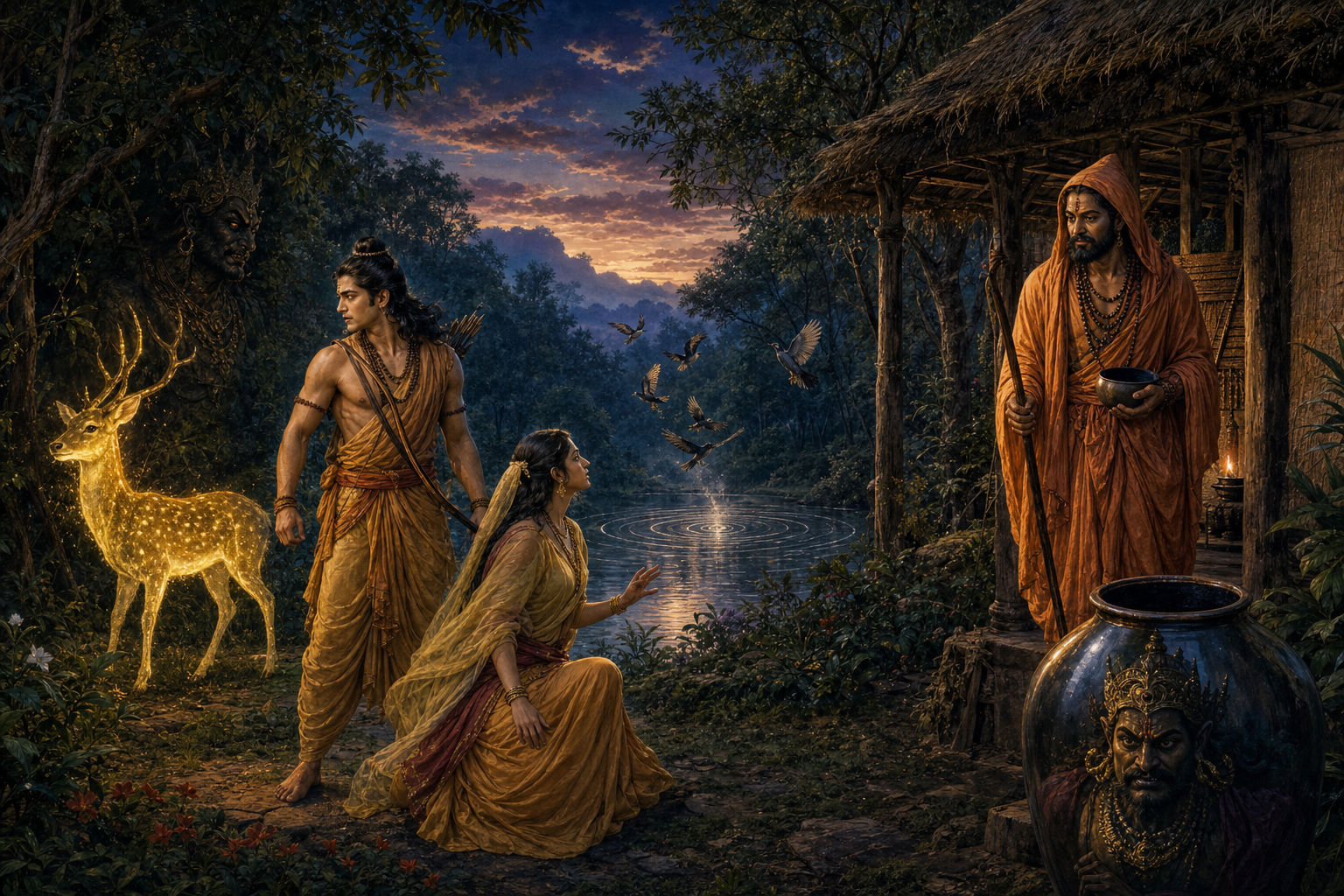
People often compress several dramatic devices into the statement that Ravana disguised himself as Rama. Before accepting or rejecting that statement, determine what kind of deception actually occurred.
| Device | What the audience encounters | Where it stands in the tradition |
|---|---|---|
| Voice impersonation | Maricha uses Rama’s voice without taking Rama’s bodily form. | Firmly present in the Valmiki abduction sequence. |
| Conjured image or phantasm | A false head, double, vision, or semblance is produced to break confidence or morale. | Prominent in later battle narratives, especially in Bengali and other vernacular environments shaped by demonic sorcery. |
| Full-bodied impersonation | A demonic figure or magical projection appears as Rama or Lakshmana and approaches Sita or deceives others. | Most strongly associated with scattered oral narratives, localized scripts, and stage traditions rather than the principal Sanskrit abduction account. |
These devices are related, but they are not interchangeable. A golden deer demonstrates shapeshifting, yet it is not an impersonation of Rama. A false head creates the appearance of death, yet it is not necessarily a character walking and speaking as a hero. A performer wearing Rama’s visible form may represent Ravana himself, another demon, or a projected illusion. The identity of the deceiver can also vary between local scripts.
When you encounter an unfamiliar version, ask three concrete questions: What exactly did Sita hear? What exactly did she see? Was the figure a transformed demon, a magical projection, or a theatrical representation of deception? Those questions usually resolve an apparent contradiction more quickly than debating whether the scene is simply real or invented.
Regional traditions prepare the stage in different ways
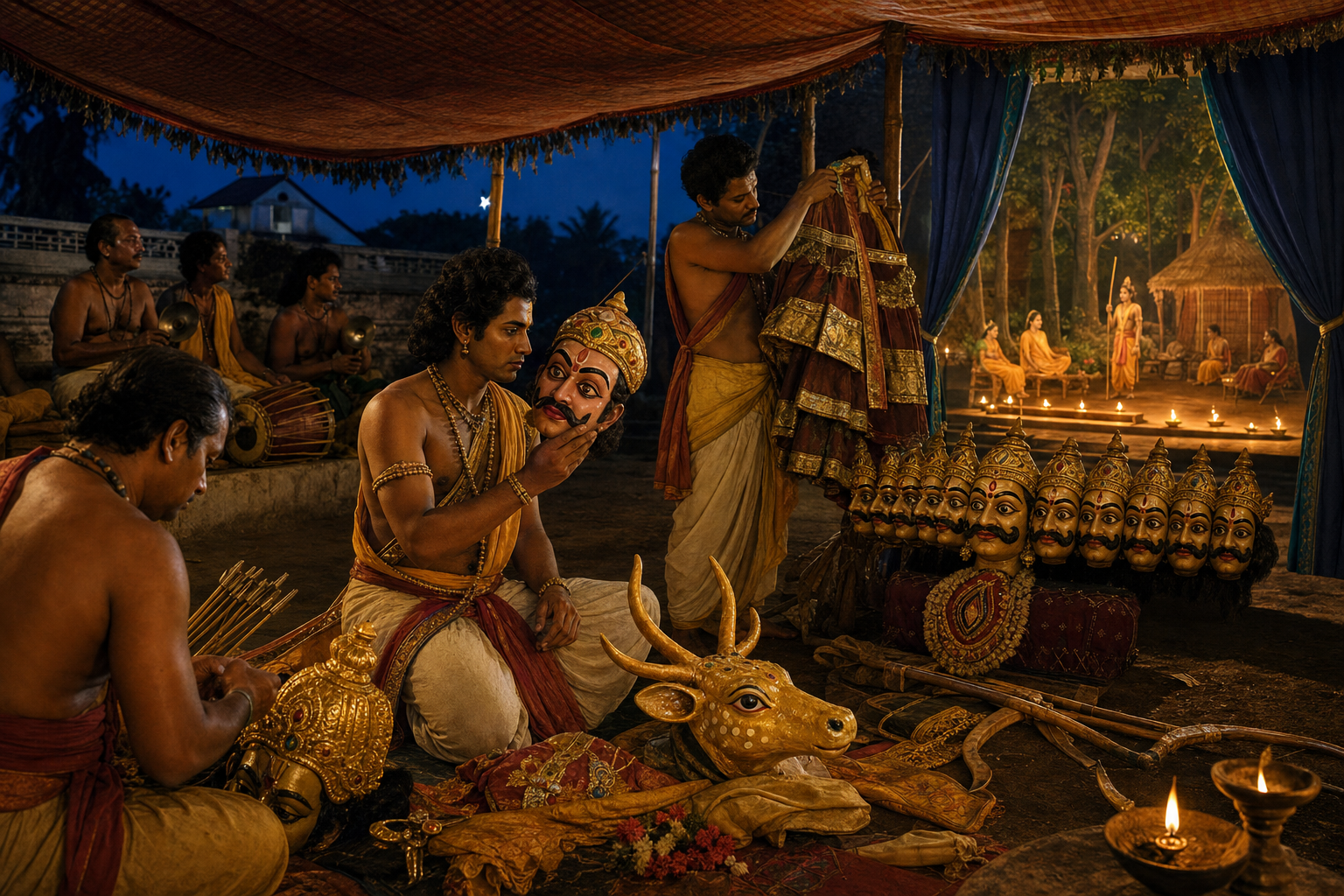
Regional Ramayanas do not form a single alternative text. A vernacular poem, a village recitation, a temple production, and a modern stage adaptation can share a language and still present different episodes. Direct impersonation must therefore be located at the level of the particular work or performance, not assigned vaguely to the Bengali, Odia, Tamil, or Southeast Asian Ramayana as a whole.
Eastern traditions make demonic semblance dramatically natural
In the Bengali Krittivasi environment, demonic forces can fabricate convincing images of the heroes and their apparent remains. Indrajit’s false visions and doubles make magical counterfeit a familiar part of the story’s dramatic language. That does not mean Ravana consistently appears as Rama in the Krittivasi poem. It means later Bengali folk performers could stage such an impersonation without making it feel alien to an audience already accustomed to demon-made likenesses.
Odia traditions associated with the Jagamohana or Dandi Ramayana of Balarama Dasa give particular force to the threshold, the deceptive visitor, and the ethics of crossing. Some locally transmitted performances take the next theatrical step by presenting or suggesting a demonic imitation of the heroes. If you are identifying such a scene, describe it as an Odia performance variant unless you can verify that its dialogue and action occur in a named textual recension.
Northern and southern texts establish possibility without all containing the disguise
In the Ramcharitmanas, demonic illusion becomes especially visible in the war narrative through Indrajit’s sorcery. North Indian katha, natak, and folk theatre inherit an imaginative world in which appearances can be deliberately manufactured. A local stage scene with a false Rama may grow within that world even though Ravana does not take Rama’s form during the Manas abduction sequence.
In Kamban’s Tamil Iramavataram, Maricha remains the deer and Ravana retains the ascetic disguise. The poetry intensifies wonder, fear, shapeshifting, and verbal manipulation, giving later performers ample dramatic material without supplying a literal Ravana-as-Rama encounter at Sita’s dwelling. Here again, thematic permission should not be mistaken for textual occurrence.
Malayalam devotional tradition adds a different kind of double through the Maya-Sita doctrine. In this theological framing, the abducted Sita is a projected counterpart while the real Sita remains protected through Agni. That is an ontological safeguard, not the same device as Ravana impersonating Rama. Both question the reliability of appearances, but they protect or deceive different persons for different purposes.
Sanskrit and Southeast Asian performance distinguish text from spectacle
In Sanskrit dramas associated with Bhavabhuti and Murari, illusion often works through voices, visions, misrecognition, and conjured tableaux. A literal face-to-face impersonation of Rama before Sita is not the dominant device. The important inheritance is a dramatic grammar in which spectators must judge what is present, what is projected, and what only appears to have happened.
Thai and Cambodian Ramayana worlds, represented by the Ramakien and Reamker, make that grammar physically powerful through dance-drama. Khon and Lakhon can use masks, codified movement, and lookalike forms to turn tactical illusion into visible action. A production may place a Rama- or Lakshmana-like figure before the audience even when the corresponding manuscript does not describe Ravana personally assuming that body.
This is why a video clip alone rarely establishes a textual claim. To identify it responsibly, note the language, production form, character revealed beneath the disguise, and position of the scene. An impersonation before the abduction performs different narrative work from a false image shown during the war.
Why performance pushes the deception further
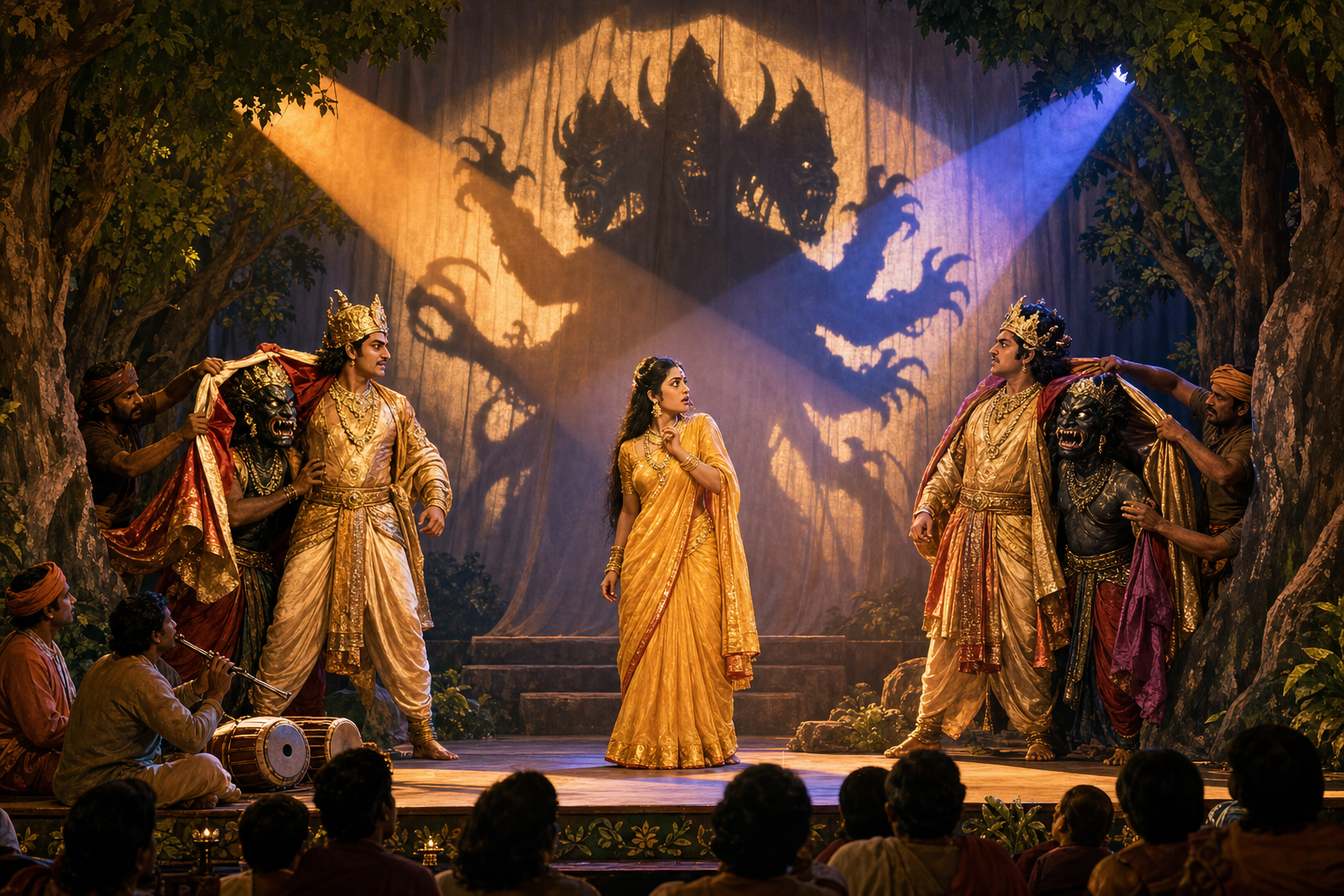
Voice mimicry is potent in recitation, but theatre needs an image that can reach the back of a courtyard. Placing adharma inside Rama’s recognizable form makes the danger legible at once. Costume, mask, gait, gesture, and music can tell the audience that the sacred image has been copied even while Sita, or another character within the scene, has not yet recognized the deception.
The device also creates a special kind of tension. Wonder arises because the transformation seems impossible. Terror comes from seeing a trusted form become unsafe. Pathos grows because the audience understands the trap while the person inside it must decide using incomplete evidence. The scene therefore brings adbhuta, bhayanaka, and karuna into the same dramatic moment.
More importantly, bodily impersonation moves the conflict from outer combat to inner discernment. Rama can defeat an open enemy with weapons. Sita facing a persuasive appearance must distinguish satya from maya while balancing hospitality, loyalty, urgency, and caution. The antagonist’s weapon is no longer brute strength; it is intelligence detached from righteous purpose.
That point should not be turned into blame directed at Sita. The trap works because several obligations and affections are manipulated in sequence: concern for Rama, trust in a familiar voice, pressure on Lakshmana, respect for an ascetic guest, and the vulnerability created by physical separation. The ethical warning is about organized deception exploiting virtues, not about virtue itself being foolish.
The Maya-Sita strand responds at another level. Where that doctrine is accepted, appearances may be violated while Sita’s true being remains untouched. This protects her sanctity while permitting a narrator or performer to explore increasingly audacious forms of illusion. It should be presented as a theological interpretation within particular devotional traditions, not imposed on every Ramayana.
You can also recognize a wider dharmic resonance without claiming that every tradition narrates the same episode. Buddhist accounts of Mara’s illusions direct attention toward mindfulness and prajna. Jain Ramayana retellings such as Vimalasuri’s Paumacariya shift moral weight toward intention, self-mastery, and ahimsa. Sikh emphasis on sat and bibek-buddhi likewise places discerning intellect above persuasive appearance. These are ethical parallels, not evidence that one shared disguise scene occurs in every tradition.
Key takeaways for discussing the episode accurately
- Do not attribute a physical Ravana-as-Rama disguise to the abduction sequence in Valmiki’s Ramayana. Maricha imitates Rama’s voice, while Ravana appears as a mendicant brahmana.
- Do not dismiss every Rama-Lakshmana impersonation as a modern fabrication. Full-bodied doubles occur most credibly in localized oral, theatrical, and dance-drama traditions.
- Separate voice imitation, conjured images, and bodily impersonation. They belong to one family of maya motifs but are not the same event.
- Do not assume that a famous vernacular text contains every scene performed in its language. A performance may extend the text’s established logic of illusion.
- Name the medium and locality whenever possible: poem, recension, katha, jatra, village play, temple theatre, Khon, Lakhon, or another identified form.
- Read the disguise as an ethical test of discernment, not as an excuse to fault Sita for a deception designed to weaponize loyalty and hospitality.
If you need one careful sentence for a caption, classroom, or discussion, use this: In some localized Ramayana performance traditions, demonic figures assume or project the forms of Rama and Lakshmana, but in Valmiki’s abduction narrative Maricha copies Rama’s voice and Ravana comes disguised as an ascetic.
The next time you encounter the scene, record its language, medium, and dramatic setting before assigning it to a scripture. That small act preserves both textual accuracy and the creative authority of the community that keeps the Ramayana alive.