
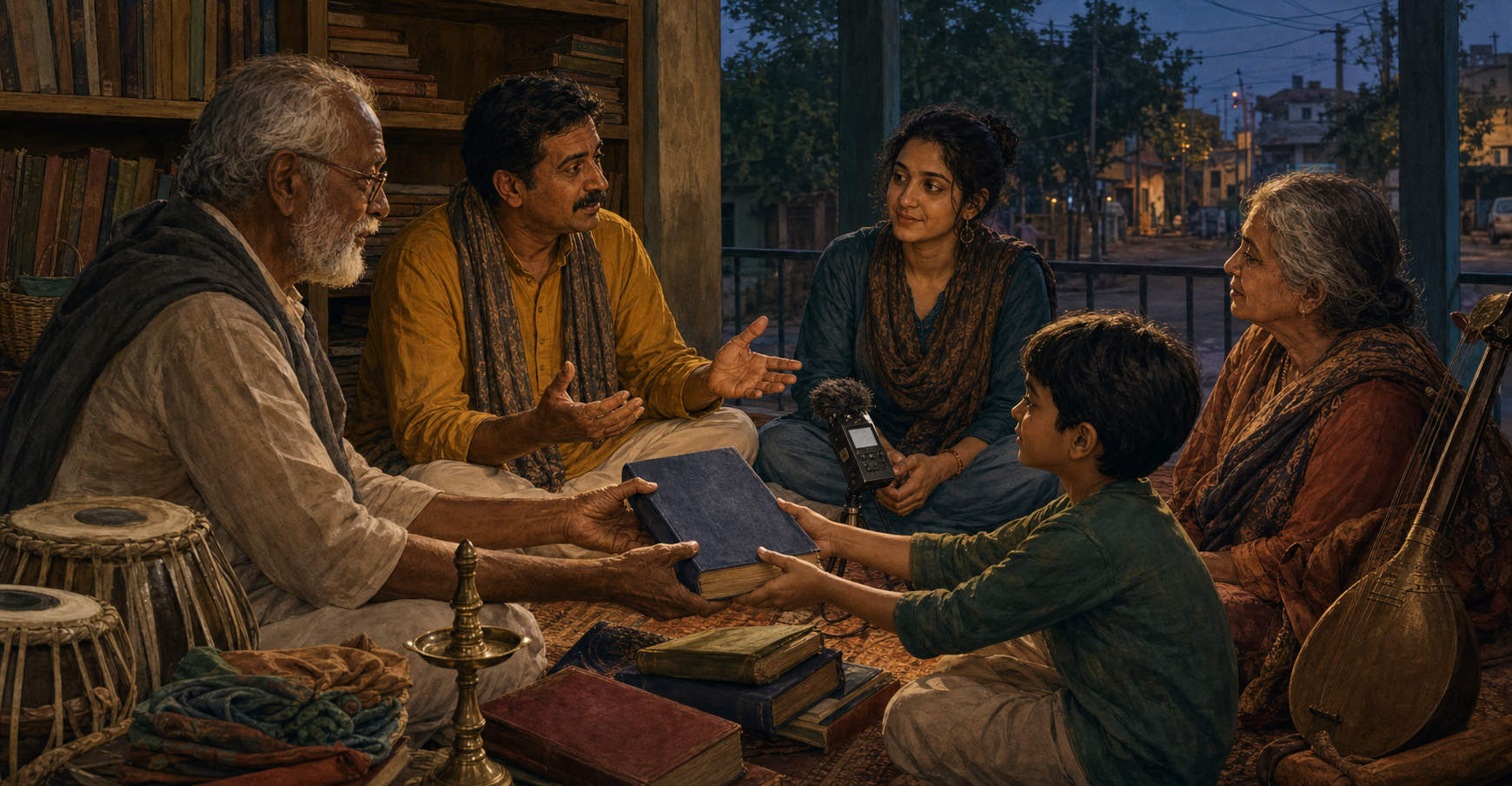
You may know a prayer, hymn or sacred story in English yet hesitate when you meet it in the language of your family or region. That gap can feel personal, but it has a public consequence: when a community can no longer read, interpret or transmit its spiritual inheritance for itself, authority moves to whoever controls the translation, curriculum, archive or platform.
You don’t need perfect fluency to reverse that movement. Start with a short work that matters to you, learn to sound it and understand it, then create a regular setting in which somebody else can receive it. Vernacular literacy becomes cultural resistance when knowledge returns to circulation.
Reading in your own language restores interpretive authority
A translation can open a door. It cannot carry every association, rhythm, pun, technical term or devotional register of the language from which it came. The problem is not translation itself. The problem begins when translation becomes the community’s only door and nobody nearby can examine what has been admitted, softened or left outside.
Vernacular literacy redistributes that authority. A reader who can compare the original wording with a translation can ask why a term was rendered in a particular way. A family that can read an inherited script can identify a manuscript or inscription without waiting for an outside intermediary. A congregation that understands its own vocabulary can discuss doctrine, ethics and history rather than merely repeat a supplied interpretation.
Bharat’s indigenous literacy was never confined to a single language or institution. It included gurukulas and pathshalas teaching Sanskrit and regional languages, Jain pathshalas preserving traditions of reasoning, Buddhist viharas sustaining Pali scholarship, and Sikh institutions cultivating Gurmukhi literacy. These settings were not interchangeable. Their philosophies and disciplines remained distinct. Yet each placed a community close to the language in which it remembered, reasoned and worshipped.
If you are relearning such a language, don’t measure success only by conversational fluency. Spiritual literacy has several useful levels. You can learn to recognize the script, pronounce a passage, identify its central terms, compare interpretations and explain its practical meaning. Each level reduces dependence on second-hand summaries.
Use a layered reading page for every passage you study:
- Write or print the passage in its original script.
- Add transliteration only as a temporary bridge, not as a permanent replacement for the script.
- Give difficult words a plain-language gloss before attempting a polished translation.
- Record who explained the passage and which lineage, school or regional usage informed that explanation.
- End with a sentence about how the teaching changes conduct, attention or duty in ordinary life.
This method keeps pronunciation, meaning and context together. It also makes disagreement visible. When two traditions interpret a term differently, preserve both attributions instead of forcing a convenient synthesis.
Spiritual literature survives because people perform it
Spiritual literature is unusually durable because it doesn’t live only on a shelf. It is recited at dawn, sung in congregations, remembered through stories and repeated during rites of passage. Its language becomes attached to melody, gesture, place and moral instruction. A person who cannot read a philosophical treatise may still carry a verse heard from a parent or granthi, a monk or teacher, a singer or storyteller.
That is why the choice of language matters. When a teaching enters the speech of ordinary people, it can travel beyond courts, universities and specialist circles. Mian Muhammad Bakhsh, the nineteenth-century Sufi poet associated with Khari Sharif, wrote in Punjabi and Pahari-Pothwari while drawing on Arabic and Persian learning. His Saif-ul-Malook carried an inward journey through oral recitation, communal singing and the familiar landscapes and idioms of the Punjab-Kashmir region. The example belongs to a Sufi lineage, not to a Dharmic sampradaya, but its method illuminates a wider civilizational truth: profound ideas endure when people can hear themselves in the language that conveys them.
You can apply the same principle without pretending that Hindu, Buddhist, Jain, Sikh and Sufi paths are the same. Look for shared modes of transmission rather than declaring all doctrines equivalent. A Bhakti composition, Buddhist teaching story, Jain ethical verse, Sikh shabad and Sufi qissa may each use accessible language, memory and performance. Their theological claims still deserve their own names and contexts.
This distinction matters in cultural work. Flattening every tradition into a vague spirituality destroys the very knowledge vernacular revival is meant to protect. Genuine dialogue requires enough literacy to notice both resonance and difference.
What cultural control targets, and what you should audit
Colonial control did not require every indigenous text to disappear. It could work by changing which forms of knowledge led to employment, legal recognition and public influence. English-medium bureaucratic education gained institutional weight while Sanskrit colleges, regional scholastic centres and monastic institutions lost social centrality. Standardized curricula and administrative classifications then made local knowledge answer to categories designed elsewhere.
Print created another arena. Readers using local languages could circulate arguments, preserve accounts, organize petitions and discuss collective rights outside an exclusively English public. British anxiety about that capacity appeared in press restrictions, including the Vernacular Press Act of 1878. Literacy was consequential because it joined memory to coordination.
The useful lesson is more precise than a general warning about foreign influence. Cultural dependence grows whenever a community loses control of the path between inherited knowledge and its next reader. Audit that path in your own family, temple, gurdwara, vihara, pathshala, library or cultural association.
- Script without readers: The institution displays Devanagari, Gurmukhi, Grantha, Sharada or another inherited script ceremonially, but nobody is being taught to read it.
- Recitation without meaning: People can reproduce the sound of a passage but cannot explain its key terms or ethical demand.
- Meaning without provenance: A simplified explanation circulates widely, but the text, commentator, lineage or translator behind it is never identified.
- Archives without access: Manuscripts, recordings or family notebooks exist, but they are uncatalogued, fragile or known only to a single custodian.
- Elders without successors: A fluent reader, singer or storyteller is repeatedly invited to perform, yet no learner is placed beside that person.
- Events without continuity: Language is celebrated on commemorative occasions, but no regular reading circle, class or recording practice follows.
Choose the weakest link you can actually repair. If readers exist but learners do not, pair them. If recordings exist but cannot be found, catalogue them. If recitation is strong but understanding is thin, attach a short vocabulary discussion to an existing gathering. Cultural resistance becomes credible when it changes a transmission habit.
Key takeaways
- Vernacular literacy matters because it lets a community examine meaning, not merely receive an approved translation.
- Spiritual literature becomes resilient through repeated reading, singing, storytelling and discussion rather than storage alone.
- Translation is a bridge when it leads back to the original language; it becomes a gatekeeper when no reader can check it.
- Shared methods of devotion can connect traditions without erasing their distinct doctrines, histories or disciplines.
- The most useful revival project repairs a specific broken link between a text, a competent reader and a future learner.
Build a practice that can outlive its founder
Large revival campaigns often begin with declarations and end with an archive nobody uses. A smaller practice can be stronger if it joins study, performance and succession. Use this sequence in a family or community setting:
- Choose a bounded anchor. Begin with a short hymn, teaching, story or set of verses tied to a language your group wants to recover. A bounded text gives learners a visible path to competence.
- Find a trustworthy language bearer. This may be a teacher, elder, monk, granthi, pandit, scholar, singer or careful reader. Ask the person to explain regional pronunciation and interpretive background, not just produce sounds.
- Pair hearing with seeing. Let learners hear the passage while following the original script. Transliteration can assist at first, but keep the inherited script visible so the bridge does not replace the destination.
- Discuss consequential words. Select terms whose meanings shape the teaching. Compare a literal gloss, the established interpretation and the way the word is used in practice. Record differences rather than concealing them.
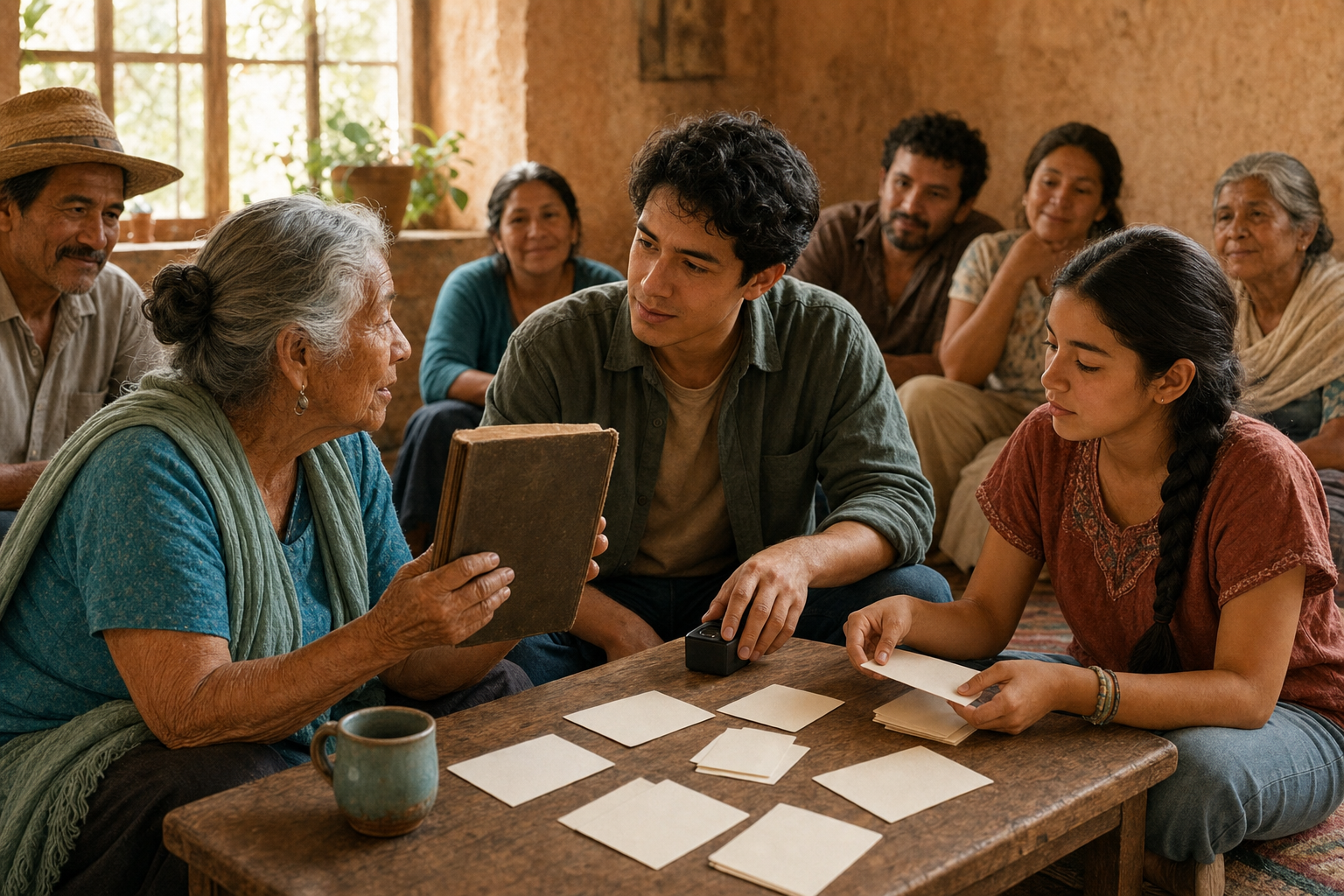
- Return the passage to communal life. Recite it during an existing gathering, connect it to a festival or ethical discussion, or invite learners to teach it to relatives. Use creates memory.
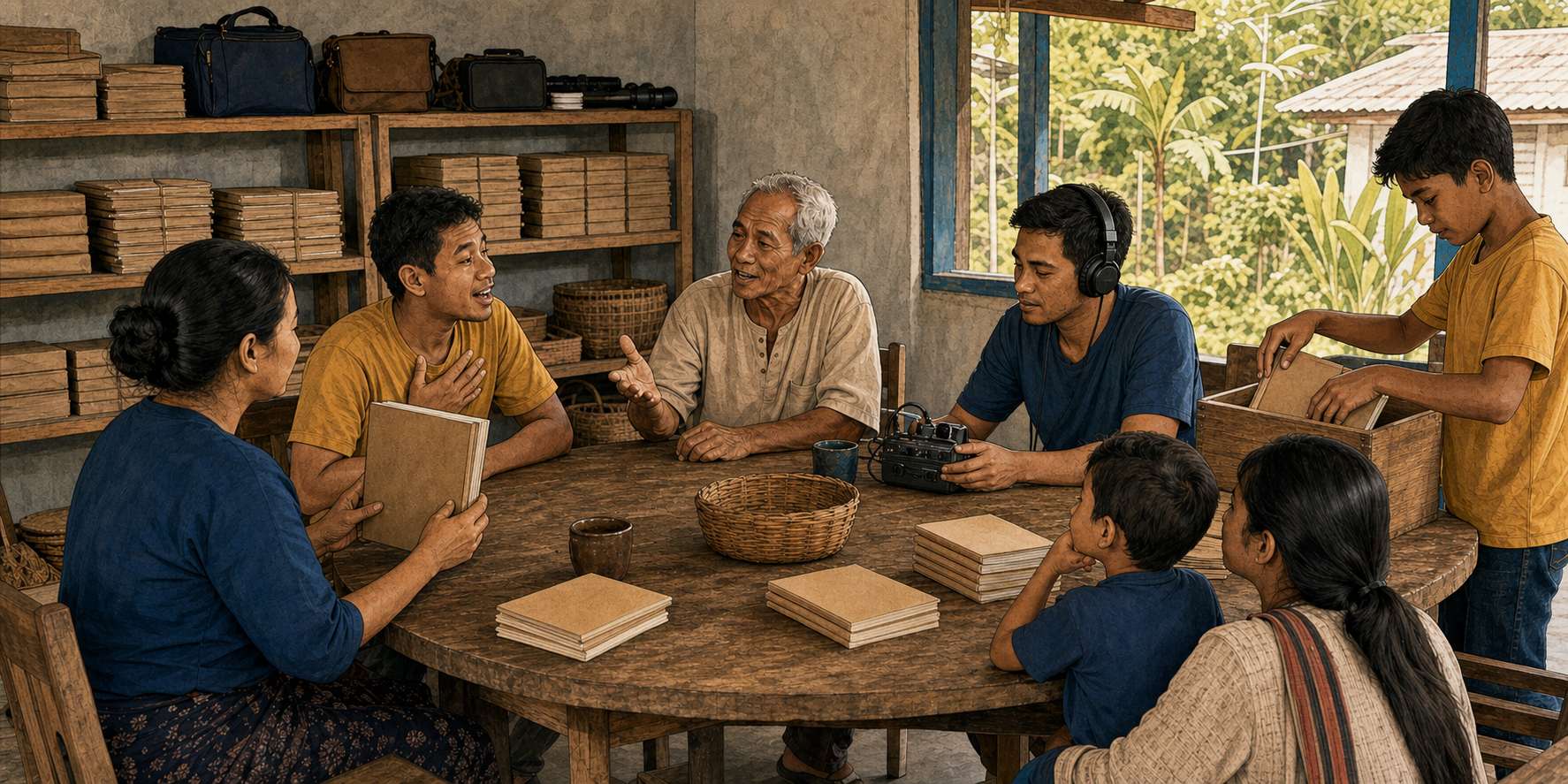
- Preserve the context. Label every recording or transcription with the work, language, script, speaker or reader, regional pronunciation, interpretive tradition and recording circumstances. Obtain permission before circulating a person’s voice or family material.
- Name a successor. Every competent reader should have a learner, and every archive should have more than a single person who knows how to access it. Succession is part of the cultural work, not an administrative afterthought.
Keep four common mistakes out of the practice
First, don’t turn linguistic skill into a purity test. A person who comes through English, transliteration or diaspora speech may be exactly the learner the tradition needs. Correct with precision, but don’t confuse an imperfect accent with disloyalty.
Second, don’t make English the enemy. English can connect dispersed communities and introduce readers to unfamiliar texts. The goal is bilingual or multilingual agency: use translation to expand access while rebuilding the ability to inspect original terms.
Third, don’t preserve only elite literature. Household songs, regional retellings, sermons, notebooks, children’s verses and oral explanations can show how a tradition was actually lived. Record their provenance carefully so later readers can distinguish local practice from universal doctrine.
Finally, don’t let digitization become a substitute for transmission. A scanned manuscript is safer from physical loss, but it remains culturally inert if nobody can read its script, explain its vocabulary or place it within a living tradition. Preservation protects the object; education renews the relationship.
At your next regular gathering, bring a short passage in its original script, a careful translation and a recording of a competent reader. Learn it closely enough to pass it to someone else. That modest act returns spiritual knowledge to the people who must carry it forward.

References
- SikhNet – News – When Literacy Becomes a Perceived Threat
- SikhNet – News – Mian Muhammad Bakhsh (1830-1907)
