
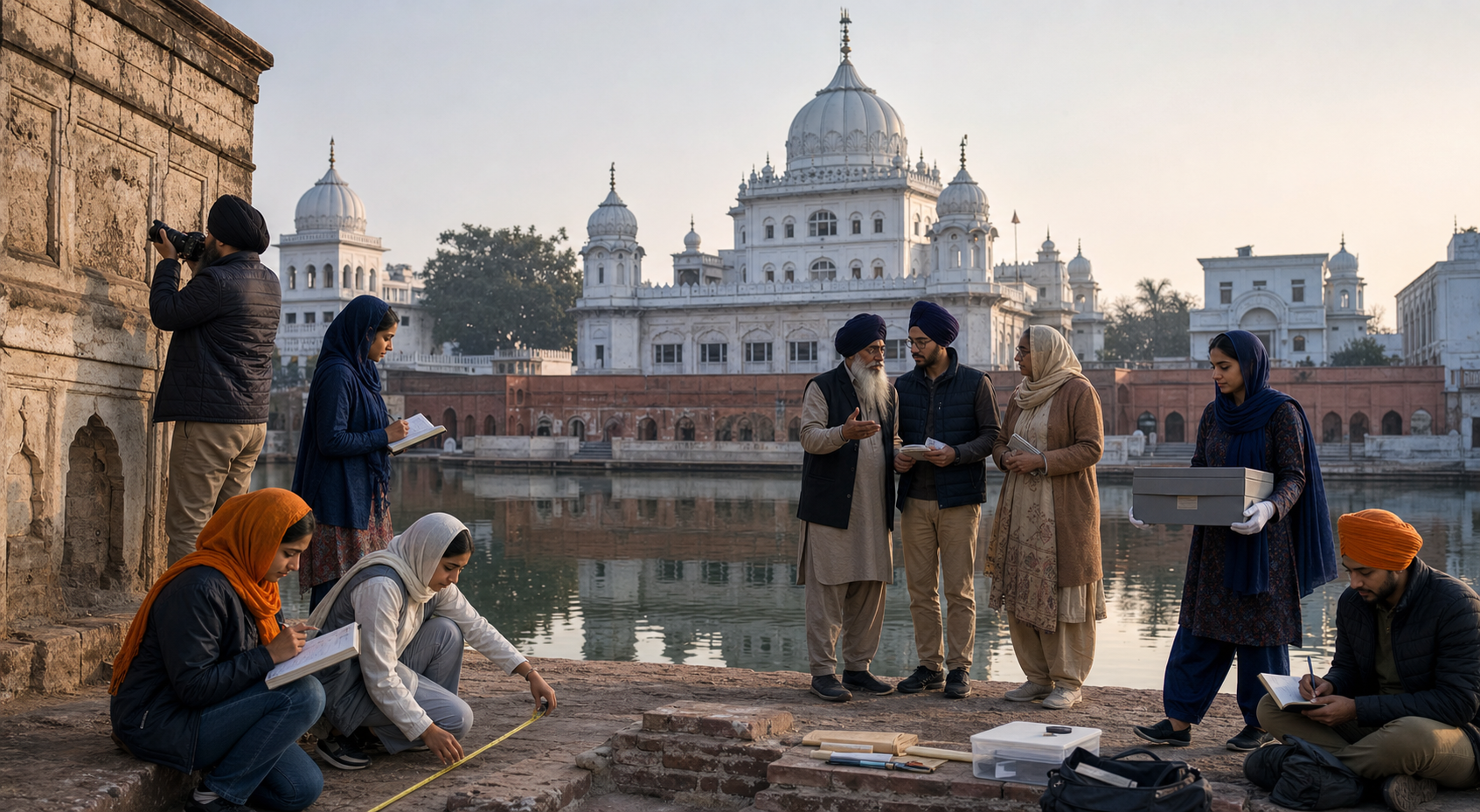
Your gurdwara may have a sarovar whose condition is judged mainly by appearance, historic pothis known only to one custodian, or years of kirtan recordings stored on a volunteer’s device. The natural impulse is to begin cleaning, repairing or digitising. Pause long enough to document what exists. In heritage care, a well-meant intervention can destroy evidence, violate maryada or create a new risk.
You do not need a large institution to begin protecting Sikh heritage. You need an agreed scope, a written baseline, named custodians and a rule that irreversible work will not proceed without the right religious and technical knowledge. That turns seva from an occasional drive into dependable stewardship.
Key takeaways
- Treat conservation as risk reduction, not beautification. Record condition before cleaning, repairing, moving or replacing anything.
- Require two kinds of guidance for sacred material: maryada-led authority and competent material-conservation advice.
- Care for gurdwara buildings, sarovars, water flows, local biodiversity, manuscripts and living practices as parts of one heritage system.
- Preserve kirtan, langar, seva, gatka and oral memory with consent, useful metadata and controlled access, not recording alone.
- Give every priority asset a named custodian, an approved response to emergencies and a recoverable off-site backup where digital records are involved.
Before you repair anything, build a risk map
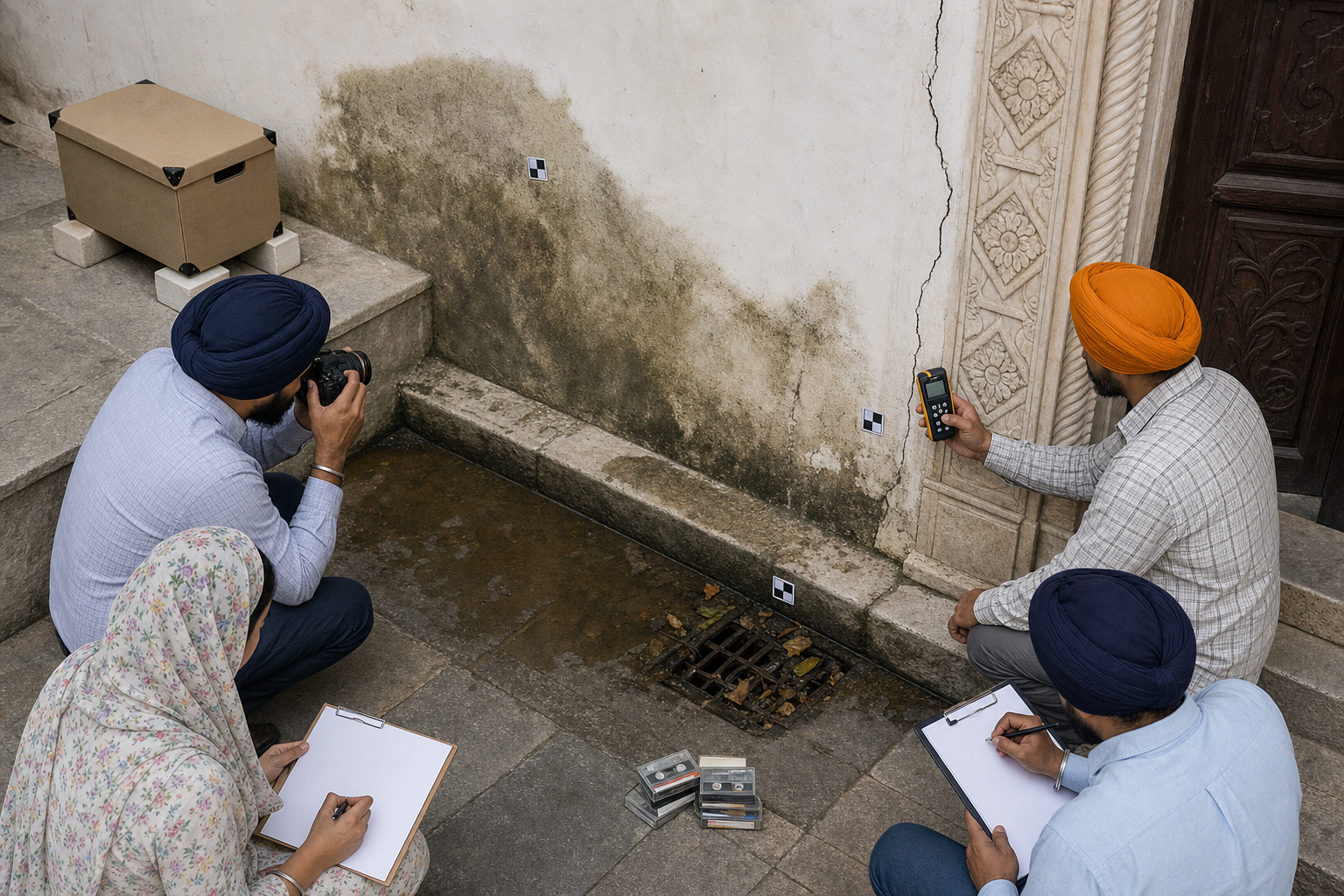
Conservation begins with deciding what must not be touched casually. A fresh coat of paint may conceal historic fabric. An adhesive repair may stain paper or make later treatment impossible. Moving a bir or pothi without the proper protocol may create both material damage and a breach of maryada. The first useful product is therefore not a renovation plan. It is a condition and risk register.
- Define the full scope. Include the gurdwara structure, sarovar and drainage, surrounding landscape, Gurbani birs, historic pothis, janamsakhi materials, photographs, committee records, sound and video files, tools used by artisans, and living practices that depend on knowledgeable people.
- Walk through the site with the right people. Include a committee representative, a granthi and the person responsible for buildings or records. Bring in raagis, artisans, local knowledge-holders and ecological or conservation specialists where their knowledge is relevant.
- Create a baseline without unnecessary handling. Give each asset or area a stable identifier. Record its location, present condition, visible changes, known history, access restrictions and immediate risks. Add photographs only when photography and handling are appropriate.
- Rank consequences, not appearances. An active fire, flood or water-ingress risk comes before cosmetic work. An unrecorded sacred collection or the only copy of a digital archive also deserves early attention because loss may be irreversible.
- Name the decision-maker and the custodian. The person authorised to approve treatment may not be the person who checks the object, water body or file. Record both roles so responsibility does not disappear between meetings.
- Freeze undocumented intervention. Until an item has been assessed, do not laminate, repaint, polish, rebind, scrub, seal or treat it with household chemicals. Use a safe holding action recommended by a qualified person instead.
A simple register is enough if it is kept current. Its value comes from consistent identifiers, clear ownership and an honest record of change. Use the following structure as a starting point and adapt it to local maryada and site conditions.
| Heritage area | What to record first | Who should be involved |
|---|---|---|
| Gurdwara fabric and architecture | Location, material, cracks or other visible change, earlier repairs and immediate fire or water risks | Management committee, facilities custodian, artisan and material-conservation professional |
| Sarovar and sacred landscape | Water entry and exit, watershed connections, water-quality baseline, flood paths, planting and biodiversity observations | Site custodian, sangat knowledge-holders and ecological or water specialist |
| Gurbani birs, pothis and archival material | Identifier, location, condition, housing, access status and any evidence of pests or water exposure | Granthi, authorised religious custodian and manuscript-conservation professional |
| Kirtan, oral history and community records | File format, content description, creator, consent, access conditions, storage location and backup status | Raagis, participants, archive custodian and trained documentation volunteers |
If you find an immediate threat, protect people first and stop the source of danger where it is safe to do so. Do not improvise salvage during an active fire, flood or electrical hazard. The emergency plan should already identify whom to call, who can authorise movement of sacred material, what can be relocated safely and how every movement will be logged.
Make maryada and material evidence work together
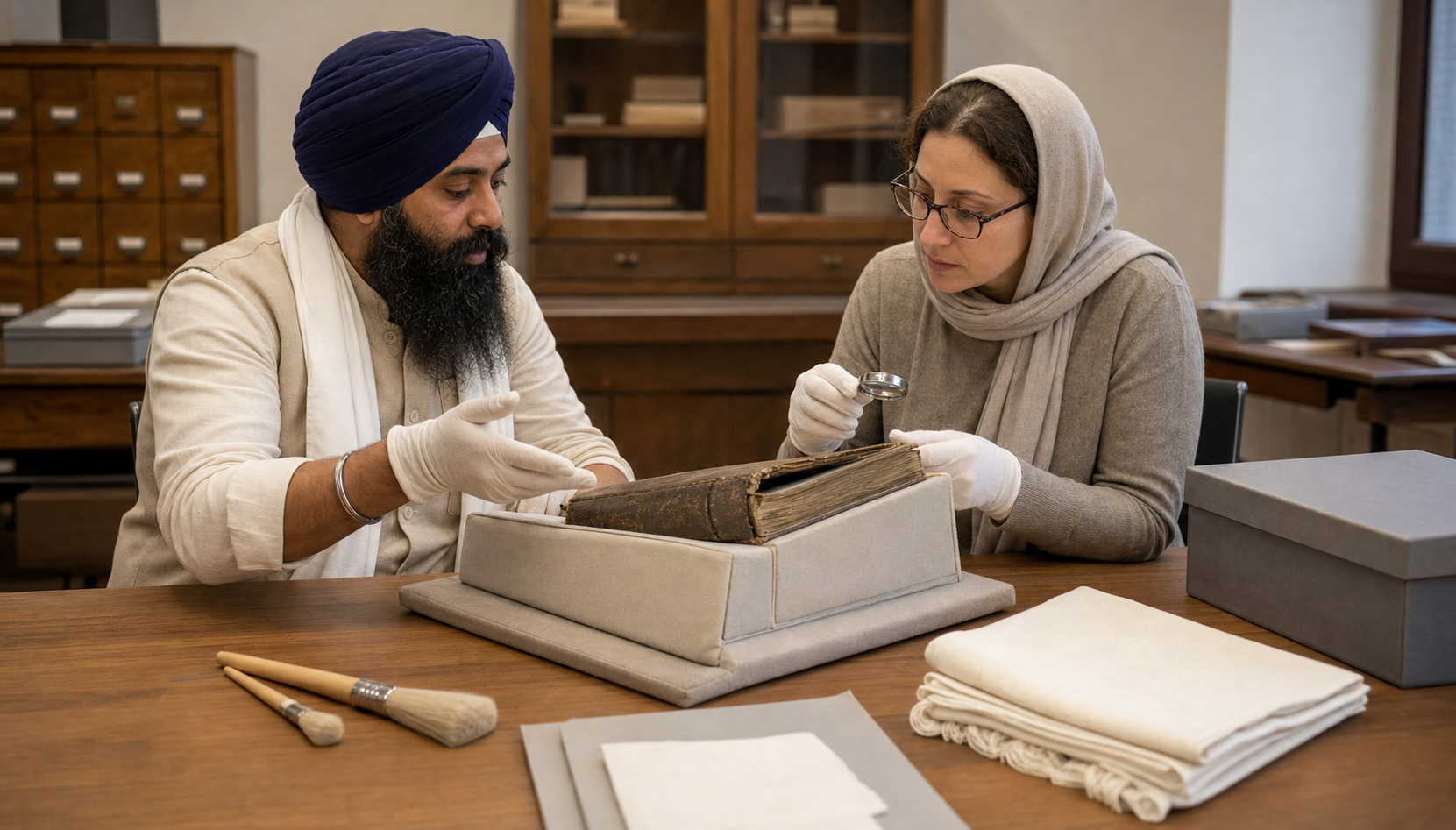
Sacred heritage cannot be conserved through technical knowledge alone. Nor can reverence by itself determine which adhesive, support, environmental control or repair material will remain compatible with an old object. Responsible treatment needs both forms of authority. A granthi or authorised custodian guides handling and religious protocol; a trained conservator assesses materials, deterioration and treatment options.
Begin with a condition assessment and favour non-invasive diagnostics. If treatment is necessary, use compatible conservation-grade materials and the smallest intervention that addresses the identified risk. Record what was done, who approved it, who performed it and which materials were used. Keep photographs and condition notes from before and after the work. A future custodian should be able to distinguish original fabric from a later repair without guessing.
Replacement is not automatically conservation. Age, tool marks, an earlier repair or a locally made component may carry historical evidence even when it looks imperfect. Before replacing anything, ask whether it is unsafe, whether it can be stabilised and whether an artisan familiar with the original technique should be consulted. This is especially important when a building campaign is described as modernisation: convenience and visual uniformity are not sufficient reasons to erase surviving material.
The same discipline applies to access. Open metadata can help the sangat and scholars know that a collection exists without exposing every sacred or sensitive item. Record identifiers, broad descriptions, condition and custodial history openly where appropriate, while restricting images, personal information or physical access when maryada, privacy or security requires it. Openness should mean accountable stewardship, not uncontrolled circulation.
Prepare separately for fire, flood, pests and digital obsolescence. Each threat needs an approved response, responsible people and an incident log. A salvage priority list involving sacred objects must be agreed with religious custodians in advance. Pest treatment and wet-material recovery should be directed by trained professionals; spraying or drying by guesswork can compound the damage. The safer principle is simple: stabilise the situation, preserve evidence and obtain competent guidance before irreversible action.
Care for the sarovar, site and surrounding ecology as one system
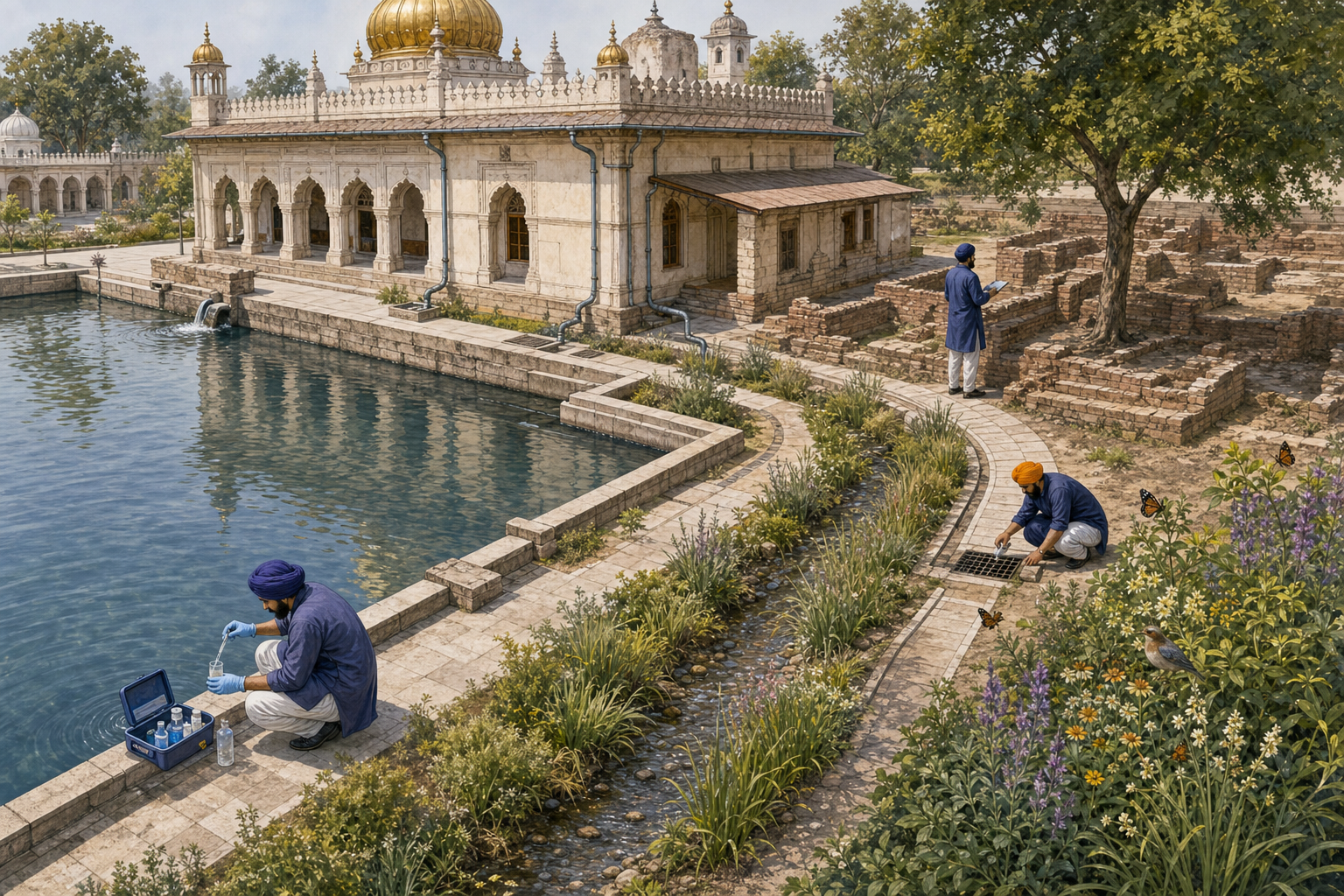
A gurdwara does not end at its walls. Its sarovar, drainage, planted areas, local water flows and surrounding landscape affect both the sacred place and the people who use it. Across Punjab, rivers, sarovars, agrarian commons and gurdwaras can be understood as one cultural and ecological whole. A project that beautifies stonework while ignoring watershed health has conserved only the visible surface.
Start with an ecological baseline. Mark where water enters and leaves the site, where flooding or stagnation has occurred, which areas connect to the wider watershed, and where local species are growing. Record water quality and repeat observations at the same locations through a consistent method. Track selected biodiversity indicators that local specialists and community members can recognise reliably. If the team has GIS capability, map the information digitally; if it does not, use a clear annotated site map that can later be transferred.
The baseline changes the questions you ask. A sarovar should not be called restored merely because its surface looks cleaner. You need evidence that water quality has improved and that the causes of degradation have been addressed. A new paved area should be reviewed for its effect on drainage and heat, not assessed only for ease of maintenance. Planting should favour suitable local species rather than decorative choices disconnected from the site.
Rainwater harvesting, low-impact materials and local-species planting can strengthen resilience when they fit the building, watershed and devotional use of the place. Treat these as site-specific interventions, not items to install from a generic checklist. Document the intended benefit before work begins, then compare later observations with the baseline. If the result cannot be checked, the committee will have no reliable way to distinguish ecological improvement from an attractive claim.
Community monitoring makes this work sustainable. Train volunteers to observe and record, but give technical interpretation to people qualified for it. A volunteer can photograph the same water entry point, maintain the map or log an agreed biodiversity indicator. A water or ecological specialist should determine what the pattern means and whether an intervention is warranted. This division keeps the sangat involved without asking enthusiasm to substitute for expertise.
Turn seva into a stewardship system, not a one-day drive
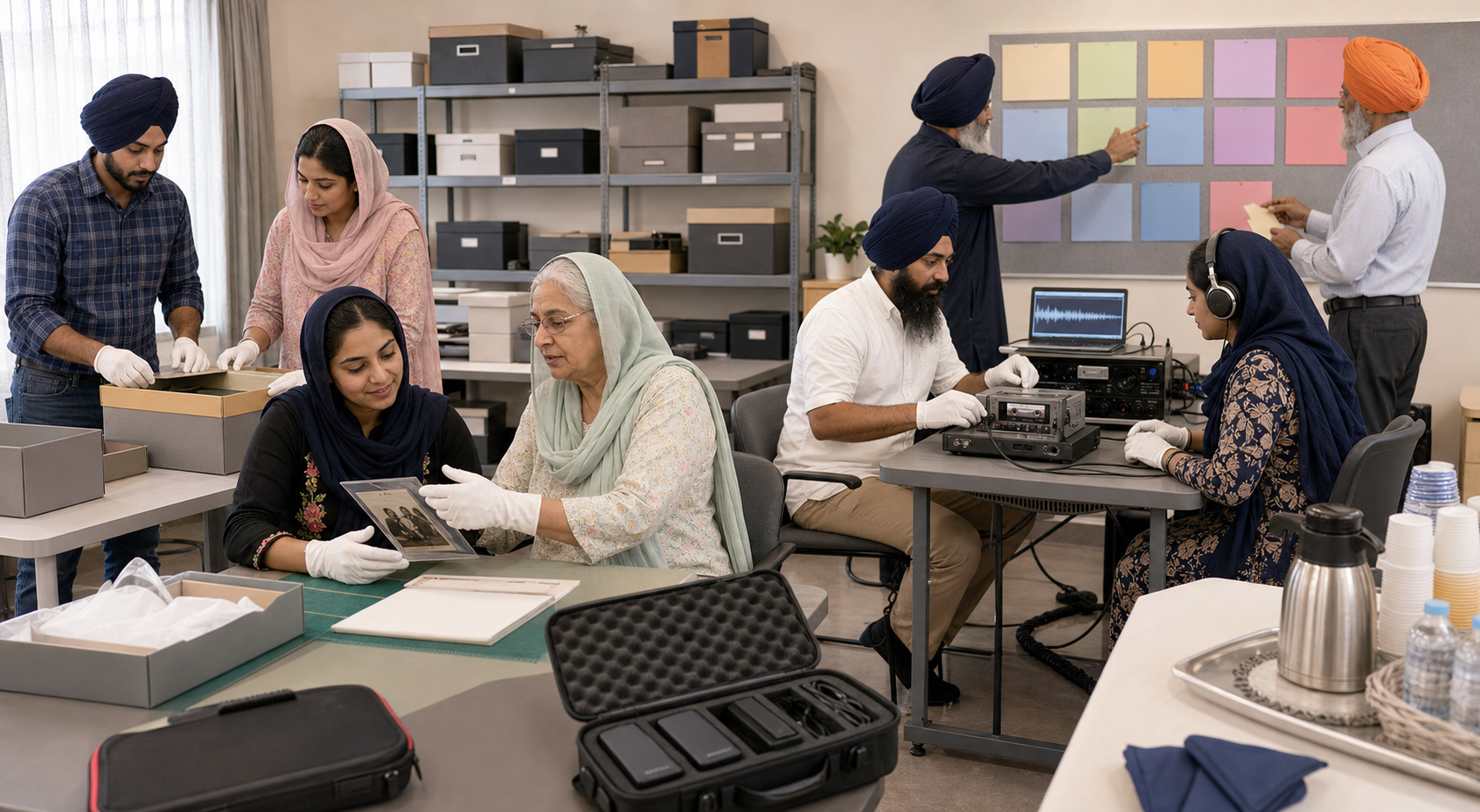
Buildings and collections are only part of Sikh heritage. Kirtan, langar, seva, gatka, craft knowledge and local memory endure because people practise and transmit them. The vulnerable point is often not the absence of a recording. It is the absence of consent, context, discoverable information or a younger person who knows how to continue the practice.
When documenting an oral history or performance, record the name the participant wishes to use, the place, language, date, practice being discussed, relevant context, consent and access conditions. Preserve the original recording as well as any edited working copy. Keep transcripts, translations and summaries clearly identified so they are not mistaken for the speaker’s exact words. Ask who may hear or view the material, whether restrictions apply and who can revisit that decision.
Do not let the only copy remain on a phone, laptop or social platform. Use stable file names, maintain redundant storage, keep an off-site backup under institutional control and test that files can actually be restored. Assign someone to watch for format and storage obsolescence. A backup that no authorised custodian can find, open or interpret is not a functioning safeguard.
Intergenerational transmission should be designed into the work. Youth learning circles can help with cataloguing, transcription, approved photography, site mapping and biodiversity logs. Women-led stewardship groups can hold defined conservation and governance responsibilities rather than being invited only for occasional support. Diaspora partners can contribute skills, storage redundancy and resources, while local custodians retain authority over priorities, maryada and access.
Give each volunteer a bounded task, a written method and a reviewer. Pair learners with granthis, raagis, artisans, archivists or ecological specialists as the task requires. Training should cover preventive conservation, documentation standards, emergency response and the difference between observing a problem and treating it. This is how visitors become contributors without placing heritage in untrained hands.
Committee governance must survive changes of office-bearers. Maintain a written stewardship charter, an approval path for interventions, named custodians for each domain, access rules and a handover record. Review the risk register whenever responsibility changes and after any incident or significant site work. Publish an appropriate progress note for the sangat: what was catalogued, which risks were reduced, what training occurred and which decisions remain open.
Measure results that correspond to actual care. Track whether collections have identifiers and condition records, whether priority objects have been stabilised, whether water-quality observations show improvement, whether volunteers have completed defined training, and whether an off-site recovery test succeeds. These measures are less glamorous than an inauguration, but they reveal whether heritage is becoming safer.
This model also creates a practical meeting ground across Dharmic communities. Sikh seva and sarbat da bhala can work alongside Jain ahimsa and aparigraha, Buddhist maitri and mindfulness, and the Hindu understanding of dharma as responsible care. Communities can share training in documentation, ecological restoration and emergency preparedness without flattening their differences. Authority over sacred practice and restricted material should remain with the community to which it belongs.
At your next committee meeting, ask one concrete question: what would be hardest to replace if it were damaged tonight? Give that collection, practice or part of the site a custodian, a baseline, an approved no-harm rule and an emergency or backup action. Complete that small circle of responsibility before opening another.
Sikh heritage will endure when reverence becomes routine: observed carefully, recorded honestly, protected competently and handed to the next generation with its meaning intact.
References
