
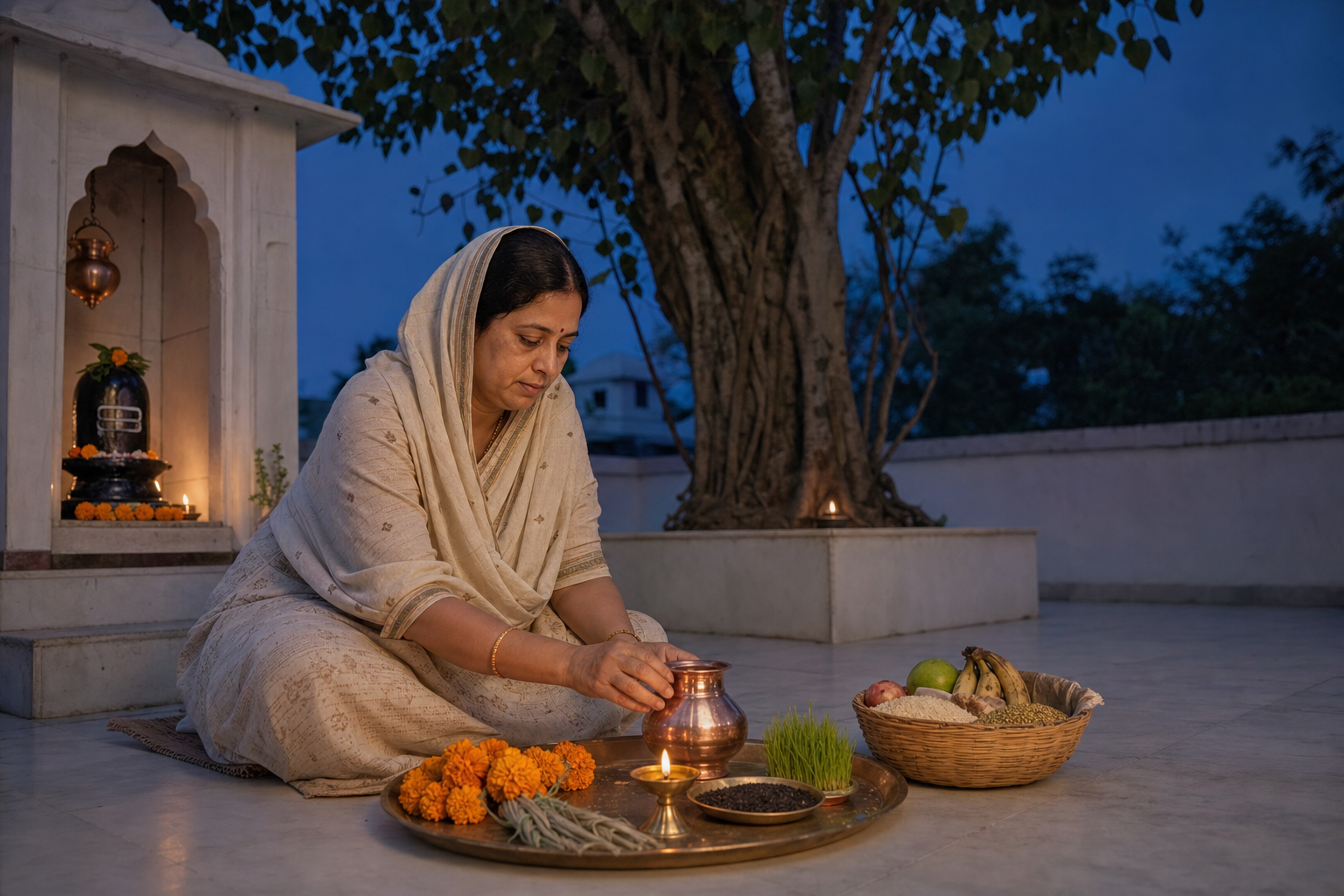
You want to observe Somvati Amavasya properly, but the instructions can quickly become overwhelming: fast or eat once, worship Shiva or the Peepal, perform Pitru Tarpan in the morning or later, and follow which date if the tithi crosses midnight?
The answer is to begin with the part that determines everything else: your local panchang and your family parampara. Once those are settled, you can build a sincere observance around four connected disciplines — worship, remembrance, restraint and daana — without turning the day into an exhausting collection of rituals.
Confirm the date before planning the ritual
Somvati Amavasya occurs when the Amavasya tithi coincides with Somvar, or Monday. In the commonly followed sunrise rule, the observance is anchored to the Monday on which Amavasya prevails at local sunrise. It is not determined merely by seeing a new moon on a civil calendar.
This matters because a tithi is based on the changing relationship between Surya and Chandra, not a fixed midnight-to-midnight day. It can begin on one civil date and end on another. Sunrise occurs at different moments in different locations, so a date printed for Bharat may not automatically apply to Toronto, London, Singapore or another diaspora location.
The general 2026 calendar identifies two Somvati Amavasya observances:
| Civil date | Weekday | Lunar-month association |
|---|---|---|
| 15 June 2026 | Monday | Jyeshtha Amavasya |
| 9 November 2026 | Monday | Kartik Amavasya |
Treat these as planning dates, then verify the operative date and tithi window for your city. Check a regional panchang that shows sunrise and the beginning and ending times of Amavasya. Also note whether your family uses an Amanta or Purnimanta calendar. These systems can name the lunar month differently even when the underlying tithi is the same.
- Set the panchang to the city where you will actually perform the vrata.
- Confirm that Amavasya is present at Monday sunrise under the rule followed by your sampradaya.
- Check whether a temple or family acharya gives a separate window for Tarpan, shraddha or another specific rite.
- If the tithi begins or ends close to sunrise, follow local guidance instead of a generic date graphic.
Do not confuse Somvati Amavasya with other observances that happen to share a related name. Mauni Amavasya is the Magha new moon associated especially with silence and sacred bathing. Sarva Pitru Amavasya concludes Pitru Paksha. Som Pradosh is a Monday observance on Trayodashi, not Amavasya. The distinction tells you which ritual framework and panchang rule to consult.
Build one coherent home observance around your sankalpa
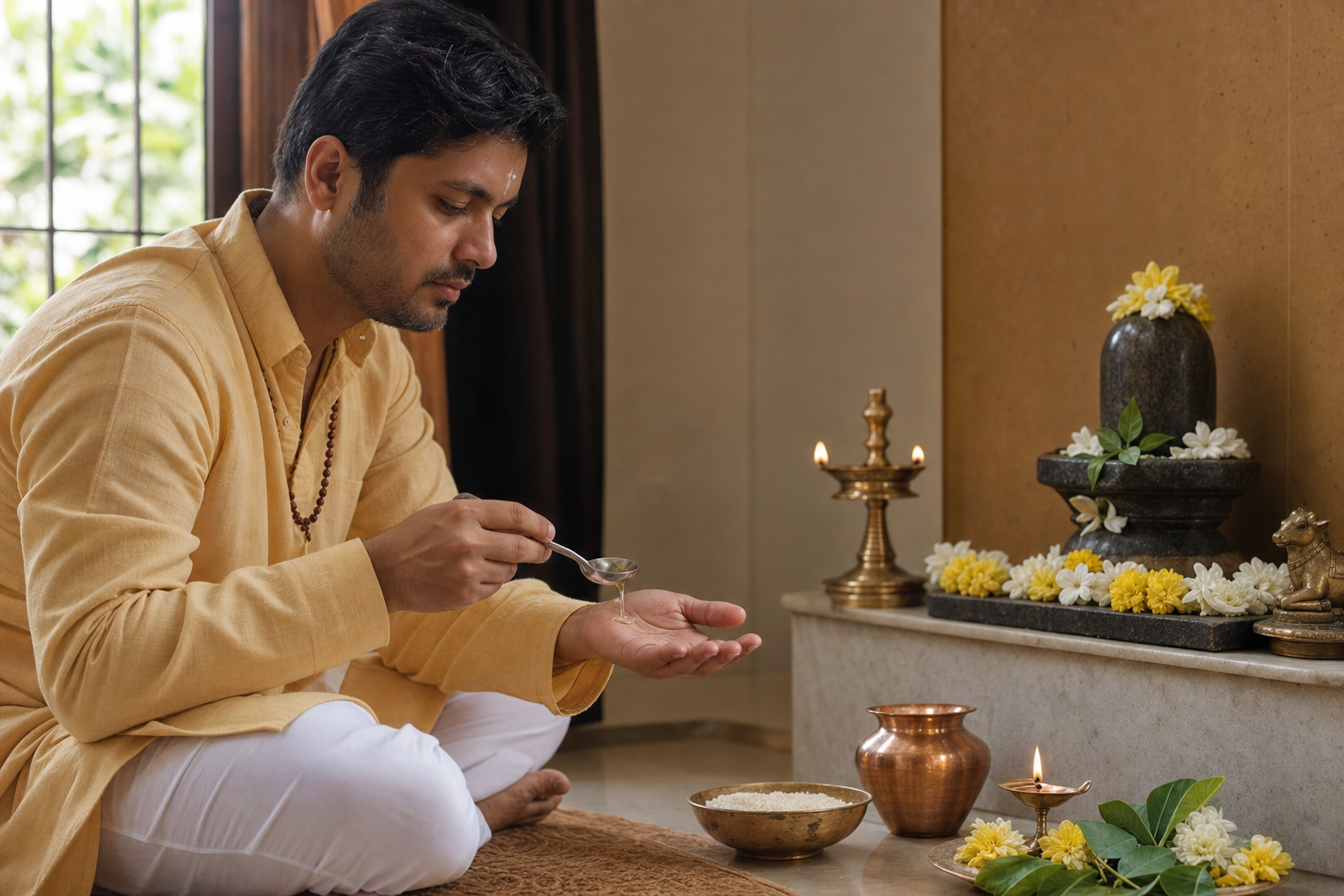
A useful sankalpa is specific enough to direct the day but modest enough to keep. You may dedicate the observance to inner steadiness, the welfare of your household, gratitude to the Pitrs and the well-being of all beings. You do not need to promise every austerity or perform every form of worship associated with the tithi.
Somvar has a strong association with Shiva and the cooling, settling principle of Soma. Amavasya provides a natural pause for introspection. Their conjunction therefore lends itself to japa, dhyana and discipline of the mind. That inner purpose should govern the schedule: reduce noise, avoid unnecessary conflict and make room for attentive worship.
A complete but manageable home observance can follow this sequence:
- Prepare the previous evening. Confirm the panchang, choose your fasting level and gather only what you will use: clean water, a lamp, flowers or leaves, naivedya and your regular puja materials. Keep tila and darbha separately if you are trained to perform Tarpan.
- Begin with snana and a clean worship space. A sacred-river bath is not required for a meaningful observance. At home, bathe mindfully and remember the tirthas according to your custom.
- State the sankalpa. Include the place, the observance and your intention. Use the formula taught in your household if you have one; sincerity does not require inventing an elaborate Sanskrit declaration.
- Offer Surya Arghya. At sunrise, offer clean water to Surya with gratitude for prana, clarity and the capacity to fulfil dharma.
- Perform your principal puja. For Shiva worship, offer water abhisheka, bilva-patra where appropriate, vibhuti and simple naivedya. Recite Om Namah Shivaya, the Mahamrityunjaya Mantra or portions of Rudram only to the extent that you can maintain attention.
- Add your family-devata practice if customary. A Vaishnava household may recite Vishnu Sahasranama and offer Tulasi. A Shakta household may perform Durga Archana or recite the Saptashloki Durga. These are legitimate streams of observance, not a requirement to worship every deity in one sitting.
- Perform Pitru rites at the proper time. Tarpan is commonly undertaken after snana in the morning, while a formal monthly shraddha may be assigned to Aparahna. Let family procedure decide the exact order.
- Carry the vrata through the day. Maintain your chosen food discipline, continue quiet japa or scriptural reading, and complete a concrete act of daana or seva.
- Close quietly. In the evening, offer a lamp, sit for a few minutes of japa or silence, and conclude the fast according to the timing and method followed in your tradition.
A larger puja is not necessarily a deeper one. If time is limited, retain the structural core: snana, sankalpa, Surya Arghya, one focused form of puja, remembrance of the ancestors, japa and daana. Fifteen distracted recitations added out of anxiety do less for the vrata than one practice completed with steadiness.
The two 2026 observances also allow different seasonal accents. For Jyeshtha on 15 June, conserve water even if you perform abhisheka, and make the offering deliberate rather than excessive. For Kartik on 9 November, a lamp offering and Vishnu or Lakshmi-Narayana worship may fit regional custom. These accents can enrich the observance, but they do not replace the core discipline.
Approach Pitru Tarpan with gratitude and procedural care
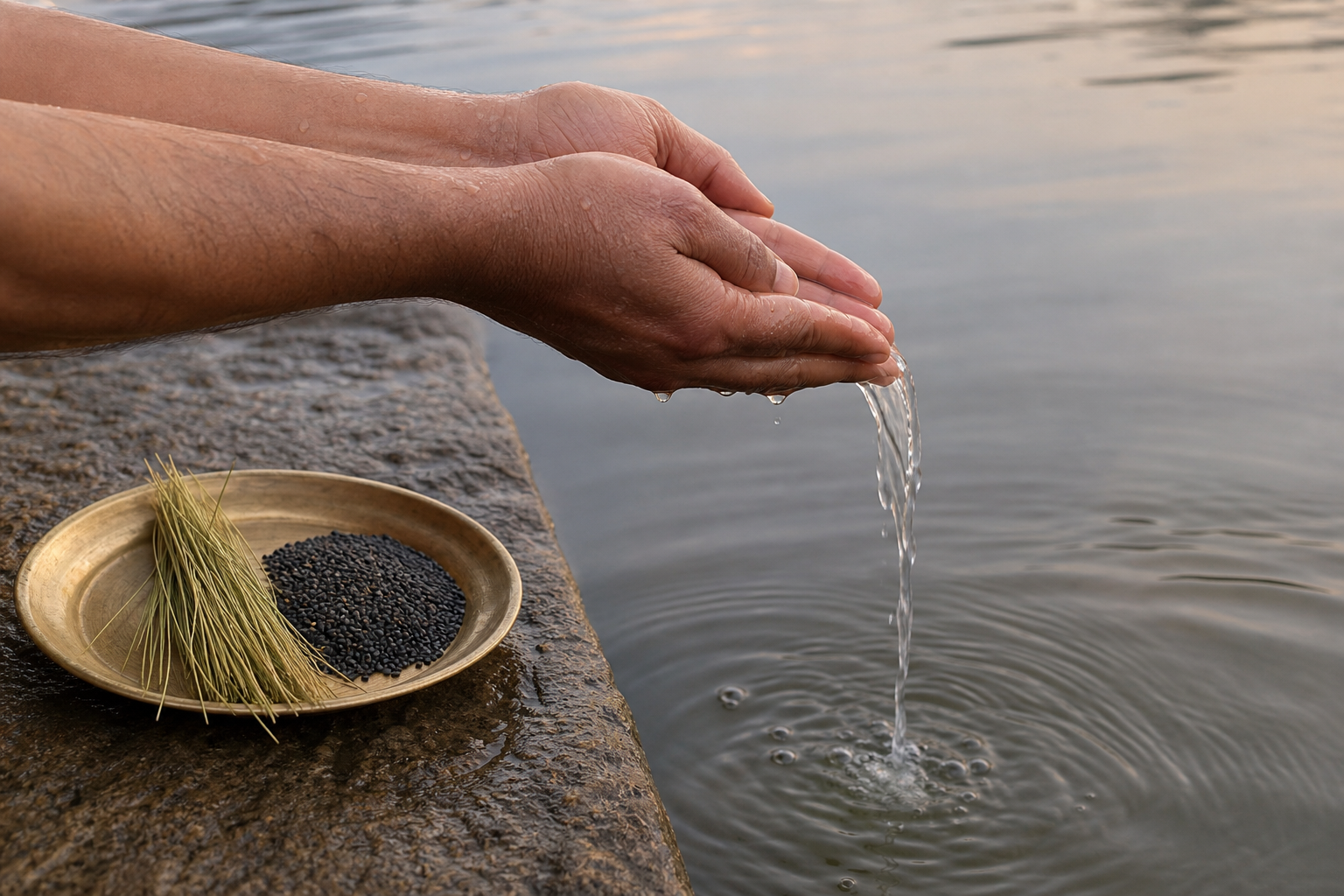
Ancestor remembrance is one of the defining responsibilities of Amavasya. It places the individual inside a lineage: you received a body, language, relationships and inherited duties through people whose lives preceded yours. Tarpan turns that recognition into a disciplined offering rather than a passing sentiment.
The customary materials are clean water, black sesame and darbha or kusha grass. Many lineages prescribe a particular direction, hand position, invocation and sequence of offerings. Some households also undertake pindika offerings or a fuller shraddha. These details are not interchangeable decorations; they belong to a transmitted procedure.
If you know your family method, prepare the materials beforehand and follow it without casually combining instructions from unrelated traditions. If you do not know the method, ask a family elder, purohit or acharya before the day. A video can demonstrate motions, but it cannot tell you which lineage-specific mantras, eligibility rules or sequence your household follows.
There is also an important timing distinction. A simple Tarpan is commonly performed in the morning after snana. A formal Amavasya shraddha is often assigned to Aparahna. Do not move one into the other’s window merely because both concern the Pitrs. When your local panchang lists a dedicated shraddha period, use that together with family guidance.
If the technical rite is unfamiliar and guidance is unavailable, do not pretend that an improvised sequence is the prescribed Tarpan. You can still observe the day honestly: remember your ancestors by name, offer a prayer of gratitude, support annadana in their memory and resolve to learn the family procedure before the next appropriate tithi. This preserves shraddha — reverent trust — without claiming ritual knowledge you do not yet possess.
Some devotional language presents the rite as a way to mitigate pitru-related karmic impediments. Keep the observance free of transactional fear. Tarpan is not a mechanical guarantee that every family difficulty will disappear. Its immediate dharmic work is clearer: gratitude, humility, continuity and responsible remembrance.
Make fasting, Peepal puja and daana serve the same discipline
Choose a fast you can keep without harming yourself
Upavasa is meant to draw you nearer to the sacred, not make food deprivation the sole measure of devotion. Decide the level before the vrata begins so that hunger does not turn the day into repeated bargaining with yourself.
- Full fast or nirjala: undertake this only when it belongs to your tradition and your health safely permits it.
- Phalahara: fruit, milk or another simple form allowed by your family practice can preserve the vrata while reducing physical strain.
- Light sattvic observance: one or more simple meals may be appropriate for people who should not undertake a stricter fast.
- Discipline beyond food: reduce entertainment, harsh speech, unnecessary purchasing and agitation. Keep time for japa, silence and seva.
Children, elders, pregnant people and those with medical conditions can adapt or forgo food austerity. If fasting would compromise your health, do not force it. Preserve the sankalpa through sattvic food, mental restraint and charity. Ahimsa includes refusing avoidable harm to your own body.
Treat the Peepal as a living presence, not a ritual surface
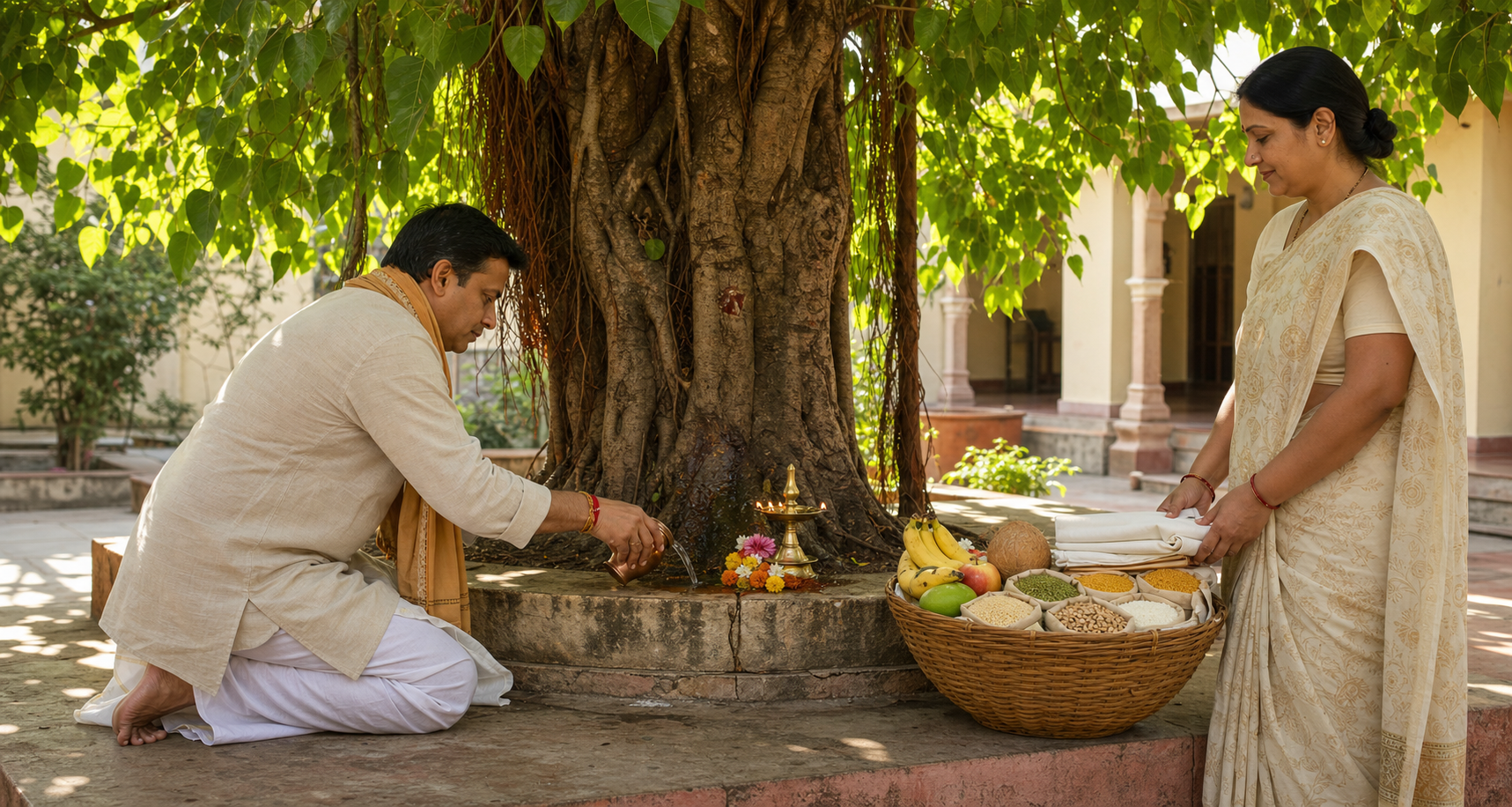
Peepal, or Ashvattha, worship is especially prominent in many Somvati Amavasya traditions. Devotees offer water, perform pradakshina and pray for household welfare. Some customs use diluted raw milk or tie a raksha-sutra around the trunk.
The number of circumambulations is not universal. Counts such as 11, 21, 51 and 108 occur in different family traditions. Follow the count you have received rather than assuming the highest number is the most meritorious. If you have no inherited count, a modest number of attentive circumambulations with japa is more coherent than copying a large number without context.
Let ecological care be part of the puja. Water is the simplest offering. If your custom includes diluted milk, use it sparingly and leave the area clean. Choose natural thread, avoid plastic decorations and do not leave packaging, lamps or food waste around the roots. Reverence for the Peepal is contradicted when the act of worship damages the tree or its surroundings.
Complete inward restraint through outward daana
Choose your act of giving before the day arrives. That prevents daana from becoming whatever small gesture is convenient at the last moment. Appropriate forms include annadana, educational support, medical assistance, service to a gaushala or contribution to a community kitchen. Give within your means, without waste and without turning the recipient into a display of your piety.
This movement from restraint to service also reveals a wider Dharmic kinship without erasing differences among traditions. Buddhist Uposatha observance on lunar days emphasizes ethical renewal and meditation. Jain practice gives a central place to vrata, restraint and pratikraman. Sikh maryada does not prescribe a Somvati lunar fast, yet simran, seva and collective welfare resonate with its ethical direction. The rites remain distinct; the shared lesson is that inner discipline should produce compassionate conduct.
For a household observance, connect one devotional act to one practical act. After offering water to the Peepal, care for a sapling or clean the area. After remembering the Pitrs, sponsor food in their memory. After reducing your own meals, help another person eat. That is how the vrata moves from private intention into lived dharma.
Key takeaways for Somvati Amavasya
- Verify the observance with a panchang set to your location; a generic civil date cannot resolve a tithi close to sunrise.
- The general 2026 dates are Monday, 15 June and Monday, 9 November, subject to local panchang and sampradaya guidance.
- Build the day around a clear sankalpa, one principal puja, ancestor remembrance, restraint and daana.
- Shiva puja is central in many households, but Vaishnava and Shakta practices may be followed according to family tradition.
- Do not improvise lineage-specific Pitru Tarpan mantras. Learn the method from a qualified elder, purohit or acharya.
- Distinguish morning Tarpan from a formal shraddha that may be performed during Aparahna.
- Adapt or forgo fasting when strict austerity would compromise health; food restriction is not the only form of vrata.
- Keep Peepal worship environmentally responsible, and turn the day’s inward discipline into concrete seva.
Your most useful preparation is simple: check the local panchang, speak with the person who knows your family procedure, choose a sustainable fast and decide your daana in advance. Then Somvati Amavasya can remain what it is meant to be — a quiet, ordered day in which worship, gratitude and service reinforce one another.
References
- Hindu Pad — Somvati Amavasya 2026: Unlock the Power of Monday New Moons, Dates, Puja Vidhi, Pitru Tarpana
- Hindu Pad — Somvati Amavasya on Monday: Sacred Mahatmya, Transformative Vrat, Pitru Tarpan, Peepal Puja