
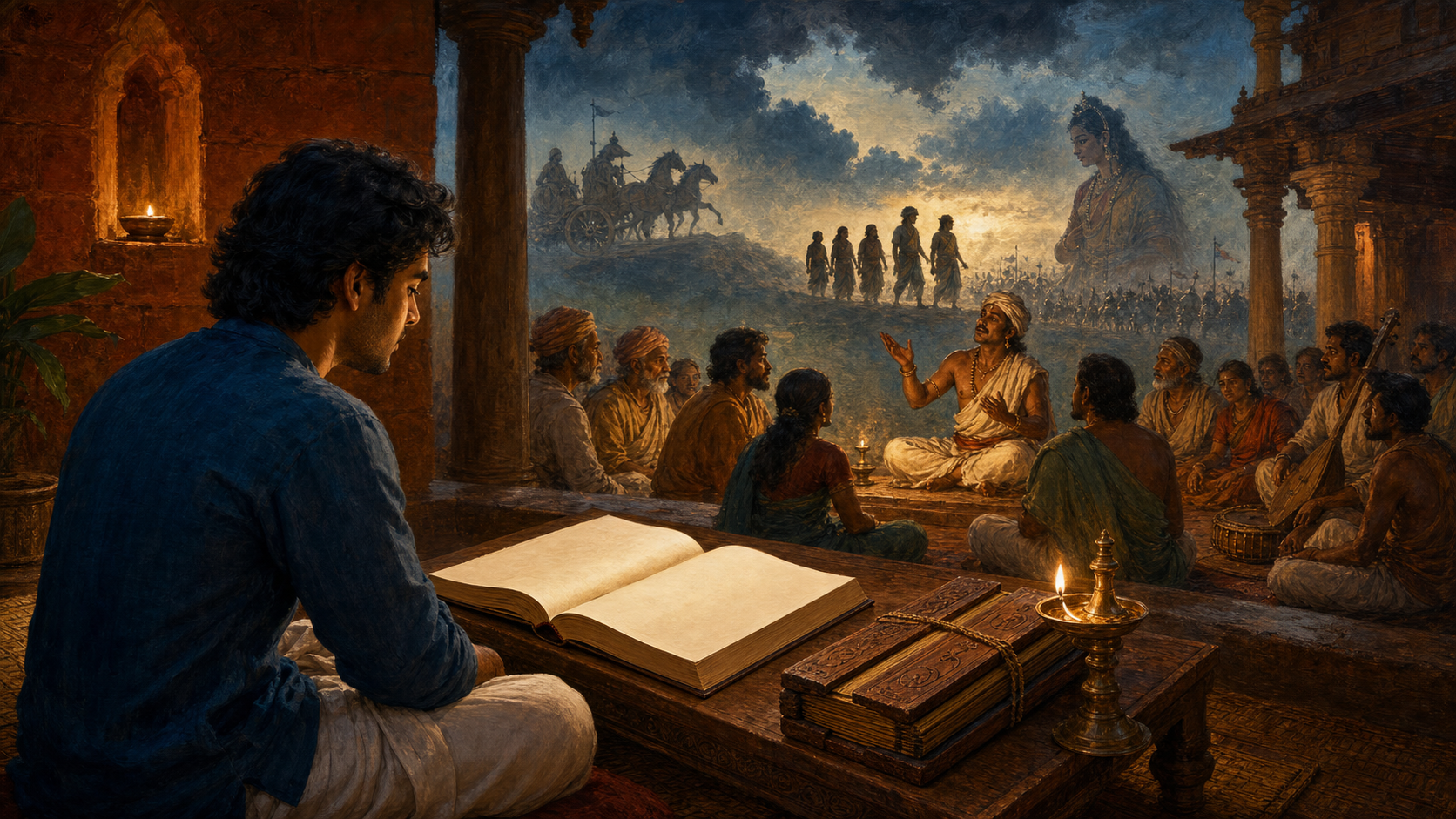
You may already know the Mahabharata’s principal characters and still wonder what you gain by reading the epic through Kumara Vyasa. The answer is not merely the same story in another language. You encounter a Kannada poet making the struggle for dharma immediate, dramatic, musical, and close to ordinary moral experience.
That difference should shape how you approach the work. Read it as a poetic interpretation, listen for the performance carried within its lines, and pause over decisions rather than rushing toward the outcome. The following method will help you enter the Kannada Mahabharata without reducing it to either a translation exercise or a monument admired from a distance.
First, know which Bharata you are opening
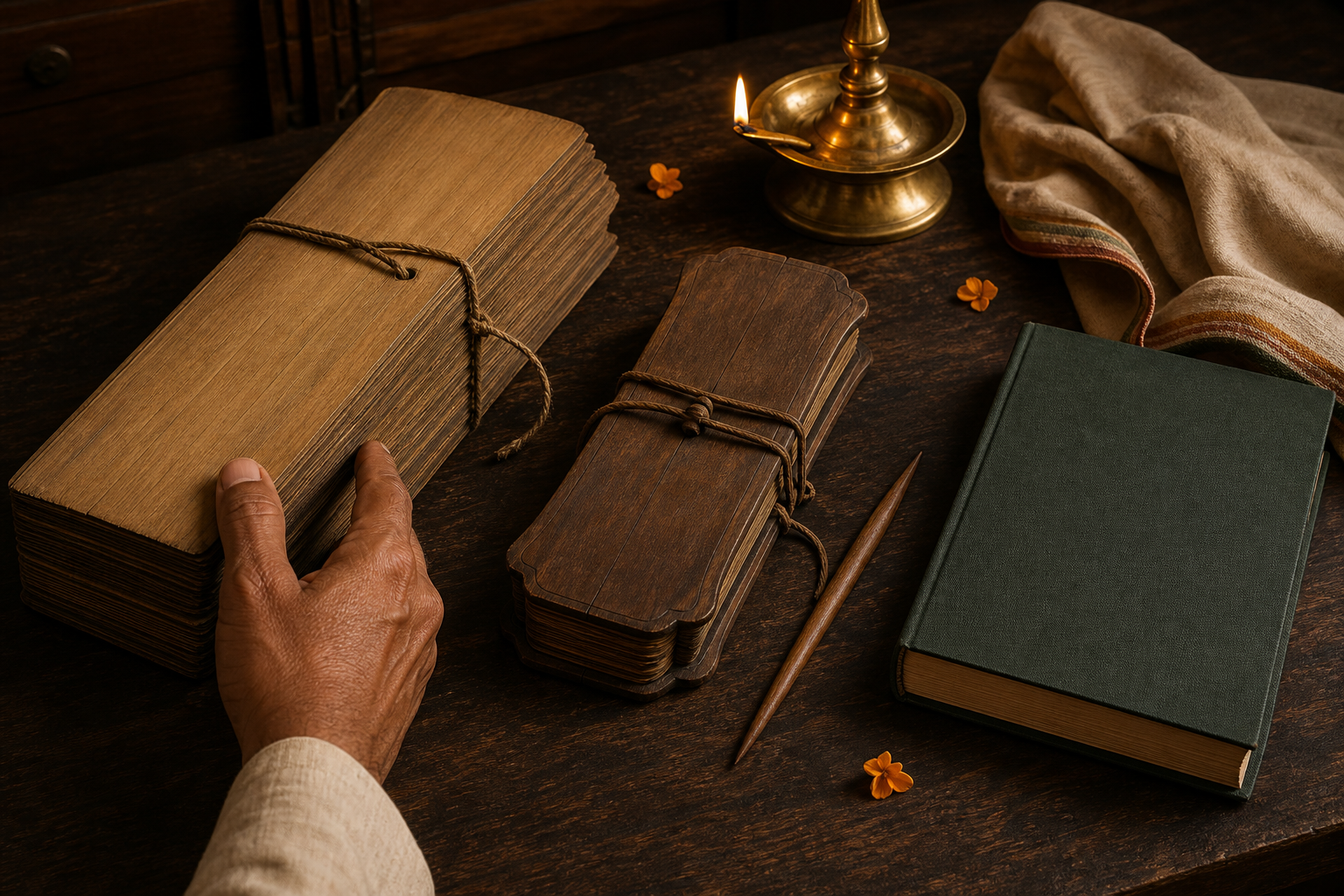
Kumara Vyasa was the pen name of Naranappa, one of the major voices of classical Kannada literature. His work is formally known as Karnata Bharata Kathamanjari, while readers also call it the Kumara Vyasa Bharata or Gadugina Bharata. These are not three separate epics. They are names associated with the same celebrated Kannada rendering of the Mahabharata.
The essential distinction is between translation and poetic recreation. Kumara Vyasa does not attempt a mechanically complete, line-by-line transfer. He compresses some material, enlarges selected moments, and uses lyrical intensity to control pace and emotion. If you judge him only by asking whether every detail appears exactly where you expect it, you will miss the literary intelligence of the work.
Instead, ask three questions whenever his telling departs from the version you know: What has been shortened? What has received more imaginative space? What ethical or emotional pressure does that choice create? Those questions turn a perceived omission into evidence of the poet’s priorities.
The names also tell you something about cultural location. Gadugina Bharata binds the work to Gadag, while Kumara Vyasa’s chosen name places his Kannada voice within the lineage of Veda Vyasa. Tradition associates him with the Vijayanagara milieu and the Veeranarayana Temple at Gadag. Preserve the word association when you discuss that history: it acknowledges a strong cultural memory without turning tradition into a falsely precise biography.
Let Bhamini Shatpadi change how you read
The poem’s form is not decorative packaging around its ideas. Kumara Vyasa works in Bhamini Shatpadi, the six-line stanza form central to the work’s poetic movement. Rhythm helps carry narrative speed, description, dialogue, wit, grandeur, and changes of mood. A silent plot summary can tell you what happened, but it cannot reproduce that experience.
If you read Kannada, work through one stanza in five passes:
- Read it aloud once without stopping to explain every word. Notice where your voice naturally gathers force or slows down.
- State the visible action in one plain sentence. This prevents poetic density from obscuring the event.
- Identify the strongest image, comparison, or turn of phrase. Ask why that image belongs at this exact moment.
- Name the emotional movement. A stanza may begin in confidence and end in doubt, or begin in grief and turn toward resolve.
- Read it aloud again, now allowing the action, image, and emotional change to govern your delivery.
If you depend on a translation, keep the Kannada text beside it whenever possible. You do not need complete fluency to notice recurring names, line endings, emphatic sounds, and the visual shape of a stanza. A translation can carry narrative and interpretation, but the facing Kannada reminds you that the poem’s reputation rests on language as well as plot.
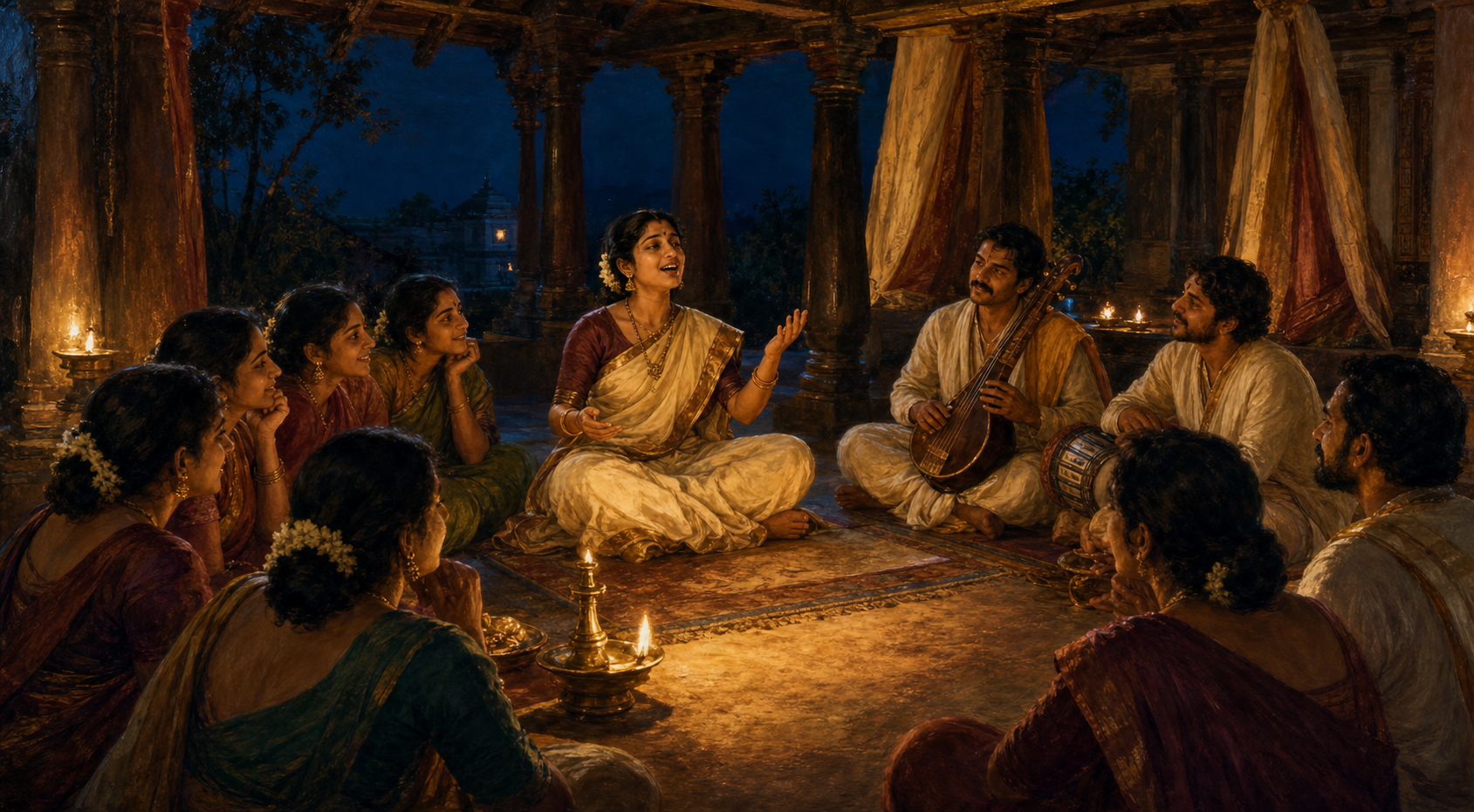
Listening is equally important. The Kannada Bharata remains alive through Gamaka recitation, community readings, and its influence on Yakshagana performance. In Gamaka, the reciter’s pacing and vocal emphasis can disclose a hesitation, irony, or shift of sympathy that a hurried reading passes over. Attend a performance or listen to a recitation before deciding that a difficult passage is remote. Sometimes the missing element is not explanation but voice.
Follow dharma through choices, not slogans
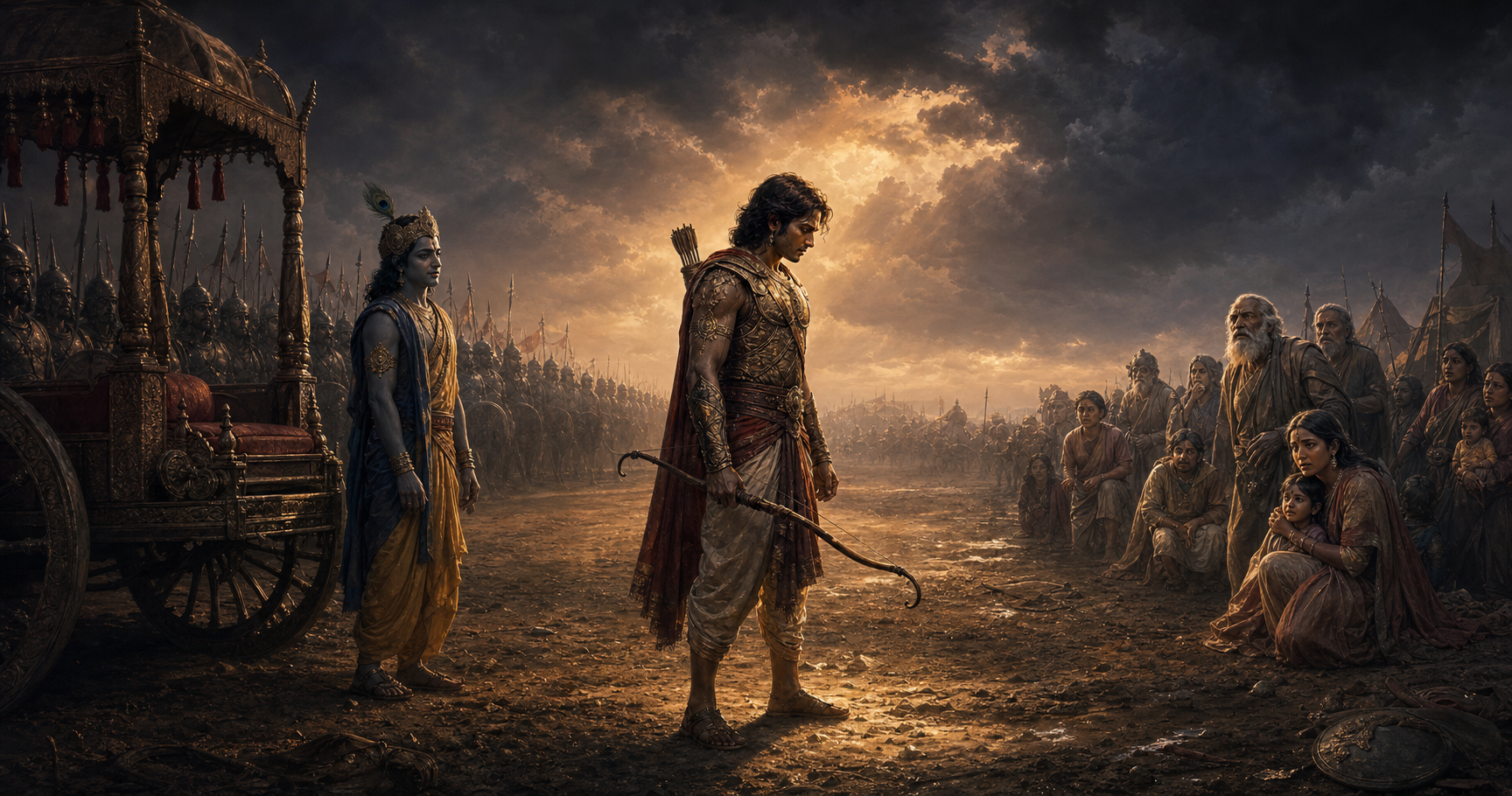
The quickest way to flatten the Mahabharata is to treat dharma as a label permanently attached to one side. Kumara Vyasa’s strength lies in presenting duty beside desire, courage beside vulnerability, and moral purpose beside human limitation. The reader’s task is therefore not just to identify dharma and adharma after the outcome is known. You should watch how a person reasons before acting and who bears the cost afterward.
Keep a decision record
For each major choice, write five short lines:
- The duty the character believes must be upheld.
- The desire, fear, loyalty, anger, or attachment pulling in another direction.
- The action actually taken.
- The immediate cost to other people.
- The question that remains unresolved even after the consequences appear.
This record protects you from hindsight. Before the consequence arrives, decide which action appears defensible and why. Afterward, revisit your judgment. Dharma becomes a practice of discernment rather than a word used to praise the winner.
Give each major character a live question
Kumara Vyasa gives Krishna, Arjuna, Karna, and Bhima psychological depth within the epic’s conflict of duty, desire, valor, and vulnerability. Do not convert that depth into a ranking of favorite heroes. Let each character test a different part of your moral reasoning:
- With Krishna, ask how wisdom guides action when no available choice is morally simple.
- With Arjuna, ask when hesitation is conscientious reflection and when it becomes avoidance of responsibility.
- With Karna, ask where loyalty ends and participation in another person’s wrong begins.
- With Bhima, ask when strength serves justice and when anger starts directing strength.
These questions are more useful than deciding that one character is wholly pure and another wholly corrupt. They also bring the epic into civic life. When you evaluate a leader, for example, do not stop at declared intention. Examine counsel, means, consequences, self-control, and responsibility for harm. The same habits sharpen decisions within a family or community.
Readers from Hindu, Buddhist, Jain, and Sikh backgrounds can meet here through shared concerns such as compassion, non-harm, self-mastery, responsibility, righteous conduct, and spiritual inquiry. Shared concerns do not make the traditions interchangeable. Use them as points of conversation, then allow each tradition’s own teachings to question your first interpretation. A Dharmic dialogue becomes richer when common ground creates inquiry rather than erases difference.
Use a three-pass practice instead of racing through the plot
The Mahabharata invites breadth, but breadth can become a trap. If you try to retain every relationship and event at once, you may finish pages without meeting the ethical drama. Work with one episode at a time and make three distinct passes.
- Narrative pass: Identify who wants what, what prevents it, and what decision changes the situation. Keep your summary to three sentences. If you need a page, you have not yet found the episode’s spine.
- Poetic pass: Return to the images, speeches, rhythmic changes, humor, and moments of heightened description. Mark the point where sympathy shifts or tension rises. This is where Kumara Vyasa’s authorship becomes visible.
- Dharmic pass: Complete the decision record. Ask which duties collide, whose suffering is overlooked, whether self-mastery is present, and what a more compassionate exercise of courage might require.
Do not combine the passes too quickly. On the first pass, constant philosophical interpretation breaks narrative momentum. On the third, fascination with plot can excuse you from judging a choice. Separation gives each kind of attention its proper place.
A reading group can use the same structure. Assign one person to recount the action, another to bring one stanza or image to the group’s attention, and another to formulate the central conflict of dharma. Then let every participant answer the ethical question before discussing it. This prevents the most confident speaker from determining the group’s judgment before others have formed their own.
Choose an edition that gives you enough help to stay with the Kannada rather than flee from it. Useful support may include explanations of difficult vocabulary, notes on meter and metaphor, and enough narrative context to locate a passage. Notes should lead you back to the poem, not replace it. If you finish the explanation but never reread the stanza, the apparatus has become a barrier.
Meet the Bharata as a living Kannada inheritance
Kumara Vyasa’s achievement is easy to praise and easy to neutralize. Calling the work a classic can place it safely in the past, where it asks nothing of us. Its continuing presence in recitation, performance, education, cultural gatherings, and public memory shows a different relationship: Karnataka has not merely preserved this Bharata; generations have repeatedly voiced and interpreted it.
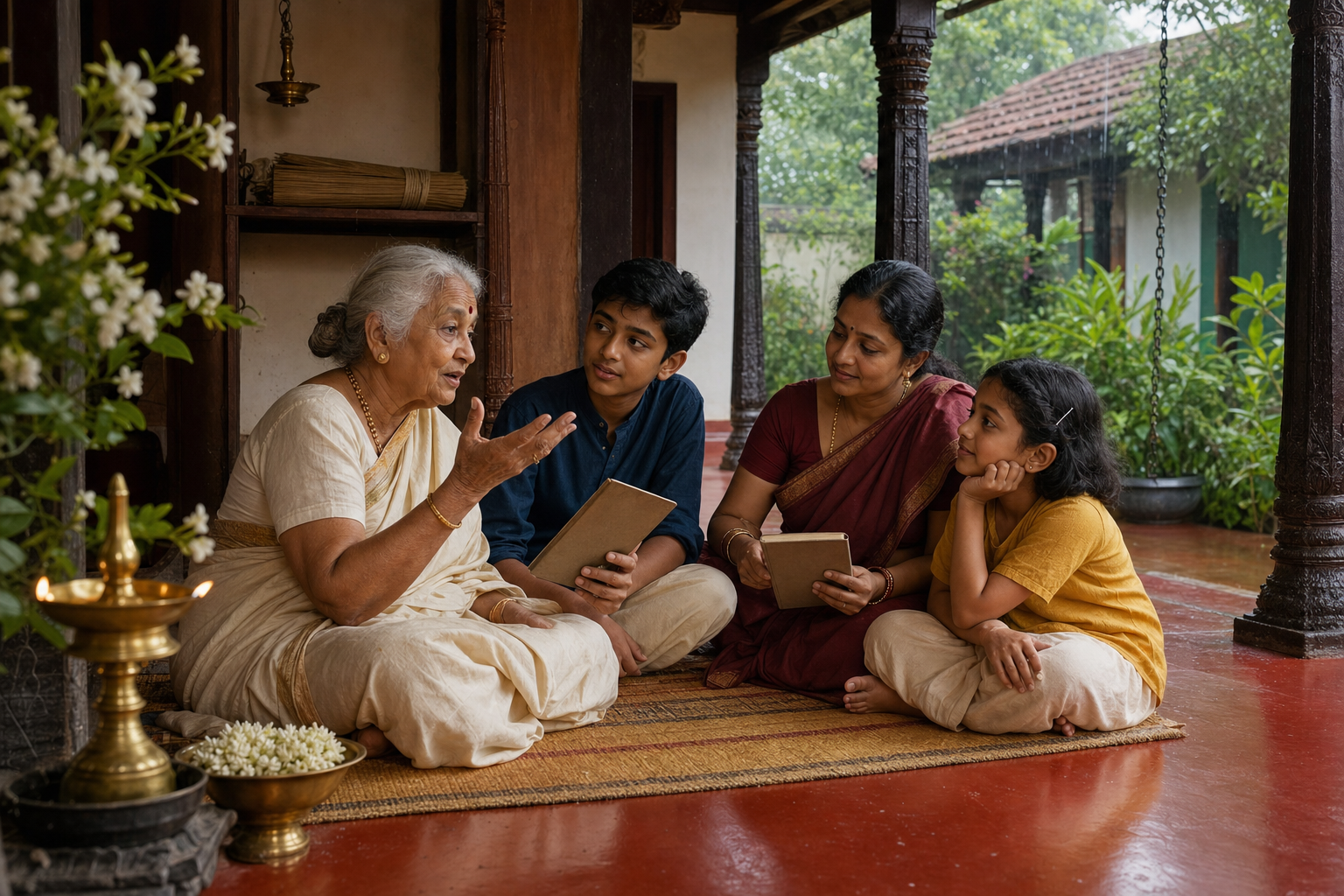
You can participate without pretending to be a specialist. Read a stanza aloud with family. Invite an older Kannada speaker to explain a word whose emotional force a dictionary misses. Compare two recitations of the same passage and note where the performers place emphasis. In a classroom, ask students to stage the competing arguments before revealing the consequence. Each practice treats Kannada as a medium of thought rather than a label of regional pride.
If you visit Gadag or the Veeranarayana Temple, approach the place as part of the work’s remembered cultural geography. The value of the visit is not proving an undocumented detail about composition. It is noticing how sacred place, poetic memory, performance, and community identity can gather around one literary inheritance.
That inheritance also corrects a common hierarchy in the way Indian classics are discussed. A Kannada Mahabharata is not important merely because it carries an older story to people presumed unable to reach an original. Through selection, amplification, meter, characterization, and performance, Kumara Vyasa makes Kannada itself a language in which the epic thinks anew. You should therefore ask not only what survived the retelling, but what became possible because the retelling happened in Kannada.
Key takeaways
- Karnata Bharata Kathamanjari, Kumara Vyasa Bharata, and Gadugina Bharata are names associated with Kumara Vyasa’s Kannada Mahabharata.
- Read it as a deliberate poetic recreation, not as a verbatim substitute for another version of the epic.
- Use Bhamini Shatpadi as an invitation to read aloud and listen to Gamaka, not merely to follow the plot silently.
- Track conflicting duties, inner motives, actions, and consequences before deciding where dharma lies.
- Let shared Dharmic values open conversation across traditions without pretending their doctrines are identical.
- Keep the work alive through close reading, recitation, performance, family discussion, and community study.
Begin with one episode, not an ambition to conquer the entire epic. Read it once for action, once for poetry, and once for dharma. Then hear it performed if you can. That small discipline will show you why Kumara Vyasa’s Bharata remains not only a landmark of Kannada literature, but a demanding companion for anyone learning how to act when every available path carries a cost.
References
