

You read that the Self is infinite, then encounter the Supreme within the small space of the heart or a person described as the size of a thumb. If the Infinite has no boundary, what are you meant to understand, contemplate, or do?
You don’t resolve that tension by choosing literalism over meditation, or private intuition over careful reading. First establish what the words are doing. Then undertake the kind of practice they prescribe. Inner realization begins when interpretation, attention, duty, and conduct stop pulling in different directions.
First ask what the Vedic sentence is asking you to do
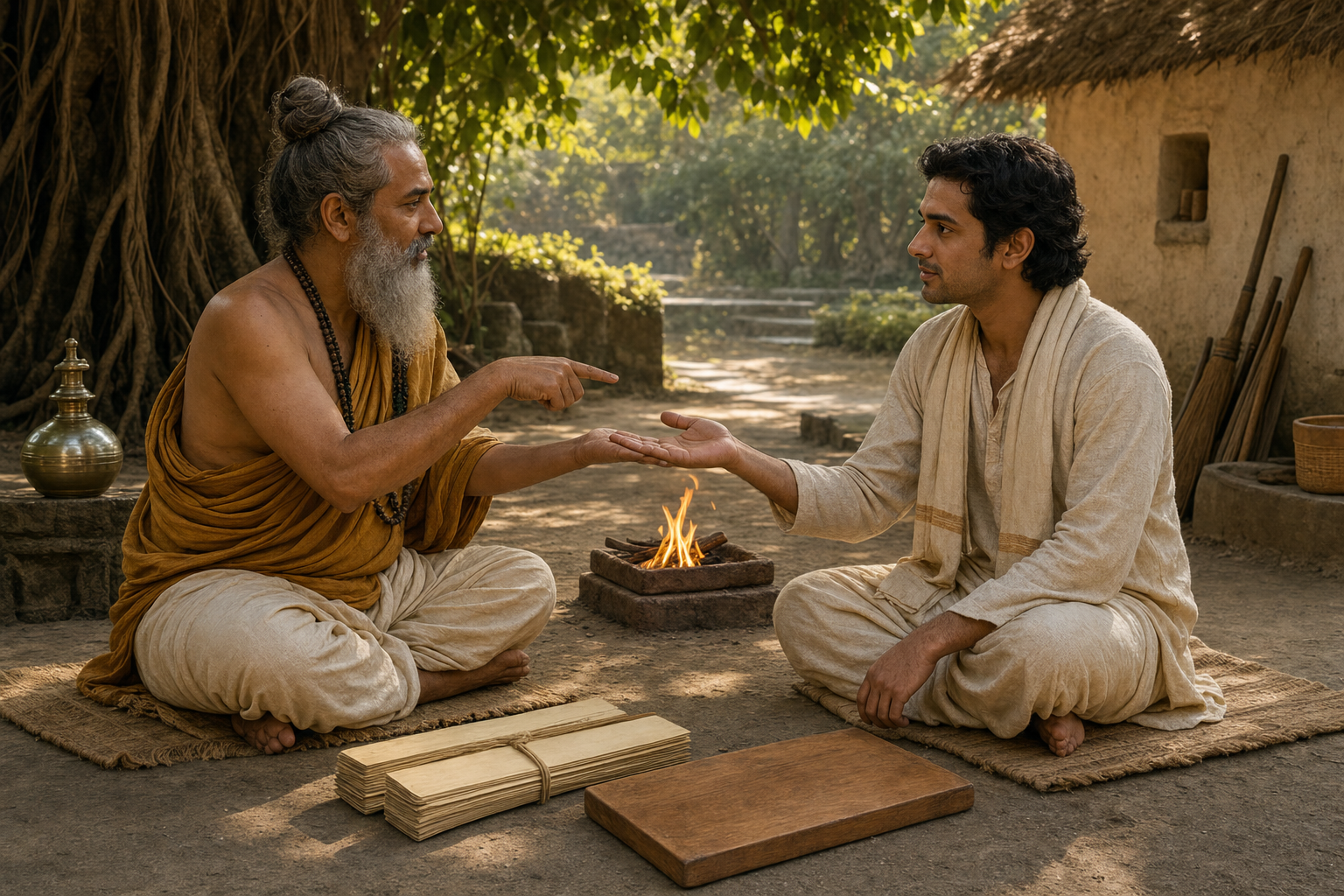
A difficult passage often becomes clearer when you stop asking only, Is this literally true? That question comes too early. Ask instead: What function does this statement perform here?
The Mimamsa discipline insists that Vedic meaning must be established through words, sentences, and the scope of an injunction. For this school, the Veda is an authorless and self-validating means of knowing dharma. That makes precision necessary rather than optional: if a statement directs action, its wording cannot be replaced by whatever symbolism happens to appeal to the reader.
Begin by distinguishing four kinds of work a passage may be doing:
- Directing action: It tells you to perform, avoid, offer, recite, observe, or arrange something. The relevant question is whether the prescribed act has been understood and performed correctly.
- Supporting an instruction: It explains, praises, warns, or supplies a reason that strengthens another teaching. Its purpose may depend on the injunction around it.
- Providing a form for contemplation: It gives the mind a name, image, quality, relationship, or locus on which to become steady. The form can be indispensable to the practice without being an exhaustive description of Reality.
- Correcting a mistaken identity: It directs inquiry toward what the Self is, or is not. Such a teaching is not fulfilled merely by repeating its vocabulary or visualizing its imagery.
These functions can cooperate within the same teaching, but they should not be collapsed. An instruction to act cannot be fulfilled merely by feeling reverent. A contemplative image need not impose a physical boundary on what it reveals. A statement concerning the Self is not reduced to an external ritual instruction simply because ritual occurs elsewhere in the Vedic corpus.
When you meet a difficult sentence, write down four questions before consulting a preferred interpretation:
<!– wp:list {