
You may know the plots of the Ramayana and Mahabharata, recognise the names of their heroes and villains, and still struggle to explain why these works matter to a decision being made in your home today. If the stories remain familiar but no longer illuminate conduct, the memory has been preserved only at the level of information.
Indian literature becomes civilizational memory when it gives you a durable way to recognise duty, disorder, sacrifice, self-deception, belonging and return. Its test is not simply age, popularity or religious prestige. The test is whether an inherited story can enter a present conflict, expose something that ordinary reasoning missed, and change what a person does next.
A civilisation remembers in more than dates
A timeline preserves sequence: which event preceded another, which ruler held power, and when an institution changed. Civilizational memory preserves orientation: what a community learned to admire, what it learned to fear, which failures became warnings, and which forms of conduct remained worth repeating.
These functions are complementary. Literature should not be asked to establish a date it cannot establish, and an archive should not be expected to explain why a remembered scene still governs the conscience. Confusion begins when we force either form to do the other’s work.
One useful Indic framework distinguishes petrified history from percipient history. The first preserves recoverable information about the past. The second preserves what the past teaches people to perceive. Within that framework, civilizational memory can operate like a prism: exemplary conduct is made memorable, destructive conduct is given recognisable form, and recurring mistakes are separated from forgotten circumstances so that later generations can still identify the pattern.
This is sometimes described as dispersive history. It should be treated as an interpretive model, not as permission to turn every tale into a literal chronicle. A narrative may carry a sound judgement about vanity, betrayal or rash action even when it cannot supply the evidence needed to reconstruct a particular event. The lesson can be historically valuable without every narrative detail functioning as archival proof.
Nor does civilizational memory require a single authorised account. Hindu, Buddhist, Jain and Sikh works do not collapse into one theology. A civilisation can remember through disagreement. Its continuity may lie in the questions that remain urgent, the vocabulary through which those questions are argued, and the willingness of each generation to answer rather than evade them.
When you read an epic, a puranic narrative, a life story or a modern novel, ask four questions:
- What conduct is made memorable? Identify the action, not merely the person praised for it.
- What kind of disorder becomes recognisable? Look beneath the villain’s name for the appetite, delusion or misuse of power being portrayed.
- What error has been converted into a reusable warning? The relevant pattern may survive even when the original offender does not.
- What carries the memory? It may be a character, a place, an object, a vow, a ritual, a relationship or an artistic form.
Those questions move you past the sterile choice between treating a story as a newspaper report and dismissing it as mere fiction. You begin to see what the civilisation chose to make unforgettable.
An epic remains alive when it changes a present decision
Rama, Sita, Krishna, Duryodhana, Ravana and Shakuni endure as more than names in old narratives. They function as moral and social idioms. A brief reference to one of them can summon an entire pattern of loyalty, endurance, statecraft, envy, appetite or manipulation. That compression is one of the practical powers of epic memory.
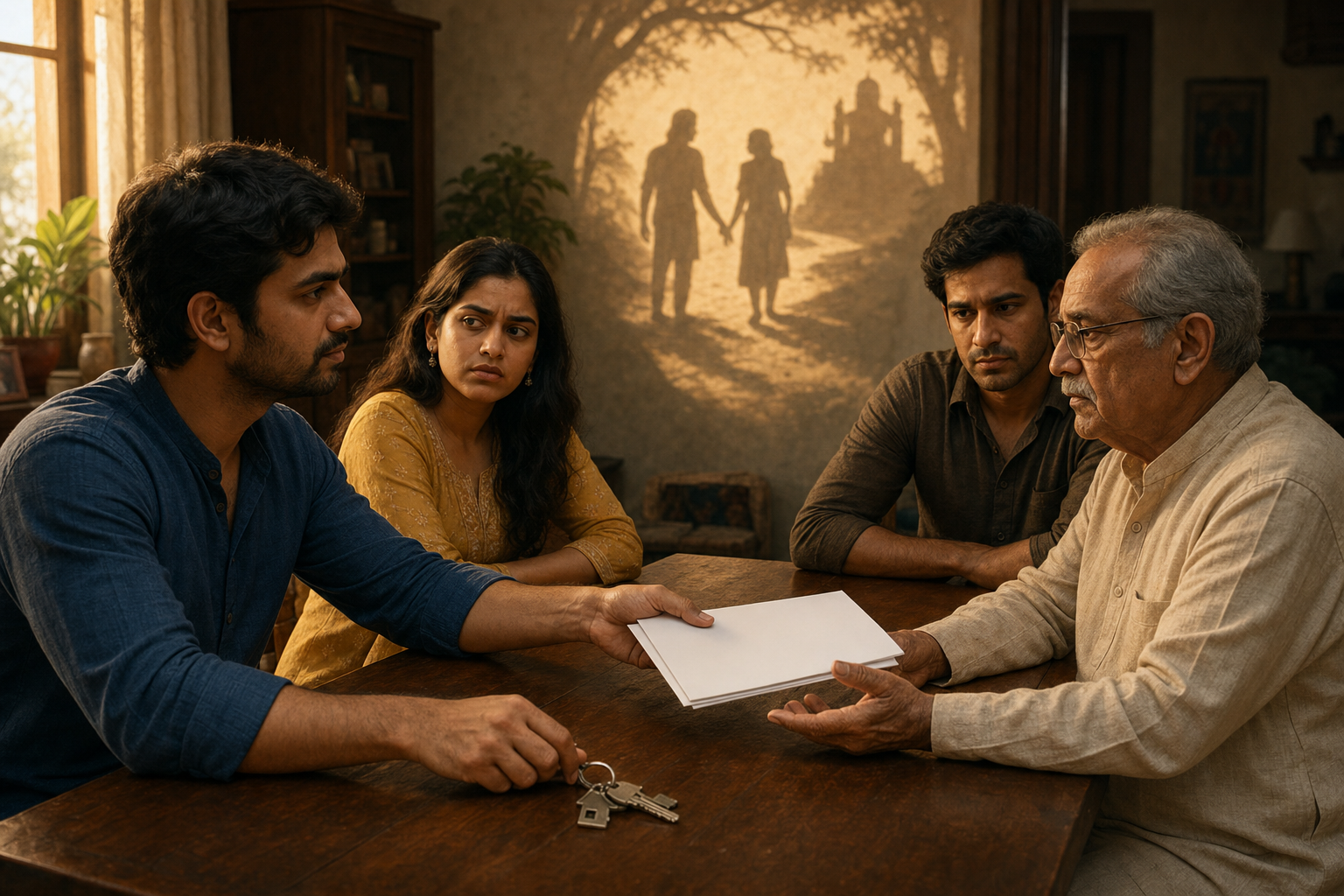
S.L. Bhyrappa demonstrates the mechanism with unusual clarity in Tantu, published in 1993. Hemant Honnatti sits at Harishchandra Ghat in Kashi, watches the funeral fires and confronts his illicit relationship with his close friend’s wife. The setting awakens the remembered climax of Satya Harishchandra.
In that remembered episode, Chandramati arrives with the body of her son but cannot pay the cremation fee. Harishchandra, separated from his family and failing to recognise her, asks for her mangalasutra as payment. Chandramati is stunned because the ornament is visible only to her husband. The demand therefore discloses the relationship that suffering and separation had concealed.
For Hemant, the memory is not a decorative allusion. It destroys the protective story he has been telling himself about his affair. At a place associated with truth tested through unbearable cost, he can no longer treat private deception as an isolated indulgence. He ends the relationship.
Notice the sequence:
<!– wp:list {