

You may have entered the D.N. Jha debate through a dispute about the sacred cow, the Gupta Empire, Nalanda, or what Indian children encountered in their history textbooks. The immediate temptation is to choose a camp. The more useful question is harder: what, exactly, would prove that a historical interpretation is sound or distorted?
You don’t have to choose between civilizational self-respect and intellectual discipline. You need both. The practical method is to separate Jha’s ideological framework, his particular historical claims, the evidence offered for each claim, and the institutional influence those claims acquired. Once you do that, the argument becomes testable instead of merely angry.
The dispute is about method, not just political identity

Historiography is the study of how history is constructed: which questions are asked, which evidence is emphasized, which categories organize it, and which causes are treated as decisive. A historian can reproduce dates accurately and still produce a distorted account if the explanatory frame excludes important evidence or makes every event serve a predetermined theory.
Marxist historiography normally foregrounds material conditions, control of production, social hierarchy, surplus, class interest, and conflict. These categories can uncover neglected dimensions of the past. They become a problem when they turn from questions into compulsory answers. If religion must always disguise material interest, sacred tradition must always legitimize domination, and political change must always arise from class relations, the framework has become difficult to falsify. Contrary evidence can then be reclassified as ideology rather than allowed to challenge the model.
Calling D.N. Jha a Marxist historian therefore tells you something about his intellectual approach, but it does not settle whether any particular conclusion is true. Jha is placed in the intellectual line of R.S. Sharma, and the objections to his work concern more than political affiliation. They include his treatment of cattle and food practices, Brahmins, Hindu deities, the Gupta period, Nalanda, and history education. Dharma Dispatch charges him with repeatedly forcing Indian evidence into a Marxist interpretation, including where the fit is disputed.
That is a serious allegation, but the force of an allegation is not measured by the force of its adjectives. A Dharmic response becomes persuasive when it can identify the exact claim, reproduce it fairly, examine the relevant evidence, expose the faulty inference, and offer a better explanation. Personal labels cannot do that work.
Each D.N. Jha controversy requires a different test

It is misleading to treat every dispute around Jha as one giant question called Marxist distortion. The controversies involve different kinds of evidence and different logical errors. If you want to judge them responsibly, test them separately.
The sacred cow: an occurrence is not automatically a norm
Jha’s The Myth of the Holy Cow sits at the center of the dispute over cattle, beef, and the development of Hindu reverence for the cow. The first task is not to react to the conclusion. It is to reduce each argument to a proposition precise enough to check.
- What animal does the passage actually identify: cattle generally, a bull, an ox, a cow, or something less specific?
- Does the passage describe a ritual prescription, an exceptional event, an accusation, a remembered custom, or an ordinary meal?
- Which community, region, and period does it concern?
- Does it establish that an act occurred, that it was permitted, that it was common, or that it represented a civilizational ideal?
- Is evidence from one period being used to make a claim about all of ancient India?
These distinctions matter. A record of an act does not by itself establish its prevalence, approval, or continuity. A ritual exception does not automatically describe daily diet. A prescription may reveal what an authority wanted people to do, not what everyone actually did. Conversely, later and widespread veneration does not prove that every Indian community held an identical practice in every earlier period.
The sound Dharmic position is neither denial by instinct nor acceptance by prestige. Ask whether the conclusion preserves the scope of the evidence. An early exception cannot, by itself, erase the sacred status the cow acquired and held within Hindu civilization. A later norm cannot, by itself, make every earlier exception impossible. The historical question is about development, distribution, authority, and meaning – not merely whether a provocative instance can be produced.
Brahmanical intolerance: define the actor before assigning guilt
The titles Brahmanical Intolerance in Early India and Adulterous Gods and their inebriated women have led critics to see hostility toward Brahmins and Hindu sacred traditions as a recurring feature of Jha’s work. Here the decisive issue is conceptual discipline.
The word Brahmanical can refer to several different things: a body of texts, a ritual order, the authority claimed by particular institutions, the conduct of particular Brahmins, or an entire civilization reduced to a theory of domination. Those meanings are not interchangeable. If a writer moves between them without warning, criticism of a specific institution can quietly become collective moral condemnation.
Whenever you encounter a claim about Brahmanical intolerance, underline the grammatical actor. Who acted? What did that person or institution do? Against whom? What evidence connects the act to a wider social structure? What counterexamples would limit the conclusion? If those questions have no clear answers, a category may be doing the work that evidence should do.
The same care applies to Hindu deities. Sacred narratives cannot be responsibly interpreted by stripping away genre, symbolism, theological commentary, ritual setting, and the tradition’s own vocabulary, then retelling them as modern scandal. That does not mean every inherited interpretation is beyond criticism. It means the critic must first demonstrate that the chosen mode of reading fits the material. A deliberately vulgar paraphrase is not an argument about what a sacred narrative means.
The Gupta period: test whether the theory can lose
The criticism of Jha’s treatment of the Gupta Empire is fundamentally a criticism of model fit: a Marxist theory is alleged to have been imposed on evidence that does not support the resulting conclusions. You can evaluate that criticism without rejecting economic history or accepting a celebratory account of the Gupta age.
Ask what observation would count against the proposed model. If prosperity confirms elite extraction, hardship confirms class exploitation, religious patronage confirms ideological control, and social cooperation confirms concealed domination, every possible outcome supports the same theory. Such a framework may interpret everything while explaining very little.
A stronger reconstruction must distinguish evidence from interpretation. Administrative arrangements, economic relations, political authority, artistic production, religious life, and social hierarchy may interact without being reducible to one cause. The practical warning is simple: when a conclusion appears before the evidence is discussed, check whether the evidence is being used to test the theory or merely decorate it.
Nalanda: separate the event, its scale, and its consequences
Jha’s critics specifically accuse him of denying Bakhtiyar Khalji’s destruction and burning of Nalanda. Because denial is a strong charge, it should be tested against Jha’s exact words rather than against a paraphrase of his position.
Four questions can easily become entangled in this controversy: whether an attack occurred, what was physically destroyed, whether burning occurred, and whether that event alone explains Nalanda’s end. A person could dispute the scale, chronology, or causal sufficiency of an event without denying every part of it. A person could also use uncertainty about one detail to evade strong evidence for the larger event. Only the exact proposition reveals which is happening.
Before repeating that any historian denied Nalanda’s destruction, record the sentence being challenged, its surrounding paragraph, the evidence cited there, and the narrower conclusion it actually supports. Then compare that with the broader claim attributed to the historian. This prevents both denial and exaggerated accusation from hiding inside ambiguous language.
NCERT influence: verify the curricular chain
The institutional charge is that Jha’s books were prescribed through NCERT schooling for decades, giving his interpretations influence over generations of students. That consequence matters, but it still requires a traceable curricular record.
Do not stop at the statement that Jha was in the textbooks. Identify the textbook title, named authors, class level, edition, period of use, relevant chapter, and actual wording presented to students. Then distinguish authorship from influence: writing a textbook, contributing to a committee, being cited in a bibliography, and representing the dominant interpretive school are different forms of institutional power.
This is where a historiography debate becomes an education question. A scholarly hypothesis can be debated among specialists with access to footnotes and competing works. A school textbook compresses uncertainty into a short narrative that may appear definitive. When you evaluate curricular bias, look for what was omitted, which contested interpretation became the default, and whether students were shown that a dispute existed.
A six-step audit for any disputed history claim
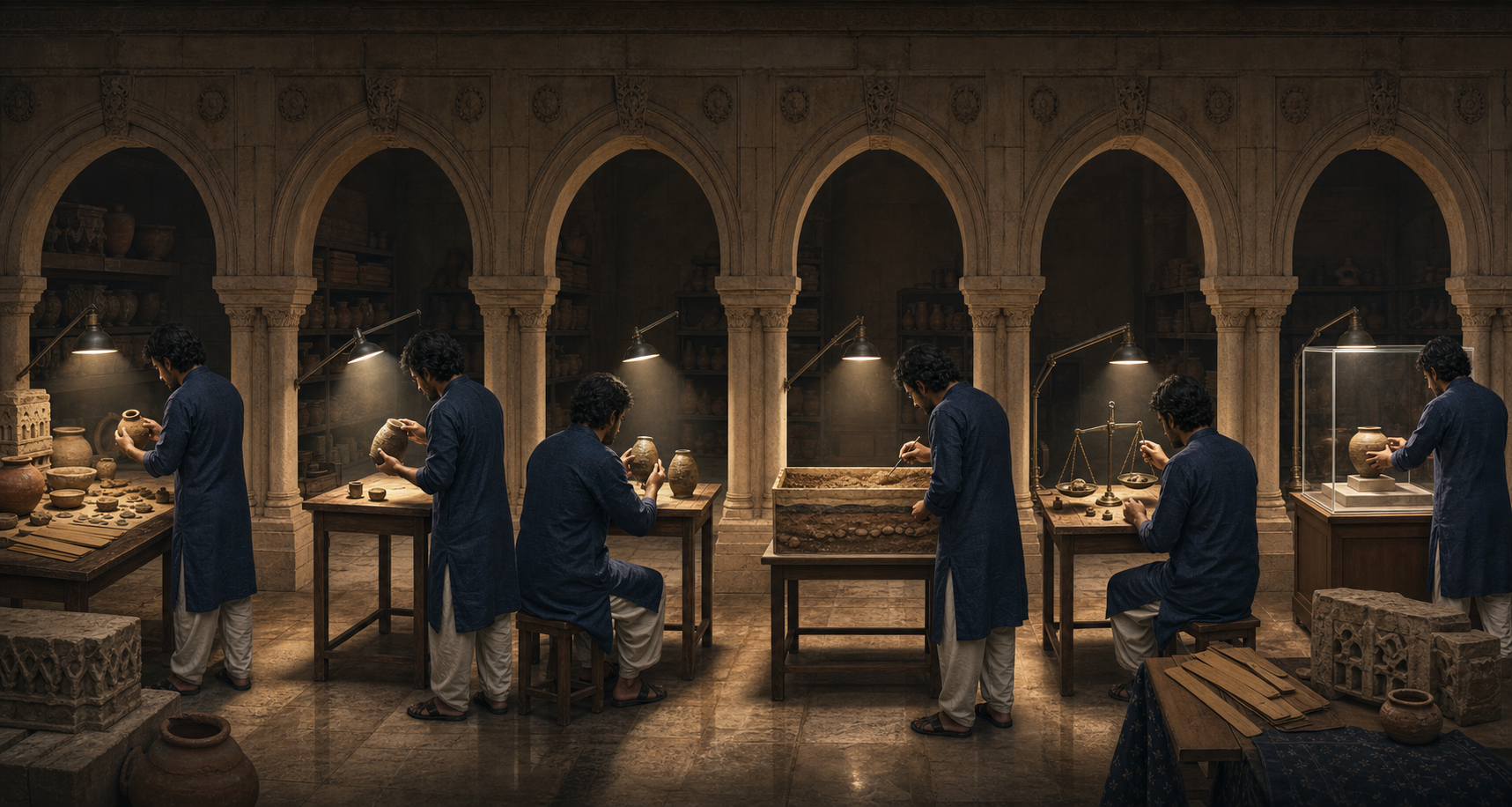
You can use the following method on Jha, his critics, or any historian writing about Bharat. It works best when you audit one claim at a time.
- Write the claim in one sentence. Include the actor, action, place, period, and scope. Replace words such as widespread, oppressive, tolerant, or decline with something that could be demonstrated. If you cannot state the claim precisely, you cannot verify it.
- Separate the evidence from the conclusion. Note whether the argument relies on a literary passage, inscription, archaeology, institutional record, later chronicle, or modern interpretation. Different evidence answers different questions. A normative text may illuminate an ideal without measuring ordinary behavior.
- Mark every inferential jump. Use a simple sequence: evidence, immediate inference, larger conclusion. If a passage describes one ritual, the immediate inference may concern that ritual. A conclusion about the diet of an entire civilization requires additional evidence.
- Test time, place, and category. Ask whether evidence from one century is being projected into another, whether one region represents the subcontinent, and whether modern political categories have been imposed on people who did not use them.
- Construct the strongest rival explanation. A useful rival must account for the same evidence, not merely express your preference. Then ask what additional evidence would distinguish the two explanations. If the favored theory cannot lose under any conceivable finding, reduce your confidence in it.
- Trace institutional transmission separately. A conclusion may be weak even if it became academically influential; it may also be strong despite being politically unpopular. Record who published it, where it entered curricula, whether competing interpretations appeared, and what qualifications disappeared during textbook compression.
A compact worksheet needs only six fields: exact claim; period and region; evidence offered; inference made; strongest alternative; current confidence. Keep the confidence provisional. High, medium, and low are more honest than true and false when you have not examined the underlying material.
What a serious Dharmic rebuttal should refuse

A pro-Dharma historiography cannot be built by reversing the direction of ideological abuse. If Marxist writing is faulted for reducing people to classes and traditions to instruments of domination, a Dharmic response should not reduce a historian to a dietary label, ancestry, or political tribe. That would reproduce the same habit of replacing argument with category.
- Refuse ad hominem as evidence. Whether a historian ate beef, disliked a community, or used offensive language does not by itself prove that a footnote is wrong. Establish motive only when the evidence supports it, and establish the historical error independently.
- Refuse civilizational flattening. Bharat contains long continuities as well as regional, sectarian, and historical variation. Protecting continuity does not require pretending that variation never existed.
- Refuse false neutrality. Fair method does not mean assigning equal credibility to every claim. Once the evidence has been tested, say plainly which interpretation is stronger and why.
- Refuse exaggerated certainty. Do not convert a plausible inference into an established fact. State what is known, what is inferred, what remains disputed, and what evidence could change the judgment.
- Refuse institutional fatalism. Academic dominance can amplify a weak interpretation, but institutional reach is not proof of falsity. Document the mechanism: appointments, syllabi, textbook authorship, citation patterns, or exclusion of rival views.
- Refuse reverence as a substitute for inquiry. Dharmic traditions deserve to be approached in their own intellectual languages and civilizational contexts. Respect opens that inquiry; it does not remove the duty to test historical claims.
This standard is demanding, but it gives a Dharmic critique durability. A rhetorical attack may satisfy readers who already agree. A claim-by-claim demonstration can persuade a student, parent, teacher, or undecided reader who wants to know what happened and how we know.
Key takeaways
- Marxist historiography is an explanatory framework, not an automatic verdict on the truth or falsity of a historical claim.
- The strongest criticism of D.N. Jha must identify the precise claim, evidence, inference, and alternative explanation rather than rely on political or personal labels.
- Evidence that a practice occurred does not automatically establish that it was common, approved, continuous, or representative of all ancient India.
- Terms such as Brahmanical must be tied to identifiable actors, institutions, texts, and actions before they can support a historical conclusion.
- The Gupta, Nalanda, and NCERT disputes involve different evidentiary questions and should not be bundled into one accusation.
- A credible Dharmic historiography combines civilizational literacy with explicit standards of evidence, scope, uncertainty, and falsifiability.
Start with one contested sentence, not a verdict on the whole historian. Put that sentence through the six-field worksheet and refuse to repeat it until you can show the evidence path. That small discipline is how you turn concern about ideological history into the patient recovery of Bharat’s historical memory.
References
