
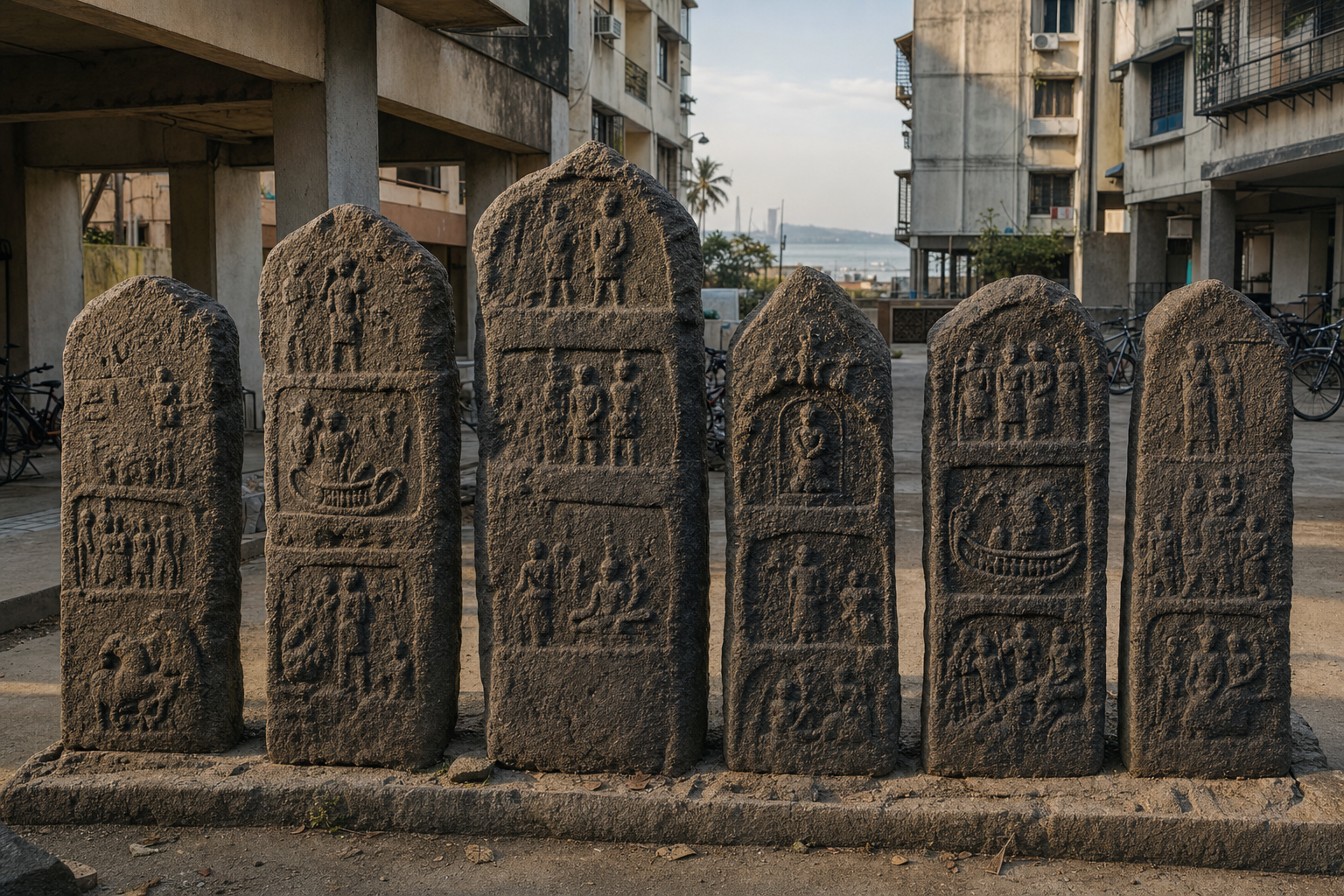
You can pass through Borivali West every day without realising that one of Mumbai’s rare visual records of premodern sea warfare stands inside a modern building compound. If you came looking for why the Eksar hero stones matter, or what anyone can still do for them, start here: heritage can be lost even while the stone itself remains standing.
Eksar’s six memorials still carry scenes of combat, ships, death, divine reception and worship. Yet their neighbourhood setting has been transformed, their relationship to the old settlement is difficult to see, and casual public access cannot be assumed. You need to know how to read what survives, how to separate evidence from interpretation, and how to ask for preservation that protects context as well as carvings.
Key takeaways
- Eksar has a group of six viragals, or hero stones, associated with the martial and maritime history of the North Konkan coast.
- The carvings should be read vertically: earthly combat occupies the lower panels, while the hero’s passage to a divine realm appears above.
- One especially important stone shows five masted ships, oars and armed men on deck, making the group valuable evidence for remembering medieval maritime warfare around Mumbai.
- The stones have been connected with several struggles for control of the approaches to Sopara, but those proposed connections should not be presented as conclusive identifications of every carved scene.
- A useful preservation campaign begins with authorised documentation, a condition baseline, readable interpretation, managed access and a plan that reconnects the stones with Eksar’s Gaon Devi temple and coastal history.
Read each hero stone as a journey, not a battle photograph
A viragal commemorates a person remembered for a heroic act, commonly a warrior, soldier or protector. Such memorials occur widely across southern Bharat and Maharashtra. The word used at Eksar is itself a clue to regional movement: viragal is a Kannada-derived formation adopted into Marathi usage, whereas dagada is the common Marathi word for stone.
The Eksar group contains six surviving hero stones within the Club Aquaria compound. Moti Chandra dated the group to the eleventh century. The first three in his description are monumental objects, each approximately 10 feet high, 3 feet wide and 6 inches thick. Their scale matters: these were not private keepsakes. They were public acts of memory designed to be seen, read and ritually understood by a community.
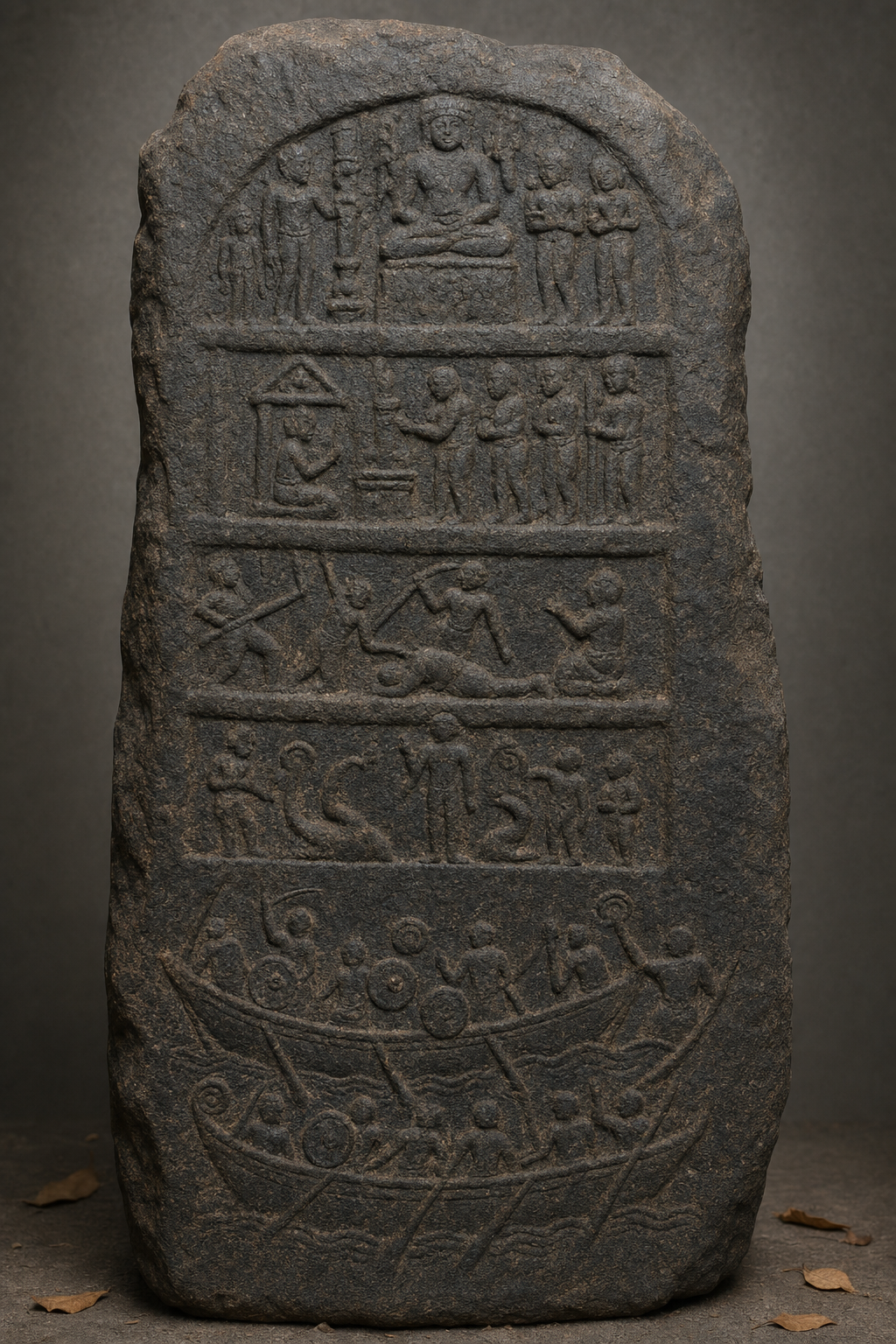
Begin at the bottom of a stone and move upward. The lower registers establish the hero’s violent world: mounted fighters, archers, swords, lances, elephants, bodies and ships. Higher registers change the mode of the story. Apsaras receive or guide the dead, garlands are offered, aerial conveyances appear, and the hero reaches Sivaloka or Kailasa. Worship, music, dancing and the bone-relic casket complete the passage.
This upward movement is the key to the memorial. The carving does not merely tell you how someone died. It tells you how that death was given meaning. Battlefield courage, communal remembrance and a Dharmic understanding of the hero’s destination form one continuous narrative. If you isolate the weapons and ignore the upper panels, you miss half the testimony.
The first viragal makes that structure unusually clear. Horsemen strike down an archer in the lowest panel. Other mounted fighters and foot soldiers continue the combat above, while dead warriors travel through the sky. The final panel places worship of a Sivalinga beside music and garland-bearing divine figures. The movement is from danger to sacrifice, and then from sacrifice to sacred recognition.
The second stone expands the social scale. Corpses lie beneath an elephant-mounted ruler, general and minister. An elephant seizes and tramples a man; elsewhere, rulers and mounted fighters clash. The soldiers’ large round earrings were read as a Konkan marker, comparable to a custom observed by the Arab traveller Sulayman. The upper register turns again toward Kailasa, garlands, song, dance and the relic casket.
The third stone supplies the group’s most striking maritime image. Its lowest panel contains five ships with masts, nine visible oars along one side and armed men on deck. Women shown near the bow of the last ship led to the tentative interpretation that it may represent the ruler’s vessel. Treat that last point as an interpretation, not as an identifying label carved into the stone.
When you examine a panel or teach it to someone else, separate three levels of certainty:
<!– wp:list {