
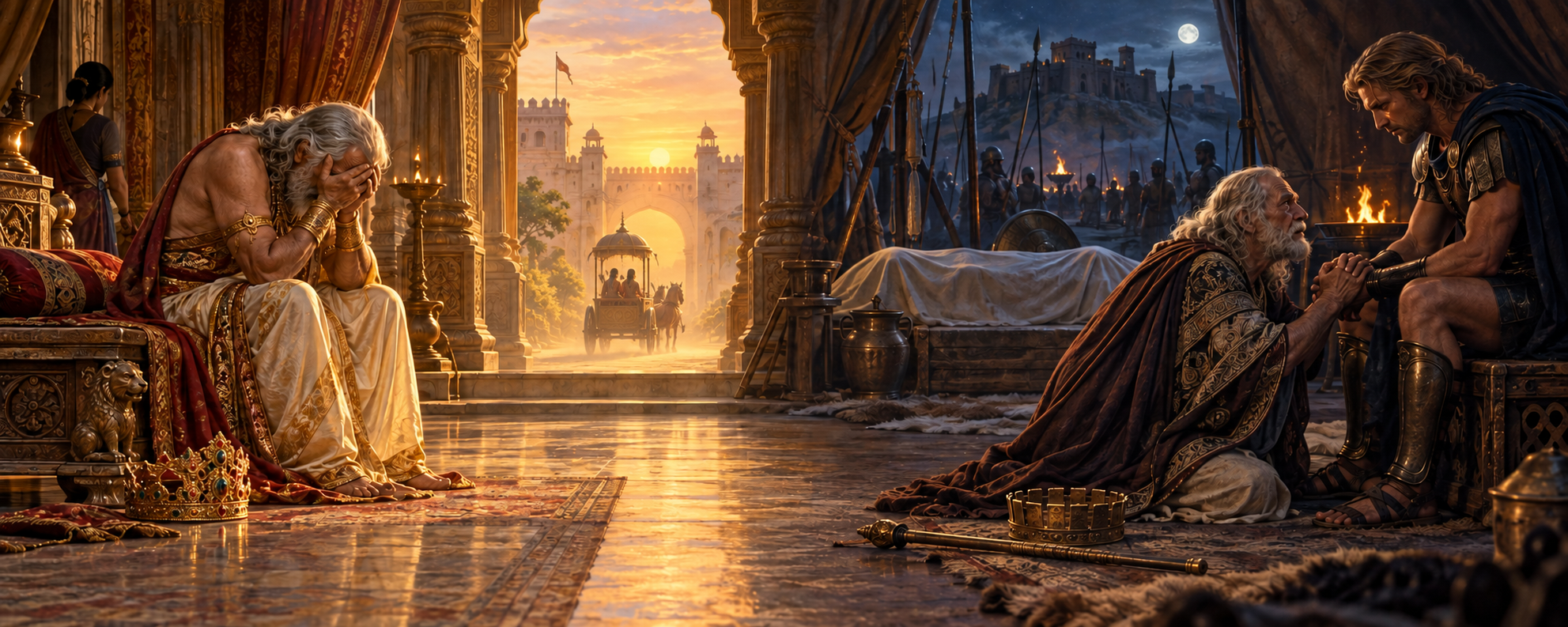
If you are wondering why a king from the Ramayana belongs beside a king from the Greek tradition, the answer is not that their stories are secretly the same. The pairing matters because both men reach the boundary at which royal power can no longer protect what they love.
That boundary changes how you should read their grief. It is not a decorative pause in a tale about rulers, and it is not proof that fatherly love makes a man unfit to rule. It is the moment when rank loses its disguises and the person beneath the crown becomes visible.
The crown cannot protect the father
Dasharatha of Ayodhya and Priam of Troy are rulers with power, wealth, and public honour who are nevertheless overwhelmed by pain connected to their children. Their authority may shape a kingdom, but it cannot make the most intimate forms of loss obey a royal command.
This is the first distinction to carry into your reading: authority is not the same as agency. Authority is the recognised right to direct other people. Agency is the ability to affect what happens. A king may retain the first while discovering that he has almost none of the second. Grief opens precisely in that gap.
Three habits will keep you from misreading that discovery:
- Do not confuse vulnerability with moral weakness. Vulnerability means that love has made something precious enough to be lost. Weakness is a failure of character or capacity. A narrative may show one without proving the other.
- Separate public position from private relationship. Subjects see a ruler, but a child is not merely a subject. The father cannot reduce that bond to administration.
- Ask what power cannot do. The most revealing part of a royal lament is often not the intensity of the emotion but the limit it exposes.
Once you make these distinctions, the two kings stop looking like mighty men who suddenly become small. They become men whose sorrow reveals that worldly greatness was always conditional.
Dasharatha shows that duty does not anaesthetise attachment
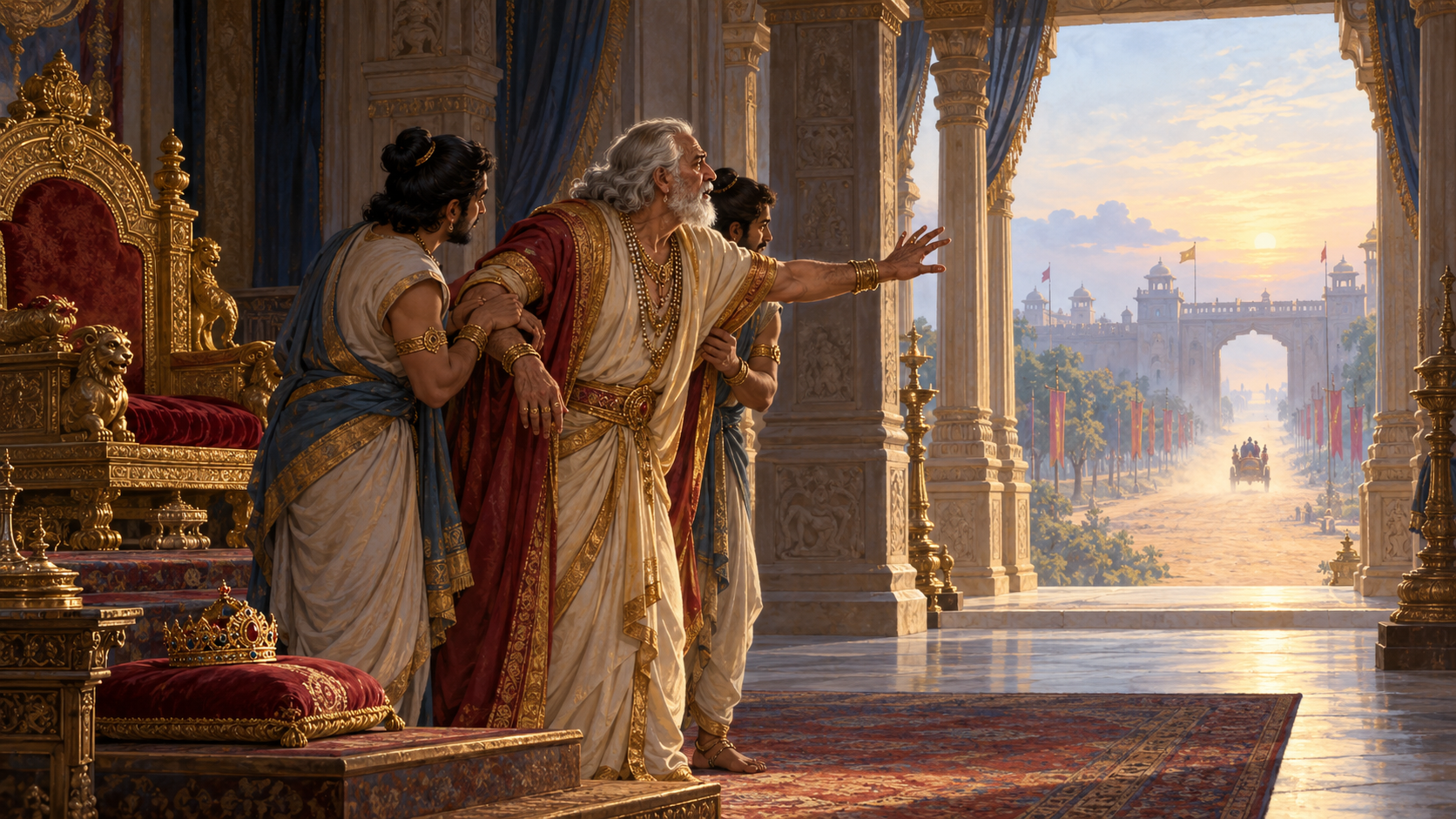
Dasharatha belongs to the moral universe of the Ramayana, where kingship is inseparable from dharma. A ruler does not possess the kingdom as a private indulgence. His position carries obligations, consequences, and a demand that personal desire answer to an order larger than itself.
That background makes his grief more than a display of parental emotion. The king and the father inhabit the same body, but they do not always ask the same thing of it. Public responsibility requires steadiness. Paternal attachment longs for the beloved child. Dasharatha’s suffering forces you to look at what happens when those claims cannot be made comfortable for one another.
A shallow reading turns this into a slogan about detachment: love less, and you will suffer less. That is not a useful Dharmic conclusion. Love is not the error. The sharper question is whether a person has any inner ground left when the desired relationship, presence, or future can no longer be secured.
Dharma does not function as an emotional sedative. Knowing that an obligation exists does not remove the human cost of meeting it. Nor does intense pain automatically cancel obligation. Dasharatha is therefore worth reading at the point where ethical order and emotional reality remain joined but refuse to become identical.
When you return to his story, track changes in agency rather than merely counting expressions of sorrow. Notice when he can direct events and when he can only react to them. Ask whether dharma eliminates pain, explains it, contains it, or simply prevents personal anguish from becoming the sole measure of what is right. Those questions produce a more serious reading than either condemning him for attachment or romanticising every expression of grief.
Priam reveals the difference between dignity and control
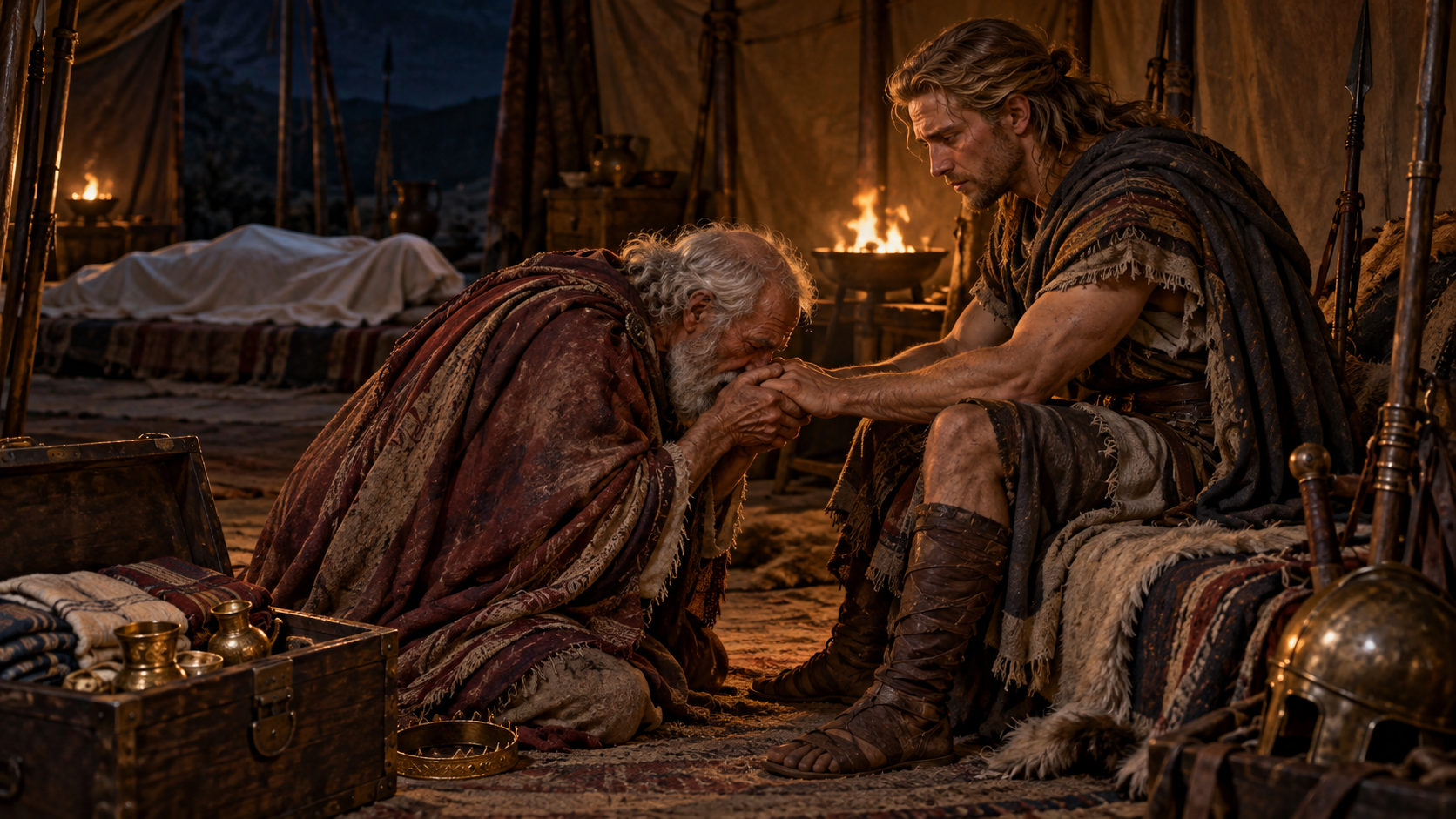
Priam comes from a different civilisational and literary setting. His grief should not be translated automatically into the vocabulary of dharma. Greek tragic imagination places severe pressure on human greatness by confronting it with mortality, reversal, and limits that neither status nor courage can abolish.
One fruitful way to read Priam is to separate dignity from control. Control means being able to determine an outcome. Dignity concerns how a person recognises reality and conducts himself when the outcome no longer belongs to him. Priam’s kingship cannot insulate his fatherhood, but the failure of insulation does not make his humanity meaningless.
This corrects a common modern assumption: that action matters only when it fixes the problem. Some losses cannot be reversed. In such a situation, meaningful action may consist in naming what matters, refusing to let rank erase kinship, or meeting an unbearable truth without pretending that authority can overrule it.
Look, therefore, at more than whether Priam gets what he wants. Attend to what he values after ordinary measures of success have failed. Listen for the difference between the ruler’s public language and the father’s direct appeal. The movement between those voices shows what remains of a person when political identity is no longer enough.
Dasharatha and Priam can then be placed beside one another without being collapsed into one figure. Dasharatha directs your attention toward the strain between obligation and attachment. Priam can direct it toward dignity under the pressure of irreversible mortality. Both reveal the end of sovereignty, but they illuminate that end through different moral languages.
Read the parallel without erasing the differences

The safest claim is also the most illuminating: the parallel is structural, not doctrinal. Two royal fathers encounter pain that kingship cannot master. It does not follow that the Ramayana and Greek tradition offer the same account of duty, fate, the self, death, or the purpose of suffering.
Shared emotion should be the beginning of interpretation, not its conclusion. Saying that every father grieves may establish human kinship, but it does not tell you what either tradition believes a person should do with grief. To preserve both the common humanity and the civilisational difference, use this four-question reading method:
- Name the precise loss. Is the father confronting separation, shattered expectation, endangered continuity, death, or several forms of loss at once? Do not allow the general word grief to blur the narrative’s actual pressure point.
- Identify the failed power. What could the king ordinarily command, and why can he not command this? The answer reveals the story’s view of sovereignty.
- Find the governing moral vocabulary. Does the narrative direct attention toward dharma, attachment, mortality, honour, fate, obligation, or another concern? Use the categories supplied by the tradition before importing your own.
- Examine what remains possible. Once restoration or control is unavailable, can the father still speak truthfully, honour a relationship, accept a duty, preserve dignity, or recognise another person’s humanity?
This method also helps you resist two opposite errors. The first treats one civilisation as merely an exotic version of the other. The second insists that cultural difference prevents any meaningful human recognition across traditions. Dasharatha and Priam reward a more disciplined middle path: comparison can clarify, provided that resemblance is not mistaken for identity.
The same discipline matters outside literature. When you encounter a grieving parent, status tells you very little about the scale of the wound. Wealth, learning, authority, and spiritual vocabulary may influence how grief is expressed, but none guarantees mastery over it. These kings teach you to withhold the easy judgement that visible sorrow is a collapse of character.
Key takeaways
- Dasharatha and Priam become comparable where royal authority reaches its limit before paternal love.
- Their grief reveals vulnerability, but vulnerability by itself is not evidence of weakness or failed kingship.
- Dasharatha is best approached through the tension between dharma, public responsibility, and attachment.
- Priam is especially illuminating when you distinguish human dignity from the power to control an irreversible outcome.
- The parallel is structural rather than theological: common fatherly pain does not make the Ramayana and Greek tradition doctrinally interchangeable.
- A careful reading identifies the exact loss, the power that fails, the tradition’s moral vocabulary, and the meaningful action that remains.
The next time you meet a royal lament, do not begin by asking why a powerful man appears so weak. Ask what his grief discloses that his power had concealed. With Dasharatha and Priam, the answer begins at the same place: before loss, the world sees a king; within grief, you are finally allowed to see the father.
References

Leave a Reply
You must be logged in to post a comment.