
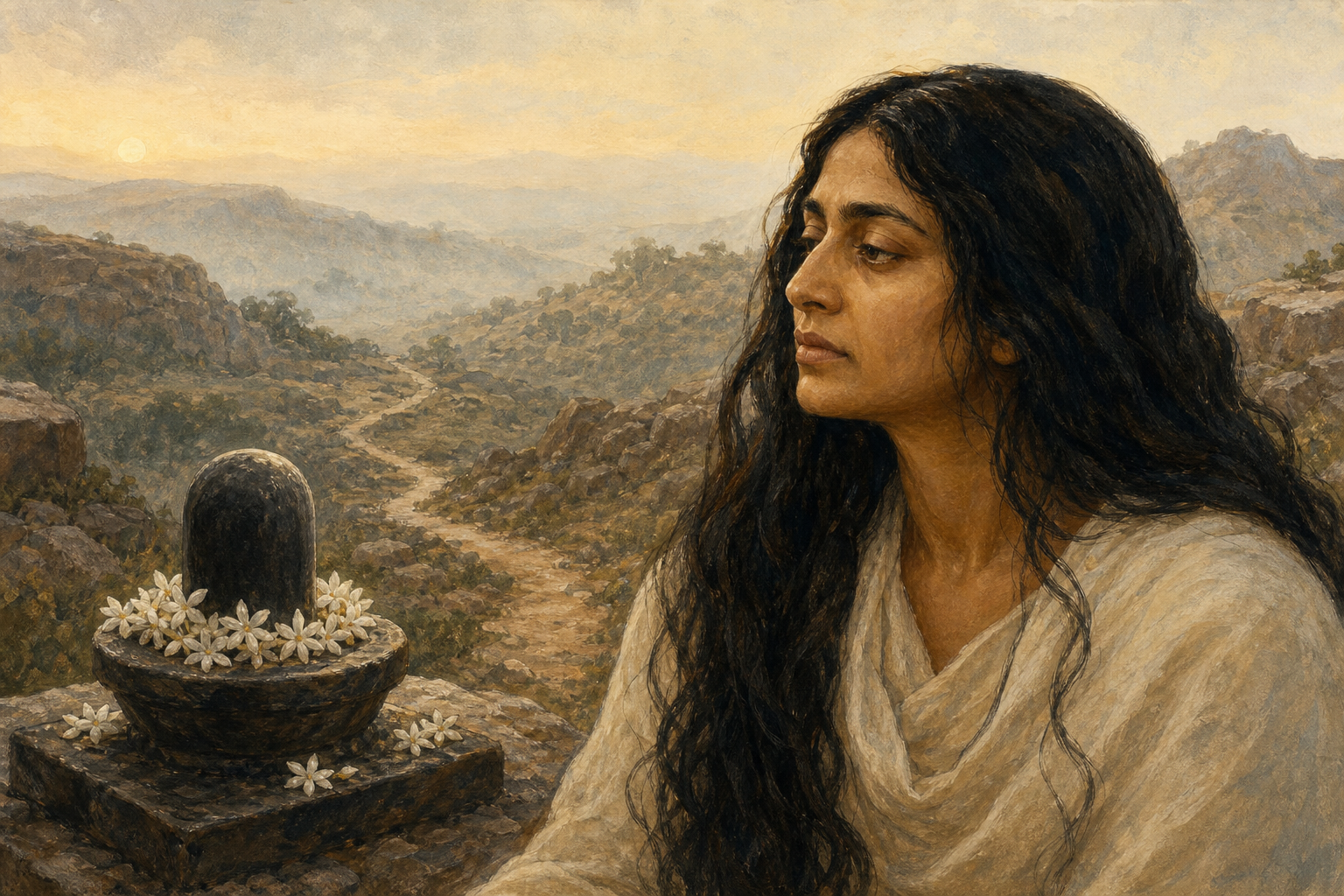
You may have encountered Akka Mahadevi through the most dramatic detail of her life: the saint who relinquished clothing, social approval, and conventional belonging. Or perhaps you know a few striking lines attributed to her but aren’t sure how to read them. In either case, the practical question is the same: how do you approach Akka without reducing her to a rebel, a symbol, or a collection of inspirational quotations?
Begin with the purpose of her vachanas. They are compact exercises in seeing through false attachments and turning your attention toward Chennamallikarjuna, her chosen form of Shiva. Read that way, Akka’s Kannada bhakti becomes more than literary heritage. It becomes a demanding method of devotion, discernment, and ethical change.
Why Akka’s Kannada bhakti is demanding, not vague
Akka Mahadevi stands among the foremost voices of the 12th-century Veerashaiva/Lingayat bhakti movement in Karnataka. She belongs in the company of Basavanna and Allama Prabhu, but her voice is unmistakably her own. It combines the intimacy of a lover addressing the Divine with the severity of a seeker unwilling to bargain with illusion.
The honorific “Akka” means elder sister. That name is useful because it tells you something about how her presence endured. She is not remembered only as an inaccessible ascetic or historical personality. She speaks with the moral authority of someone who can expose self-deception while still guiding the seeker toward freedom.
The center of that guidance is Chennamallikarjuna, Shiva as worshipped at Srisailam. The name commonly appears as the ankita-nama, or identifying signature, of her compositions. It is not a decorative sign-off. It keeps the vachana anchored in a relationship: a particular human voice calls upon a particular form of the Divine. If you remove that relationship and preserve only a general message about independence, you have changed the spiritual character of the work.
Akka’s association with Kalyana and the Anubhava Mantapa is equally important. This assembly brought saints and seekers into dialogue, and traditions surrounding Akka place her in serious exchange with figures such as Allama Prabhu and Basavanna. Her authority was therefore not presented merely as private emotion. It was articulated, questioned, and recognized within a community concerned with realization and conduct.
Three strands meet in this setting. Bhakti gives devotion its unwavering object. Jnana distinguishes what is lasting from what is merely displayed. Dharma asks whether realization has changed the way a person lives. Akka’s force comes from refusing to separate them. Love without clarity can become sentimentality. Clarity without devotion can become pride. Both become hollow when conduct remains untouched.
This is also why the directness of the Kannada vachana matters. Its relative freedom from courtly ornament does not make it intellectually slight. Brevity places pressure on every image and reversal. Status, adornment, reputation, bodily identity, and social expectation can be made to collapse within a few lines, leaving the reader face to face with the one commitment that remains.
Two contextual ideas help you avoid mistaking this directness for unstructured individualism. Shatsthala describes progressive stages of spiritual maturation, while the ishta-linga is the personally borne emblem of the Divine within the Veerashaiva/Lingayat setting. Inward realization therefore does not mean vague spirituality without practice, symbol, discipline, or community. It means that outward forms must become truthful rather than remain empty.
Key takeaways
- Akka’s vachanas are addressed to Chennamallikarjuna; they are not generic declarations of personal freedom.
- Her bhakti joins devotion, spiritual insight, and ethical conduct rather than treating them as separate paths.
- Her criticism is aimed at hollow ritual, social display, and attachment. It should not be turned into a rejection of every sacred form.
- Traditions about her renunciation come through hagiographies with varying emphases, so biographical details should be presented with care.
- The most faithful way to honor Akka is to connect vachana study with remembrance of Shiva and a concrete act of seva.
How to read a vachana as a spiritual exercise

A vachana is short enough to tempt you into reading it quickly. Resist that temptation. Its economy is part of its discipline. Instead of collecting a memorable line, follow the movement of the whole composition: what appearance does it expose, what attachment does it unsettle, and where does it finally direct your attention?
- Read the entire vachana before deciding what its message is. A forceful image near the beginning may be qualified or overturned by the conclusion.
- Locate the ankita-nama. Ask how the invocation of Chennamallikarjuna changes the preceding images. The closing name often reveals that the poem’s freedom is freedom for divine belonging, not freedom from every bond.
- Identify the image and its movement. Notice whether something opens, encloses, attracts, conceals, ripens, or dissolves. The action of the metaphor usually matters more than the object by itself.
- Name the false refuge being challenged. It may be status, adornment, social approval, bodily identity, verbal piety, or a practice emptied of inward attention.
- Translate the insight into one test of conduct. Ask what you will stop displaying, what you will remember more steadily, or what truthful action must follow from the reading.
Akka’s characteristic imagery gives you practice in doing this. Jasmine whiteness can bring purity and transparency into view. Bees and honey can stage attraction, nearness, and the desire to taste rather than merely describe. A silkworm and its cocoon can make you examine the enclosures created by your own attachments. Do not force every image into a fixed symbolic dictionary. Ask what changes within the image and what corresponding change the vachana demands from you.
Pay particular attention to contrasts between ornament and substance. Akka repeatedly strips away what the world uses to rank a person. The point is not that every ornament is inherently corrupt. The sharper question is whether appearance has become a substitute for realization. You can apply that question to religious life as readily as to wealth or social prestige. A visible identity, sophisticated vocabulary, or elaborate observance can still conceal an undisciplined mind.
It is equally important to read the vachana as speech addressed to someone, not as an isolated philosophical proposition. The address to Chennamallikarjuna carries longing, surrender, and recognition. A purely secular reading can identify Akka’s social resistance but miss the source of her fearlessness. Her detachment does not end in self-sufficiency. It ends in radical dependence upon Shiva.
After reading, write three short responses in a notebook: what collapses in the vachana, what remains when it collapses, and what must change in your conduct. If your interpretation leaves you impressed by Akka but unable to identify any attachment of your own, you have probably stopped at admiration. Read again until the composition becomes a mirror.
How to understand renunciation without turning it into spectacle

Akka’s life reaches us through hagiographical traditions that differ in their emphases. Their recurring contours place her early life in present-day Karnataka, describe strong social and familial pressures, and remember a decisive renunciatory turn centered on Chennamallikarjuna. That gives us a meaningful sacred biography, but not a modern documentary record in which every episode can be treated as equally certain.
Use precise language when recounting the most famous part of that biography. Akka is remembered for a digambara-like renunciation in which the body itself became a spiritual declaration. Within the bhakti frame, the act signifies detachment from worldly identity and complete reliance on the Lord. It is not an instruction that a present-day devotee must imitate externally.
The first common misreading turns this renunciation into spectacle. It makes nakedness the story and devotion the background. Reverse that emphasis. The bodily act becomes intelligible only within her refusal to seek security in status, imposed identity, or social recognition. Chennamallikarjuna is not an accessory to the act; divine belonging is its center.
A second misreading converts Akka into a modern individualist who simply rejected tradition. Her vachanas do criticize empty ritualism, but their alternative is not spiritual consumerism or the isolated self. The Divine Name, the ishta-linga, disciplined remembrance, dialogue among seekers, progressive maturation, and truthful conduct all remain part of the horizon. She challenges form without realization, not sacred practice as such.
A third misreading praises Akka only as an emblem of feminine courage. Her courage deserves recognition, especially given the pressures remembered in her life, but praise can become another way of not listening. She exercised theological and intellectual agency. She made claims about freedom, embodiment, truth, devotion, and the conditions of genuine belonging. Read her as a thinker and teacher, not merely as a person who endured restrictive circumstances.
When you teach or discuss her life, keep three checks in view. Mark a traditional episode as tradition rather than flattening it into verified chronology. Interpret renunciation alongside devotion to Chennamallikarjuna rather than treating it as an isolated protest. Then ask whether your account allows Akka to speak as a spiritual authority. These checks protect both historical honesty and the integrity of the bhakti tradition.
How to make her legacy a living practice
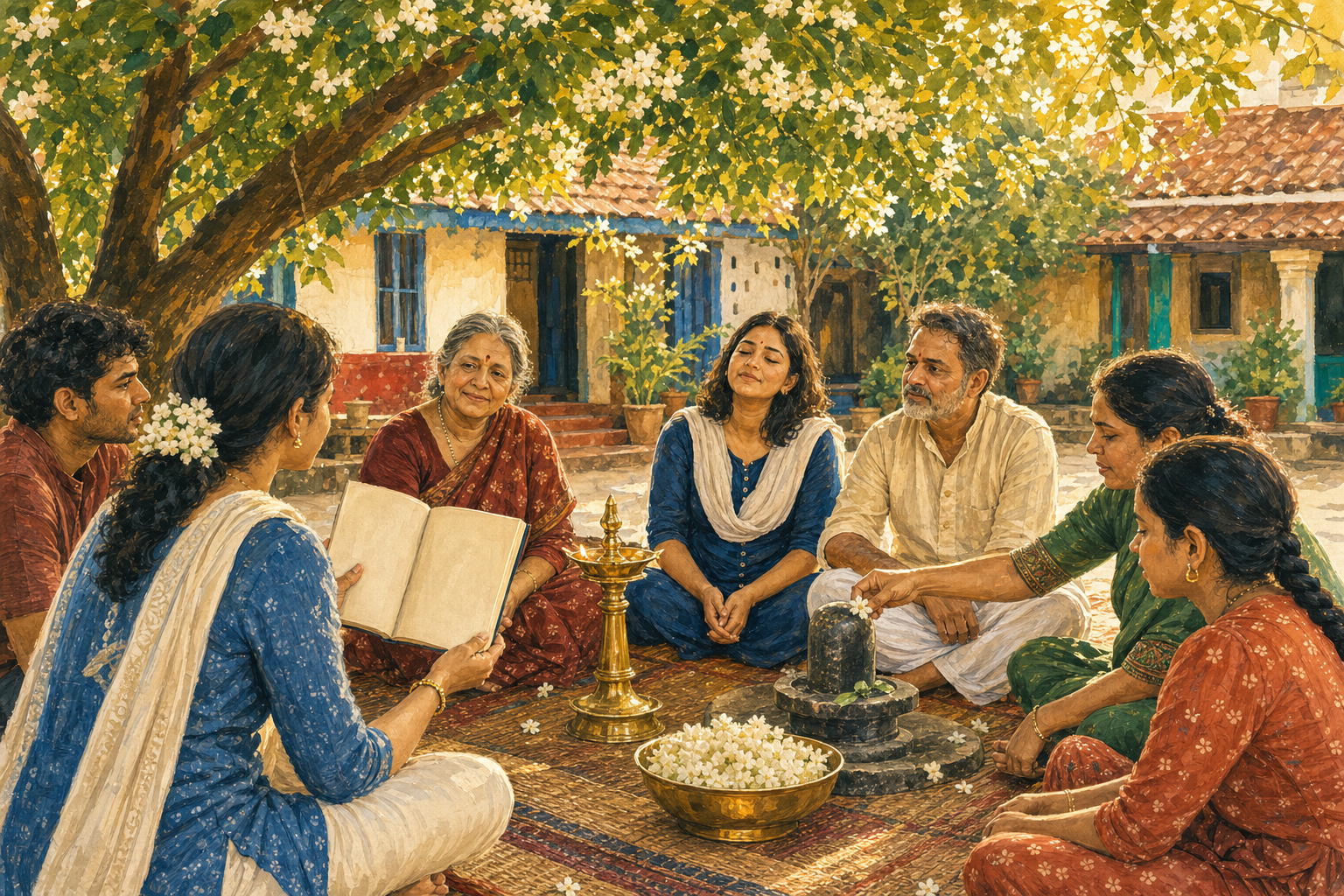
You do not need an elaborate program to begin. Select one vachana concerned with detachment or remembrance. Read it aloud slowly. Sit with its central image, repeat the name of Chennamallikarjuna, and identify one form of display or attachment that has been directing your choices. End by deciding on one act that makes the insight visible in conduct. This may mean telling the truth where you have been managing appearances, giving up an unnecessary claim to status, or serving someone without turning the service into self-promotion.
A simple home observance can preserve the same sequence. Begin with steady breathing and quiet attention. Offer a lamp and water before a Shiva linga or sacred image. Read or listen to a selected vachana. Practice japa with the Divine Name. Then carry the devotional act beyond the shrine through seva, such as food donation, educational support, or ecological service. The order matters: recollection becomes offering, offering becomes insight, and insight becomes action.
Akka Mahadevi Jayanthi gives this practice a communal setting. In 2026, the observance falls on April 1, Chaitra Pournami, the full moon associated with the opening lunar month of the traditional Hindu calendar. A household observing that day can begin at sunrise with pranayama and dhyana on Chennamallikarjuna, continue with vachana reading and japa, make a simple offering, and close with a charitable act.
For a temple, Kannada association, educational institution, or diaspora gathering, avoid building the entire event around biography and ceremonial praise. Give the vachanas room to work. A strong program can combine recitation in Kannada, a clear explanation for listeners who do not know the language, a period of quiet reflection, guided discussion, and a shared seva commitment.
A study circle will become more focused if every participant works from the same questions: Where does the ankita-nama appear? What movement occurs in the central image? Which external identity or false security is exposed? How do bhakti, jnana, and conduct meet in the composition? What action would show that the group has understood it? These questions keep discussion close to the text and prevent the session from dissolving into general praise.
Teachers can make the same adjustment in a classroom. Pair each biographical episode with a vachana-related theme rather than presenting a timeline alone. Renunciation can be paired with detachment, the Anubhava Mantapa with disciplined dialogue, the ankita-nama with devotional relationship, and imagery with ethical self-examination. Students then encounter a living intellectual tradition rather than a sequence of memorable events.
Chaitra Pournami also offers room for a wider Dharmic conversation. Hindu practices of japa, dhyana, and satsang can be discussed alongside Buddhist uposatha, Jain posadha, and Sikh disciplines of Naam Simran and kirtan. These paths should not be treated as interchangeable. Their shared emphasis on ethical renewal, contemplation, and disciplined remembrance can nevertheless help a gathering recognize a broader Indic inheritance while preserving Akka’s distinct Shaiva devotion.
Begin with one vachana rather than waiting to master the whole corpus. Keep Chennamallikarjuna at its center, let one image uncover one attachment, and give the reading an ethical consequence before the day ends. That is how Kannada bhakti passes from cultural memory into sadhana.
References
