

If you opened the Bhagavata Purana for Krishna’s childhood stories and found yourself facing creation, royal genealogies, sacred geography, yoga, renunciation, and the end of an age, your confusion is understandable. The work does not arrange its material like a modern handbook. It prepares you for Krishna-lila by changing the questions with which you approach it.
Once you see that architecture, the apparent detours become necessary steps. The twelve cantos move from a human crisis – how to live when death is certain – through cosmology, ethics, devotion, divine grace, and Krishna’s intimate presence, before returning to mortality with a transformed answer.
Begin with the question that holds the whole Purana together
The Bhagavata Purana, also called the Srimad Bhagavatam, is one of the Maha Puranas. Its twelve skandas contain approximately 18,000 Sanskrit verses. That scale can make the work look like an encyclopedia of unrelated Hindu traditions. Its narrative frames reveal a much tighter design.
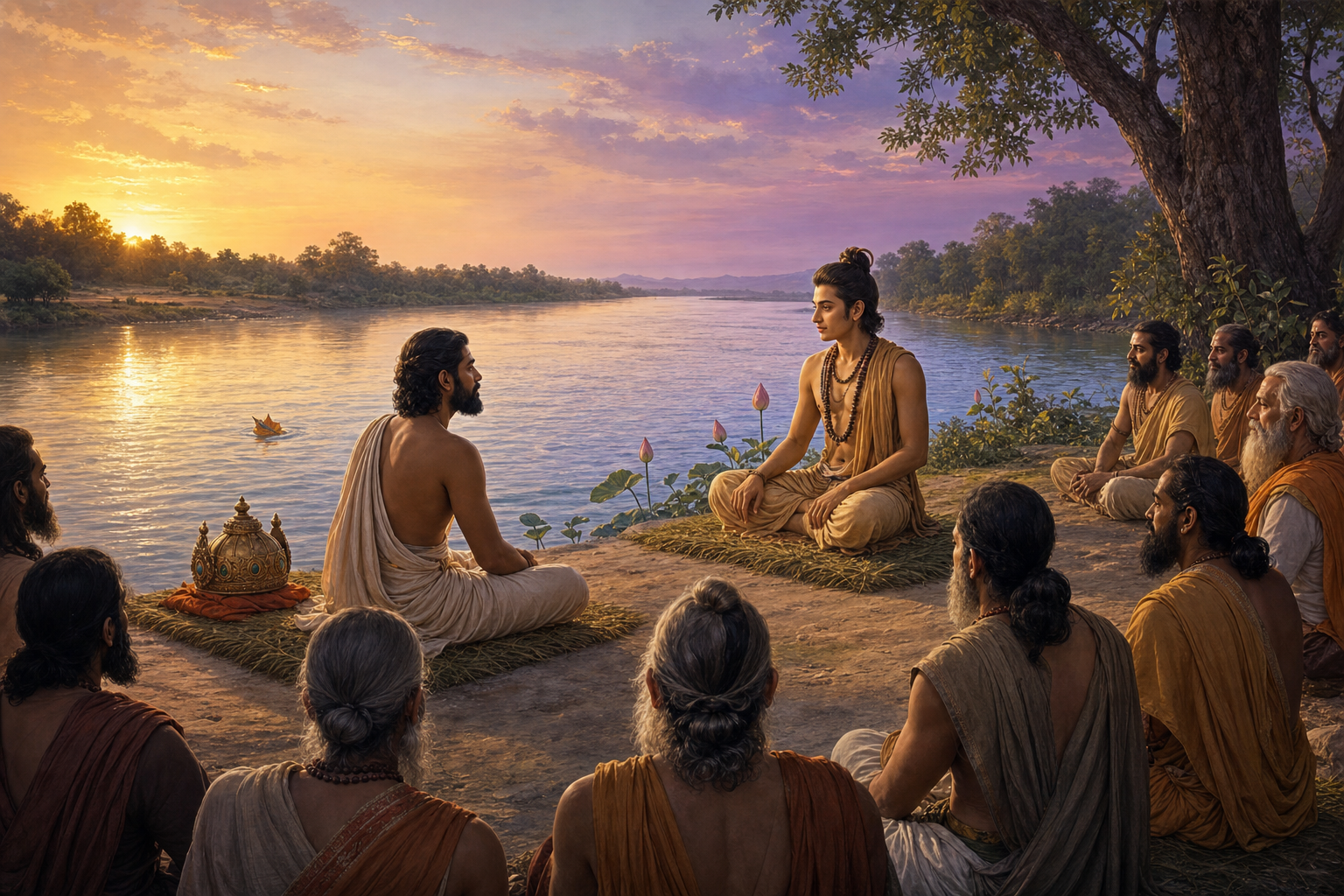
At the center stands King Parikshit. Condemned to die from the bite of the serpent Takshaka, he gives his remaining seven days to hearing Shuka’s teaching. His question is therefore not speculative. What should a person hear, remember, and do when death can no longer be treated as a distant possibility?
A second frame places that exchange inside Suta’s recitation to the sages at Naimisharanya. The teaching passes from speaker to listener and then into a wider community. Hearing is not merely how information travels in this arrangement. Attentive hearing is itself a spiritual act. The form of the Purana enacts one of its central convictions: sacred remembrance is sustained through repeated, public transmission.
A third strand concerns Vyasa. Traditional reception attributes the compilation to him at the threshold of Kali Yuga, after Narada counsels him to compose a work centered unmistakably on devotion. Modern historical scholarship places the text’s crystallization across the first millennium CE. You do not have to erase either lens before you can read well. Traditional attribution addresses sacred authorship and authority; historical inquiry asks how a large work took shape and circulated in time.
The commentarial tradition matters for the same reason. Shridhar Swami, Vallabha, Jiva Goswami, and Madhvacharya are among the influential interpreters associated with the Bhagavata. Their presence should alert you that difficult verses do not arrive without a history of interpretation. Before relying heavily on a translation, check whether it identifies its Sanskrit basis, commentator, and theological lineage. When a passage bears major doctrinal weight, compare more than one interpretation instead of assuming that the smoothest English rendering is neutral.
Keep Parikshit’s approaching death in view as you read. Cosmology then becomes a lesson in proportion, kingship becomes accountable service, stories of failure become examinations of grace, and Krishna-lila becomes more than sacred entertainment. Every canto is testing what remains worthy of attention when time is short.
Use the twelve cantos as a sequence, not a story collection

The quickest way to lose the Bhagavata’s argument is to treat its celebrated episodes as detachable tales. Each canto performs a particular job in the reader’s formation. This map gives you a question to carry into each one.
| Canto | Principal material | What it contributes | Question to carry while reading |
|---|---|---|---|
| 1 | The sages’ inquiry, Narada and Vyasa, the Mahabharata’s aftermath, and Parikshit’s crisis | Establishes the need for a teaching centered on the highest human good | What deserves your attention when ordinary securities fail? |
| 2 | The cosmic form of Vishnu, yogic concentration, creation, and the divine name | Trains attention to perceive the divine at both cosmic and accessible levels | How does contemplation replace fear with orientation? |
| 3 | Vidura and Maitreya, cosmogony, Varaha, and Kapila’s theistic Sankhya | Distinguishes matter, mind, and consciousness without separating knowledge from devotion | Which parts of your experience are changing, and what is capable of knowing that change? |
| 4 | Dhruva, Prithu, the Pracetas, and Rudra’s blessing | Examines desire, rulership, meditation, and devotion across sectarian boundaries | Can ambition be purified into service rather than merely suppressed? |
| 5 | Rishabha, King Bharata, renunciation, and sacred cosmography | Shows how attachment survives under unexpected forms and enlarges the scale of contemplation | What are you still clinging to after believing that you have renounced? |
| 6 | Ajamila, Vritrasura, Daksha, repentance, and the sacred name | Explores moral failure, remembrance, grace, and the heart’s deepest orientation | Does a moment of remembrance reveal a life beneath its outward disorder? |
| 7 | Prahlada, Nrisimha, fearless devotion, and reflections on social duty | Places inward realization above birth, power, and external religious form | What sustains fidelity when family, authority, and fear demand the opposite? |
| 8 | Gajendra’s surrender, the churning of the ocean, and Vamana’s encounter with Bali | Studies cooperation, discernment, humility, generosity, and divine reciprocity | What does surrender require when strength and status cannot rescue you? |
| 9 | Solar and Lunar dynasties, royal exemplars, Rama, and the approach of Krishna’s advent | Places Krishna within inherited memories of lineage and dharmic rule | How should power transmit Dharma across generations? |
| 10 | Krishna in Vrindavana, Mathura, and Dvaraka; Govardhana and the rasa-lila | Brings the theology of Bhagavan into intimate, relational, and aesthetic realization | How can love of the divine exceed calculation without abandoning ethical seriousness? |
| 11 | The Uddhava Gita, the Avadhuta’s twenty-four teachers, and the Navayogendras | Integrates devotion, self-knowledge, yoga, equanimity, and remembrance | How do you carry realization into instability and loss? |
| 12 | Kali Yuga, cycles of time, recitation, and Parikshit’s departure | Returns the teaching to mortality and demonstrates freedom from fear | What practice remains possible when an age is spiritually disordered? |
The sequence can be read in five movements. Cantos 1 and 2 establish the crisis and the discipline of hearing. Cantos 3 through 5 locate the individual within creation, consciousness, social responsibility, and cosmic scale. Cantos 6 through 9 test devotion amid sin, terror, surrender, power, and inherited Dharma. Canto 10 reveals Krishna-lila as the theological center. Cantos 11 and 12 teach the reader how to live after the height of revelation, when dissolution and death still have to be faced.
This is why jumping directly to the rasa-lila can produce a shallow reading. The earlier cantos have already examined discipline, detachment, moral repair, surrender, service, and the difference between consciousness and its objects. Canto 10 assumes that preparation. Its intimacy is a culmination, not permission to bypass ethical formation.
The central theology joins ultimacy, personality, and devotion
Bhagavan is not a lesser form of the absolute
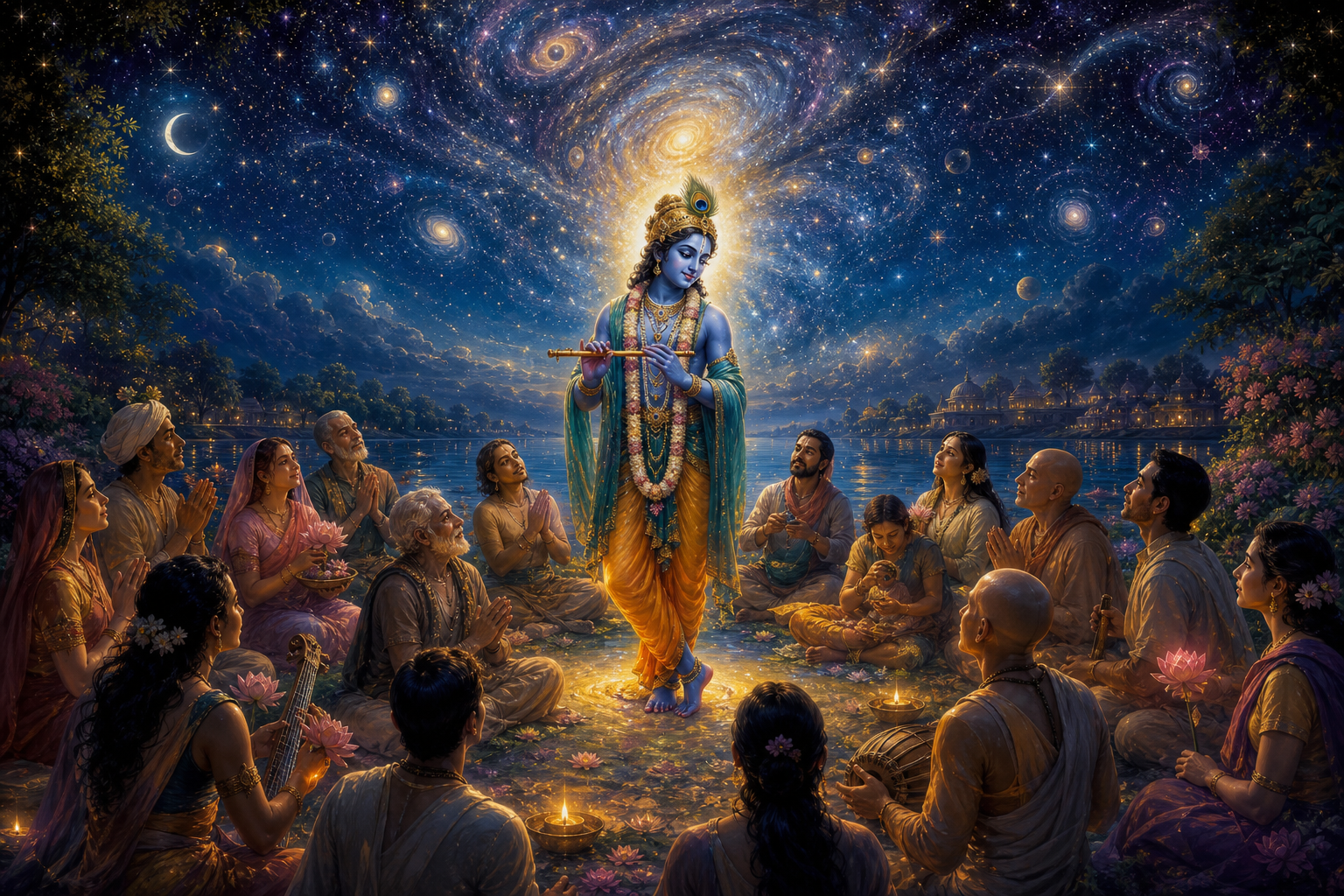
The Bhagavata’s decisive theological move is to present Bhagavan as ultimate reality without sacrificing divine personality. Vishnu and, preeminently, Krishna are not merely useful images placed over an impersonal truth. The divine can be the ground of existence, manifest through avataras, and still enter relationships of protection, friendship, parental affection, service, and love.
That conjunction explains the work’s unusual range. Cosmogony establishes divine ultimacy. Avatara narratives show the transcendent acting within the world. Devotee stories reveal that the appropriate response is relational rather than merely conceptual. Krishna-lila then carries relationship to its highest intensity without shrinking Bhagavan to an ordinary personality.
When reading an episode, ask two questions together: what does this reveal about the nature of Bhagavan, and what kind of relationship does it ask the devotee to cultivate? If you ask only the first, theology becomes abstraction. If you ask only the second, devotion can become projection or sentiment.
Bhakti orders knowledge, action, and discipline around Bhagavan
Bhakti is the Bhagavata’s governing path, especially under the conditions of Kali Yuga. Yet devotion does not require the rejection of jnana, karma, or yoga. Knowledge clarifies the nature of the self and reality. Ethical action restrains selfishness and serves the world. Yogic discipline steadies attention. Bhakti gives all three their center by orienting them toward Bhagavan.
This gives you a practical test for any spiritual discipline. Ask what it is training and where it is directing you. Knowledge that produces pride has lost devotional orientation. Action performed only for recognition remains bound to its reward. Concentration used to strengthen self-importance misses surrender. In the Bhagavata’s synthesis, a practice ripens when it deepens remembrance, humility, compassion, and loving service.
Grace answers effort without making conduct irrelevant
Ajamila, Gajendra, Prahlada, and Vritrasura stand in radically different circumstances, but each prevents bhakti from being reduced to a reward for respectable appearances. The sacred name, helpless surrender, fearless remembrance, and inward devotion can disclose a person’s deepest orientation when social judgment would reach a different verdict.
Grace therefore unsettles spiritual bookkeeping. It does not turn wrongdoing into virtue or make repentance unnecessary. It means that failure need not have the final word when consciousness genuinely turns toward Bhagavan. Read the rescue and the transformation together. Isolating the rescue makes grace look arbitrary; ignoring it makes spiritual life into self-salvation by merit.
The ninefold pattern of devotion makes this theology actionable. It includes hearing, chanting, remembering, serving, worshiping, bowing, servitude, friendship, and surrender. Treat these as mutually supporting modes, not as a rigid ladder. A householder may hear during communal recitation, remember while working, serve through family and civic duty, and chant the divine name. A renunciant may organize the same modes differently. The governing question is not whether your life resembles someone else’s practice, but whether its attention is repeatedly returned to Bhagavan.
Avoid four readings that distort the theology
The Bhagavata’s breadth allows readers to isolate whichever element confirms a prior preference. Four corrections preserve the balance built into its structure.
- Do not reduce Canto 10 to romantic poetry. The rasa-lila belongs to a theological ascent already shaped by detachment, moral responsibility, surrender, and divine sovereignty. Read it as sacred aesthetics directed toward love of Bhagavan, not as an ordinary human relationship enlarged to mythic scale. Keep Govardhana, Krishna’s wider life, and the previous nine cantos in view.
- Do not turn the divine name into a mechanical loophole. Ajamila’s deliverance displays the reach of nama and grace, but the surrounding theological concern is moral recovery and the heart’s ultimate orientation. Sacred sound is not a formula that licenses deliberate harm. Notice what remembrance interrupts, reveals, and begins to transform.
- Do not force sacred cosmography to compete with empirical science. Canto 5’s Jambudvipa, oceans, mountains, yugas, kalpas, and manvantaras place human life within vast, ordered rhythms. Read carefully for sacred scale, moral location, and contemplative meaning. Treating every image as a modern physical measurement can obscure what the passage is training you to notice.
- Do not confuse theological confidence with sectarian contempt. Vishnu and Krishna occupy the center, yet Rudra blesses the Pracetas, and the work can honor devotion across established Hindu lineages. Its compassion, truthfulness, non-harm, service, and remembrance also resonate with Buddhist karuna and maitri, Jain ahimsa and samayika, and Sikh seva and nam-simran. Resonance does not make these traditions interchangeable. Compare practices by the work they perform while allowing each tradition to retain its own account of liberation, selfhood, and the divine.
These corrections all depend on the same reading habit: interpret a celebrated passage within the whole progression. The Bhagavata repeatedly holds together realities that impatient reading pulls apart – transcendence and intimacy, grace and responsibility, knowledge and love, renunciation and service, particular devotion and civilizational plurality.
Turn the structure into a disciplined reading practice

You do not need to master all twelve cantos before the work becomes spiritually useful. You do need an order that preserves their relationship. The following route gives Canto 10 its proper preparation while keeping the first encounter manageable.
- Read Canto 1 slowly. Record the questions asked by the sages, Vyasa’s problem, Narada’s counsel, and Parikshit’s response to death. Write one sentence identifying the human problem to which the rest of the Purana responds.
- Use Canto 2 to learn the scale of the teaching. Place the cosmic form, meditation, and the divine name beside one another. Notice that the same theology can expand attention toward the universe and concentrate it in a name available to the individual.
- Sample Cantos 3 through 7 by following transformations. Read Kapila for the relation of consciousness and matter; Dhruva for desire purified into devotion; Bharata for the persistence of attachment; Ajamila for grace and moral recovery; and Prahlada for courage rooted in remembrance.
- Read Cantos 8 and 9 as preparation for divine kingship and Krishna’s advent. Track helpless surrender in Gajendra, discernment during the cosmic churning, generosity and humility in Bali, and the responsibilities preserved through royal lineages.
- Approach Canto 10 in two passes. First follow the movement from Vrindavana to Mathura and Dvaraka. Then return to Govardhana and the rasa-lila with a narrower question: how does each episode reveal both Krishna’s divine status and a distinct mode of relationship with him?
- Finish with Cantos 11 and 12. Use the Uddhava Gita, the Avadhuta’s teachers, the Navayogendras, Kali Yuga, and Parikshit’s departure to ask how insight survives change. The ending is not an appendix. It converts revelation into a way of meeting impermanence.
For every episode, make four brief notes: the crisis, the attachment exposed by it, the devotional act, and the resulting transformation. Dhruva begins with injured ambition; Prahlada faces coercive power; Gajendra exhausts worldly strength; Ajamila confronts the consequences of a disordered life. This simple pattern prevents the miraculous ending from eclipsing the inner movement that gives it theological meaning.
Then let reading cross into practice. If a passage centers on hearing, listen without simultaneously performing another task. If it centers on nama, chant or remember the divine name attentively. If it centers on service, identify a concrete duty you have been treating as beneath you. If it centers on surrender, name the outcome you are trying to control and distinguish responsible action from the demand to command its result.
Key takeaways
- The Bhagavata’s controlling question is what a person should hear, remember, and do in the face of death.
- The first nine cantos prepare the ethical, philosophical, and devotional ground for Krishna-lila in Canto 10.
- Bhakti does not discard knowledge, action, or yoga; it directs them toward remembrance and loving service of Bhagavan.
- Grace exceeds moral bookkeeping, but it should be read together with repentance, transformation, and responsibility.
- Cantos 11 and 12 show how devotion becomes steadiness when revelation gives way to dissolution, Kali Yuga, and mortality.
Your next step is simple: begin with Parikshit’s question rather than your favorite episode. Read Canto 1 with a notebook, identify what the coming death strips away, and carry that urgency into every later canto. The structure will then do what it was built to do – lead you from hearing about Bhagavan toward remembering, serving, and meeting mortality without fear.
References
