
In September 1969, A.C. Bhaktivedanta Swami Prabhupada (Srila Prabhupada), founder-acarya of the Hare Krsna movement (ISKCON), arrived at Tittenhurst Park as a house guest of John Lennon. On a tranquil, eighty-acre estate in the Berkshire countryside, a meeting unfolded that linked a centuries-old bhakti lineage with the epicenter of modern popular culture. This convergence provides a precise vantage point for examining how chanting functions as a rigorous spiritual practice oriented toward liberation, and why the practice resonated so powerfully with artists seeking inner clarity at the turn of a tumultuous decade.
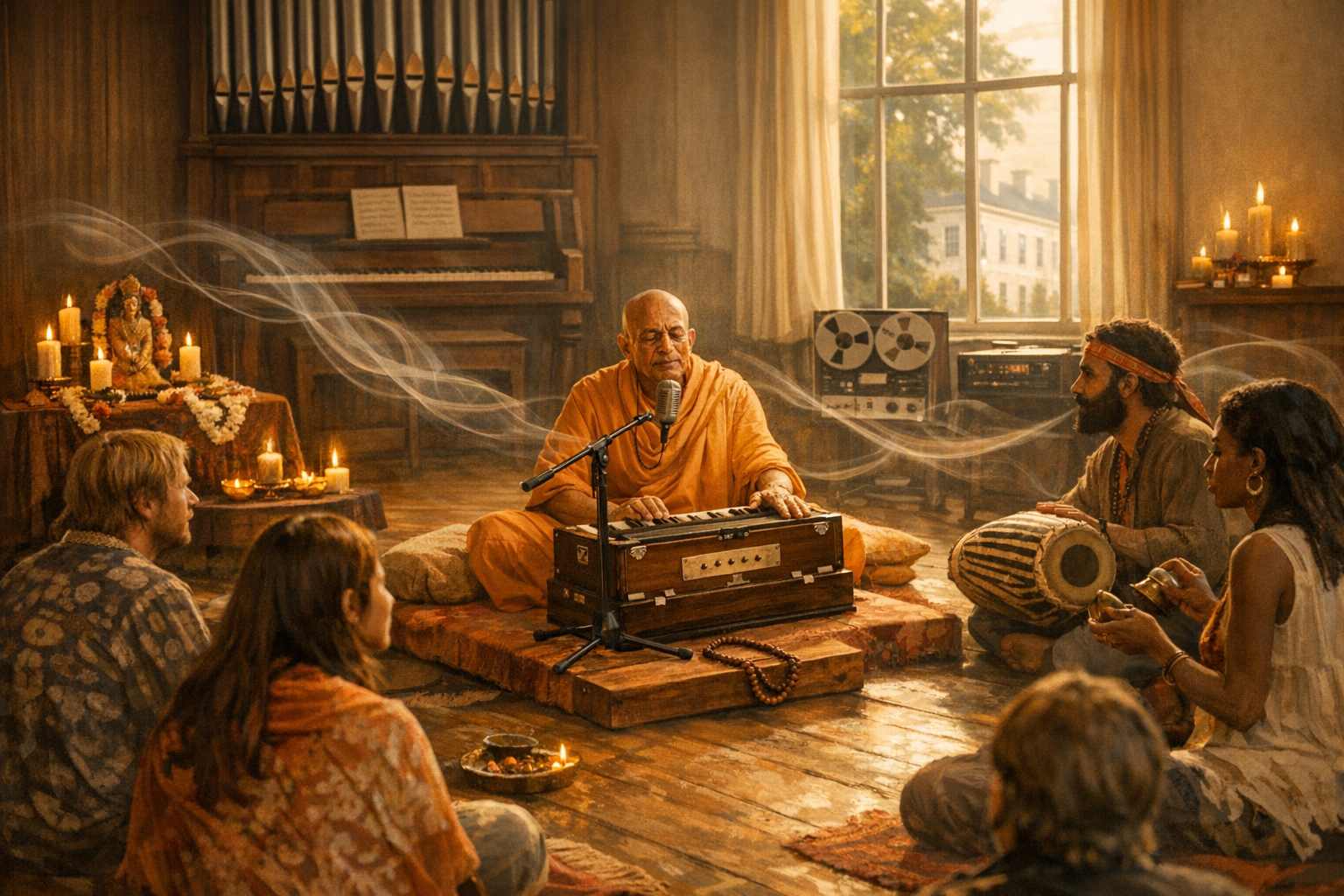
Several times each week, Srila Prabhupada delivered public lectures in a tall, stately building near the property’s northern edge, about a hundred yards from the main house where John Lennon and Yoko Ono lived. Once a hall for chamber-music recitals, it was transformed by resident disciples into a simple sanctum with a Deity altar and a speaking podium. The building soon acquired an informal name the Temple a colloquial designation that persisted even after the grounds were later integrated into a recording-studio complex under Ringo Starr.
On September 14, John, Yoko, and George Harrison attended after enjoying an Indian vegetarian meal prepared by the devotees. They walked to Srila Prabhupada’s quarters for a first conversation that was at once intimate and searching. More than a social visit, the encounter mapped the contours of a shared inquiry into sound, consciousness, and the disciplined pursuit of freedom from anxiety.
Within the Gaudiya Vaishnava tradition, chanting takes two principal forms: kirtan, collective call-and-response singing with musical accompaniment, and japa, personal mantra repetition often counted on a mala of 108 beads. The principal mantra Hare Krsna Hare Krsna Krsna Krsna Hare Hare / Hare Rama Hare Rama Rama Rama Hare Hare is held to be non-different from the Divine names it invokes. As a result, practice is not merely symbolic or aesthetic; it is a technology of inner transformation grounded in sound (sabda) and devotion (bhakti).
Classical sources articulate liberation, or moksha, as release from compulsive patterns of thought and action and from the cycle of birth and death. In Gaudiya theology, however, liberation is not an end point but a threshold to the higher telos of loving service (prema-bhakti). Chanting aims at both, first quieting the mind and softening reactive habits, then reorienting attention toward a sustained relationship with Krsna characterized by humility, gratitude, and steady joy.
Scriptural anchors such as the Bhagavad-Gita and the Bhakti-rasamrita-sindhu describe mantra as a direct means to steady the mind and reframe identity from the material ego to the atman in relation to the Divine. In this framework, sabda is not merely symbolic representation but revelatory presence; hence, careful enunciation, attentive listening, and moral restraint (yama and niyama) are treated as integral controls that stabilize and validate the practice.
For 1960s Britain, this sounded both ancient and startlingly new. George Harrison, already exploring Indian music and spiritual practice, helped spotlight the practice in mainstream culture. His support for the London Radha-Krishna Temple community, including recordings that brought the Hare Krsna mantra onto popular charts, demonstrated that kirtan could speak meaningfully to audiences far beyond traditional ashram settings. The Tittenhurst gatherings exemplified that dialogue: disciplined practice meeting creative experimentation, without dilution of principle.
Chanting’s appeal at Tittenhurst also illustrates a broader unity across dharmic traditions. In Hindu practice, japa and kirtan cultivate remembrance of the Divine; in Buddhism, mantra recitation and mindfulness of sound stabilize attention and compassion; in Jainism, the Namokar Mantra fosters ethical purification and equanimity; in Sikhism, kirtan and Naam Simran center the mind in the remembrance of Waheguru. While metaphysical emphases differ, the shared insight is clear: sacred sound, approached with integrity and discipline, refines perception and harmonizes community life.
A technically sound chanting routine balances breath, posture, and intention. Practitioners sit with an upright spine, relax the shoulders and face, and coordinate articulation with gentle diaphragmatic breathing to avoid strain. Japa proceeds bead by bead at a sustainable cadence, with attention returning to the syllables whenever the mind wanders. In kirtan, the voice is projected from the mask of the face rather than the throat, preserving vocal health while allowing dynamic response to mridanga and kartala rhythms. Alternating periods of louder congregational sankirtana with quieter individual japa helps entrain focus without fatigue.
Contemporary research on contemplative sound practices reports several converging effects: improved heart-rate variability suggestive of increased vagal tone, reductions in perceived stress and ruminative thinking, and enhanced sustained attention. Neuroimaging studies of sacred sound have observed deactivation patterns within midline default-mode regions during focused chanting, consistent with decreased self-referential mental chatter. While methodologies vary and more longitudinal data are needed, the overall direction of evidence aligns with the traditional claim that mantra practice systematically quiets the nervous system and clears cognitive bandwidth for ethical discernment.
Chanting at Tittenhurst unfolded alongside other dimensions of practice that give bhakti its distinctive ethical texture. Vegetarian meals prepared as offerings (prasadam) were shared in a spirit of hospitality that dissolved social barriers and anchored conversation in mutual respect. The liturgical rhythm of deity worship (arcana), scriptural study, and service made the Temple not merely a venue but a living curriculum, one that invited guests to test claims experientially rather than accept them on sentiment.
From an historical perspective, the Tittenhurst interlude helped normalize public kirtan and japa in the West. It stood at the confluence of several streams: postwar curiosity about non-Western philosophies, the counterculture’s search for meaning, and the maturation of Indian spiritual lineages into global institutions. The memory of a small sanctum on a British estate framed by trees, a pipe organ, and soon a recording-studio complex thus marks more than an anecdote; it signals a shift in how sacred sound traveled and took root.
A sustainable entry point for newcomers involves modest, precise commitments. One may begin with ten minutes of japa in the morning and evening, tracking breath and pronunciation, and joining a weekly kirtan to cultivate communal resonance. Keeping a brief journal noting mental tone before and after practice, and any shifts in clarity or patience during the day builds metacognitive awareness that encourages continuity. As steadiness develops, duration can be extended gradually without compromising articulation or attention.
Because chanting hinges on disciplined attention and ethical intention rather than sectarian identity, it offers a meeting ground where Hindu, Buddhist, Jain, and Sikh practitioners can recognize common purpose while honoring doctrinal distinctions. This inclusive horizon is consistent with the spirit present at Tittenhurst Park in 1969: a willingness to sit together, to listen closely, and to let sacred sound disclose a more generous field of awareness.
Viewed through this lens, chanting for liberation is both historically concrete and spiritually precise. It is a repeatable method that interweaves sonic discipline, ethical life, and community, as visible in the lectures and gatherings that animated Tittenhurst’s Temple. The continuing relevance of that moment lies in a simple invitation that remains open to all: take up the names with care, let the mind rest in their cadence, and allow the heart to discover the freedom that attention makes possible.
Inspired by this post on Dandavats.
