
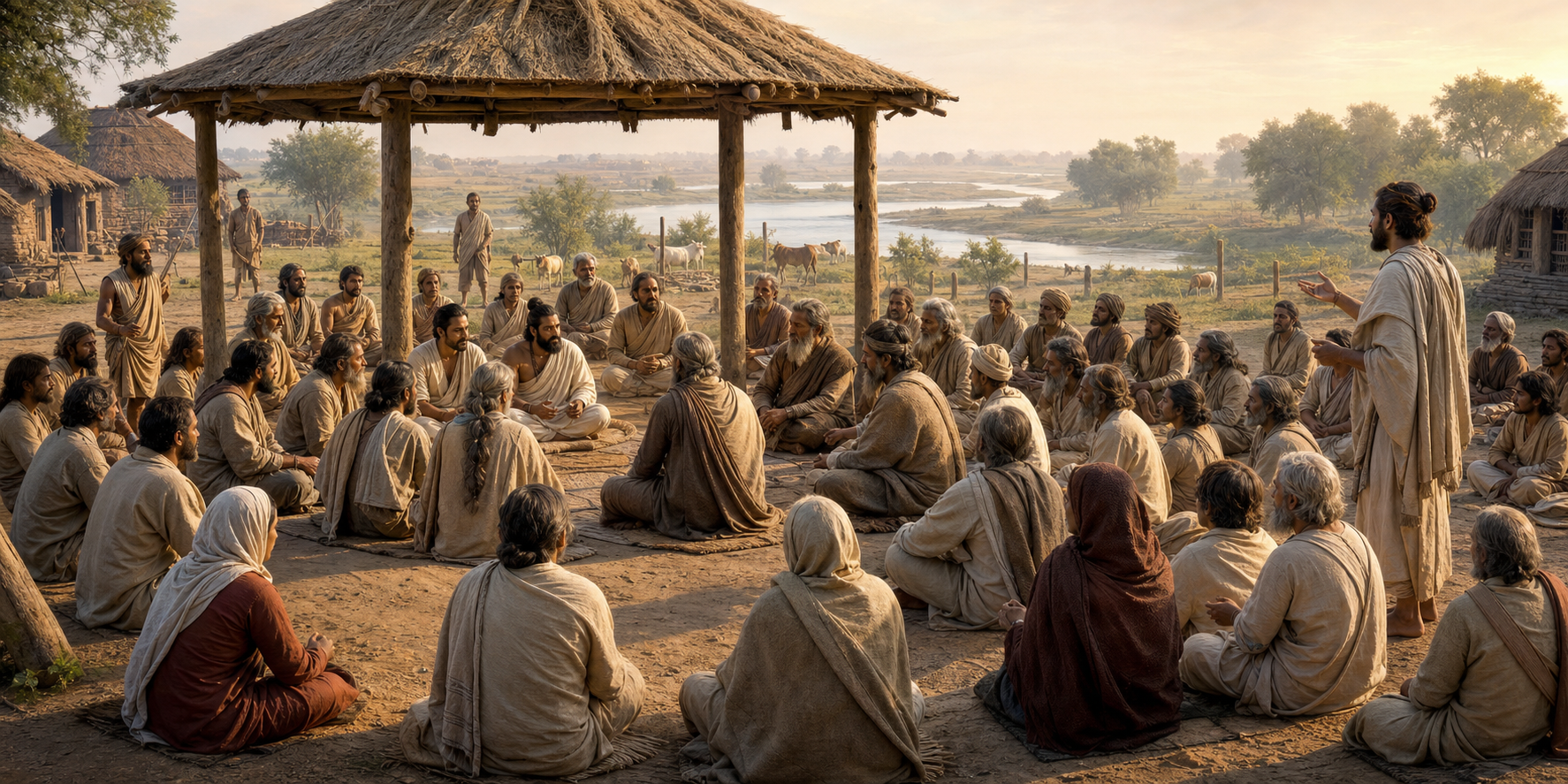
If you came asking whether ancient Bharat had democracy, the useful answer is neither a slogan nor a dismissal. Vedic political life was not modern electoral democracy, but it did make room for public counsel, expert judgment, consent, criticism, and limits on the ruler.
Sabha and Samiti matter because they show how governance could be distributed without separating power from duty. Once you understand what each assembly was expected to do, you can judge historical claims more carefully and recover a practical model for accountable Dharmic institutions.
The clearest answer: a layered system, not a modern parliament
The names Sabha and Samiti are sometimes treated as interchangeable words for a council. That erases their most useful distinction. The Samiti represented the broader act of coming together, while the Sabha usually denoted a more select deliberative body and could also name the hall in which it met.
Sabha and Samiti appear as distinct but complementary institutions in the Rigveda and Atharvaveda. Their exact membership and authority were not identical in every period or locality, but a durable functional contrast can still be drawn.
| Institution | Likely social base | Principal work | Check it created |
|---|---|---|---|
| Samiti | A wider circle of householders and respected community figures | Public counsel, broad policy, communal interest, consent, and political legitimacy | The ruler could not safely treat the community as politically irrelevant |
| Sabha | A more select body of elders, nobles, ritual authorities, jurists, and experienced advisers | Law, strategy, adjudication, ritual correctness, and sustained counsel | Popular approval could be tested against knowledge, custom, and duty |
| Vidatha | An early gathering whose boundaries are less certain | Ritual activity, consultation, and distribution | Collective provisioning remained connected to shared obligation |
| Rajan | The ruler and the officers through whom authority was exercised | Leadership, protection, decision, and execution | Kingship remained answerable, in the governing ideal, to dharma and counsel |
This was not a fixed bicameral constitution. It is better understood as a division of political work. One forum widened participation; another concentrated experience and judgment; the rajan supplied executive leadership. The arrangement addressed a problem every governing body still faces: broad participation can lack technical depth, while expert decision-making can lose legitimacy if it becomes closed and self-serving.
Key takeaways
- Samiti is best understood as the broader assembly associated with communal voice and consent.
- Sabha is best understood as the more select council associated with advice, law, judgment, and expertise.
- The rajan remained central, but legitimate kingship was conceived as a trust under dharma rather than unlimited personal possession.
- Consensus meant disciplined agreement-seeking, not proof that every decision was unanimous or that every person possessed an equal vote.
- The strongest historical claim is that Vedic governance valued structured counsel. The weakest is that it reproduced a modern electoral state.
How a decision acquired legitimacy
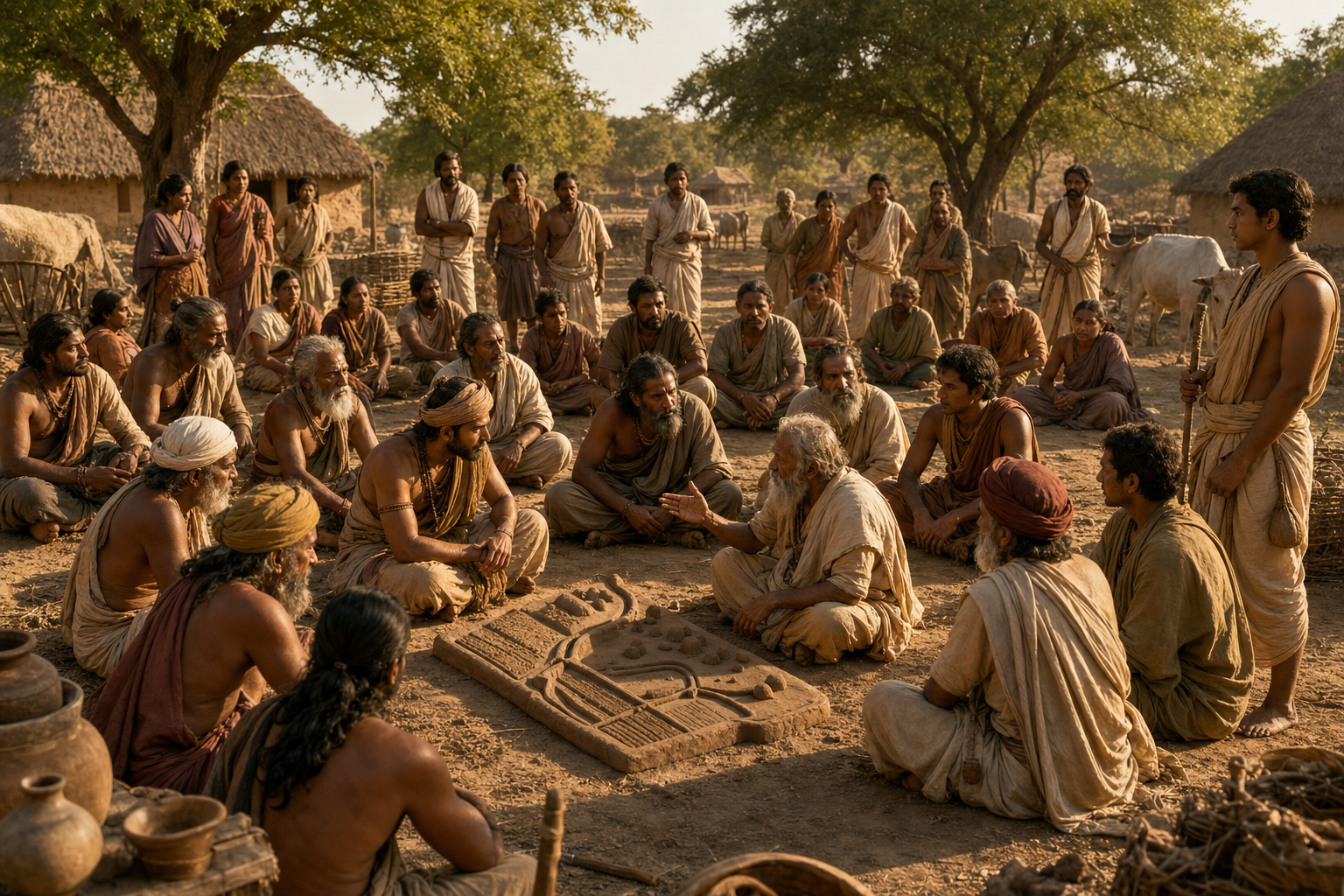
No single, universally applicable procedure can be reconstructed for all Vedic assemblies. The terms travelled across long periods, changing communities, and different kinds of political order. You can nevertheless see a coherent logic: a decision became rightful by passing through counsel, informed judgment, Dharmic restraint, and acceptance by the people expected to live with it.
A useful way to understand that logic is as a governing sequence. This is an analytical reconstruction, not a claim that every assembly followed a surviving rulebook word for word.
- A communal concern had to become speakable. A levy, dispute, alliance, public work, succession, or shared obligation could not remain solely within the ruler’s private will.
- The wider body tested acceptability. A Samiti-like gathering revealed whether a proposal could command public confidence and serve the broader community.
- The council tested judgment. A Sabha-like body examined law, precedent, strategy, ritual propriety, testimony, and foreseeable consequences.
- The rajan converted counsel into action. Assemblies did not eliminate leadership. They placed leadership inside a network of duties, advisers, customs, and expectations.
- The decision remained open to accountability. Criticism, reputation, customary norms, and judicial assessment constrained the arbitrary use of power.
Several likely roles made deliberation more than an undirected crowd discussion. A presiding figure maintained order. The purohita tested action against sacred and ethical obligations. The suta or herald communicated decisions. Sabhyas or sabhasadas could assess disputes and testimony. Later Dharmic jurisprudence made the judicial character of Sabha especially visible through panels expected to weigh evidence and apply proportionate judgment.
The governing standard was dharma, not the arithmetic of whichever side assembled the larger faction. This did not make deliberation apolitical. It changed what counted as a valid political argument. A speaker had to address duty, custom, social cohesion, and the welfare of the community, not merely personal preference.
Three concepts clarify the difference. Samaya pointed toward an accepted norm or compact. Riti carried the force of established custom. Lokasangraha directed attention to social welfare and cohesion. Together, they required a decision to be recognizable as rightful, not merely enforceable.
This is the deepest check on the rajan. A ruler might possess the capacity to command, but capacity alone did not produce legitimacy. Rajadharma required listening, restraint, protection, and responsiveness to counsel. A king who treated criticism as disloyalty weakened the very concord on which political order depended.
What the evidence does and does not justify
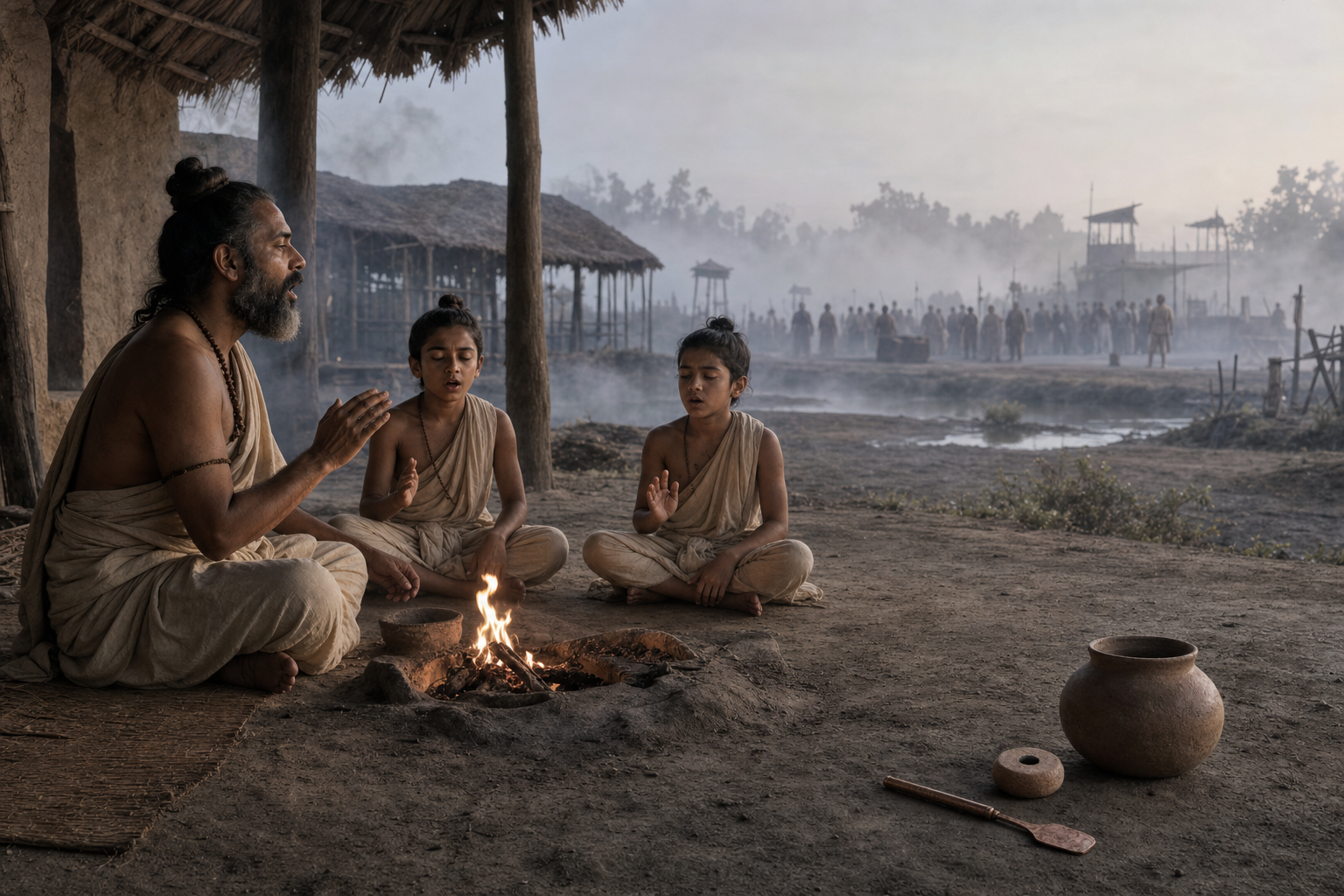
Claims about Vedic democracy often fail in one of two directions. One side turns every assembly into a modern legislature. The other assumes that the presence of kings made meaningful consultation impossible. Both readings force unfamiliar institutions into categories they were not designed to satisfy.
The safest conclusion is specific: ancient Indic political thought recognized that rulers needed counsel, that different assemblies could perform different functions, and that political authority was morally bounded. Broader claims need corresponding qualification.
- Do not claim universal suffrage. Wider participation in the Samiti does not establish equal voting rights for every adult, a fixed electorate, or a modern secret ballot.
- Do not assume one permanent constitution. Membership, influence, and procedure varied across time and locality. Sabha and Samiti are functional patterns, not identical institutions preserved unchanged everywhere.
- Do not confuse consensus with simple majority rule. The emphasis fell on persuasion, concord, shared norms, and moral acceptability. That does not reveal a universal vote-counting formula.
- Do not turn public intellectual life into proof of complete political equality. The celebrated debates involving Gargi and Maitreyi show that learned women could question and reason in public settings. They do not by themselves prove a guaranteed franchise for all women in every assembly.
- Do not use later institutions to fill every Vedic gap. Gana-sanghas, monastic councils, medieval village assemblies, and the modern gram sabha illuminate an Indic aptitude for collective governance. They cannot retroactively supply procedures absent from the earlier record.
- Do not make Athens the measuring rod. Similarities in deliberation are worth noticing, but Vedic assemblies arose within a different relationship among sacred order, social duty, political authority, and customary law.
When you encounter a sweeping historical claim, apply three tests. First, ask which period and institution it concerns. Second, ask whether it describes an ideal of rule or documented practice. Third, ask whether a later resemblance proves direct continuity or only a recurring civilizational preference. These questions preserve a strong Dharmic case without asking the evidence to carry more than it can.
The wider Dharmic pattern and its later echoes
Vedic assemblies become more intelligible when placed within the wider Dharmic comfort with organized disagreement. Deliberation was not treated as a regrettable pause before authority acted. Under the right discipline, it was one of the means by which a community discovered and maintained right order.
By the age of the Mahajanapadas, gana-sanghas made assembly-based government more visible among communities such as the Shakyas and Licchavis and within the Vajji confederacy. These were republican or oligarchic polities rather than replicas of modern republics. Their significance lies in the constitutional alternative they represented: monarchy was not the only political form available in ancient Bharat.
Kautilya treated gana polities as distinct orders with which a king might negotiate, ally, compete, or fight. That hard-headed recognition matters. Assembly government was politically substantial enough to require its own strategic treatment, not merely ceremonial acknowledgment.
The same family resemblance appears across Dharmic traditions without making every institution identical. Buddhist Sanghas used Vinaya-based procedures for deliberation, censure, settlement, and reconciliation. Jain communities retained collegial forms among ascetic and lay bodies. Sikh praxis later gave the collective Panth a voice through the Sarbat Khalsa. Each tradition developed its own authority, vocabulary, and purpose, yet each made collective discipline a serious part of institutional life.
Later local government offers more administratively detailed examples. Chola-period governance at Uttiramerur included rules concerning eligibility, selection by lot, tenure, recall, and audit. Temple-town bodies managed matters such as endowments, irrigation, education, and disputes. The common assembly, the more specialized sabha, and merchant bodies could operate as separate but related corporate institutions.
Uttiramerur does not prove that an unchanged Vedic constitution survived into the Chola period. It demonstrates something more defensible and still important: Indic communities repeatedly built governance around defined membership, divided responsibilities, public resources, and mechanisms of accountability.
The modern gram sabha belongs to a different constitutional and electoral order. Its role in local deliberation, transparency, budgeting, and consent nevertheless gives you a contemporary point of comparison. The continuity is clearest at the level of political grammar: gather the affected community, expose a proposal to speech, define responsibility, and require power to answer publicly.
To judge whether a modern body carries that grammar in substance, look past its Sanskrit name. Ask whether people can question a proposal before it is settled, whether knowledgeable members must give reasons, whether accounts can be inspected, whether conflicts of interest are managed, whether dissent can be recorded, and whether leaders can be corrected. A body that only ratifies decisions already made elsewhere is an assembly in appearance, not in function.
Use the Vedic design logic in a council today
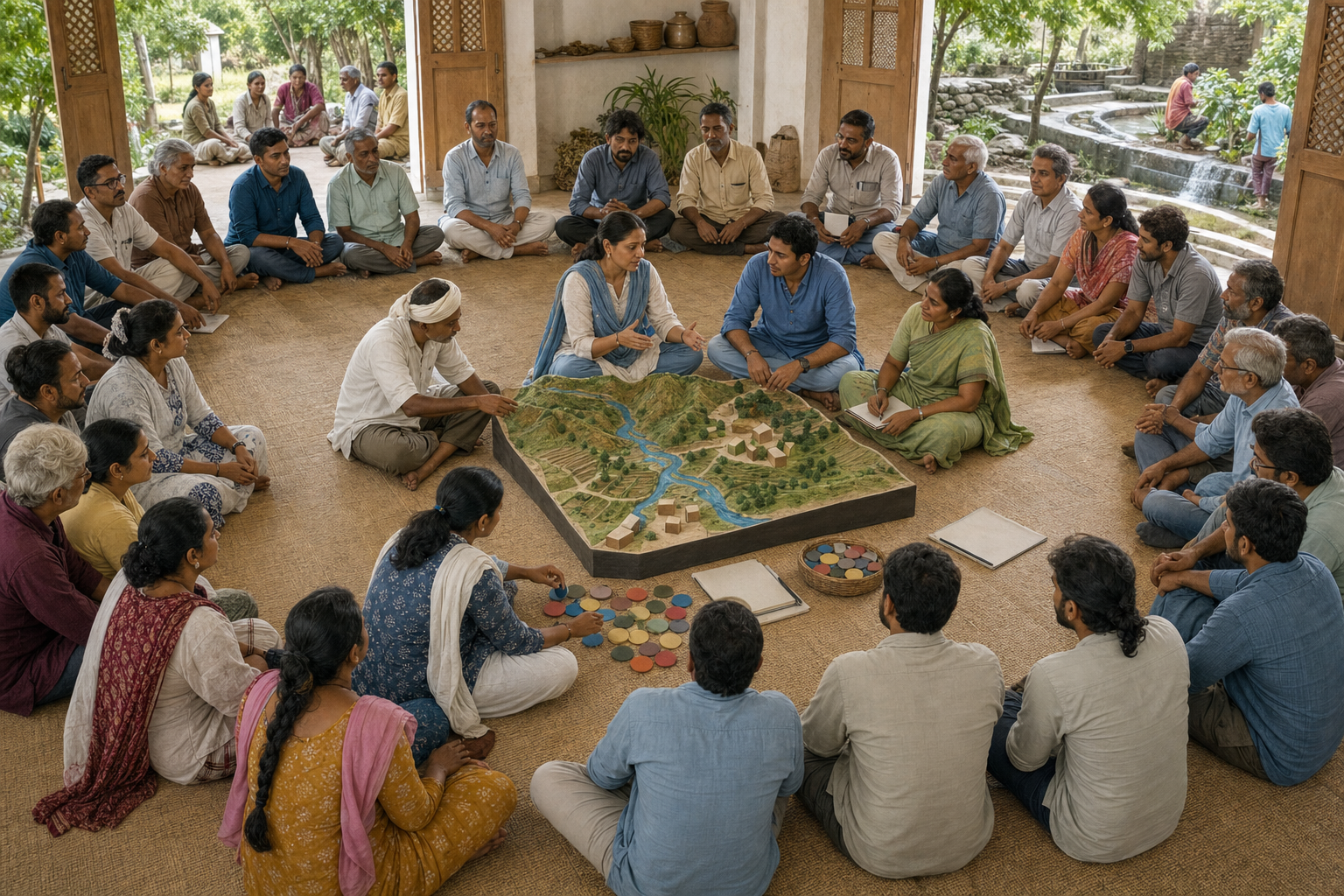
If you help govern a mandir, gurudwara, Jain association, Buddhist centre, cultural organization, or community trust, the value of Sabha and Samiti is not that you can copy an ancient procedure whose details are partly uncertain. The value is a design principle: public voice and informed judgment should strengthen each other while leadership remains answerable to duty.
- Separate participation from final adjudication. Give affected members a genuine forum to raise needs and objections. Then require a smaller, competent body to examine feasibility, obligations, risks, and precedent. State clearly who makes the final decision.
- Publish the question before seeking consent. Members should know what is proposed, why it is needed, which resources it requires, who will be affected, and what alternatives remain open. A vague call for approval produces ceremony, not deliberation.
- Define the Dharmic constraints. Put the governing duties into the organization’s charter or meeting rules: truthful disclosure, stewardship of common resources, protection of beneficiaries, respect for commitments, and accountability for entrusted authority.
- Match expertise to the decision. Ritual learning is essential for ritual questions, but it does not automatically settle engineering, finance, education, safeguarding, or administration. A Sabha-like council earns trust by knowing the boundaries of its competence.
- Record reasons, not just outcomes. Minutes should preserve the proposal, material objections, relevant advice, the decision, the person responsible for action, and the point at which the result will be reviewed. Future members then inherit institutional memory instead of rumours.
- Make conflicts visible. A member with a personal, family, or financial interest should disclose it and step away from judgment where appropriate. Status cannot substitute for impartiality.
- Close the accountability loop. Report what was done, how shared resources were used, and whether the promised result occurred. Consent obtained before action is not permission to become silent afterward.
Consider a disputed repair at a place of worship. A Samiti-like forum should surface the congregation’s needs, concerns, and willingness to support the work. A Sabha-like group should bring together the relevant ritual, technical, financial, and administrative judgment. The authorized trustees should then decide within current law and the organization’s governing documents, publish their reasons, and report on execution. No single circle has to pretend it possesses every kind of knowledge.
Ritual can reinforce this process when it reminds participants that speech and authority carry obligations. It should not be used to declare a disputed administrative preference sacred before deliberation begins. Dharma disciplines power; it is not a label that makes power immune to questions.
At your next council meeting, begin with four visible answers: who may speak, who must assess, who has authority to decide, and how the decision will be reviewed. Once those roles are explicit, consultation stops being ceremonial and becomes a dependable practice of Dharmic governance.
References
