

If you manage a temple in Maharashtra, cultivate Devasthan land, or support a temple whose daily worship depends on land income, the word abolition should not decide your position. The decisive questions are practical: who will control the land, where its income will go, what happens to existing occupants, and whether worship and seva will continue without interruption.
The dispute over the proposed Devasthan Inam Abolition Act 2026 has unfolded while its precise contours have not been publicly codified in full. Sweeping claims of either harmless reform or wholesale confiscation therefore run ahead of the available detail. Your safest course is to demand the official text, read its operative clauses, and prepare the records that establish how each affected property serves its endowment.
Key takeaways before you take a position
- Abolishing an inam classification is not a single, self-explanatory legal act. A measure may change revenue status, title, management powers, income rights, or several of these at once.
- Devasthan land is not ordinary private wealth. Its legal and moral significance comes from the religious or charitable purpose to which the property and its income are dedicated.
- Government oversight is not automatically unconstitutional, but intervention should address a defined secular problem, preserve the beneficiary purpose, and remain proportionate and reviewable.
- The equality objection must be tested carefully. Different religious endowment statutes need not be identical word for word, but comparable institutions should face a neutral baseline of fiduciary, audit, alienation, and due-process rules.
- Temple boards should assemble title records, maps, leases, income trails, service obligations, and encroachment files now. Waiting for a final law can leave the trust unable to prove what an affected parcel actually supports.
Separate the inam tenure from the temple endowment
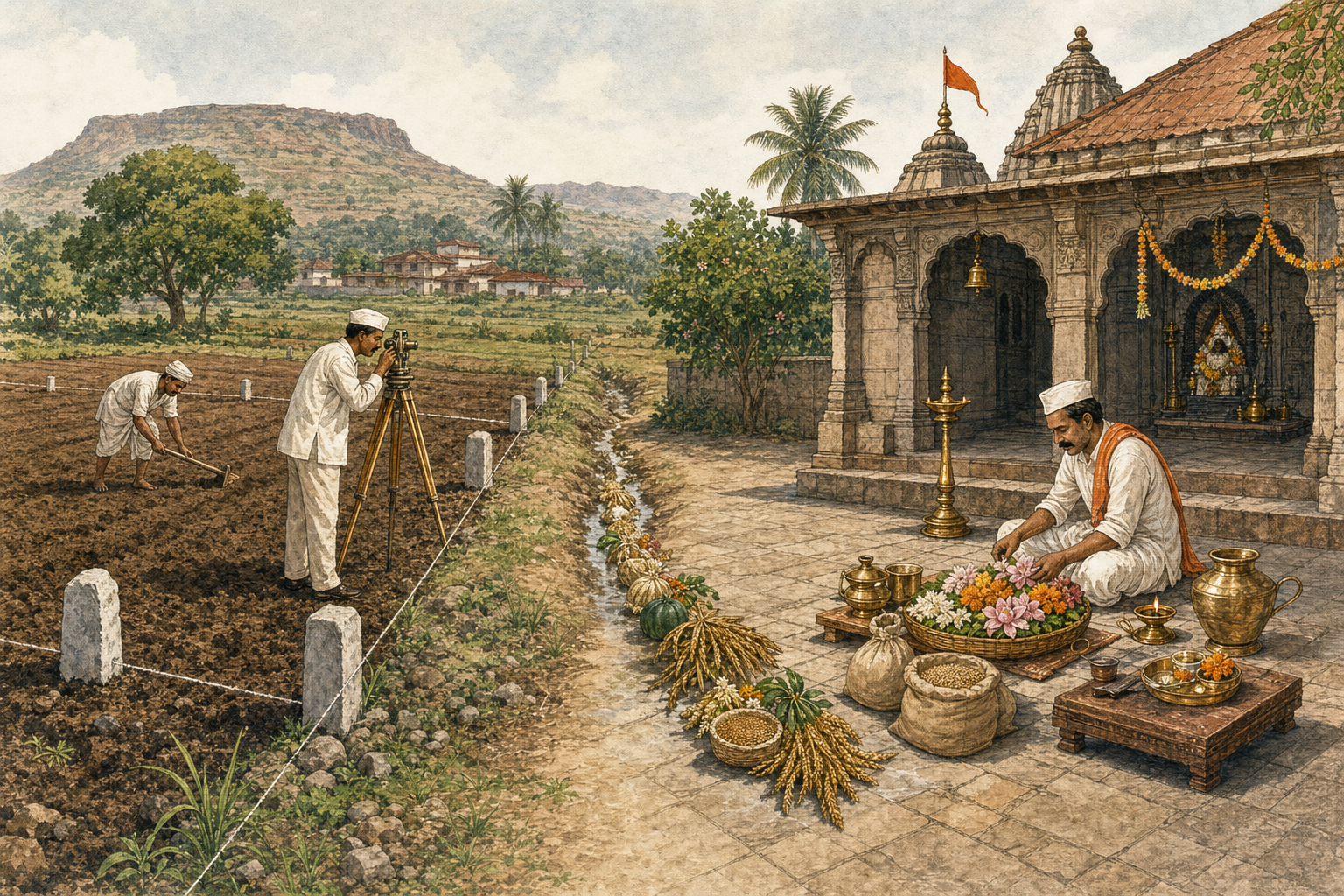
Historically, an inam was a grant made by a ruler or local authority, often on revenue-free or concessional terms, so that a religious or charitable institution could continue its work. In a Devasthan arrangement, the land was not simply handed to a trustee for personal enjoyment. The beneficial interest belongs to the deity or religious trust, while those administering the property are expected to apply its income to the endowed objects.
That distinction matters because one parcel can carry several legal and practical layers. If public debate collapses all of them into the single word land, it becomes almost impossible to tell what a proposed reform will actually do.
- The tenure layer records how the grant originated and what revenue concession or obligation accompanied it.
- The control layer determines who may possess, manage, lease, protect, or seek recovery of the property.
- The beneficiary layer identifies the religious or charitable purpose that must receive the benefit.
- The operating layer connects rent, crops, or other proceeds to worship, temple staff, annadanam, pilgrim facilities, repairs, sacred tanks, groves, and community services.
A change to the first layer does not logically require destruction of the other three. But a poorly designed vesting clause could disturb all four. That is why neither the name of the measure nor a general promise of reform is enough. You need to follow the entire chain: who holds the property after commencement, who may make decisions, who receives the income, what restrictions survive, and what remedy exists if the dedicated purpose is ignored.
Temple autonomy also cannot become a shield against accountability. Trustees who invoke the sacred purpose of an asset should be able to show where its income goes. The stronger the claim that land is held for a deity and the public, the stronger the case for an accurate inventory, auditable accounts, lawful leases, and protection against private diversion.
Read the proposed law through eight operative questions

When an official bill, rules, notification, or explanatory memorandum becomes available, do not begin with speeches about its intention. Begin with the clauses that transfer rights, impose duties, and create remedies. Eight questions will reveal most of the practical risk.
- What property is covered? Check the definitions of Devasthan, inam, endowment, trust, occupier, tenant, and land. A broad definition can capture parcels with very different histories and uses.
- What exactly vests, and in whom? Distinguish the vesting of superior tenure or revenue interests from transfer of possession, management, beneficial ownership, or leasing power. These are not interchangeable consequences.
- Does the beneficiary purpose survive? The text should state whether the land or its value remains dedicated to the deity, trust, worship, charity, heritage, and associated services.
- Where will future income go? Look for a ring-fenced account, permitted uses, audit obligations, withdrawal controls, and a prohibition on diverting proceeds to unrelated purposes.
- What happens to rent, produce, and compensation during transition? A temple can lose daily operating capacity even when a law promises a later settlement. Continuity arrangements matter for institutions that rely on seasonal produce or rental receipts.
- How are tenant cultivators and other lawful occupants treated? Existing leases, cultivation safeguards, rent terms, arrears, renewal rights, and grievance procedures should be addressed explicitly rather than left to administrative improvisation.
- How will records and encroachments be resolved? Old grants may cross several revenue regimes. The process needs notice, archival verification, survey-grade mapping, an opportunity to contest mistakes, and a clear method for handling overlapping claims.
- What review and time limits apply? Administrative orders should carry reasons, remain open to judicial review, and avoid indefinite state control when the stated problem is temporary or specific.
What a workable reform design should contain
Maharashtra does not have to choose between unmanaged property and permanent bureaucratic control. A credible framework can protect the endowment while making trusteeship more transparent.
- A statewide inventory linked to verified land records and GIS maps, with corrections recorded through a notice-and-objection process.
- Public data showing location, area, legal status, manager, lease status, and endowment purpose, while withholding information that genuinely requires privacy protection.
- Model leases with fair rent benchmarks, cultivation protections, written renewal terms, and an accessible grievance mechanism.
- Separate, auditable accounts into which endowment income is deposited and from which only authorised religious, charitable, heritage, and administrative expenses are paid.
- Periodic independent audits and proportionate public disclosure, including unresolved qualifications and corrective action.
- Non-alienation protections, prior approval for exceptional transactions, and transparent tendering where leases are competitively granted.
- A specialist tribunal or fast-track bench familiar with endowment and land law, so that worship and services are not suspended by years of unresolved title litigation.
- District-level pilots before statewide implementation, followed by published findings and correction of record, lease, or audit procedures that do not work.
If tenure rationalisation truly requires deprivation or transfer of a protected interest, the framework should confront compensation and continuity directly. It should not leave a temple to discover after implementation that the asset has moved while the obligation to fund worship, staff, repairs, or annadanam has remained behind.
Equality requires a common rulebook, not a slogan
The coalition opposing the proposed measure argues that Hindu temple lands appear to face a distinct burden while Waqf properties operate under a dedicated statutory framework. At the state-level Devasthan Bhoomi Sanrakshan Parishad convened by Maharashtra Mandir Mahasangh, participants sought neutral standards across Hindu, Buddhist, Jain, Sikh, and Islamic endowments.
That is a serious equality claim, but it should be framed accurately. The existence of different statutes does not, by itself, prove unconstitutional discrimination. Religious institutions may have different histories and organisational forms. The real comparison is functional: which bodies may manage property, when the state may intervene, how alienation is restricted, what accounts must be disclosed, what penalties apply, and what appeal is available.
Article 14 supplies the equality and non-arbitrariness test. Articles 25 and 26 protect religious freedom and denominational management of religious affairs, subject to constitutional limits. Article 300A requires authority of law before a person is deprived of property. Article 27 also forms part of the constitutional setting because it limits compelled taxation for the promotion of a particular religion. These provisions do not produce an automatic answer; they identify the questions that the enacted mechanism would have to survive.
The line of jurisprudence associated with the Shirur Mutt case also draws an important boundary. The state may regulate secular administration and act against demonstrable mismanagement, but an intervention affecting religious endowments should be problem-specific, proportionate, time-bound, and reviewable. A permanent displacement of lawful trusteeship needs more justification than a general assertion that regulation is desirable.
For public advocacy, compare regimes on the same grid: endowment purpose, control, non-alienation, fiduciary duty, audit, disclosure, intervention threshold, duration of takeover, compensation, and appeal. This makes the equality argument testable. It also supports Dharmic solidarity without asking Hindu, Buddhist, Jain, or Sikh institutions to surrender their distinct forms of worship and governance.
A neutral baseline should bind every religious endowment: no private diversion, no opaque alienation, no indefinite takeover without a defined cause, and no loss of dedicated assets without lawful procedure. Institutional details may differ, but the burden of accountability and the protection of beneficiary purpose should not depend on which community established the endowment.
Build the evidence before the law is settled

The most useful preparation is not another resolution declaring support or opposition. It is a parcel-by-parcel record showing what the trust owns or administers, who occupies it, what it earns, and which religious or charitable obligations depend on that income.
For temple trustees and managing committees
- Create a master land schedule containing the district, village, survey or equivalent identifying number, area, boundaries, current classification, recorded holder, endowment purpose, and physical use of every parcel.
- Collect the original grant or inam records, later revenue entries, mutation records, maps, survey material, court orders, administrative decisions, and correspondence affecting each parcel. Keep legible digital copies in more than one controlled location.
- Maintain an occupancy register listing every tenant, cultivator, licensee, encroacher, and disputed claimant separately. Do not conceal a difficult occupancy by describing the parcel simply as temple land.
- Link each parcel to its financial trail: lease amount or produce received, collection status, bank deposit, authorised expense, and the worship, staff, charity, conservation, or community service funded from it.
- Prepare a continuity statement identifying which rituals and services would be affected if income stopped for a season, a financial year, or longer. Name the dependency rather than claiming that every temple activity will collapse.
- Record encroachments and title defects with supporting documents, the action already taken, and the next lawful step. A public inventory will expose inconsistencies, so correct them before submitting formal representations.
- Pass properly recorded board resolutions authorising document custody, legal review, representation to government, and responses to notices. Individual office-bearers should not make irreversible commitments without the authority required by the trust’s governing framework.
Do not backdate a lease, manufacture an income trail, pressure an occupant to surrender rights, or transfer property in anticipation of legislation. Those steps can create separate civil, revenue, trust, or criminal exposure. Have Maharashtra counsel experienced in both land and religious-endowment matters review the official text and the trust’s records before any transaction or litigation decision.
For tenant cultivators and other occupants
- Preserve your lease, rent or produce receipts, cultivation records, notices, maps, correspondence, and proof of payments. Arrange them by parcel and date.
- Check whether the name of the lessor and the land identifier match across documents. An inconsistency may be clerical, but it becomes harder to resolve once a mass record-verification exercise begins.
- Do not assume that protection of the temple automatically cancels lawful occupancy rights. Do not assume that abolition of an inam automatically makes an occupant the owner either. Both conclusions depend on the enacted text, the property’s history, and applicable law.
- Respond to an official notice within the deadline printed on that notice. If title, possession, livelihood, or accumulated rent is at risk, obtain individual legal advice rather than relying on a public meeting or social-media interpretation.
For devotees, donors, and community organisations
- Ask the trust for an asset inventory, its latest available audited accounts, and a plain explanation of how Devasthan income supports worship and seva.
- Request parcel-specific evidence before repeating claims about the amount of land threatened, encroached, recovered, or diverted. Unverified totals weaken legitimate advocacy.
- Support publication of maps, lease status, income, permitted use, and audit findings. Transparency protects the deity’s property from both arbitrary state action and private misuse.
- Ask whether the trust has documented the interests of cultivators, temple workers, pilgrims, and local residents. Endowment protection is more credible when it accounts for the people whose lawful livelihoods and services are connected to the land.
For a clause-specific public representation
- Request publication of the complete bill, proposed rules, definitions, land data, stated policy problem, and impact assessment before irreversible action.
- Ask for structured district hearings involving trustees, devotees, tenant farmers, archivists, heritage specialists, accountants, and affected religious communities.
- Demand a written comparison of the proposed obligations across religious endowment regimes using the same functional criteria.
- Specify the safeguards you want: notice, hearing, verified mapping, ring-fenced revenue, continuity of worship, lawful compensation where applicable, reasoned orders, independent appeal, and time limits on intervention.
- Propose pilots in selected districts and publication of their results before statewide rollout.
- Separate objections to a particular vesting, compensation, or control clause from opposition to audits and accurate records. Defending temple autonomy does not require defending opacity.
Your next useful step is a two-page readiness packet for each affected temple: a land schedule, a revenue-to-seva map, a list of occupants and disputes, the missing records, and the clauses on which the trust needs a written government answer. That packet gives officials, lawyers, courts, and devotees something concrete to evaluate before a tenure change becomes an irreversible loss of purpose.
References
