
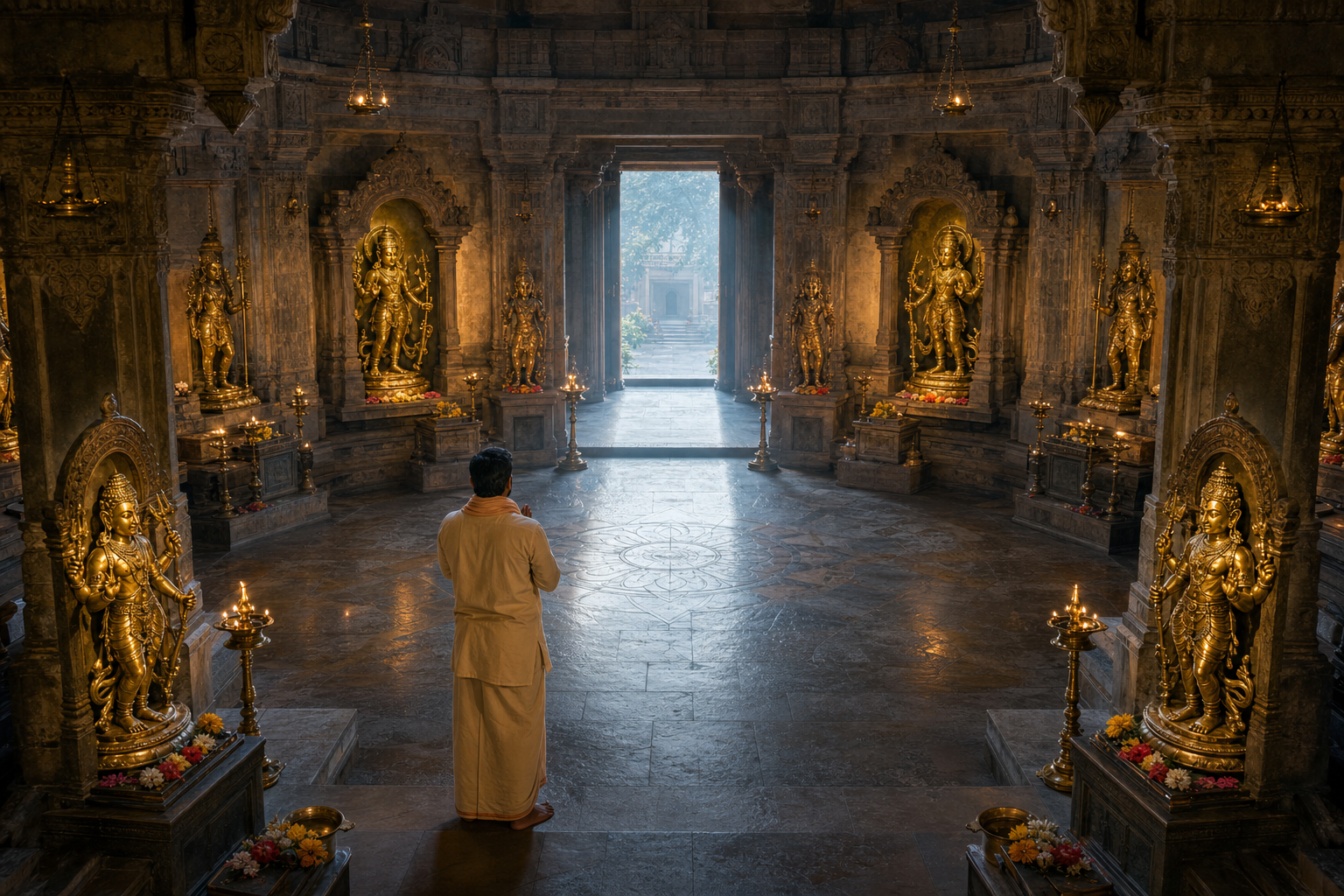
You may have encountered a golden Bhairava in an eastern shrine, or seen Asitanga named first in a temple’s group of eight Bhairavas, and wondered how to approach him. Begin with the temple’s own arrangement. The image, direction, attendant deity, and worship sequence belong together; isolating one dramatic feature can lead you to misidentify both the form and the practice.
Recognition and worship are also different tasks. You can learn to read Asitanga’s iconography without assuming that every mantra or ritual attached to him is open for self-initiation. That distinction will help you visit a shrine attentively, respect regional traditions, and carry the symbolism into daily life without inventing a tantric practice.
Start with Asitanga’s place in the sacred arrangement
Asitanga is commonly treated as the first of the Ashta Bhairavas, followed in familiar enumerations by Ruru, Chanda, Krodha, Unmatta, Kapala, Bhishana, and Samhara. The eight forms present guardianship and transformation as a complete circle rather than as eight unrelated fierce deities.
In many lineages, Asitanga governs the east. This connects him with sunrise, beginnings, awakening vitality, and the first movement from obscurity toward understanding. His frequently golden coloration belongs to the same symbolic pattern: it communicates an illuminating power that helps consciousness become alert and discerning. These associations make Asitanga an initiatory presence within the octet, not merely the first name on a list.
The qualification in many lineages matters. Classical lists occur in the Skanda Purana, the Shiva Purana, and Shaiva tantric traditions, while regional Agamic paddhatis determine how a particular temple installs and serves the deities. The eastern, luminous identity of Asitanga is a frequent pattern, but it should not be turned into a rule that erases local practice.
When you enter an unfamiliar temple, therefore, look for a complete Ashta Bhairava circuit before trying to identify one image from color alone. Note whether the shrines follow directional order, whether Asitanga occupies the east, and whether a name is inscribed or displayed. Placement within the ensemble is usually more informative than any single object held by the murti.
Read the murti as a set of connected signs
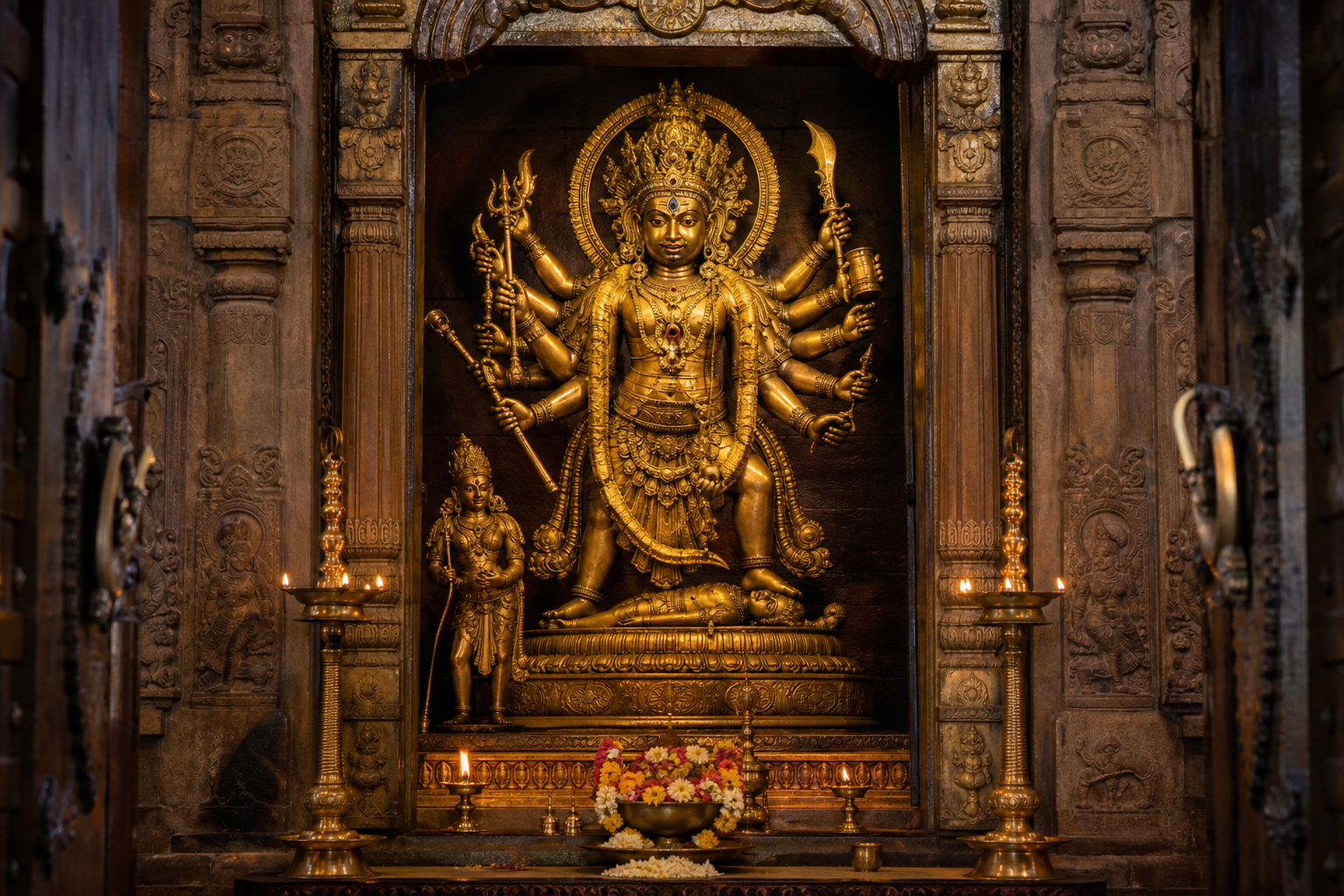
Asitanga’s iconography is fierce, but fierceness is not its final message. Skull imagery, serpents, ash, weapons, and vigilant eyes teach the devotee to face mortality, govern instinct, and remain awake at life’s thresholds. Use the following clues together rather than treating any one of them as conclusive.
| Clue | What to notice | What it teaches |
|---|---|---|
| Golden hue | A radiant or gold-colored body associated with the east | Illumination, discernment, and an auspicious beginning |
| Trishula | A trident, commonly carried in a right hand | Creation, sustenance, and dissolution brought under one sovereignty |
| Damaru | The small drum associated with Shiva | Rhythm, mantra, and the vibrational ordering of life |
| Kapala | A skull-bowl, often held in a left hand | Impermanence faced honestly and transformed into wisdom |
| Pasha or khatvanga | A noose or ritual club, depending on the local form | Restraint, discipline, and the harnessing of inner forces |
| Serpents, ash, skull garland, or tiger skin | Shaiva emblems worn on or around the body | Awakened awareness, mortality-consciousness, and mastery of fear and instinct |
| Dog or hamsa association | A dog as Bhairava’s familiar vehicle, or a swan motif through the Brahmani pairing | Loyal guardianship and courageous boundary-crossing, or discriminative wisdom |
The face and arms will not always settle the identification. Asitanga may be shown with one face or several, and with four to eight arms, depending on the local canon. The jaṭa-mukuṭa, crescent moon, Ganga motif, vibhuti, and rudraksha affirm continuity with Shiva, but they are not exclusive to Asitanga. Even the dog, important as a symbol of loyalty and threshold guardianship, belongs broadly to Bhairava imagery.
The best reading combines four kinds of evidence: the shrine’s name, its place in the directional circuit, the complete cluster of attributes, and the temple’s own ritual identification. If those do not agree with a chart you found elsewhere, do not declare the temple mistaken. Ask which Agamic or regional tradition governs the installation.
Understand variation without flattening every tradition
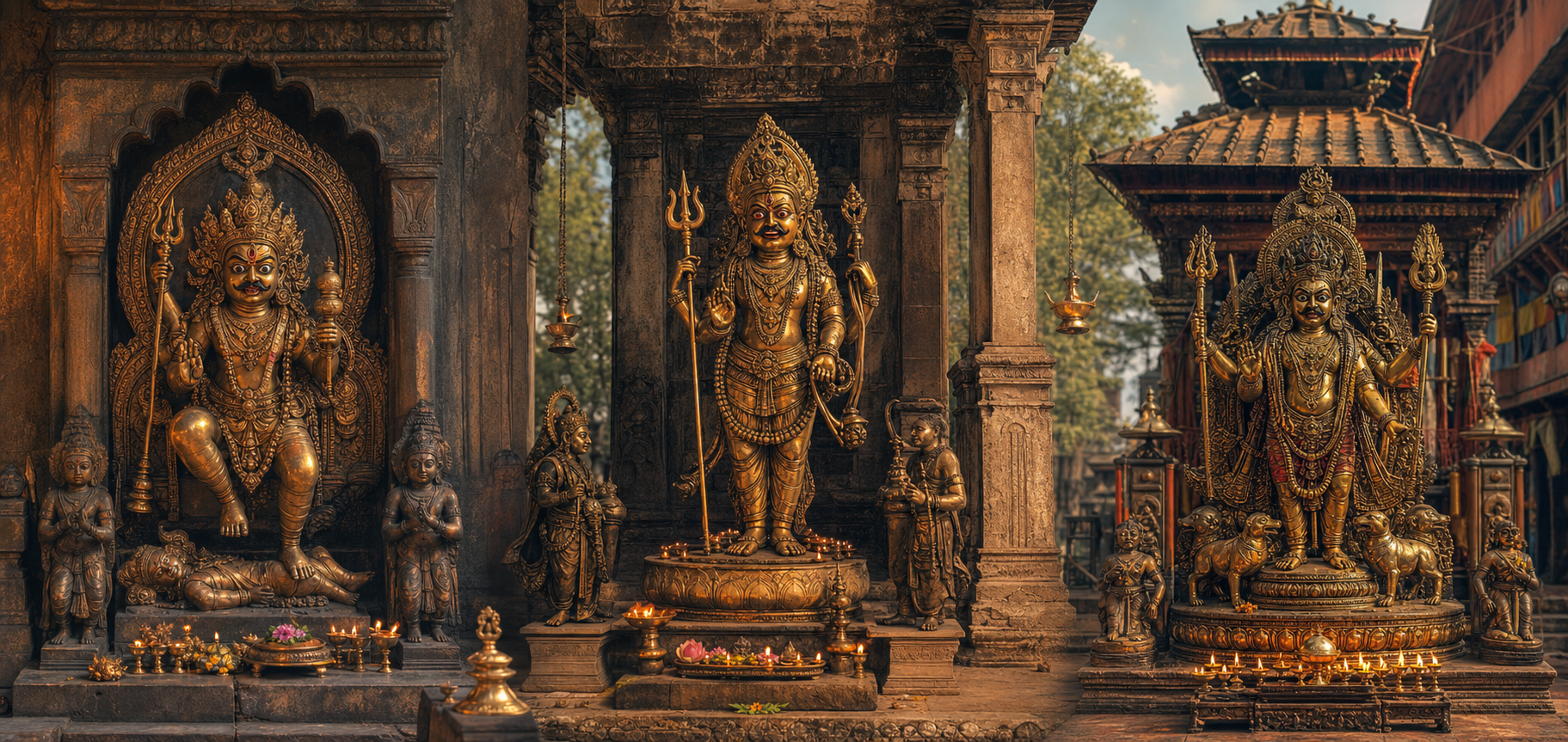
There is no single universal Asitanga image reproduced identically across every Shaiva community. One temple may emphasize the golden eastern form, another the pairing with Brahmani, and another the common Bhairava vehicle. A multi-faced, eight-armed form and a simpler four-armed form can both belong to legitimate local systems.
The pairing with Brahmani deserves particular care. Systems that connect the Ashta Bhairavas with the Ashta Matrikas associate Asitanga with Brahmani. This can introduce the hamsa, or swan, whose symbolism points toward viveka, the capacity to distinguish clearly. It does not necessarily displace the dog. The two motifs perform different work within overlapping symbolic systems.
Temple location supplies another layer of meaning. Bhairava images commonly stand near gateways, corners, or processional paths because Bhairava functions as kshetrapala, the guardian of sacred territory. In some temples, devotees seek the guardian’s permission before proceeding to the principal linga. The movement from boundary to sanctum turns architecture into instruction: vigilance prepares the worshipper for vision.
The tradition also crosses regional and sectarian settings. Newar communities in Nepal venerate Bhairava in both Hindu and Buddhist contexts, while Vajrayana protectors such as Mahakala share elements of fierce guardianship and ritual placement. Similarity should help you notice a wider Indic vocabulary of protection; it should not be used to collapse distinct deities, initiations, or lineages into one interchangeable practice.
If you need to verify an unfamiliar form, use this order:
- Read the shrine label or inscription, if one is present.
- Locate the image within the temple’s directional and processional plan.
- Compare the whole set of attributes, not just the color, weapon, or vehicle.
- Ask the priest or temple authority which local paddhati identifies and serves the form.
- Treat a general iconographic chart as an aid, not as authority over the living shrine.
Approach worship without outrunning your authority
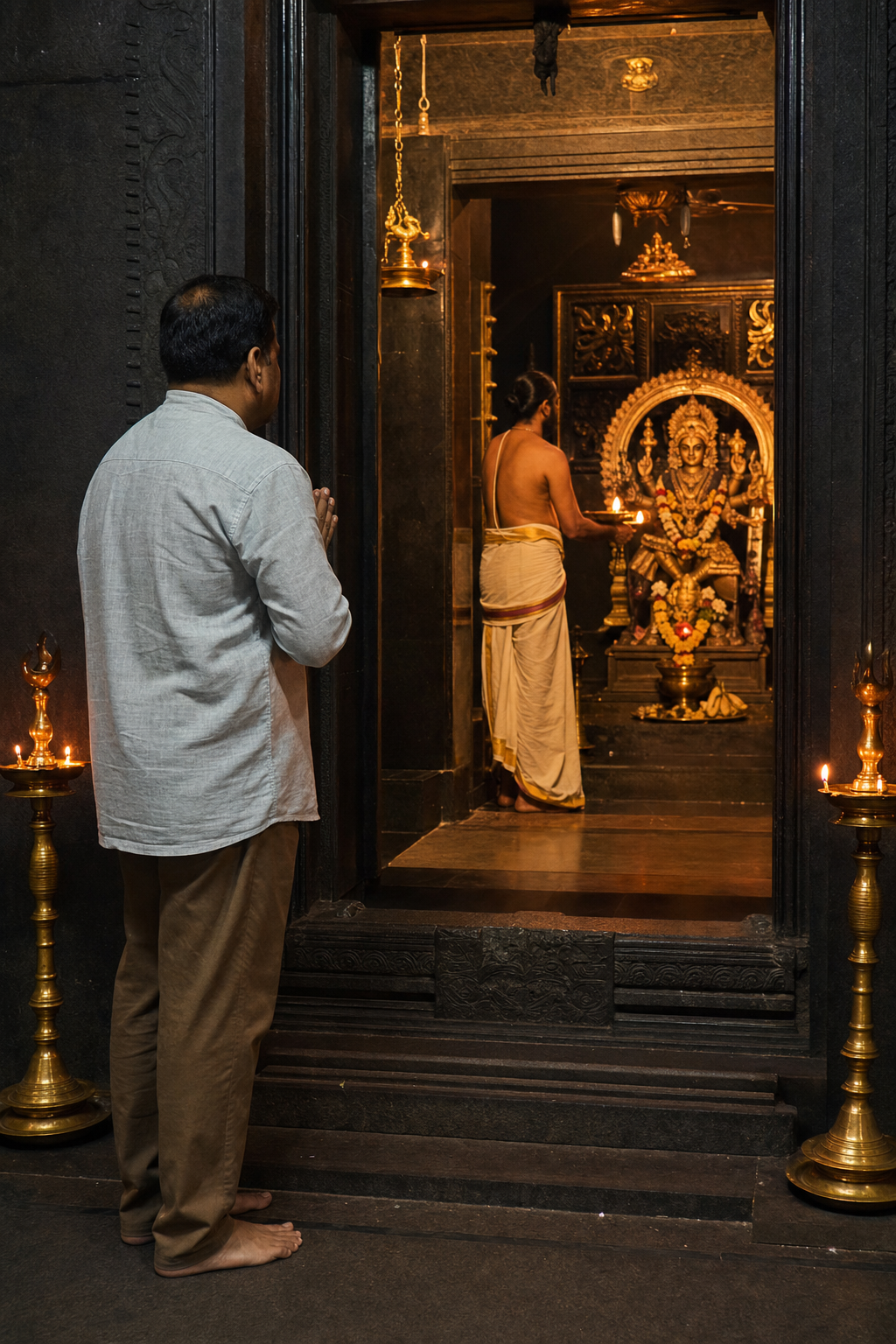
Bhairava worship contains both public devotional forms and lineage-bound tantric disciplines. Confusing the two is the most important practical mistake to avoid. Reverence does not require you to adopt a bija mantra, mudra, visualization, or breath method that you have not been taught.
A respectful sequence at a temple
Many communities give particular attention to Krishna Paksha Ashtami, and public worship may include lamps, black sesame, flowers, fragrant substances, circumambulation, the Bhairava Gayatri, or stotras to the eight Bhairavas. These are lineage- and temple-specific practices, not a universal shopping list.
- Pause at the Bhairava shrine before moving toward the main sanctum if that is the temple’s customary order.
- Confirm that the shrine is Asitanga rather than assuming that every Bhairava near a gateway is this particular form.
- Ask which offerings are accepted there. Bring or purchase only what the temple permits.
- Follow the local direction for circumambulation and mantrarchana rather than importing a sequence from another temple.
- Join public chants when they are led or clearly provided for devotees. Keep unfamiliar initiatory formulas outside your independent practice.
If no instructions are available, simple reverence is preferable to improvised ritual. You can offer namaskara, observe the murti carefully, and allow the temple’s established worship to set the boundary of your participation.
Why mantra restraint belongs to the tradition
Initiatory mantras and bija syllables are traditionally learned from a qualified guru because pronunciation, breathing, gesture, visualization, and ritual context may operate as one discipline. Removing a potent-looking formula from that discipline does not make the practice more authentic. It removes the very guidance by which tantric power is expected to mature into insight, steadiness, and ethical responsibility.
You can still work with Asitanga’s public symbolism without representing your reflection as initiated tantra. At dawn, or at the first quiet point in your day, use the east and the golden form as reminders to examine four things: the rhythm you must keep, the fear you must face, the impulse you must restrain, and the action that clear discernment now requires. The damaru, kapala, pasha, and golden radiance give each question a concrete anchor.
This is a contemplative application of the iconography, not a substitute for a temple paddhati or guru-given sadhana. Its value lies in making the symbols ethically operative. If contemplation leaves your conduct unchanged, you have admired the image without yet accepting its instruction.
Key takeaways
- Identify Asitanga through context: the eastern position, golden hue, place within the Ashta Bhairava circuit, and local temple name should be considered together.
- Expect legitimate variation in faces, arms, implements, vehicles, consort associations, and ritual sequences.
- Read fierce imagery as a discipline of vigilance, mortality-awareness, restraint, and discernment rather than as decorative terror.
- Let the temple’s priest, inscription, and paddhati outrank a generalized iconographic checklist.
- Keep public devotion distinct from bija mantras, mudras, breath disciplines, and other practices that require qualified initiation.
- Carry Asitanga’s symbolism into action by beginning the day with clearer motive, steadier rhythm, honest awareness of impermanence, and restraint where impulse would otherwise rule.
On your next temple visit, do one thing before offering or chanting: locate the shrine within the sacred geography. Once you see how direction, image, and ritual order reinforce one another, Asitanga appears not as an isolated fearsome figure but as the luminous guardian who teaches you how to cross a threshold awake.
References
