
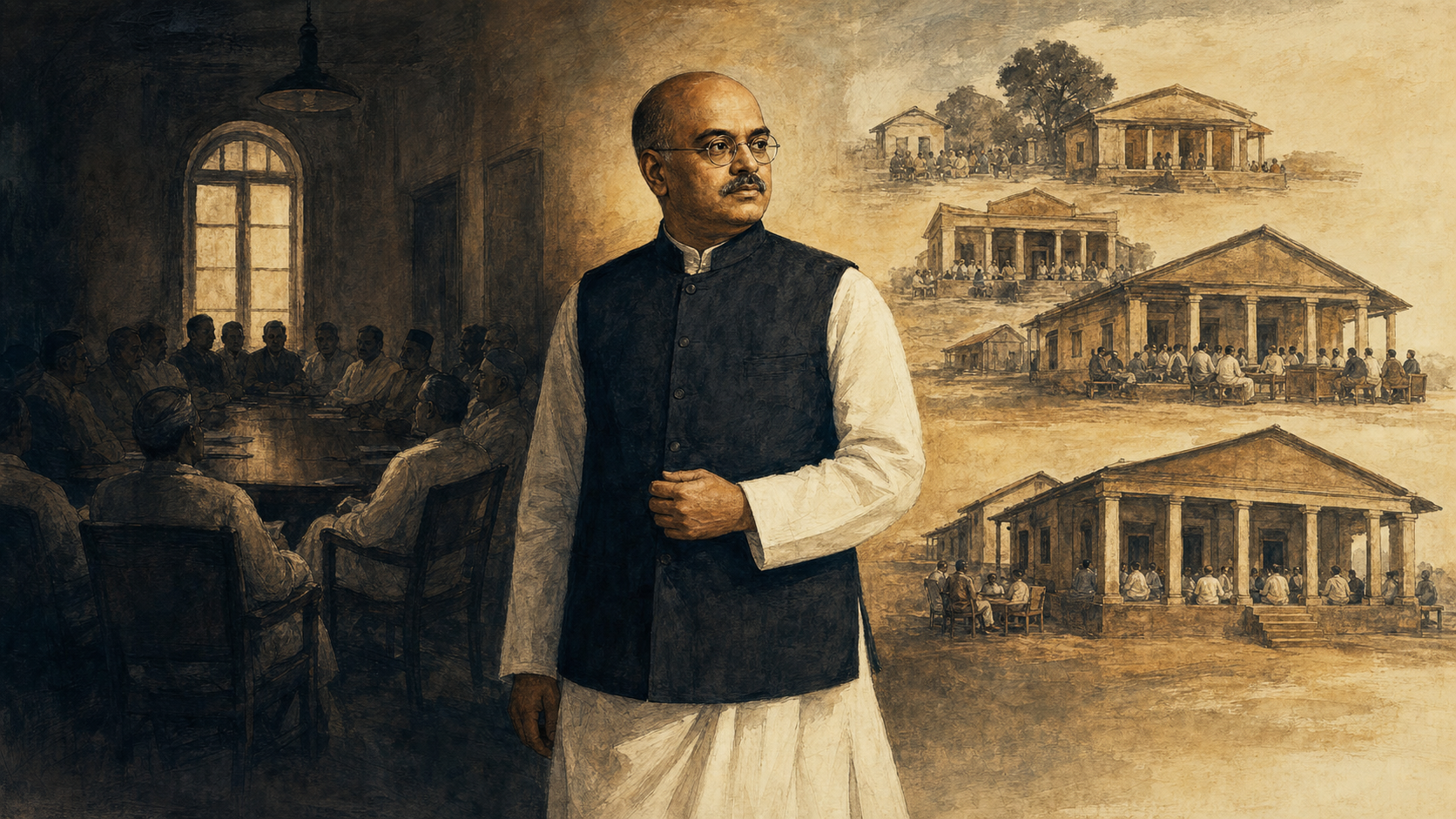
If you have encountered Syama Prasad Mookerjee mainly as a name invoked in political argument, you face a choice: inherit someone else’s verdict or examine the structure of his legacy. The second route is more demanding, but it gives you a conclusion you can defend.
Start with one hard distinction: legacy is not reputation. Reputation is what later admirers and critics say about a leader. Legacy is what that leader helped carry into institutions, political ideas and habits of public reasoning.
The institutional bridge is the firmest starting point
The clearest documented element of Mookerjee’s political legacy is organizational. He was a veteran Hindu Mahasabha leader who later played a significant role in the formation of the Bharatiya Jan Sangh. That sequence places him at a passage between an established Hindu political organization and a new party-building effort.
This is more consequential than a commemorative label. Political ideas become durable when they acquire an organization capable of selecting leaders, framing programmes and carrying arguments beyond one person’s lifetime. Mookerjee therefore matters not only for what he may have believed individually, but also for helping give a political outlook an institutional vehicle.
Read that continuity precisely. A bridge connects two political settings; it does not prove that their programmes, priorities or later descendants were identical. Nor does participation in an organization’s formation make its entire subsequent history the work of one founder. If someone credits or blames Mookerjee for a later position, ask which of three claims is actually being made:
- Mookerjee explicitly argued the position himself.
- An organization with which he was directly involved adopted the position during his political life.
- A later movement retrospectively associated the position with his name.
The first is a claim about his own thought. The second concerns institutional responsibility. The third concerns political memory and requires a demonstrated chain of continuity. Keeping these categories separate prevents both hero worship and guilt by association.
Nationhood and religion belong in the analysis, but not as shortcuts
In Leaves from a Diary, Mookerjee wrote about political events, religion, nationhood and the freedom movement alongside family affairs, memories and ordinary occurrences. This establishes that religion and nationhood belonged to his sustained field of reflection. It does not, by itself, disclose the exact argument he made about either.
That distinction is essential because an inventory of themes is not a manifesto. The presence of religion in a political leader’s reflections does not tell you whether he treated it as civilizational inheritance, personal faith, social identity, constitutional principle or electoral category. Likewise, concern with nationhood does not reveal where he located its boundaries or how he reconciled cultural unity with political disagreement.
When evaluating a claim about his worldview, sort it into three levels:
- Documented: his political affiliations, organizational role and the subjects he chose to examine.
- Interpretive: an argument about how those subjects formed a coherent conception of nationhood.
- Projected: an assumption that a present-day platform must reproduce his own position.
Only the first level can be accepted without further argument. The second needs his actual words and decisions. The third needs an additional history showing what later actors retained, revised or abandoned. This test lets you take Mookerjee’s Dharmic and national concerns seriously without turning broad themes into claims the evidence cannot carry.
Use 1942 to test historical discipline
Mookerjee left five letters bearing on his reaction to the 1942 movement. Their existence identifies a primary-evidence trail. It does not authorize a verdict about the substance of his reaction before the correspondence itself has been examined.
This is where many political biographies go wrong. A later reputation is allowed to dictate what an earlier decision must have meant. The safer method runs in the opposite direction: establish what he wrote at the time, identify the audience and circumstances, and only then ask how the position fits his wider political development.
If someone presents 1942 as decisive proof either for or against Mookerjee, ask for the exact passage and then test four points: What course of action did he support? What did he oppose? Was he writing as an office-holder, partisan strategist or private correspondent? Did his subsequent organizational choices preserve or modify that position?
Until those questions can be answered from the correspondence, the disciplined conclusion is narrow: Mookerjee recorded a reaction to the movement, and that reaction belongs in any full assessment of his politics. Restraint here is not evasiveness. It is the difference between historical judgment and retrospective scripting.
Keep the human being in view without turning biography into acquittal
Mookerjee initially wrote in English and moved into Bengali in later, more personal portions of his record. In his mother tongue, he expressed himself more freely about family life. He also wrote with grief about his wife, whom he lost to pneumonia.
These details help you notice registers that public politics can conceal. A change of language may accompany a change in intimacy, emotional candour or intended audience. Family memory can show what a leader valued privately and how loss entered his self-understanding.
But private tenderness is not proof of sound public policy, just as political disagreement is not proof that the private person was incapable of tenderness. One common error uses sympathetic biography to soften every political judgment. The opposite error removes the person entirely and reduces him to an organizational label. Both produce caricature.
Use intimate writing to investigate temperament, motive and self-perception. Use public choices and institutional work to judge political consequence. Where the two appear to conflict, preserve the tension instead of forcing one register to cancel the other. That approach yields a fuller portrait without confusing empathy with endorsement.
Key takeaways for assessing Mookerjee’s legacy
- Begin with the strongest institutional fact: Mookerjee moved from leadership in the Hindu Mahasabha to a significant role in forming the Bharatiya Jan Sangh.
- Treat this as an organizational bridge, not as proof that every later programme or policy originated with him.
- Recognize religion, nationhood and the freedom movement as recurring subjects in his political reflection, while requiring his own words before assigning him a precise doctrine.
- Use the five letters concerning 1942 as a checkpoint for primary evidence; their existence alone does not establish what position he took.
- Read his Bengali personal reflections and family grief for character and self-understanding, not as substitutes for evaluating public action.
- Separate Mookerjee’s stated position, his institutional influence and later political uses of his name. Each is a different kind of historical claim.
The next time you encounter a confident claim about Mookerjee, ask four questions: Is this his own stated view? Is it an inference from his organizational role? Can its continuity into later politics be demonstrated? Or is his name being used as a symbol for a position developed afterward?
Follow those questions back to his words, chronology and institutional choices. You may still arrive at admiration, criticism or a mixed verdict. The difference is that your judgment will rest on history rather than inherited political memory.

References
