
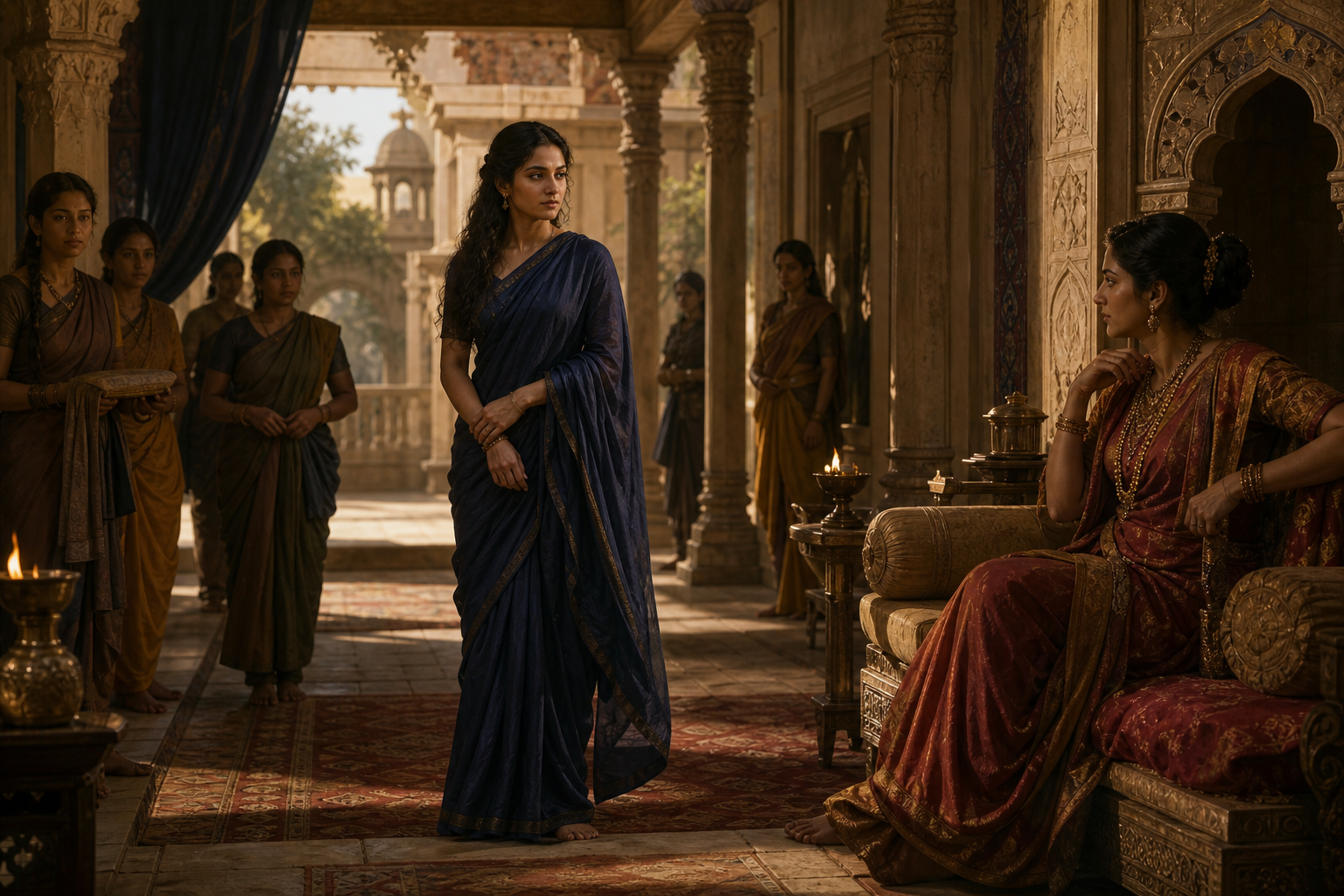
You may have come to Draupadi’s description in the Virata Parva wondering what to do with its intense attention to beauty. Is the passage simply praising an extraordinary woman? Is it offering an ancient standard of feminine appearance? Or is the beauty doing something within the story?
The clearest answer is that Draupadi’s beauty functions as evidence. Queen Sudeshna sees a woman whose stated position and visible presence do not agree. What first appears to be a portrait of physical grace therefore becomes a scene about recognition, concealed identity, social rank, and danger.
Beauty makes Draupadi’s disguise difficult to believe
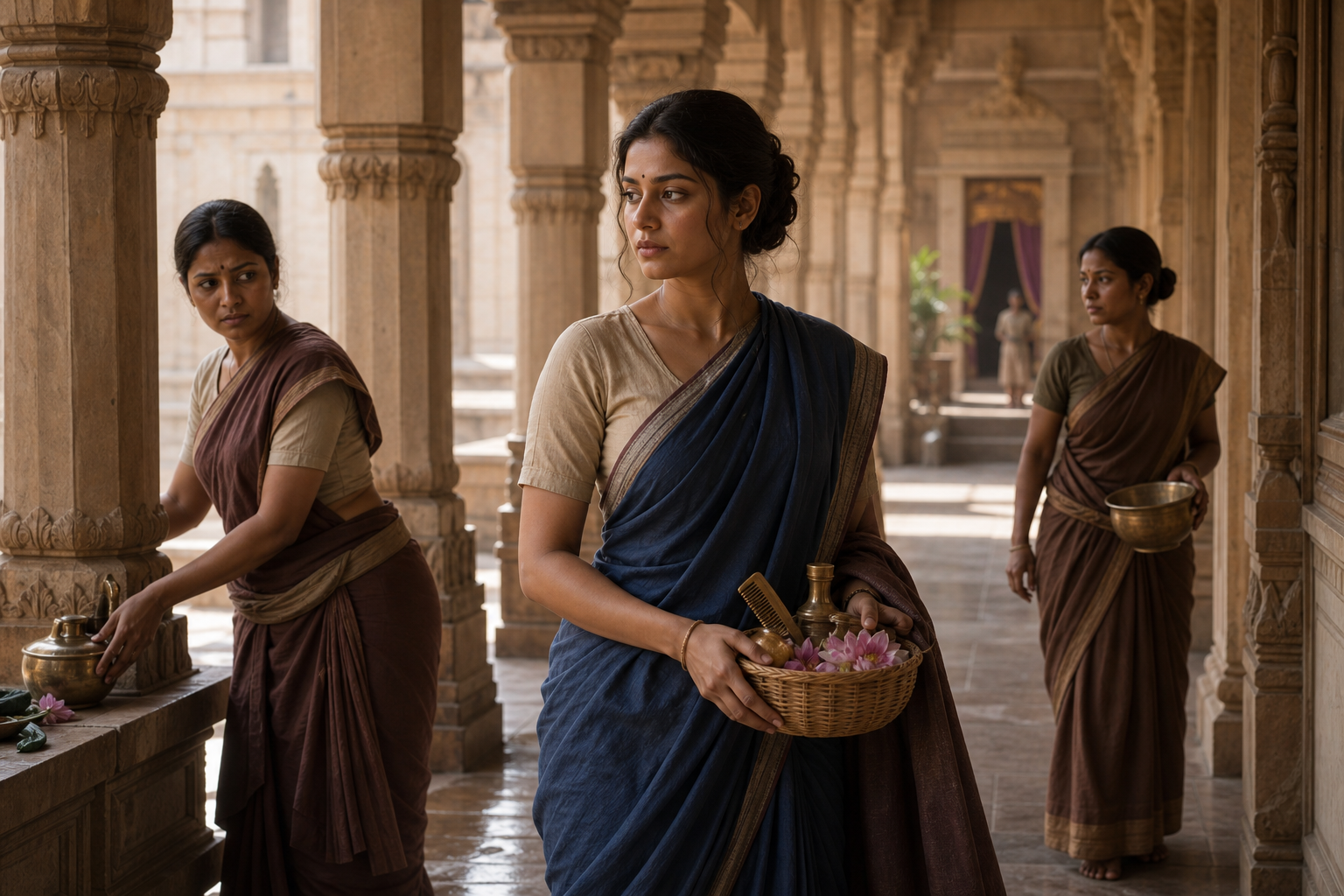
Concealment in the Virata Parva is a practical necessity. Draupadi must enter another court without openly announcing that she is Yagnaseni: the fire-born daughter of King Drupada of Panchala and the wife of the five Pandavas. Her safety depends on passing as someone whose presence will not expose the hidden royal family.
That is why Sudeshna’s unusually detailed perception of Draupadi matters. The queen does not merely decide that the newcomer is attractive. She detects a contradiction. Draupadi presents herself in a dependent position, but her appearance and bearing resist that position. She may conceal her name, lineage, and relationships, yet she cannot easily suppress the impression of distinction.
This turns beauty into unwanted legibility. The very qualities that distinguish Draupadi also make anonymity harder. In another setting, recognition might affirm her rightful place. In Virata’s court, recognition can endanger everyone whose identity must remain hidden.
Read the description with that tension in mind. Before examining any individual feature, write down three facts: Draupadi needs concealment, Sudeshna is evaluating her, and successful evaluation could have consequences. Those facts prevent the passage from becoming an isolated catalogue of attractive traits.
Sudeshna’s gaze changes the meaning of the portrait
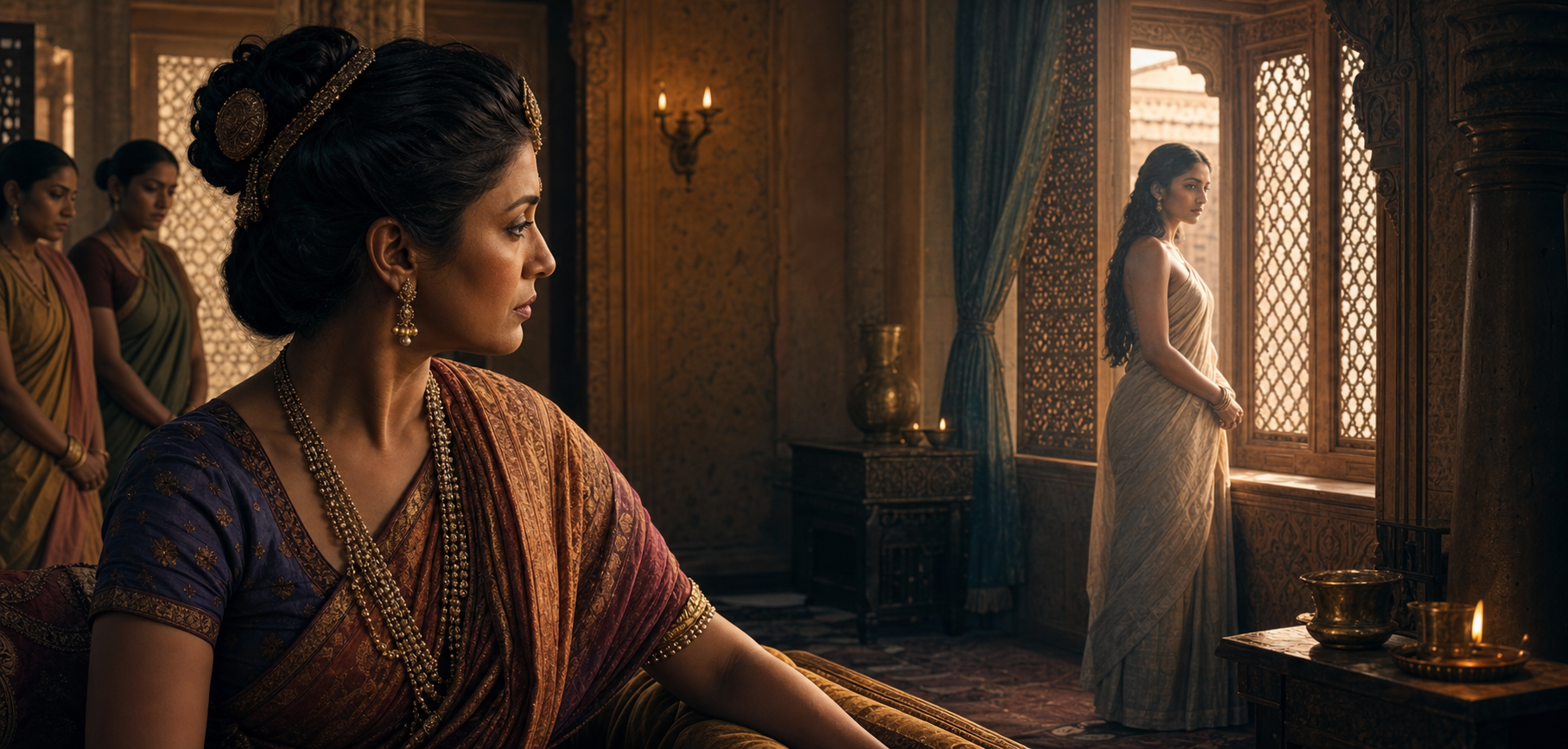
Who sees Draupadi is as important as what is seen. This is not initially a suitor praising a prospective bride or a poet interrupting the story to decorate it with feminine beauty. A queen is examining an unfamiliar woman who seeks a place within her household. Sudeshna’s gaze is therefore aesthetic, social, and practical at the same time.
That difference should not be exaggerated into a simple claim that one woman’s gaze is automatically benign. Sudeshna still possesses authority over the woman standing before her. She can admire Draupadi, question her account, admit her, refuse her, or worry about the disruption her presence might bring. The scene contains both recognition between women and an unmistakable imbalance of power.
Yet the female observer does allow the portrait to carry meanings beyond courtship or possession. Sudeshna notices a whole presence. Physical form cannot be cleanly separated from composure, dignity, and the impression of high birth. Beauty is not presented as a detachable object that happens to belong to Draupadi; it is woven into the way she inhabits the room.
This is the detail to notice when you reread the encounter: Sudeshna is not merely saying that Draupadi is desirable. She is effectively asking how a woman who appears so exceptional can truthfully occupy the humble role she claims. Admiration becomes suspicion because beauty carries social information.
Natural beauty is not a universal prescription for women
Draupadi’s beauty is natural in a specific narrative sense: it does not depend upon the public display of her royal identity. Titles, ceremonial surroundings, and declared lineage have been withheld, but her distinction remains perceptible. External rank has been concealed; presence has not.
That does not make the passage a timeless checklist against which women should measure themselves. A singular epic portrait describes Draupadi. It does not define the value of every woman, establish bodily conditions for dignity, or teach that moral worth can be inferred from appearance. Turning its details into a modern beauty test strips away both the story and the person being described.
Nor should natural beauty be converted into an argument that adornment is false or spiritually inferior. Within Dharmic cultures, adornment can express auspiciousness, celebration, devotion, marital status, artistry, and regional identity. Draupadi’s lack of openly displayed royal splendour serves the demands of concealment. It is not a condemnation of alankara.
A more faithful distinction is between beauty as decoration and beauty as characterization. Decorative praise can be removed without changing a story. Sudeshna’s perception cannot be removed so easily, because it tells you something essential: Draupadi’s identity survives the loss of its public signs. The court may not know her name, but it cannot make her presence ordinary merely by placing her in an ordinary role.
This also explains why grace and vulnerability appear together. Draupadi’s visible distinction is not a magical protection. It draws attention when safety requires obscurity. Beauty becomes part of the pressure placed upon her rather than a reward that makes life easier.
Read the description in four passes
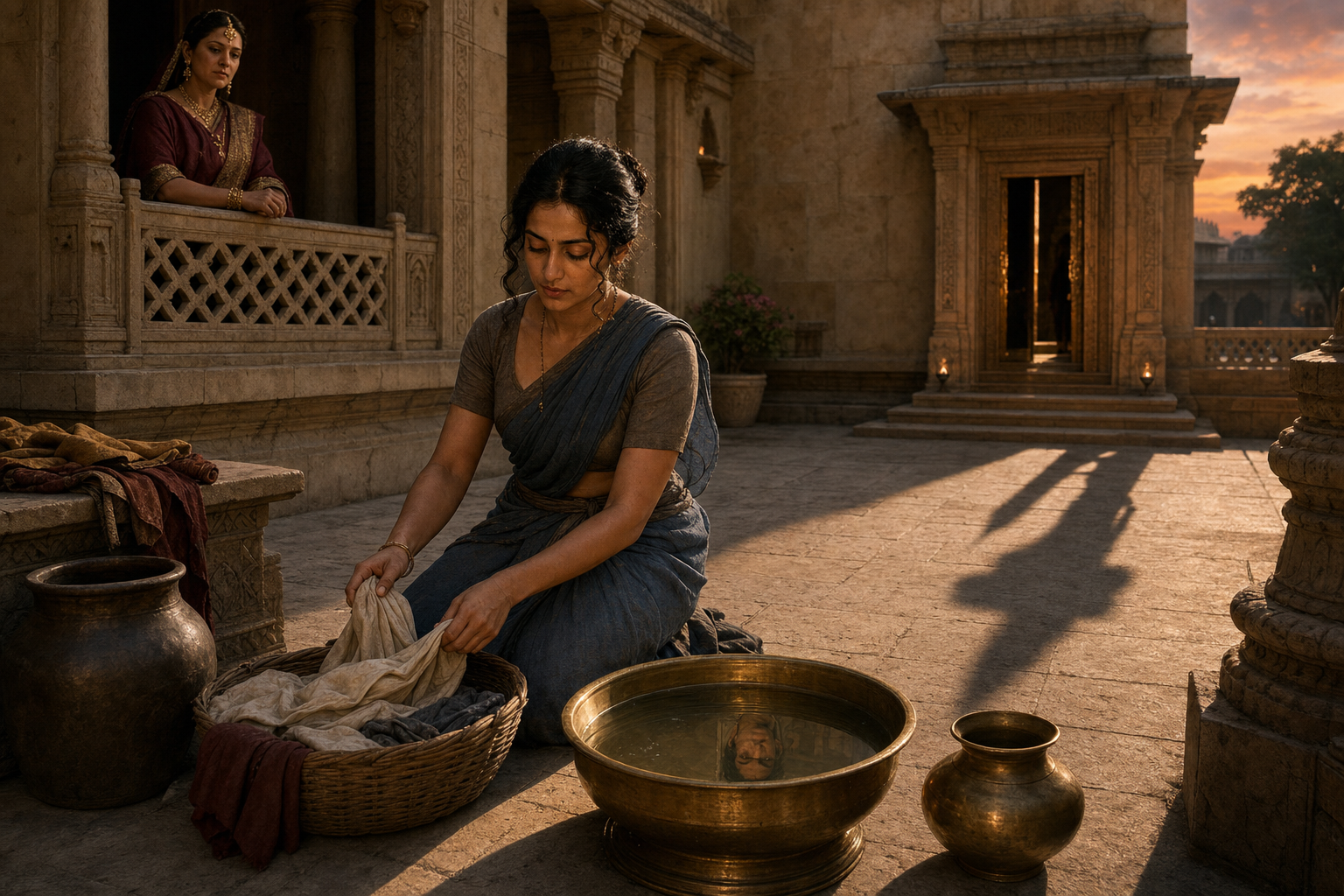
You can recover the full force of the scene without either dismissing its physical language or treating that language as the whole meaning. Use four passes when reading it.
- Establish the immediate stakes. Ask what Draupadi needs at this moment. She needs shelter and concealment, so being closely examined is already a complication.
- Identify the observer. Sudeshna is not an anonymous spectator. She is a queen assessing someone who may enter her household. Her admiration is joined to judgment, caution, and authority.
- Look for the governing impression. Do not isolate each bodily detail as though it were an entry in a beauty manual. Ask what the accumulated description makes Sudeshna conclude. The important result is the mismatch between Draupadi’s claimed station and her evident distinction.
- Follow the consequence. Beauty attracts notice, notice threatens concealment, and heightened visibility creates vulnerability. This chain explains the narrative work performed by the description.
The fourth pass is also ethically important. Attention may be a consequence of beauty, but misconduct is never caused or excused by the person who receives that attention. Visibility is not consent. Admiration does not create entitlement. If another person responds to Draupadi by violating dharma, responsibility belongs to the violator, not to Draupadi’s appearance.
This distinction keeps two truths together. The epic can show that beauty increases Draupadi’s exposure while refusing the false conclusion that she is responsible for what others choose to do. Grace becomes dangerous because the surrounding social world contains dangerous intentions, not because grace is itself a fault.
The same method helps with other descriptions in the Mahabharata. Ask who is looking, what power the observer possesses, what the person being observed needs, and what changes because of the encounter. Epic description often acts through those relationships rather than through adjectives alone.
Key takeaways
- Sudeshna’s description is a scene of recognition, not merely a pause for praise.
- Draupadi’s beauty exposes the mismatch between her concealed royal identity and her apparent social position.
- The queen’s perspective combines admiration with assessment, caution, and power over a vulnerable newcomer.
- Natural beauty here means that Draupadi’s distinction survives without the public signs of royalty; it is not a rule against adornment.
- The portrait describes one exceptional person. It should not be turned into a universal standard for women’s bodies or worth.
- Draupadi’s beauty increases her visibility, but it never makes her responsible for another person’s adharmic conduct.
When you return to the Virata Parva, mark three things beside Sudeshna’s description: the identity Draupadi must hide, the status Sudeshna nevertheless perceives, and the danger produced by that perception. You will then see more than an image of a beautiful woman. You will see Yagnaseni’s irreducible presence pressing through a disguise that circumstances require but cannot make complete.
References
- Hindu Blog — The Natural Beauty of Draupadi: A Reading of Sudeshna’s Description in the Virata Parva
