
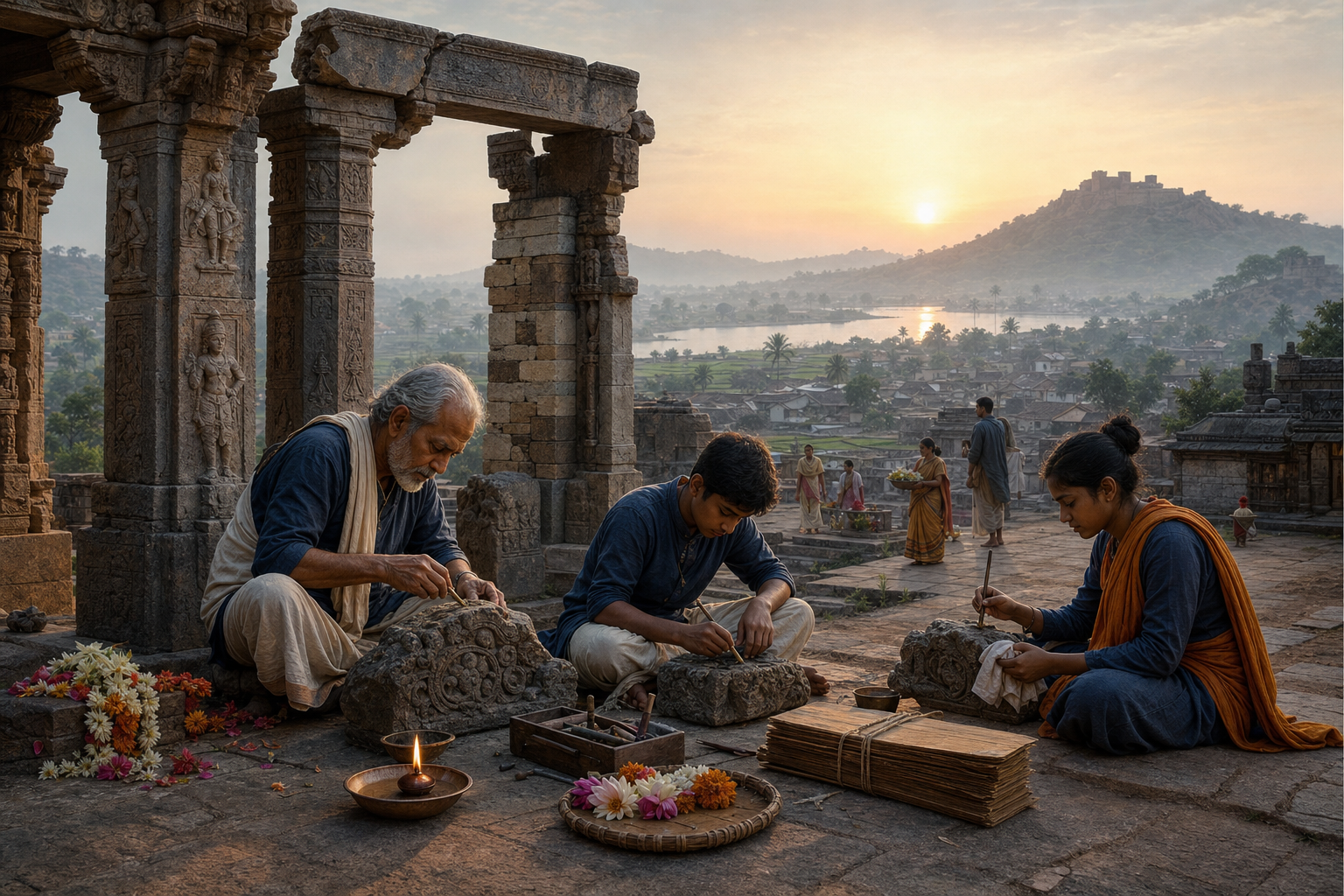
You may be trying to hold two truths at once. Conquest brought real losses to South Asia: political defeat, redirected wealth, damaged sacred institutions, and pressure on inherited ways of life. Yet Bharat’s history is not adequately described as a succession of conquerors acting upon a passive people.
The useful question is not whether to remember conquest, but how. Ask what changed, what endured, who carried it forward, and what ethical limits governed the response. That approach lets you recognize injury without making injury the center of Dharmic identity.
Key takeaways
- Do not mistake a change of rulers for the disappearance of a civilization. Examine households, pilgrimage routes, schools, festivals, trade networks, and religious institutions as well as courts and armies.
- Read resilience through five connected fields: material life, institutions, ritual practice, intellectual life, and ethical conduct.
- Treat continuity as active work. Relocation, negotiation, vernacular teaching, rebuilding, and reorganization are forms of agency, not evidence that the original loss was insignificant.
- Test large historical claims against inscriptions, archaeology, texts, local memory, and the sequence of destruction and restoration.
- Let remembrance produce preservation, education, dana, seva, and disciplined courage. If it produces indiscriminate hatred, it has ceased to serve Dharma.
A dynasty is not the whole civilization
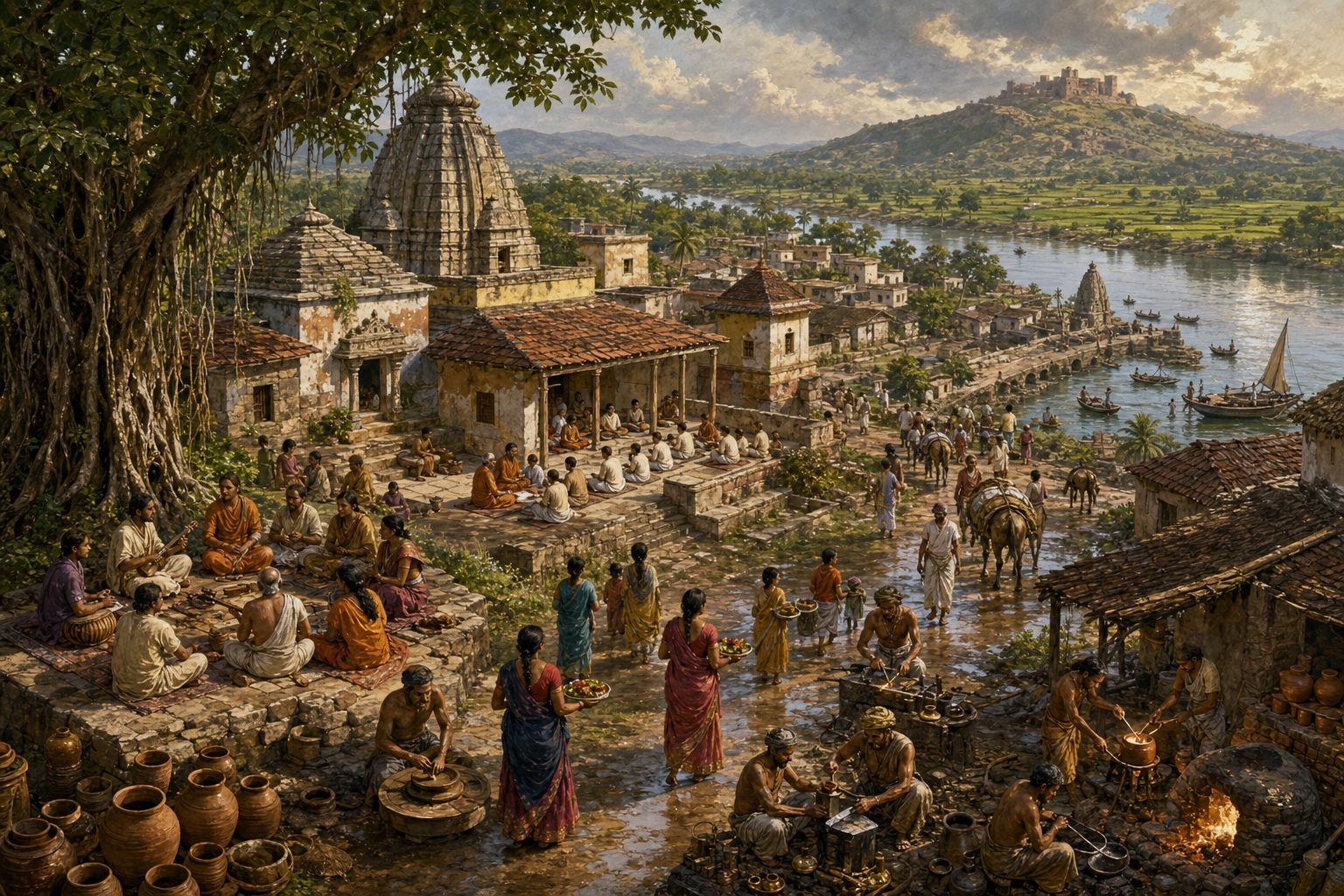
Political history naturally follows capitals, campaigns, dynasties, and rulers. Civilizational history must look wider. A capital can fall while a village keeps its sacred calendar. A royal endowment can disappear while merchants, householders, monks, acharyas, artisans, and local patrons find another way to sustain worship or teaching. A deity can be moved without being forgotten. A school can re-form around a new teacher or location.
This wider view does not minimize conquest. It shows more precisely where conquest landed. The iqta and jagir arrangements associated with Sultanate rule and the mansabdari system under the Mughal Empire changed how revenue and elite service were organized. Such changes affected the resources available to courts, communities, landholders, pilgrimage centers, and religious endowments. They deserve examination in their own right rather than being reduced to a slogan about either total destruction or seamless continuity.
The Delhi Sultanate, Mughal polities, and British colonial administration should not be compressed into a single undifferentiated era. Their governing structures and effects were not identical. British codification and bureaucratic centralization, for example, reworked property, revenue, courts, and religious endowments while forcing diverse practices into more rigid administrative categories. Vijayanagara, Rajput, and Maratha polities likewise developed different regional responses through local traditions of law, custom, statecraft, and dharma.
Use three questions whenever you encounter a sweeping account of conquest:
- What changed in power and resources? Identify the ruler, revenue arrangement, patronage system, institution, and locality involved.
- What changed in ordinary practice? Look for effects on teaching, pilgrimage, festivals, artisan work, food distribution, monastic discipline, and household observance.
- What happened next? Trace relocation, negotiation, rebuilding, new patronage, vernacular transmission, or institutional reorganization.
The third question is often neglected. Without it, destruction becomes the final scene even when the community’s history continued. Yet continuity must not be used to erase loss. Somnath’s repeated restoration, Kashi’s enduring scholastic neighborhoods, and the remembered monastic landscape of Nalanda reveal different relationships between rupture and renewal. None proves that damage did not matter. Each shows that survival required people to repair, teach, fund, protect, and return.
Read conquest through five civilizational ledgers
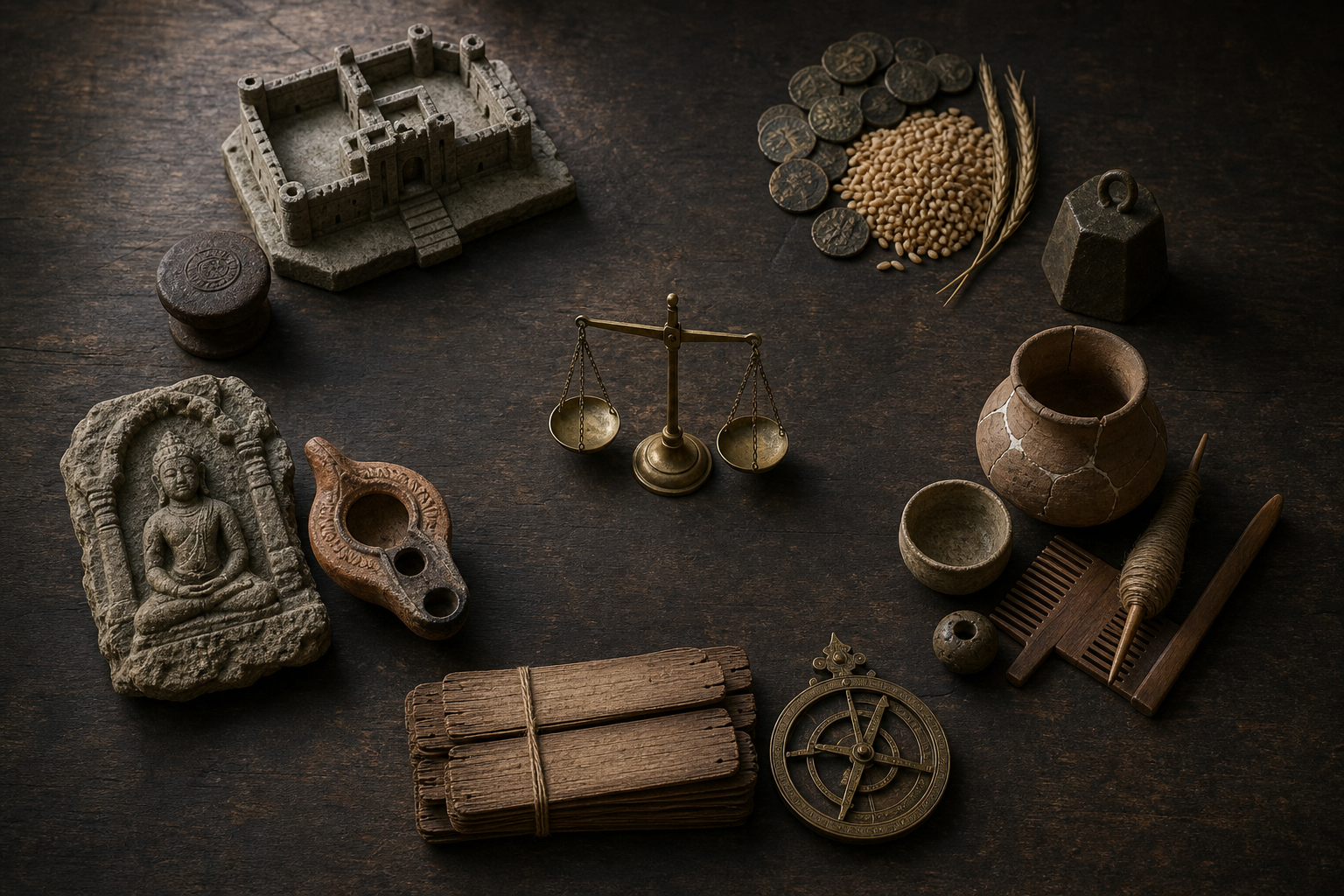
A ruler-centered account records who held the throne. A civilizational account keeps five ledgers at once. This prevents one dramatic event from standing in for the entire experience of a region or tradition.
| Ledger | What to inspect | What resilience may look like |
|---|---|---|
| Material | Land, revenue, trade, grain, artisan work, and travel routes | New patrons, adjusted revenue arrangements, sustained commerce, or redirected pilgrimage |
| Institutional | Temples, mathas, viharas, sanghas, upashrayas, pathshalas, gurukuls, and gurudwaras | Negotiated protection, reorganized endowments, dispersed learning, rebuilding, or renewed discipline |
| Ritual | Festivals, icons, vows, fasts, processions, and sacred geography | Relocation, re-consecration, calendrical continuity, and transmission within households |
| Intellectual | Texts, languages, philosophical debate, oral teaching, and historiography | Manuscript preservation, commentary, vernacular expression, and debate across changing boundaries |
| Ethical | Ahimsa, protection, restraint, courage, dana, daya, karuna, and seva | Defense without dehumanization, care under pressure, and solidarity organized through institutions |
1. Material life: follow revenue as well as armies
Military victory becomes durable rule when it reorganizes land, revenue, labor, and access to trade. That is why a history concerned only with battles remains incomplete. Ask who collected the agricultural surplus, which institutions received grants, how pilgrimage corridors functioned, and whether merchants or artisans could redirect their networks when a political center changed.
South Asia’s coastal worlds add another corrective. Indian Ocean ports remained connected with Arabia, East Africa, and Southeast Asia, carrying merchants, artisans, monks, and ideas across political boundaries. This does not make inland upheaval irrelevant. It shows that civilizational life had multiple arteries. When one center weakened, other networks could continue to circulate wealth, skill, texts, and sacred forms.
When reading about a reign, therefore, make a small material map. Record the revenue system, major religious or scholastic endowments, nearby trade routes, and the livelihoods tied to them. You will see whether a conquest produced abrupt rupture, gradual realignment, or different outcomes for different communities.
2. Institutions: find the infrastructure behind continuity
A temple, vihara, matha, upashraya, pathshala, gurukul, or gurudwara is more than a building. Such institutions can connect worship with teaching, grain storage, charity, land stewardship, manuscript preservation, and the work of artisans. Agraharas, temple endowments, Buddhist viharas, Jain bhandaras, and other community institutions joined learning to material support.
This is why institutional history changes how you understand resilience. If the original patronage failed, who supplied food and space? If a center was damaged, where did its teachers, ritual specialists, manuscripts, or sacred objects go? If political restrictions changed, which organizational forms allowed the community to continue?
The Sikh experience makes the relationship between ethics and organization especially visible. Gurudwaras, langar, seva, Khalsa discipline, and related institutions gave durable form to spiritual commitments under shifting political conditions. Hindu mathas and temple trusts, Buddhist sanghas, and Jain communities followed their own disciplines and were not interchangeable with these Sikh forms. The shared lesson is narrower and more useful: values endure when people give them institutions, resources, rules, and responsibilities.
3. Ritual life: look for continuity in time and place
Ritual organizes memory at a scale political chronicles often miss. Kumbh Mela, Vesak, Paryushan, and Gurpurab belong to different traditions, but each orders communal time through recurring observance. Festivals, fasts, vows, processions, pilgrimages, and hospitality continued to bind communities across changes of regime.
When a sacred site faced danger, communities sometimes moved icons, restored shrines, or re-consecrated altered spaces. That is not an unchanged continuity. It is continuity carried through adaptation. Keep four things distinct in your notes: the original place, the disruption, the protective response, and the later restoration. Collapsing them into the single word survived conceals the labor and judgment involved.
Sacred geography also prevents you from viewing Bharat only as a recipient of outside power. Temple forms and festival motifs traveled outward with merchants and monks, leaving visible imprints in Southeast Asia, including the monumental landscape associated with Angkor. A civilization can endure conquest at home while continuing to influence distant societies. Both movements belong in the same historical field.
4. Intellectual life: preserve difference without manufacturing division
Dharmic resilience is not the survival of one uniform creed. Jain anekantavada, Hindu Advaita, Buddhist Madhyamaka and Yogacara, and the Sikh affirmation of Ik Onkar make different philosophical claims. Treating them as identical would erase the very traditions you intend to honor.
At the same time, these traditions sustain a recognizable ethical conversation around ahimsa, karuna, daya, dana, seva, responsibility, and disciplined self-transformation. Shared vocabulary does not require shared metaphysics. It creates room for solidarity while preserving doctrinal precision.
Use a three-part comparison when you study two traditions. First identify the metaphysical claim: what does each say about self, reality, liberation, or the divine? Then identify the ethical demand: what conduct follows? Finally identify the vehicle of transmission: scripture, commentary, monastic lineage, kirtan, vernacular poetry, ritual, or community discipline. This stops vague talk of unity from swallowing real differences.
The Bhakti movements show how intellectual and spiritual life could move into vernacular public space during political change. Some Sufi lineages and Bhakti communities also met through song and ethical practice, creating porous cultural zones. Such interaction neither erased doctrinal boundaries nor converted the entire period into a story of conflict-free synthesis. Notice the exchange, name the difference, and resist using one to cancel the other.
5. Ethical life: measure resistance by its restraints
Conquest creates a difficult Dharmic question: how should a community protect life and sacred order without reproducing the hatred it opposes? The traditions do not answer in one voice. Jain and Buddhist teachings repeatedly foreground the costs of harm and the transformation of intention. Hindu traditions place kshatra, the duty to protect, beside ahimsa and develop ideas of restrained Dharma-Yuddha. Sikh thought joins courage to nirbhau and nirvair: freedom from fear and freedom from hatred.
That pairing matters when historical memory enters present debate. Fear can produce silence, but hatred can destroy moral discrimination. A Dharmic response must be able to name aggression, defend the threatened, preserve evidence, and rebuild institutions without treating every present-day person as an extension of a past ruler.
Use restraint as a test, not as an excuse for passivity. Ask whether a proposed response protects what is vulnerable, distinguishes responsibility from inherited identity, uses proportionate means, and leaves room for truth after anger has passed. Courage that abandons these limits may be forceful, but it is no longer disciplined by Dharma.
Test every large claim before you repeat it
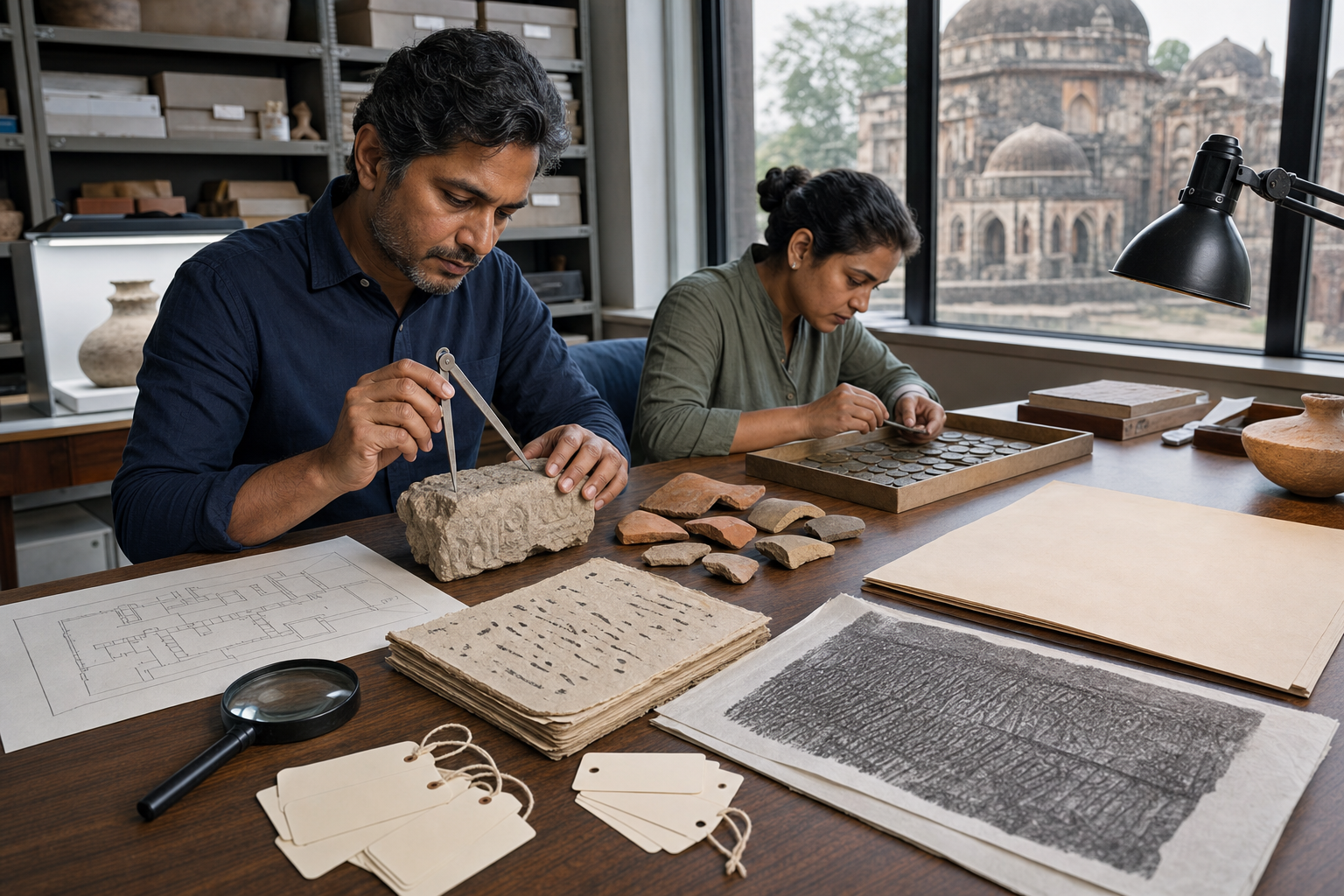
South Asian conquest attracts categorical language: always, never, total, peaceful, complete, uniquely tolerant, or uniquely destructive. Those words often carry more certainty than the evidence permits. You do not need to become a professional historian to improve the quality of what you read and share. You do need a repeatable method.
- Define the claim narrowly. Name the place, institution, political authority, type of event, and period under discussion. A claim about one shrine or ruler is not automatically a description of an entire subcontinent or dynasty.
- Triangulate the evidence. Compare inscriptions and material remains with texts and later historical interpretation. Each can answer different questions, and no single class is automatically complete.
- Build the sequence. Establish what existed before the event, what changed, how contemporaries responded, and whether restoration or reorganization followed.
- Mark confidence honestly. Distinguish documented fact, well-supported inference, inherited tradition, disputed interpretation, and an assertion for which you have not yet found adequate evidence.
The material archive is unusually varied. Temple inscriptions, hero stones, copperplates, palm-leaf manuscripts, murals, archaeological remains, and public records can illuminate patronage, conflict, landholding, ritual, and memory. Scientific tools such as multispectral imaging can help recover difficult manuscript text, while GIS mapping can clarify relationships among pilgrimage routes and sites. A powerful tool still requires careful interpretation; a map reveals spatial patterns, not motive by itself.
Historiography needs the same discipline. Colonial frameworks associated with figures such as Thomas Babington Macaulay often placed Indian history inside Eurocentric hierarchies and periodizations. Later efforts to recover indigenous methods, including Mīmāṁsā, Nyāya, and dharmashastric reasoning, correct important imbalances. But decolonization is not permission to decide the conclusion before examining the evidence. Replacing colonial certainty with civilizational wishfulness repeats the underlying error.
R.C. Majumdar, Jadunath Sarkar, and later scholars offer different historiographical pathways through this terrain. Their value is not that one name can settle every controversy. It is that serious history requires chronology, regional context, philology, and arguments that can be checked. When two interpretations conflict, identify the precise disagreement: the event, scale, motive, chronology, or meaning. That is more productive than labeling one side truthful and the other hostile before testing either claim.
Silence also needs careful handling. The absence of an inscription does not prove that nothing happened; nor does it prove that a desired event occurred but went unrecorded. State what the surviving evidence can establish and where it stops. Intellectual honesty strengthens civilizational memory because it prevents one weak claim from discrediting a larger, well-documented history.
Make historical memory produce Dharmic conduct
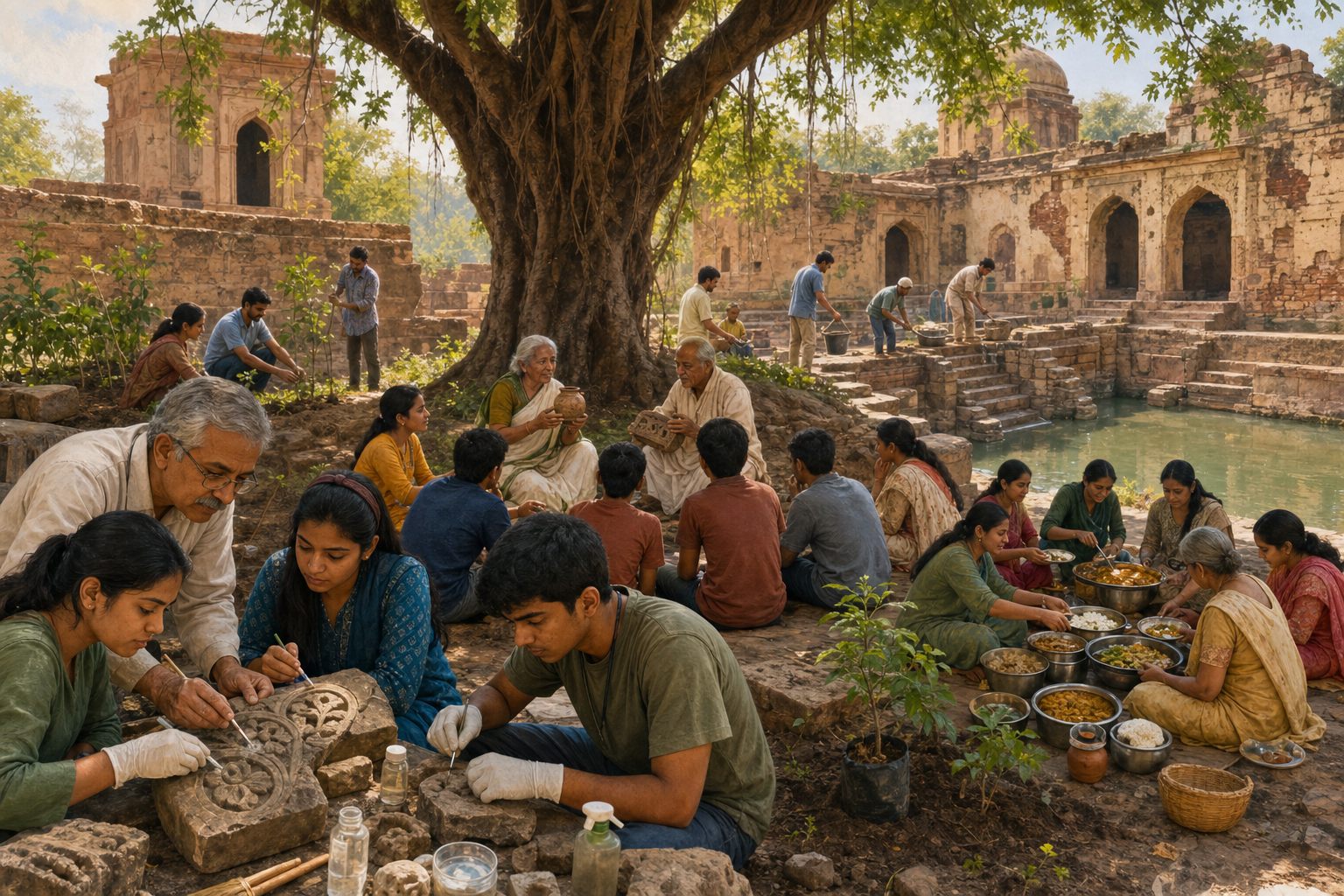
Iconoclasm and temple desecration belong in the historical record. So do restoration, manuscript protection, re-consecration, community patronage, and the maintenance of daily practice. Recording only destruction leaves the conqueror with all the agency. Recording only survival makes the cost disappear. A responsible memory keeps both columns open.
You can put that principle into practice without waiting for a grand institution:
- Choose one local site or tradition. Build a short chronology that separates foundation, patronage, disruption, relocation, restoration, and present practice. Do not merge tradition and documentation; label each clearly.
- Identify the carriers of continuity. Record the role of households, priests, monks, acharyas, granthis, merchants, artisans, community kitchens, teachers, and donors where the evidence supports it.
- Preserve context, not just images. When you photograph an inscription, manuscript, shrine, or memorial, record its location, language, present custodian, and the basis for its identification. A decontextualized image is easy to miscaption and hard to verify.
- Support living transmission. Attend a teaching, festival, performance, or heritage program; contribute to a credible conservation or educational effort; or help a younger person learn the history and vocabulary of the tradition.
- Pair remembrance with service. Dana, seva, langar, educational support, and care for sacred places turn inherited memory into present responsibility. They ensure that remembrance builds capacity rather than merely circulating anger.
Living arts also deserve attention. Yakshagana, Chhau, Kathak, Gotipua, oral epics, kirtans, and pravachans carry ethical memory through performance rather than through academic prose alone. When you support them, ask what episode is being remembered, how the telling has changed, and which moral choice the audience is being invited to consider. That turns performance into historical inquiry without reducing it to a data point.
Language is the final discipline. Name a ruler, policy, army, institution, or documented act as precisely as you can. Avoid transferring guilt from a historical actor to an entire living population. Precision is not softness toward wrongdoing. It is what keeps justified remembrance from becoming indiscriminate enmity.
Your next step can be modest: take one contested episode, write its sequence in two columns labeled loss and response, and verify each line before sharing it. You will begin to see Dharmic resilience where it actually lives — not in denial of the wound, but in the disciplined work of carrying Dharma beyond it.