
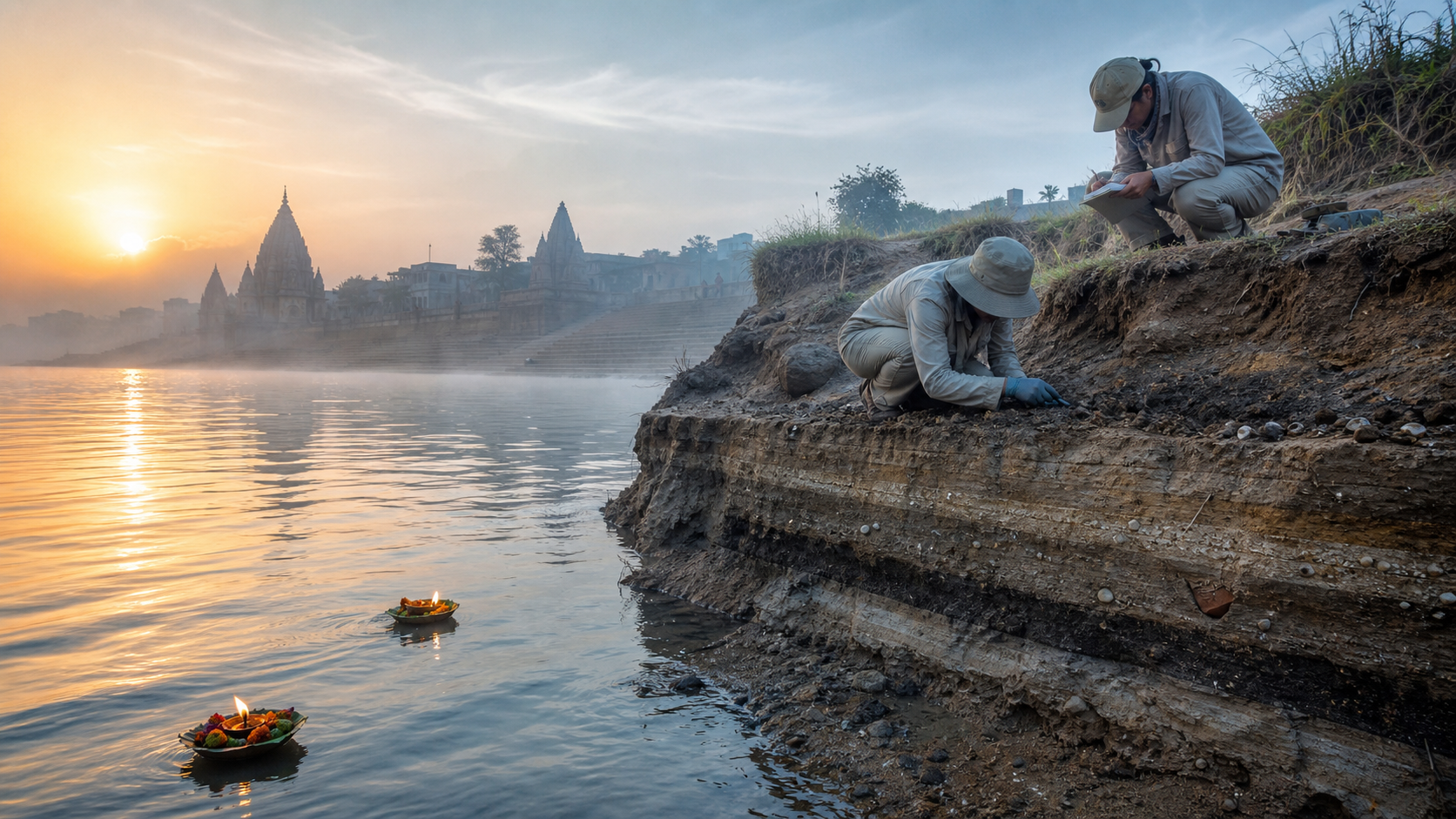
You may be trying to decide whether a flood tradition preserves history, teaches sacred truth, or combines both. You do not have to choose between reverence and evidence. You do have to keep different kinds of claims from borrowing authority from one another.
Start with three questions: What does the water mean within the tradition? What scale of physical event is being claimed? What evidence should that event have left behind? Those questions let you honor Ganga, Tamil memories of inundation, and Dharmic accounts of dissolution without turning every sacred narrative into literal cartography.
Sacred truth is not a failed geological report
In Hindu life, water is not merely a substance described by chemistry. Ganga is Tripathaga, the current connecting heaven, earth, and the netherworld. Her descent through Shiva’s matted locks brings overwhelming force under disciplined control. Bhagiratha’s tapas brings that grace into the human world for the sake of his ancestors. The narrative joins cosmic order, sacred geography, lineage, purification, and ethical persistence.
That meaning remains present in physical practice. A pilgrim enters a named river, a family performs ancestral rites on its bank, and sacred water is carried into household worship. Ganga is therefore both river and tirtha: a crossing place where ordinary geography becomes a site of contact with the divine. Her water is not interchangeable with an abstract symbol of water.
Flood traditions work in several registers as well. They may express the fragility of human order, the rhythm of dissolution and renewal, the consequences of adharma, or the duty to preserve life and knowledge. The Matsya narrative belongs to this sacred and cosmological field. Tamil poetry about inundation and lost territory can likewise hold cultural memory, grief, identity, and reflections on impermanence.
Before debating any such tradition, identify the kind of statement in front of you:
- A devotional statement tells you how a community encounters the sacred: Ganga purifies, blesses, or grants punya.
- A philosophical statement interprets existence: formed worlds are impermanent, and human power remains subject to forces larger than itself.
- A memory claim proposes that a narrative may preserve an echo of an actual flood, shoreline retreat, storm, tsunami, or abandoned settlement.
- A historical claim identifies a particular people, place, event, sequence, and approximate period.
- A geological claim describes the former position of coastlines, the movement of plates, the depth of a seabed, or the mechanism by which land became submerged.
These statements require different forms of judgment. Geology cannot measure karmic purification. Devotion cannot determine the age of a sediment layer. A poem may preserve memory without functioning as a survey map, while a real submerged site does not automatically validate every later story attached to it. Keeping the categories distinct protects both spiritual meaning and historical reasoning.
Real shoreline change explains much without a vanished continent
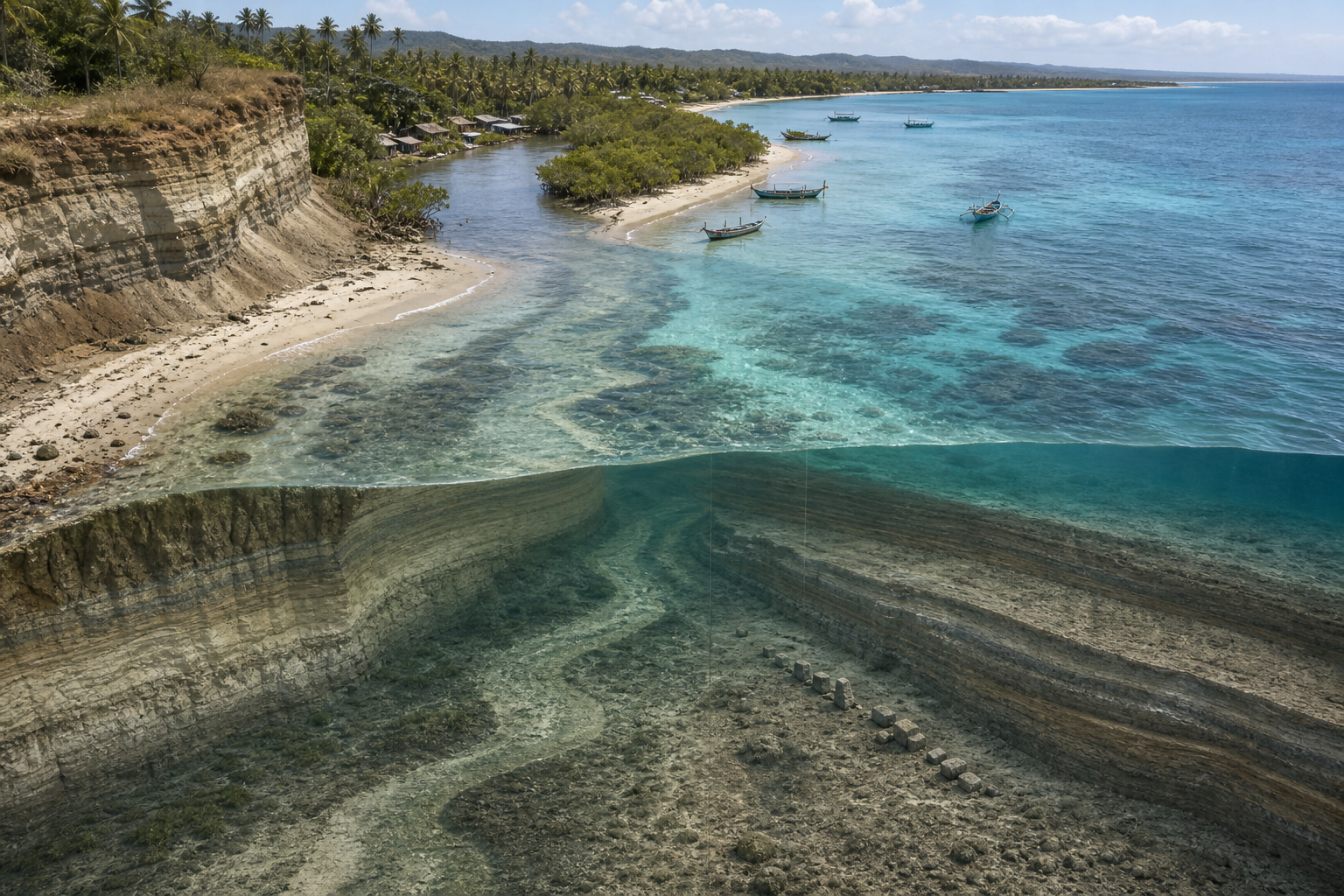
The strongest starting point is not that coastlines have always remained fixed. They have not. Around the Last Glacial Maximum, roughly 20,000 years ago, global sea level was approximately 120 metres lower. More of the continental shelf around peninsular Bharat was exposed. Rising water later moved shorelines inland and transformed estuaries, lagoons, barriers, islands, and channels.
This distinction matters: land can be covered because the sea rises, because the land subsides, or because both occur. A drowned coastal plain is not evidence that a continent suddenly dropped into the ocean. If you hear that a structure or settlement now lies offshore, first ask which mechanism is actually being proposed.
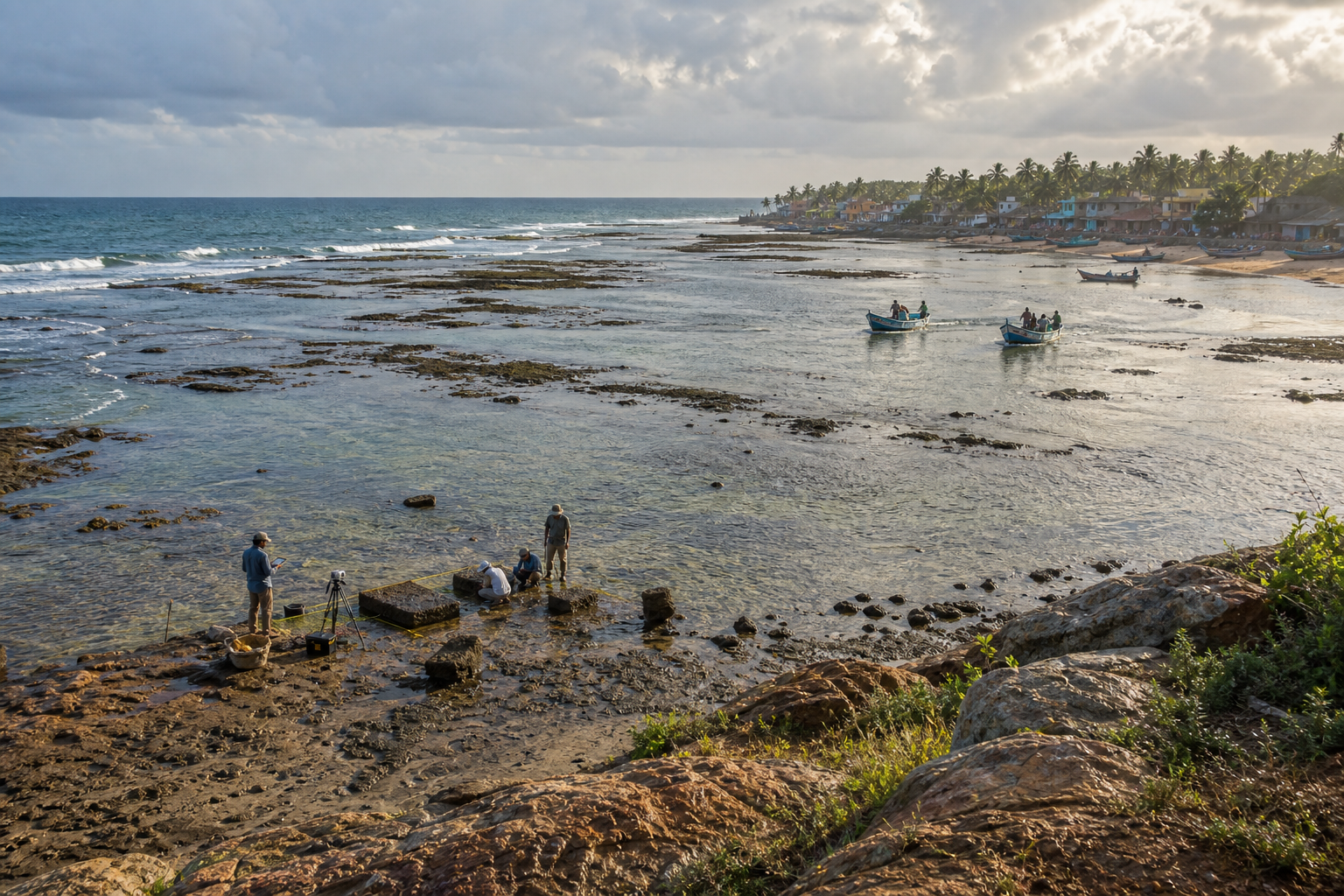
The continental shelves near Kanyakumari, the Gulf of Mannar, and the Palk Strait could have supported landscapes that no longer lie above water. Along the Tamil coast, underwater and nearshore work around Poompuhar has recovered cultural material from submerged or reworked seabeds. Such finds matter. They deepen the history of coastal settlement, craft, navigation, and trade. They do not, by their mere presence, disclose the original position, date, or cause of deposition.
Use the scale of the claim to decide what kind of evidence should carry weight:
| Claim being considered | Appropriate evidence | What would not settle it |
|---|---|---|
| A river or body of water is spiritually purifying | Scripture, theology, ritual continuity, pilgrimage, sacred geography, and lived practice | Bathymetry or a laboratory measurement presented as a verdict on sacred meaning |
| A coastal settlement was inundated or abandoned | Palaeo-shoreline mapping, stratigraphy, securely located artefacts, sediment analysis, and reliable dating | An isolated object from a mobile seabed with no documented context |
| A regional flood entered cultural memory | Several independently dated sites, environmental traces, a plausible mechanism, and critically dated textual traditions | A general resemblance between two flood stories |
| A continent-sized homeland vanished in recent prehistory | Compatible bathymetry, seismic profiles, tectonic history, sediment cores, dated archaeology, and widespread evidence matching the proposed time and scale | A poetic reference, a modern map, one language surviving far away, or an ancient geological fragment from a different era |
Context is decisive underwater because currents, storms, tsunamis, erosion, fishing activity, and later human movement can relocate material. Ask whether a find was recorded in place, whether it belongs to a coherent layer, whether that layer was dated, and whether the proposed shoreline existed at that date. Without those links, an artefact proves human activity more readily than it proves a drowned city.
A six-step test for turning flood memory into history
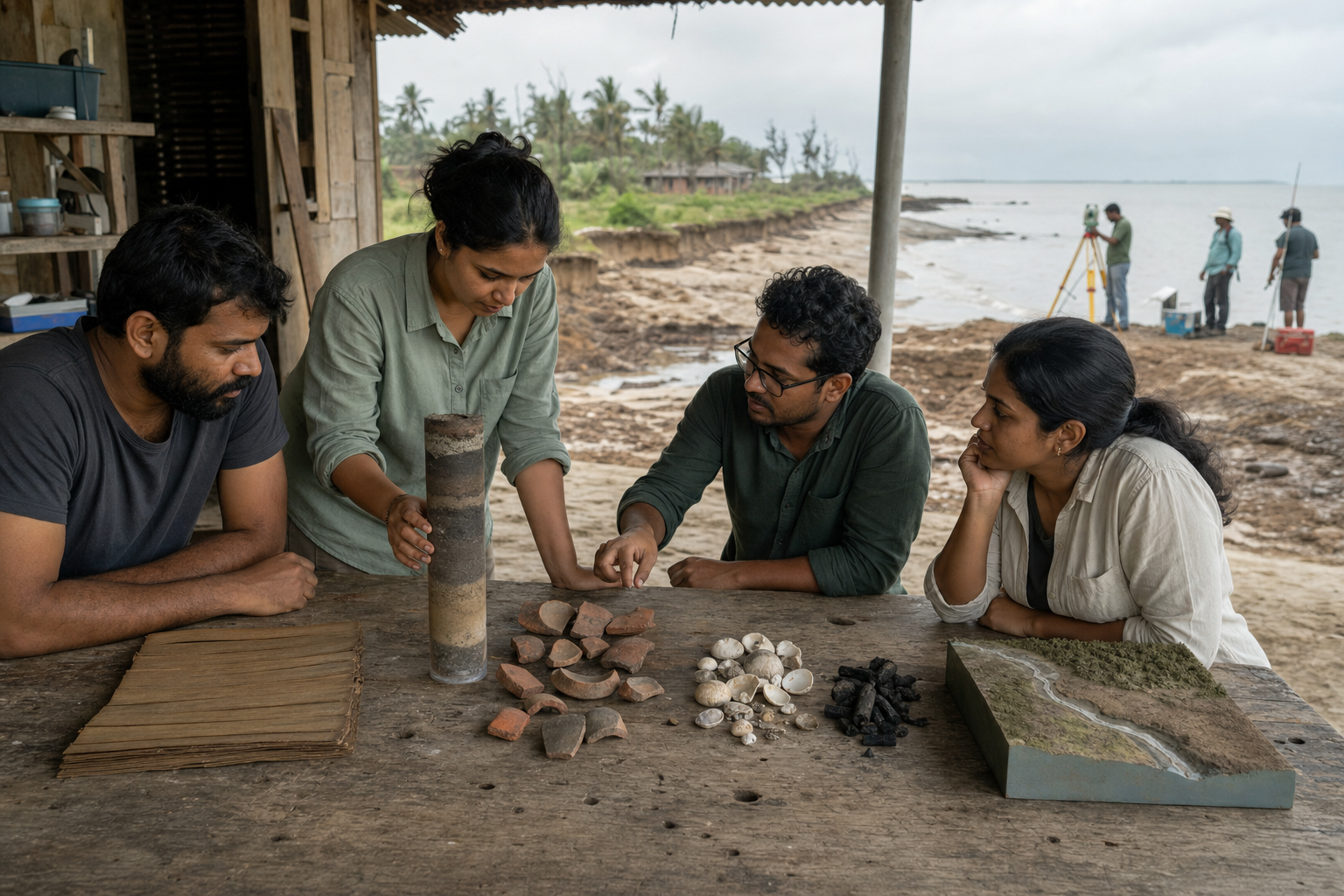
When a video, speech, family discussion, or social-media map presents a sacred tradition as established history, run the claim through the following sequence. Do it before deciding whether the claim is inspiring, offensive, politically convenient, or embarrassing. Emotional usefulness is not a dating method.
- Write the claim in one precise sentence. Name the place, population, approximate period, scale, and mechanism. There is a large difference between a village lost to coastal erosion, a broad shelf covered by post-glacial sea-level rise, and a continent that suddenly sank.
- Date the evidence, not merely the event in the story. Ask when the surviving wording is securely attested, when its manuscript or inscription was produced, and whether the relevant passage may belong to a later commentary or redaction. An old tradition can preserve older memory, but that possibility is not an exact date.
- Match the alleged event to a physical mechanism. Rising sea level, tectonic subsidence, river flooding, storm surge, tsunami damage, and plate movement leave different patterns. A claim that never specifies a mechanism cannot explain why the evidence should look one way rather than another.
- Check archaeological context. An in-place floor, harbour feature, habitation layer, or repeated artefact distribution carries more historical information than an attractive object separated from its original layer. Dating must attach to the relevant context rather than to nearby material that may be older or younger.
- Require convergence. Textual criticism, archaeology, palaeoclimate, palaeobotany, epigraphy, numismatics, comparative linguistics, radiocarbon or OSL dating, bathymetry, seismic profiles, and sediment cores answer different questions. A major claim becomes persuasive when several independent lines point to the same place, period, and process.
- State a proportionate verdict. Use established, well supported, plausible, unresolved, unsupported, or contradicted. Do not force every question into either proven or false.
Chronology deserves special care in Tamil history. The earliest secure Tamil-Brahmi attestations begin around the third century BCE, while the extant Sangam corpus took shape across later centuries. That does not make the poems historically useless. It means their imagery cannot be assigned automatically to an event thousands of years earlier.
The commentary associated with the Iraiyanar Ahapporul illustrates the same problem. Its traditional attribution and date remain disputed, with proposals ranging from the eighth to the thirteenth century CE and some estimates clustering in the tenth or eleventh century. If an argument depends upon wording from that commentarial layer, you must not silently treat it as an eyewitness record of remote prehistory.
Notice what this test does not require. It does not require you to prove that oral memory can never endure. It asks you to distinguish the possibility of preserved memory from a demonstrated identification. The greater the chronological gap and the larger the claimed event, the more convergence you should expect before assigning a name, date, territory, and migrating population to it.
What can responsibly be said about Kumari Kandam
Kumari Kandam is where these distinctions become immediately useful. Tamil traditions of inundation and territorial loss deserve to be read seriously as literature, civilizational memory, and possible witnesses to a changing coast. Kalittogai, Silappadikkaram, and the broader Sangam inheritance should not be discarded merely because later political retellings make claims that exceed the evidence.
At the same time, the modern name Lemuria carries a very different history. Philip Sclater proposed Lemuria in 1864 as a biogeographical explanation for animal distribution, not as the recovery of a Tamil historical tradition. Plate tectonics later supplied a deep-time account of India’s separation from Madagascar and its northward movement. Those events occurred tens of millions of years before human civilization, not within the period claimed for a recent lost homeland.
Ancient crustal fragments beneath the Indian Ocean do not close that gap. Mauritia, identified through ancient zircons beneath much younger volcanic material near Mauritius, belongs to a geological history vastly older than humanity. Its existence cannot be transferred into evidence for a populated Tamil landmass connected to present-day Tamil Nadu during the last 6,000 to 15,000 years.
Brahui also needs proportionate treatment. It is a Dravidian language spoken in Balochistan and shaped heavily by Iranian and Indo-Aryan contact. Its history remains debated: one possibility involves an older northern Dravidian presence, while another proposes a later migration by a Dravidian-speaking community. The lack of decisive deep hydronymic and historical evidence leaves that question unsettled. In neither scenario does Brahui, by itself, prove a mass Tamil migration from a submerged southern continent.
A responsible assessment therefore has four levels:
- Established at the global level: sea level was substantially lower near the Last Glacial Maximum and later rose across continental shelves.
- Credible at the regional level: Tamil coastal communities experienced changing shorelines, marine hazards, settlement loss, and relocation at different times.
- Unresolved in particular cases: a poem may preserve memory of one or more real inundations, but identifying the exact event requires dated textual and material links.
- Not established by the available convergence: a continent-sized Tamil homeland vanished in recent prehistory and launched a documented mass dispersal across Bharat.
This wording avoids two equal mistakes. Do not claim that geoscience has disproved every memory of a lost Tamil settlement; real coastal change makes such losses entirely credible. Do not claim that coastal change proves the maximal version of Kumari Kandam; the scale, chronology, and expected geological signatures do not match.
If you need a concise response in a discussion, use this formulation: Tamil flood traditions deserve serious literary and historical attention, and post-glacial sea-level rise makes local coastal submergence credible. A recently vanished continent and a resulting pan-Indian Tamil migration remain separate claims that require multiple, independently dated forms of evidence.
This is not a retreat from civilizational confidence. Dharma does not become stronger when every sacred memory is converted into a modern territorial claim. Ganga’s sanctity does not depend on geology mistaking theology for hydrology, and Tamil cultural depth does not depend on reviving a discarded nineteenth-century land-bridge hypothesis. Disciplined chronology protects a tradition from easy dismissal because it makes clear what is sacred, what is plausible, what is proven, and what remains open.
Key takeaways
- Classify the statement before judging it: devotional, philosophical, memorial, historical, or geological.
- Do not ask physical science to validate sacred efficacy, and do not ask sacred authority to substitute for physical dating.
- Match the evidence to the scale. A submerged harbour can support coastal history without proving a vanished continent.
- Check whether underwater material was found in place, securely dated, and tied to a reconstructed shoreline.
- Treat a later text as evidence for a tradition attested at that later date unless an older layer can be demonstrated.
- Demand convergence before accepting a large migration or continental-loss claim.
- Use proportionate verdicts such as plausible, unresolved, or unsupported instead of forcing a choice between literal certainty and total dismissal.
The next time you encounter a flood claim, write its place, date, scale, and mechanism in one sentence. Then name the one missing piece of evidence that would most change your judgment. Share only the verdict that the present evidence supports. That habit gives sacred memory room to remain sacred while giving history the discipline it needs.
References
- DharmaRenaissance Blog – Unraveling Lemuria and Kumari Kandam: An Evidence-Based Look at Tamil Myth and History
- DharmaRenaissance Blog – Goddess Ganga vs Amphitrite: A Deep Comparative Study of Sacred Waters and Worldviews
