
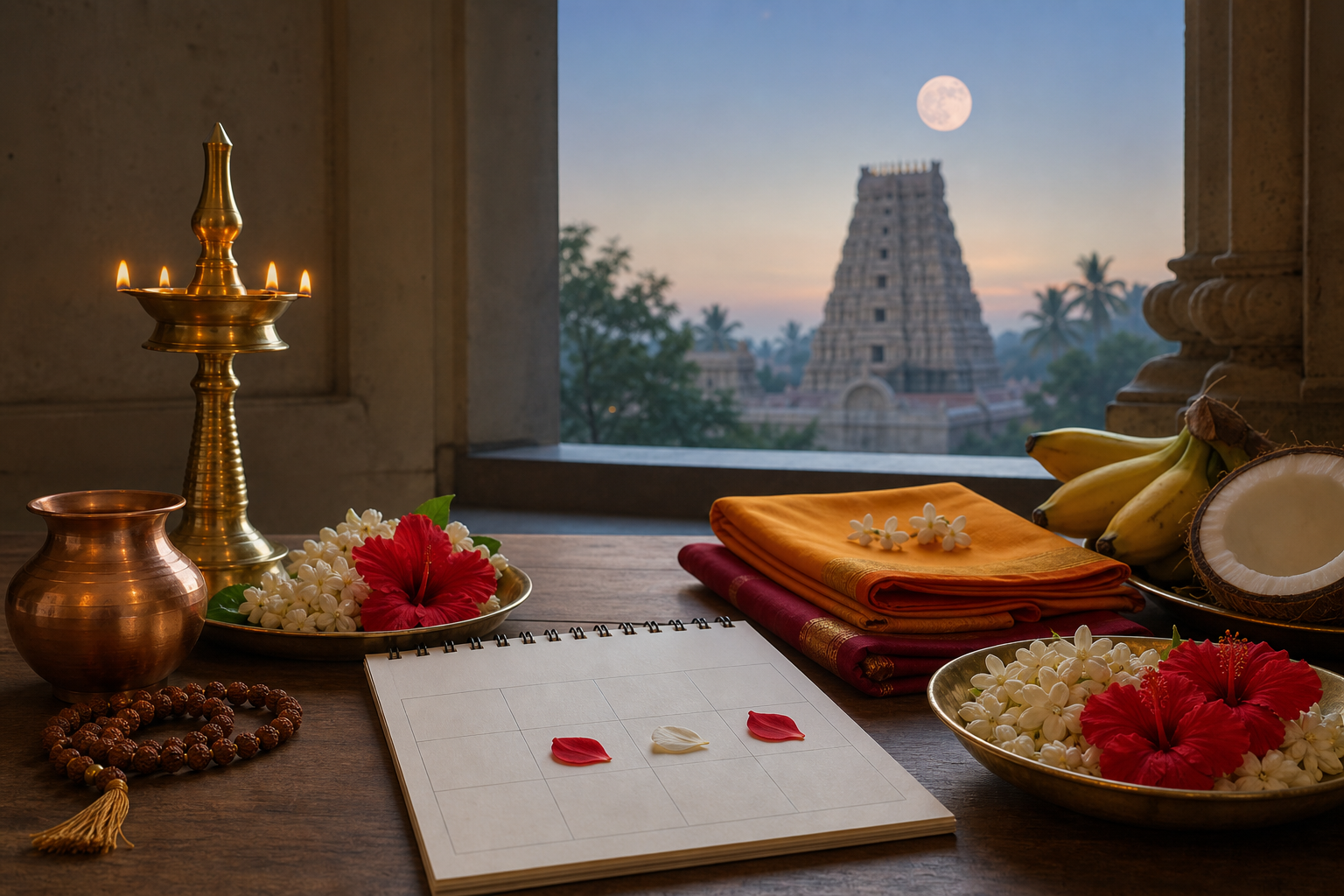
If your calendar shows Chaturdashi, Purnima and Panguni Uthiram on April 1, followed by Hanuman Jayanti on April 2, you are not necessarily looking at an error. You are seeing several calendrical rules meet across two civil dates.
This is an Indian Standard Time planning map for the April 1-3 observance cluster. Use it to decide what belongs in your home practice, what requires a temple visit, and what must still be confirmed in your local Panchang.
Mark these IST dates, then verify your local clock

| Date in IST | Observance | What you need to plan |
|---|---|---|
| April 1 | Renuka Chaturdashi | A regional Renuka Devi or Yellamma observance, especially relevant to families connected with Karnataka, Maharashtra, Telangana and Andhra Pradesh. |
| April 1 | Panguni Uthiram | A Tamil temple and family observance associated with divine marriages, including Shiva-Parvati and Muruga-Deivanai. |
| April 1 | Purnima Vrat | Chaitra Purnima fasting, japa, moonrise worship and dana according to your capacity and tradition. |
| April 2 | Hanuman Jayanti | In many regions, worship of Sri Hanuman on Chaitra Shukla Purnima through Rama-Nama, stotra recitation, abhishekam and seva. |
| April 3 | Vaishakh month begins | The start of Vaishakh in North Indian Purnimanta calendars, suitable for beginning a month-long snana-dana-japa discipline. |
The most important distinction is that these are observance dates, not claims that a lunar tithi begins at midnight. A tithi is determined by the changing angular distance between the Sun and Moon, with each tithi covering roughly 12 degrees of lunar elongation. It can begin during one civil day and end during the next. The relevant tithi may therefore be present at sunrise, moonrise or another ritual time on different dates.
Why Purnima appears across April 1 and April 2
Purnima Vrat is assigned to April 1 in this IST calendar, while Hanuman Jayanti is assigned to April 2. That does not mean there are two full moons. The two observances apply their calendrical requirements to different ritual moments within a Purnima window that crosses civil dates.
Do not move either observance merely to make a wall calendar look tidier. For a fast or home puja, consult a Panchang calculated for your location. For a temple programme, follow the temple’s announced date and time. If your family sampradaya has a settled practice, preserve it unless your acharya or purohit directs otherwise.
Why the month name also changes by region
North Indian Purnimanta calendars reckon the lunar month around the full-moon boundary, so Vaishakh begins on April 3 in that convention. Amanta calendars, common across much of peninsular India, reckon months from one new moon to the next and will not place the same month boundary there.
Tamil practice adds another layer. Panguni is a solar month, while Panguni Uthiram depends on the Uttiram, or Uttara Phalguni, nakshatra meeting the full-moon season of Panguni. That is why a Tamil festival, a lunar fast and a regional Chaturdashi vrata can share one civil date without being versions of the same observance.
If you live outside India, do not copy IST dates blindly. Sunrise, moonrise and tithi boundaries belong to your location. Use the table to identify what is approaching, then verify the final date through a local Panchang or the temple where you intend to participate.
Choose the practice that belongs to your tradition
April 1 is not a demand to conduct three elaborate pujas. Begin with your kula, sampradaya, Ishta Devata and regional inheritance. If one observance is central to your family, give it the main place. You can acknowledge the others without compressing unrelated ritual systems into one improvised ceremony.
Renuka Chaturdashi: purification, protection and resilience
Renuka Chaturdashi on April 1 venerates Renuka Devi, also widely known as Yellamma. She is honoured as Shakti and as the mother of Parashurama, with particularly strong living traditions in Karnataka, Maharashtra, Telangana and parts of Andhra Pradesh.
A simple household observance can be complete without imitating the scale of a jatra:
- Begin with snana and clean the place of worship.
- Light a deepa and make a clear sankalpa for purification, maternal protection or steadiness in adversity.
- Offer red or yellow flowers, turmeric-kumkum and naivedya that follows your regional custom.
- Undertake phalahar or another mild fast if that is already part of your practice.
- Complete the vrata with mantra-japa, charity or direct service to someone who needs care.
If children are participating, tell them why Renuka is remembered rather than assigning them a long ritual they cannot understand. A short account of compassion, dignity and fortitude gives the day an ethical centre they can carry beyond the shrine.
Panguni Uthiram: put relationship dharma at the centre
Panguni Uthiram on April 1 is especially important in Tamil traditions. Temple celebrations recall divine weddings such as Shiva-Parvati, Muruga-Deivanai, Muruga-Valli in traditions that include her, and Sriman Narayana-Sri Lakshmi. The day joins devotion to a practical teaching: love in grihastha-dharma is sustained by fidelity, responsibility and shared sacred purpose.
If a nearby temple is conducting Kalyana Utsavam, procession or special archana, check its schedule before arranging the rest of your day. Temple time should govern your attendance. Murugan devotees who have undertaken kavadi or paal abhishekam pledges should follow the discipline and procedures of their tradition rather than treating the offering as a festival-day experiment.
At home, a family can worship the relevant divine couple, offer flowers and naivedya, and read or discuss one duty that strengthens the household. Make that last step concrete: reconcile a neglected obligation, speak respectfully during a disagreement, share a burden that has fallen on one person, or invite an elder to transmit the family’s festival memory.
Purnima Vrat: simplify food and deepen attention
Chaitra Purnima is suited to sattvika upasana, dana and sustained japa. A customary fast may run from sunrise to moonrise, but the vrata is not reduced to whether you avoided food. Its purpose is disciplined attention.
Choose one mantra connected with your Ishta Devata and stay with it. Suitable established choices include Om Namo Narayanaya and Om Namah Shivaya. A modest, attentive count is more useful than declaring an ambitious target and abandoning it halfway through the day.
At moonrise, you may light a lamp, offer arghya to Chandra and complete your worship. Keep dana ready before the evening arrives: grains, ghee, a prepared meal or another genuinely useful offering. Planning the gift in advance prevents charity from becoming a symbolic afterthought.
The full moon also gives dharmic communities a shared rhythm of self-examination. Buddhist Uposatha practice emphasises meditation and sila, Jain disciplines often include fasting or partial fasting, and Sikh life continually affirms seva and reflective engagement with sabad. The forms are distinct, but restraint, ethical clarity and compassionate action offer a civilizational meeting ground.
Hanuman Jayanti: unite devotion, discernment and strength
Hanuman Jayanti falls on April 2 in traditions observing his appearance on Chaitra Shukla Purnima. Sri Hanuman embodies bhakti, buddhi and bala: devotion that does not become passivity, intelligence that does not become pride, and strength placed entirely in the service of dharma.
For a focused home observance, select one principal recitation rather than rushing through everything available:
- Recite the Hanuman Chalisa attentively if that is your established daily or weekly text.
- Choose Sundara Kanda parayana when you have the time and familiarity to complete it with steadiness.
- Conduct a 108-name archana if your household already follows that form.
- Repeat Rama-Nama and dedicate the merit to courage, protection of dharma and selfless service.
Abhishekam may use water, panchamrita or sesame oil where the temple or household tradition permits it, followed by sindoor and other customary offerings. Materials and procedures vary, so do not assume that every practice seen elsewhere is appropriate for your murti or temple.
Some South Indian communities celebrate Hanuman Jayanti in a different month. If your temple does not observe it on April 2, that difference is not evidence of neglect. Follow the regional calendar and lineage that govern the community’s worship.
Vaishakh begins: adopt a discipline you can sustain
April 3 begins Vaishakh in North Indian Purnimanta calendars. Its practical framework is the triad of snana, dana and japa: begin the day in cleanliness, give with generosity and maintain remembrance of the Divine.
Treat April 3 as the beginning of a month-long rule, not as another isolated festival. You might rise earlier for snana, establish a daily mantra period, arrange recurring annadana, feed living beings, or reserve one day each week for seva. Choose a commitment small enough to keep. A daily discipline that survives a difficult week is more valuable than a dramatic promise that lasts three mornings.
Turn April 1-3 into one coherent three-day observance

The cluster becomes manageable when each date has a clear centre. Use this sequence as a planning template, then adjust it to the tithi times and temple programmes in your location.
- Before April 1: Check one reliable local Panchang, call or consult the temple you intend to visit, and write down its actual programme times. Buy only the flowers, lamp supplies, naivedya ingredients and dana items you will use.
- April 1 morning: Make the sankalpa appropriate to your primary observance. Renuka devotees can perform simple Devi worship; Purnima vratins can begin their food discipline and japa.
- April 1 daytime: Families observing Panguni Uthiram can attend Kalyana Utsavam or conduct their home worship. Do not let preparation for a large meal displace the day’s teaching on relationship dharma.
- April 1 evening: Observe the locally calculated moonrise practice for Purnima, offer arghya if customary, give the dana you prepared and conclude the fast according to your tradition.
- April 2: Give the day a Hanuman-centred rhythm. Keep Rama-Nama through ordinary work, then reserve a definite period for Chalisa, Sundara Kanda, archana or temple sankirtan.
- April 3: Begin one Vaishakh discipline and put its next occurrence on your calendar immediately. If the commitment is weekly annadana or seva, decide the recipient, place and resources now.
When work or caregiving makes the full sequence impossible, preserve three anchors: one act of worship, one period of restraint and one act of giving. That retains the movement from inward purification to outward service without turning the festival calendar into a source of agitation.
Keep the vrata without harming the body

A vrata is meant to refine awareness, not injure the person undertaking it. Pregnant people, children, elders, anyone managing a medical condition, and anyone who must take medicine with food should not copy a strict fast designed for a healthy adult. Follow medical instructions and adapt the religious discipline around them.
Depending on personal health and family practice, a moderated observance can include fruit, milk or light sattvika preparations, adequate hydration, a simple meal, or reduced portions. Someone whose medical diet makes those foods unsuitable should keep that diet and use a non-food discipline instead.
- Give up rajasic and tamasic food for the day rather than giving up all nourishment.
- Keep a period of silence and suspend recreational screen use.
- Replace time normally spent on entertainment with mantra-japa or scriptural reading.
- Prepare and give food to another person even when you cannot fast yourself.
- Guard speech from anger, ridicule and needless argument.
If fasting produces concerning symptoms, stop and seek appropriate medical help. Continuing through physical danger is not a higher form of devotion. Ahimsa applies to the body through which you perform seva, fulfil duties and continue sadhana.
Key takeaways and your next step
- In IST, April 1 carries Renuka Chaturdashi, Panguni Uthiram and Purnima Vrat; April 2 carries Hanuman Jayanti; April 3 begins Vaishakh in North Indian Purnimanta calendars.
- Consecutive Purnima-related dates arise from tithi timing and observance rules, not from two full moons.
- Purnimanta, Amanta and Tamil solar calendars do not use the same month boundaries.
- Your local Panchang governs home timing, while the announced temple schedule governs temple participation.
- You do not need to perform every April 1 ritual. Give priority to your family tradition, sampradaya and Ishta Devata.
- When strict fasting is unsafe, preserve the vrata through sattvika food, japa, disciplined conduct, dana and seva.
Before April begins, settle three details: the Panchang for your actual location, the temple programme you will attend, and the one discipline you intend to carry into Vaishakh. Once those are fixed, the crowded calendar becomes a clear path from worship to restraint and from restraint to service.
References
