
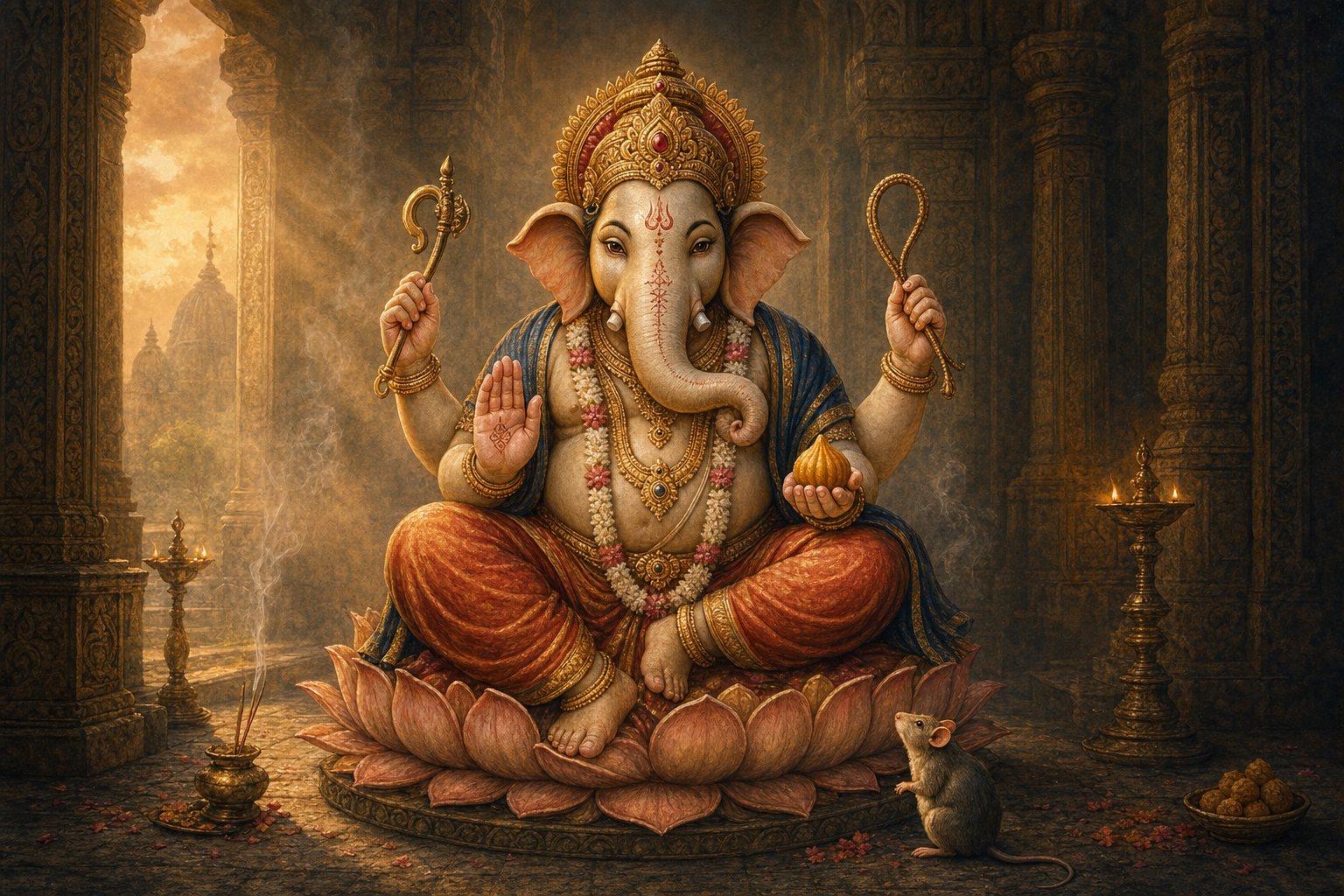
You may approach Ganesha before beginning a journey, a course of study, a business decision, or a difficult conversation. Then your eye drops from the immense elephant-headed form to the tiny mouse beneath him, and an obvious question arises: how can this creature possibly carry him?
The disproportion is the teaching. The mouse represents the quick, acquisitive movement of mind and desire that slips through small openings and carries attention away. Ganesha above it represents the discriminating intelligence that can give those impulses a dharmic direction. The image does not ask you to destroy the mouse. It shows you how to stop letting the mouse decide where you go.
What the mouse represents in Ganesha’s iconography
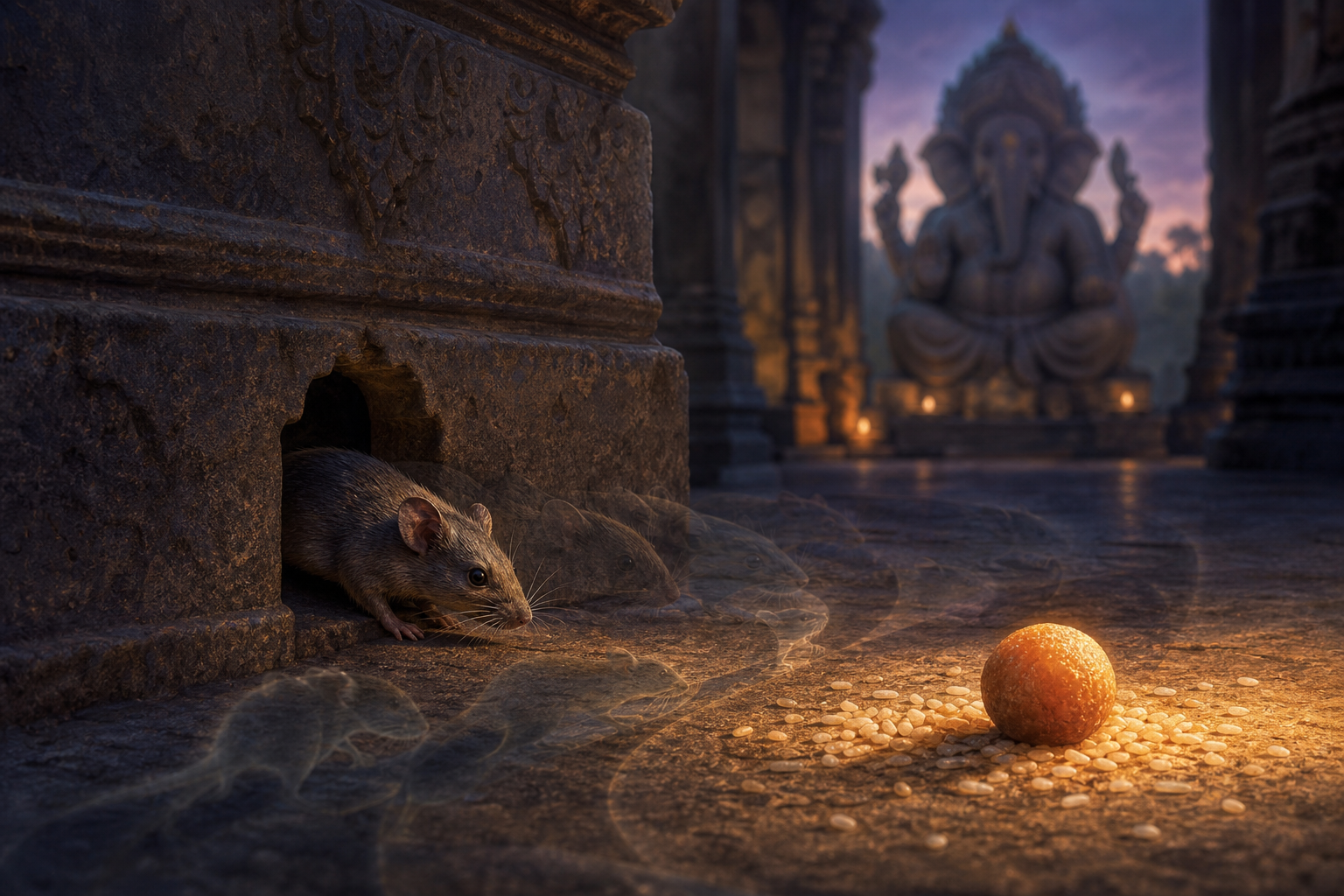
A deity’s vāhana is not simply transportation. In sacred iconography, the vehicle identifies an energy that the deity governs, steadies, and puts to purposeful use. Ganesha’s mouse is therefore part of the meaning of the whole form, not an amusing accessory placed beside it.
The Sanskrit names mūṣika and mūṣaka are associated with the verbal root muṣ, meaning to steal. The symbolism becomes immediately practical when you ask what the mouse steals from you. It may take the attention you meant to give to prayer, the patience you needed in a conversation, or the resolve behind a promise. It rarely announces the theft. It nibbles away through another notification, another imagined argument, another comparison, or another unnecessary acquisition.
This symbolism becomes clearer when three mental functions are distinguished. Manas is the responsive mind that receives impressions and moves among sense objects. Buddhi is the capacity to discriminate, judge, and choose. Ahaṃkāra is the identity-making tendency that turns an experience into a claim about me and mine. These functions cooperate, but they need not lead equally. Ganesha signifies the primacy of steady, integrating intelligence; the mouse depicts manas when it has been captured by sensory novelty, craving, and avoidance.
You can use that distinction as soon as attention scatters. Notice the first impulse: look at this now. Then notice the identity claim that may follow: I must have this, I must answer, or I must prove myself. Finally ask the question of buddhi: What action actually serves my duty and intention? That final question is Ganesha taking his seat.
Why Ganesha rides the mouse instead of banishing it
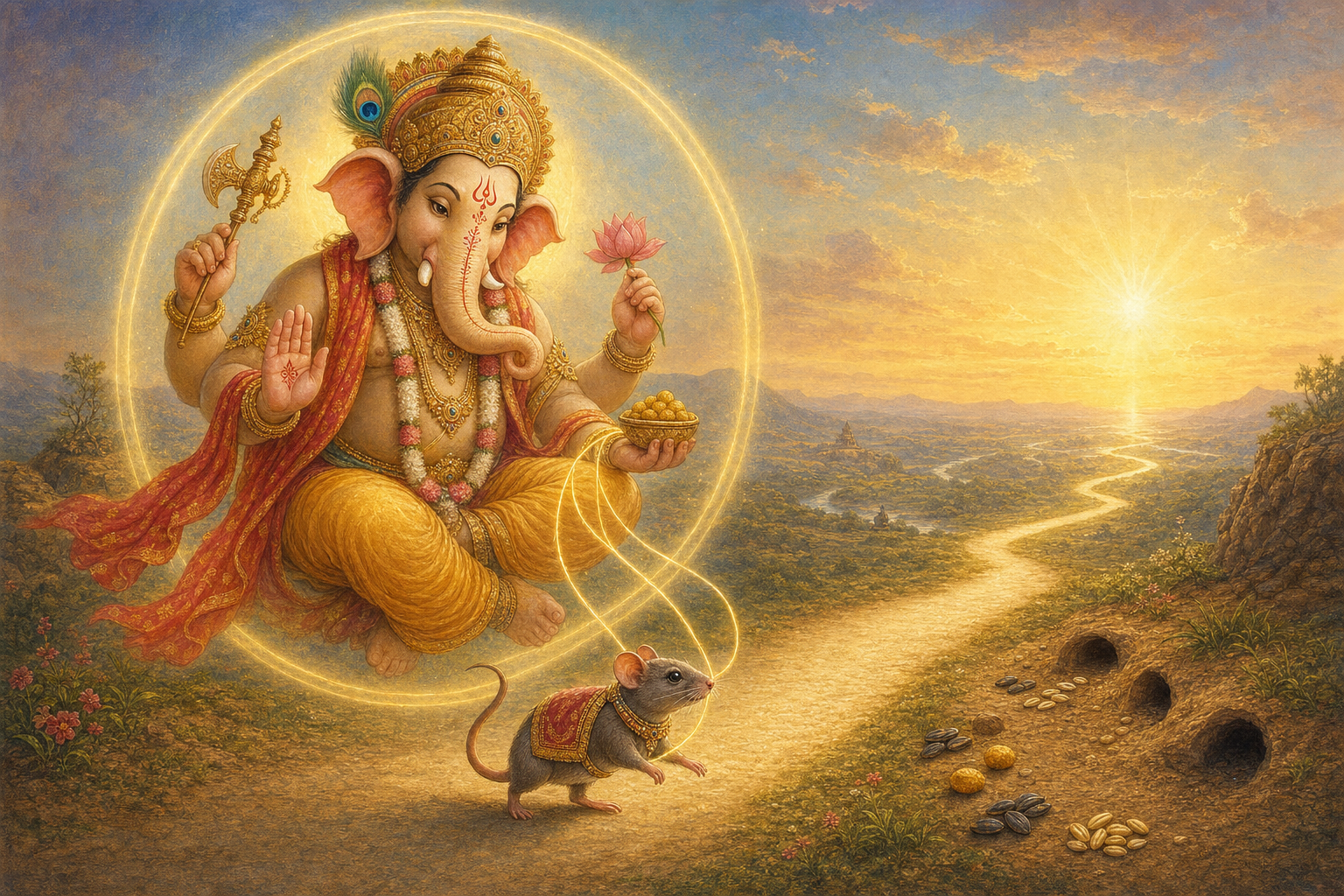
Placement matters. Ganesha does not erase, crush, or flee from the mouse. He rides it. The animal remains alive, alert, and capable beneath the stabilizing presence of wisdom. Spiritual maturity, in this image, is integration rather than mutilation of the inner life.
The mouse is a fitting emblem because its activity resembles the way habits operate. It moves at night and through hidden passages, much as a saṃskāra can influence conduct before you have consciously named it. It gnaws gradually, like a repeated thought that weakens a good resolve. It enters through narrow gaps, like a small exception that becomes a pattern. Its tendency to multiply evokes papañca, the proliferation through which one impression generates a crowd of stories, fears, and imagined outcomes.
The great size of Ganesha beside the small mouse reverses the way distraction feels from inside it. An urge may seem enormous while it is happening, but the icon restores proportion: the urge is small when placed beneath awakened intelligence. This does not mean it is harmless. A small creature can still consume the grain in a storehouse. It means that you should govern an impulse without mistaking it for your entire self.
Key takeaways
- The mouse represents restless, acquisitive impulse, not the whole mind and not an inherently evil creature.
- Its association with stealing points to the quiet loss of attention, resolve, and clarity.
- Ganesha above the mouse shows buddhi directing manas toward dharma.
- The living vāhana teaches restraint and redirection rather than hatred of desire.
- The size contrast asks you to restore proportion when a passing urge feels overwhelmingly important.
Read the mouse together with Ganesha’s other attributes
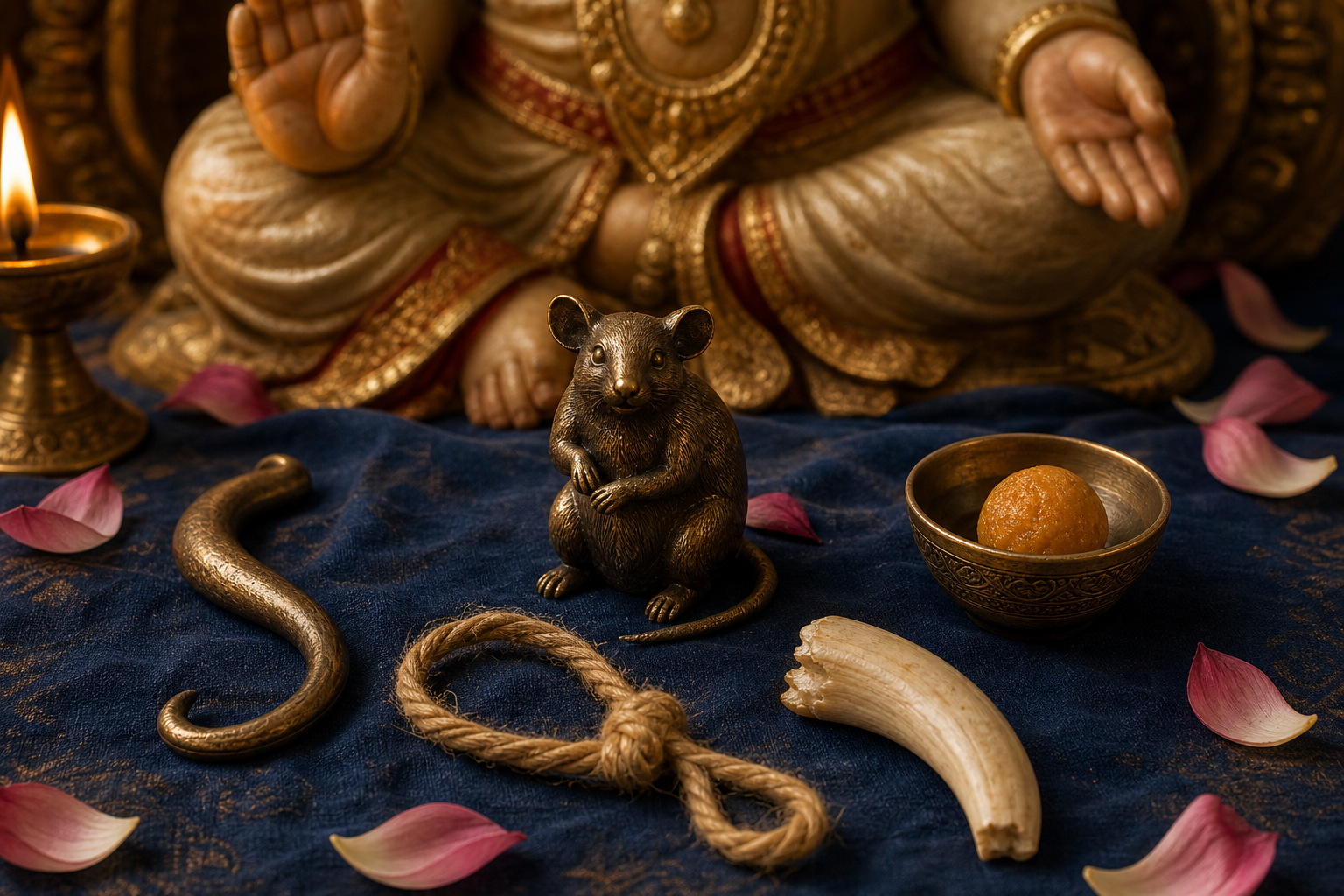
The mouse yields only part of the teaching. Ganesha’s implements and bodily features show what mastery of the restless mind requires. Read together, they form a compact map of sādhana:
- The goad, or aṅkuśa: Direct attention when it wanders. In practice, this is the firm return to your mantra, duty, or chosen object without staging an argument with every distraction.
- The noose, or pāśa: Set a boundary around what repeatedly pulls you away. A boundary may be as ordinary as removing the phone from the place where you pray, study, or speak with your family.
- The single tusk, or ekadanta: Accept the sacrifice involved in one-pointedness. You cannot follow every possibility and still give yourself wholly to one worthy undertaking.
- The modaka: Remember that discipline has an inward sweetness. Contentment becomes perceptible when compulsive seeking no longer consumes every quiet interval.
- The large ears: Listen before reacting. This is especially important when the mouse appears as the urge to interrupt, defend an identity, or prepare a reply while another person is still speaking.
- The flexible trunk: Match the response to the obstacle. The same intelligence must sometimes handle a heavy responsibility and sometimes notice a very subtle habit.
The goad and noose belong together. Direction without restraint leaves too many openings for the old habit. Restraint without direction produces an empty prohibition and often intensifies fixation. Ganesha’s icon supplies both movements: gather attention toward what matters, then loosen its attachment to what does not.
This iconography should not be flattened into a rigid dictionary in which every image has one meaning everywhere. The Mudgala Purāṇa describes eight forms of Ganesha, with variations in the vehicles associated with particular forms. Regional images also emphasize different gestures and implements. The mouse remains a powerful and enduring reading, but Hindu sacred art permits layers of theological, ritual, and psychological meaning rather than demanding a single exclusive gloss.
Turn the symbol into a practice when attention scatters
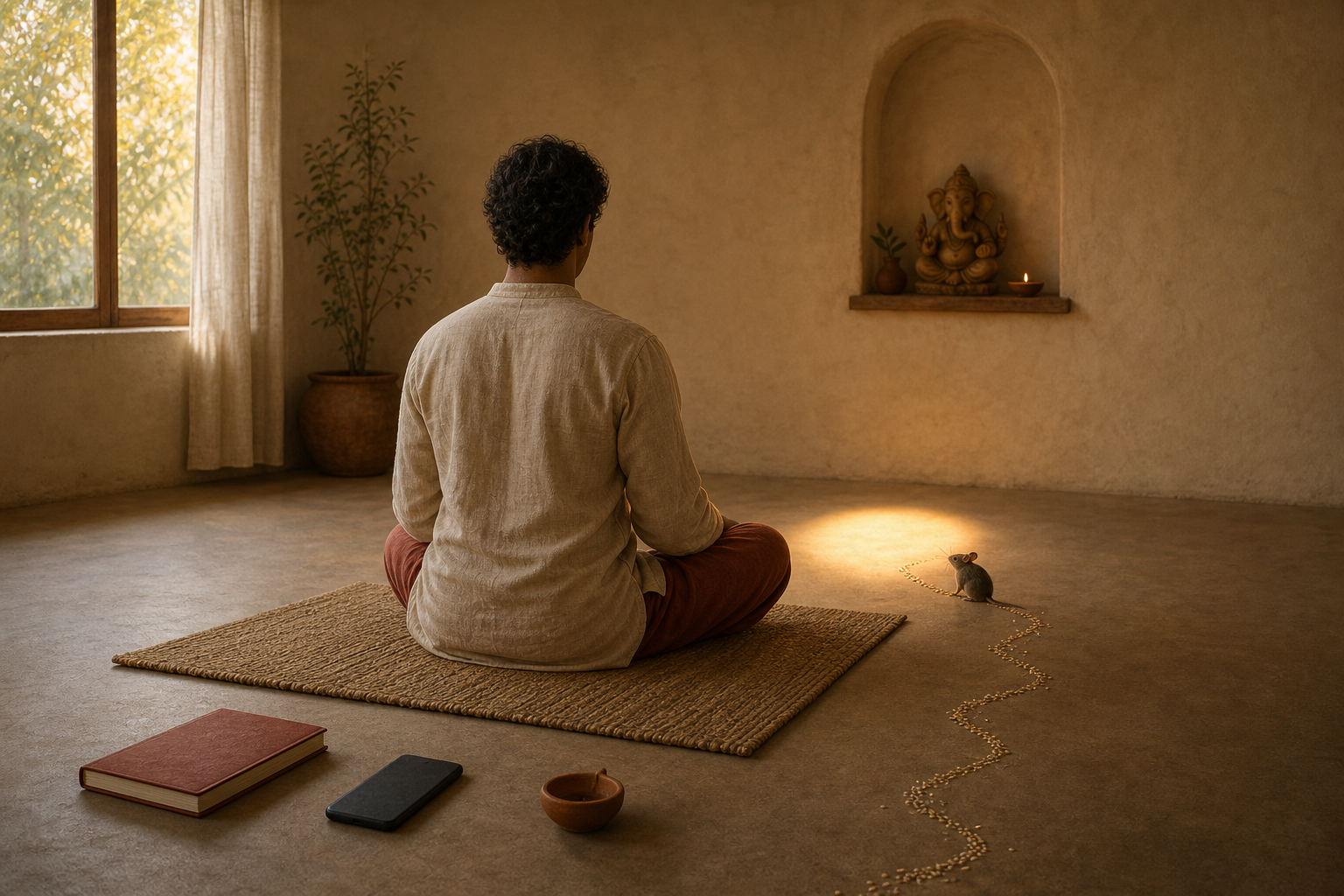
You do not have to wait for an elaborate ritual to work with this image. Use the following sequence before a task that matters, or whenever you notice that worry, craving, or digital distraction has begun to consume your intention.
- Name the obstacle precisely. Avoid a vague statement such as my mind is bad. Say what is happening: I am repeatedly checking for a response, I am rehearsing a quarrel, or I am avoiding the first step.
- State a saṅkalpa. Form one short intention that describes the action you will take now. Keep it close enough to perform: I will read this page attentively is more useful than I will become perfectly focused.
- Settle the body and breath. Let the breath become gentle and unforced before beginning japa. If nāḍī-śodhana is already part of your established practice, it can serve as preparation; unfamiliar breath control is not required for this contemplation.
- Use Ganesha mantra as an anchor. Repeat ॐ गं गणपतये नमः (Om Gam Ganapataye Namaha) with attention on the sound. When thought runs elsewhere, the practice is the return, not irritation at having wandered.
- Visualize the relationship, not a battle. Imagine the mouse becoming steady beneath Ganesha. Let the aṅkuśa represent the gathering of scattered attention and the pāśa the release of grasping. The impulse is acknowledged, contained, and given another direction.
- Make the boundary physical. Close the unused screen, move the tempting object, postpone the reactive message, or prepare the single book or tool needed for the saṅkalpa. An inner resolution becomes stronger when the environment stops reopening the same doorway.
- Begin the chosen action. Do not wait for every distracting thought to disappear. The mouse can remain present without being permitted to lead.
This is also a useful way to understand Ganesha as Vighneśvara, lord of obstacles. Invoking him is not a demand that circumstances obey your preference. Sometimes the obstacle revealed by prayer is your own divided intention, careless speech, or attachment to a particular outcome. The practice becomes real when remembrance changes your next action.
Let the mouse reveal where your discipline is still porous
The mouse usually enters through a small opening rather than the front door. Look for the similarly small permissions through which your attention leaks. The useful question is not merely Am I disciplined? It is Where does my stated intention repeatedly lose authority?
- At a screen: State why you are opening the device before you touch it. If you cannot name the purpose, the movement may already belong to the mouse.
- In speech: Watch for the urge to answer before listening. Let Ganesha’s ears govern the mouse-like need to seize the conversation.
- In consumption: Use aparigraha, non-grasping, to distinguish a real use from the temporary relief of acquiring something.
- In conflict: Let ahiṃsā restrain the wish to injure and satya restrain the wish to manipulate. Mastery of impulse is not permission to control another person.
- In work or study: Choose the next visible duty and protect it from competing possibilities. Ekadanta reminds you that concentration always excludes something.
- In pūjā: Allow mantra, offering, ārati, and silence to gather attention instead of rushing through the sequence. The ritual movement from dispersion to presence is itself part of the teaching.
The broader dharmic family recognizes this problem through distinct disciplines. Yoga joins abhyāsa, sustained practice, with vairāgya, non-grasping. Buddhist mindfulness and concentration train attention without declaring war on every arising thought. Jain gupti restrains body, speech, and mind under the discipline of ahiṃsā. Sikh practice addresses haumai and the fickle mind through nām simran and sevā. These are not interchangeable theologies, and Ganesha should not be assigned indiscriminately to every tradition. They do, however, share a practical recognition: freedom requires impulse to serve a higher orientation rather than rule it.
Keep the symbolism from collapsing into a slogan
- Do not equate the mouse with absolute evil. A vāhana is a governed power. Curiosity, appetite, quickness, and sensitivity can all become useful when they are directed.
- Do not confuse mastery with suppression. Forcing yourself not to think about an impulse may keep attention fastened to it. Name it, contain its expression, and return to the chosen object.
- Do not treat mantra as a transaction. Japa that leaves conduct unchanged has missed the icon’s demand. The noose must become a boundary, the goad a return, and the single tusk a real choice.
- Do not insist on one exhaustive interpretation. Sacred symbols carry several related meanings across texts, sects, artistic regions, and contexts of worship. A psychological reading can illuminate the image without exhausting its devotional significance.
When you next bow before Ganesha, name one thing that is quietly nibbling at your intention. Give it a boundary, state the dharmic action in front of you, and begin. The mouse does not have to disappear before you move; it only has to stop choosing the direction.
References
