
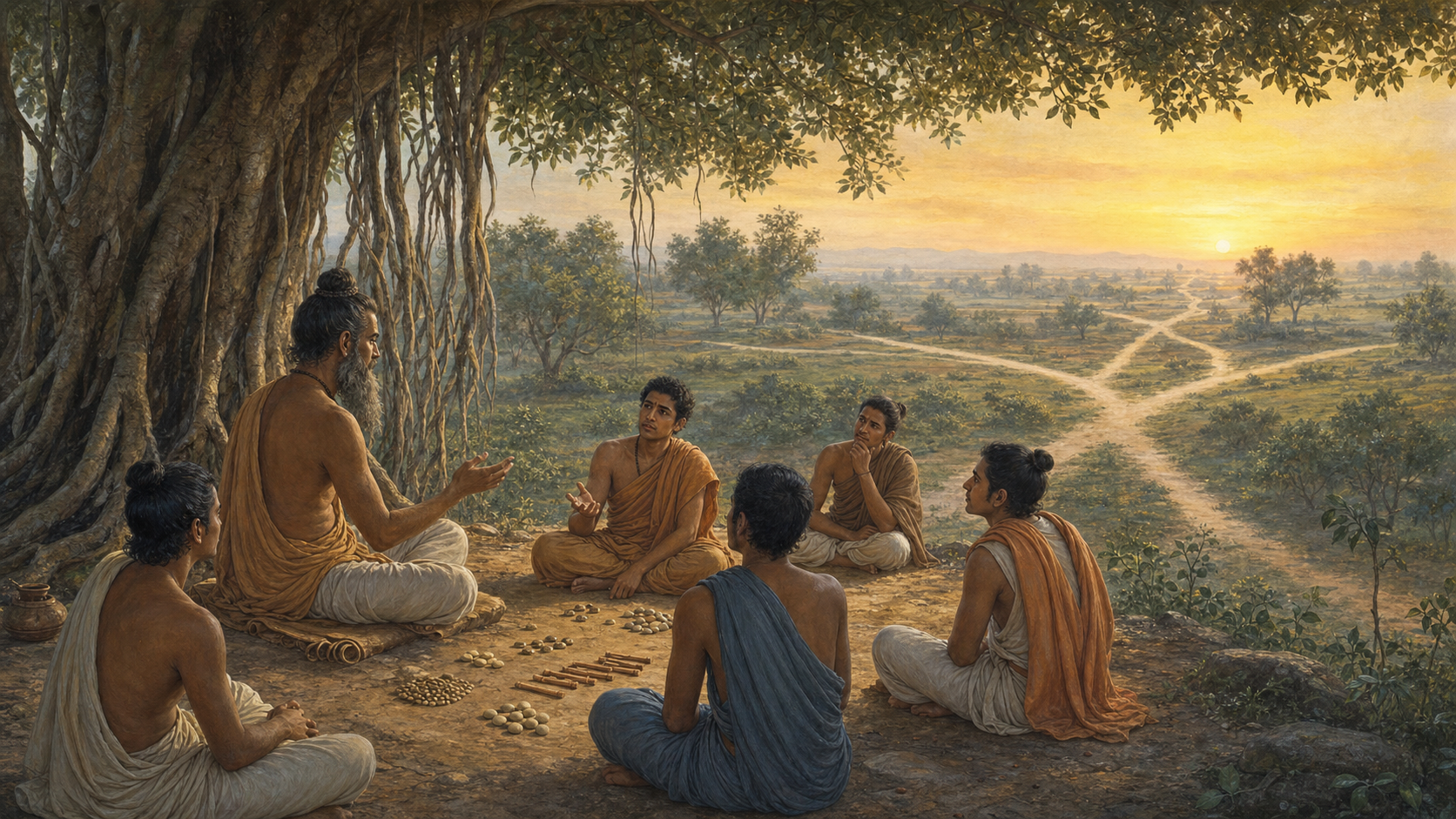
If you have encountered Panchashikha only as a name in a teacher lineage, the obvious question is whether he actually changed Samkhya or merely passed it on. The most useful answer lies between those alternatives: he matters because he stands at the point where inherited wisdom was becoming an organized philosophical discipline.
That changes how you should read the history of Samkhya. A darshana does not ordinarily appear as a finished system in a single moment. Its decisive figures receive teachings, clarify their implications, arrange them for instruction, and make them durable enough to survive transmission. Panchashikha represents that formative work.
Why Panchashikha is more than a name in a lineage
Panchashikha is remembered as an author, scholar, and major disciple in the Samkhya lineage, occupying the transition between ancient Vedic wisdom and systematized classical philosophy. Each part of that description matters.
Calling him a disciple places him inside a living chain of instruction. Calling him a scholar indicates that transmission involved reflection and explanation, not mechanical repetition. Calling him an author points toward a further stage in which teachings could be formulated beyond the immediate encounter between guru and shishya. His importance therefore rests in the combination of continuity and intellectual development.
This is the first distinction to keep in view: preserving a tradition and developing it are not opposites. In a serious philosophical lineage, preservation requires interpretation. A teacher must decide which distinctions are essential, how one proposition follows from another, which objections need answers, and how a student can move from memorized terms to direct understanding. That work can shape a system even when the teacher does not claim to have invented it.
You should therefore resist two misleading pictures. Panchashikha was neither an isolated founder creating Samkhya from nothing nor an inconsequential messenger carrying an unchanged package. His more credible place is that of a formative intermediary: rooted in what came before him, yet helping prepare the conceptual ground on which classical Samkhya could stand.
What it means for wisdom to become a philosophical system
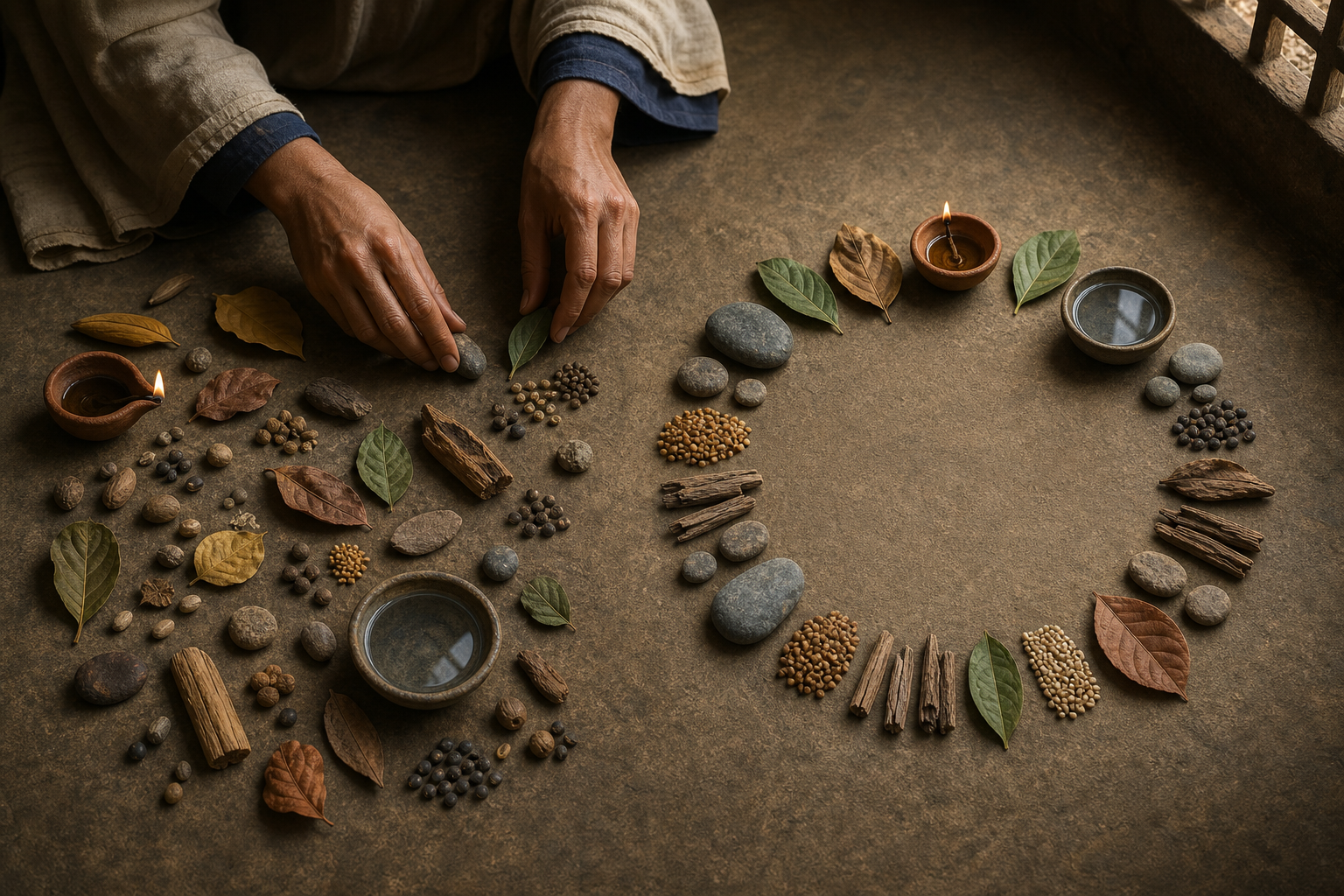
The transition from wisdom teaching to darshana is not a rejection of spiritual purpose. It is a change in precision. A teaching becomes a philosophical system when it states its central problem clearly, distinguishes its fundamental principles, explains experience through an ordered account, answers rival possibilities, and connects knowledge to liberation.
In mature Samkhya, the governing distinction is between Purusha and Prakriti. Purusha is consciousness: the witness for whom experience appears. Prakriti is the dynamic but unconscious ground of manifested experience, including intellect, ahankara or the sense of individuality, mind, the senses, and the material elements. This distinction is not merely a theory about what exists. It diagnoses why bondage occurs and how freedom becomes possible.
The ordinary person treats the changing contents of Prakriti as the self. Bodily conditions, thoughts, emotions, preferences, social identities, and the assertion of “I” all become entangled with the witnessing consciousness. Samkhya responds with discriminative knowledge: learn to distinguish the seer from everything seen, including the most intimate movements of the mind.
This is why Samkhya’s analysis of categories matters. The categories are not a collection of metaphysical curiosities. They form a map of experience. By tracing how intellect, ahankara, mind, sensation, and material embodiment belong to Prakriti, the student learns not to mistake any changing function for Purusha.
A transitional thinker contributes to such a system by making its internal order easier to see. The key questions become sharper: What is conscious? What changes? What acts? What experiences? Why does the witness seem bound by processes that belong to nature? What kind of knowledge ends that confusion? Once those questions are arranged around stable distinctions, a spiritual insight can be taught as a coherent darshana.
Read Panchashikha through function, not unsupported detail
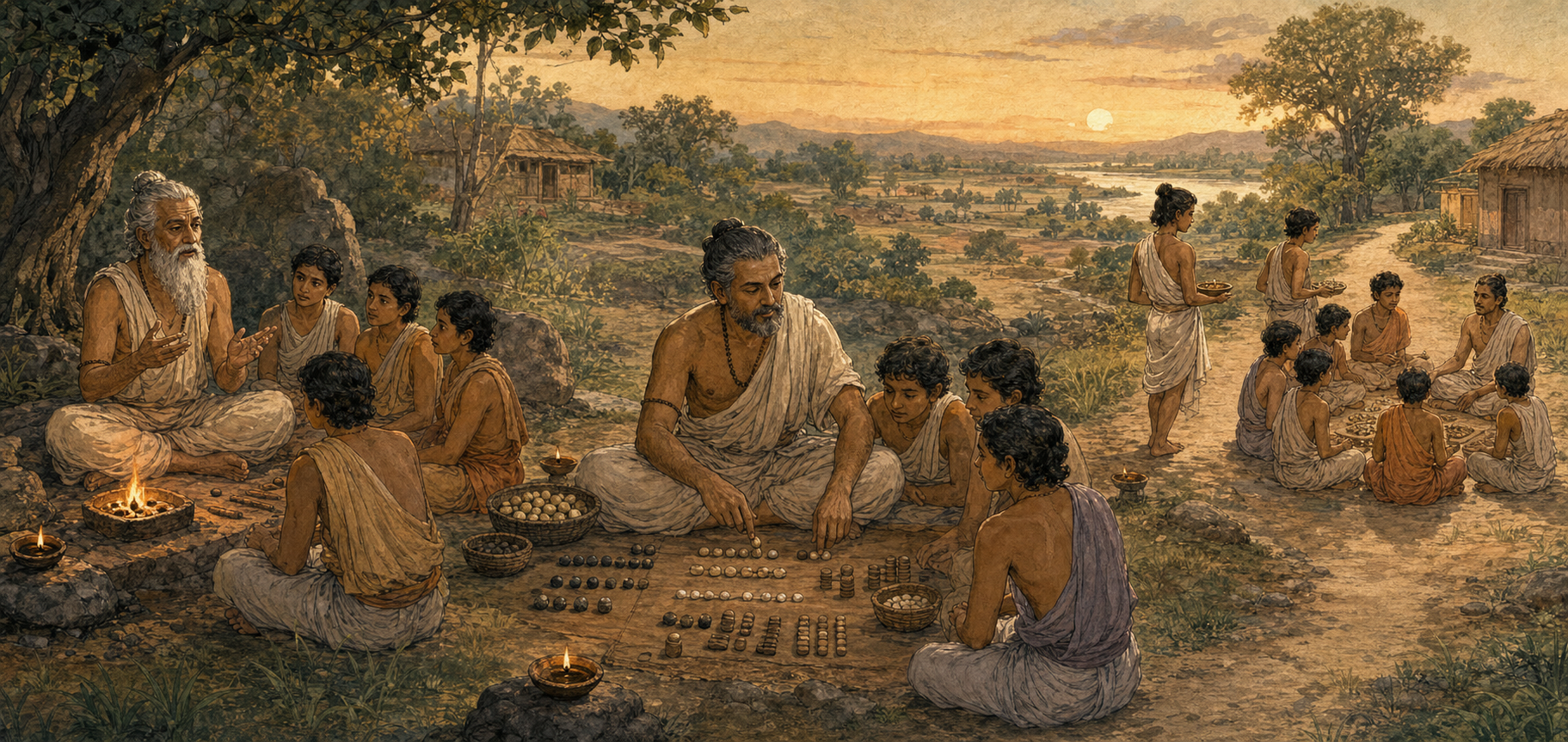
The historical record available to an ordinary reader may tempt you in opposite directions. One temptation is to inflate a respected name with precise dates, titles, quotations, and doctrines that have not been securely established. The other is to dismiss anyone who cannot be reconstructed like a modern academic author. Neither approach helps you understand how Dharmic knowledge traditions developed.
A more disciplined method is to ask what position the lineage assigns to Panchashikha and what intellectual function that position implies. The secure point is his transitional importance within Samkhya. From there, you can recognize three dimensions of his role without pretending that every feature of later classical Samkhya originated with him.
- Continuity: he belongs to a received line of instruction, so his philosophical activity begins within an inheritance rather than outside it.
- Clarification: his identity as a scholar indicates the reasoned articulation of teachings, the work by which inherited insights become intelligible as a connected whole.
- Transmission: his identity as both disciple and author links person-to-person teaching with forms capable of reaching later students.
This functional reading also prevents a common historical mistake: attributing the complete mature system to whichever early teacher appears in the lineage. Philosophical schools grow through accumulated teaching, debate, interpretation, and organization. Panchashikha’s stature does not require us to claim that he personally formulated every later doctrine. His importance is substantial precisely because system-building is cumulative.
When you encounter a confident claim about him, test it in stages. Is it a claim about his place in the lineage, a claim about a teaching associated with him, or a claim about the exact wording and date of a particular work? Those are different levels of certainty. Do not let confidence at the first level silently become certainty at the third.
Key takeaways
- Panchashikha matters chiefly as a formative link between inherited Samkhya wisdom and its classical systematization.
- His status as disciple, scholar, and author shows that lineage transmission can include genuine philosophical development.
- The central movement of Samkhya is practical as well as metaphysical: distinguish conscious Purusha from changing Prakriti.
- Samkhya’s categories should be read as a map for identifying what belongs to nature, not as a list to memorize without purpose.
- Respect for Panchashikha does not require assigning the entire mature system to him or filling gaps with unsupported precision.
A practical way to study his contribution

If your aim is to understand Panchashikha rather than merely remember his name, begin with the architecture of Samkhya and then return to his historical position. This keeps the philosophy in view while preventing later ideas from being carelessly projected backward.
- Start with the human problem. Ask how confusion between consciousness and the changing contents of experience produces bondage.
- Mark the fundamental distinction. Keep Purusha and Prakriti separate before studying the more detailed categories. If that distinction becomes blurred, the rest of the system turns into vocabulary without direction.
- Follow the functions of Prakriti. Notice how intellect, ahankara, mind, senses, and embodiment account for the experience you ordinarily call “me.”
- Return every category to liberation. Ask how identifying a function as part of Prakriti weakens the mistaken identification of Purusha with it.
- Place Panchashikha at the transition. Look for the work of preservation, clarification, and teachable organization instead of searching only for a single dramatic invention.
This reading sequence gives you a better measure of his achievement. The question is not simply, “Which doctrine did Panchashikha invent?” Ask instead, “What had to happen for Samkhya to become a durable, reasoned path of knowledge?” His place in the tradition becomes clearer when the second question guides the first.
On your next reading, take one Samkhya distinction and test it against experience: a thought changes, an emotion changes, the body changes, and ahankara claims each change as “I” or “mine.” Then ask what is aware of that movement. That exercise will not settle every historical question about Panchashikha, but it will show you why the philosophical tradition he helped transmit was worth systematizing.
References
