
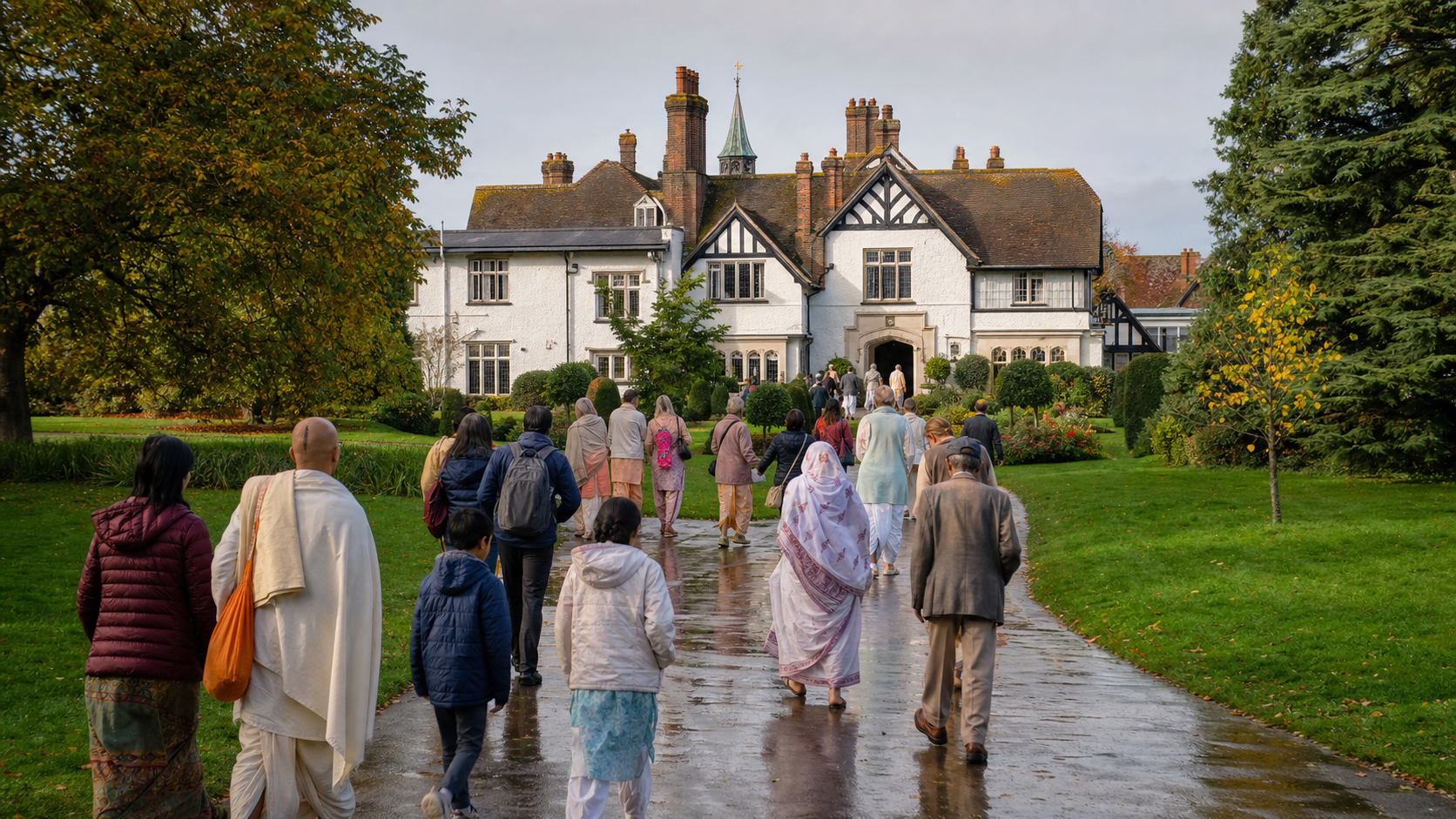
You want to spend a Sunday at Bhaktivedanta Manor, but perhaps you do not know the programme, the etiquette or how much of the worship you should join. The most useful preparation is not learning to imitate experienced devotees. It is knowing how to arrive attentively, participate without pretence and let the visit become more than a pleasant excursion.
Approach the Manor as a place of worship first. A peaceful Sunday at the Hare Krishna temple in Watford can include sound, movement, families and shared devotion; peace here need not mean silence. It means giving your attention to Krishna instead of allowing the day to become another item on an itinerary.
Confirm the practical details before you travel
Do not build your journey around an assumed timetable. Temple programmes, access arrangements and special observances can change. Check directly with Bhaktivedanta Manor for the date you intend to visit, especially if you are travelling a long distance, bringing children, accompanying someone with limited mobility or hoping to attend a particular part of the worship.
Your pre-visit check should answer these practical questions:
- What is happening on that particular Sunday, and when should visitors arrive?
- Are there instructions for parking, public transport or entering the grounds?
- What accessibility arrangements are available for the person travelling with you?
- Will prasada be served, and must any meal or event be booked?
- Are photography, filming or large bags restricted in any worship area?
- Is there a special festival, ceremony or altered programme that day?
This check matters because arrival friction follows you into the temple. If you are searching for an entrance, worrying about a missed programme or negotiating an unexpected restriction, your body may be present while your mind remains outside. Resolve what you can before leaving home and allow unhurried time for the final approach.
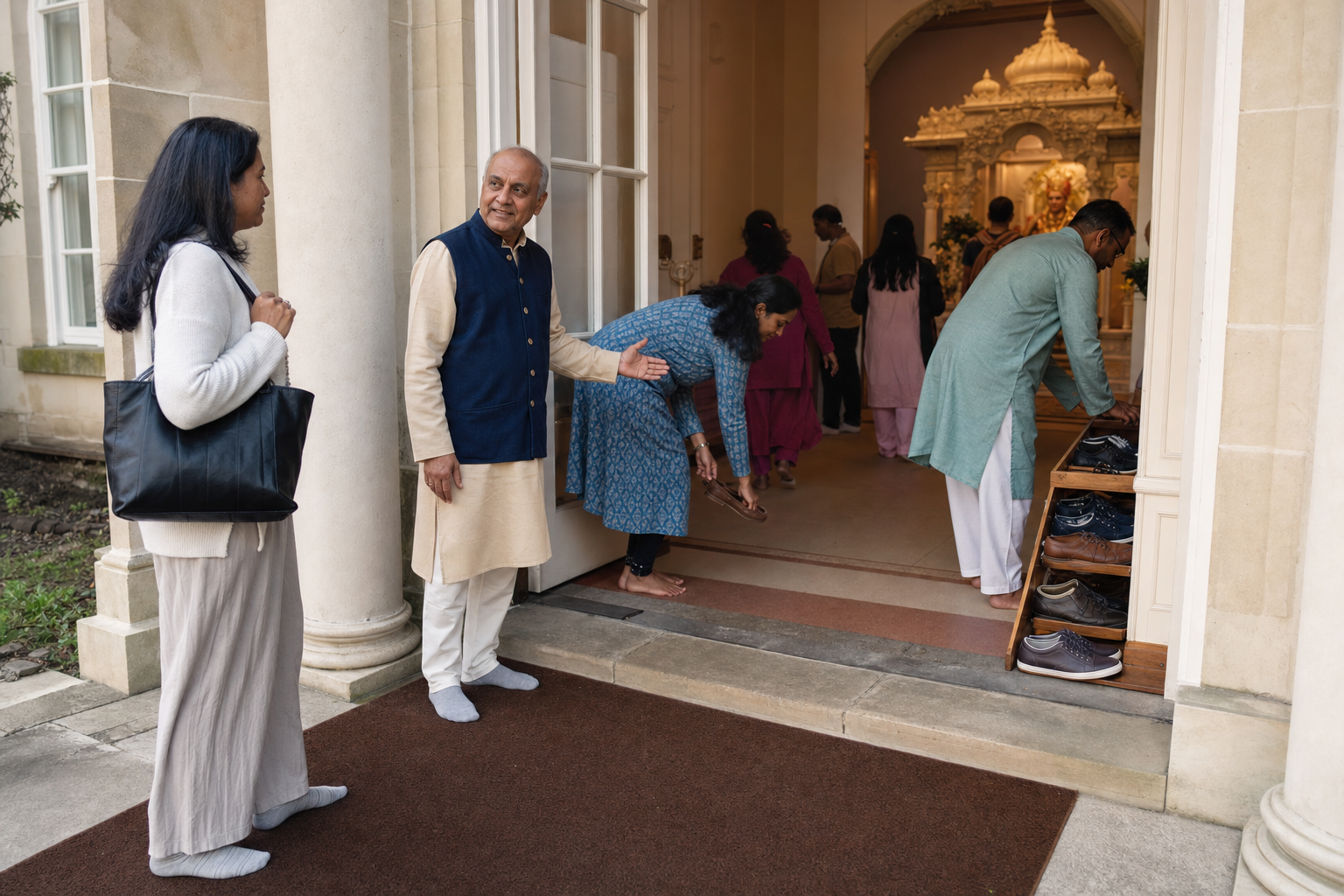
Wear clean, modest clothing that lets you sit, stand and move comfortably. You do not need ceremonial dress merely to look as though you belong. Bring fewer possessions, silence your phone before entering the worship space and look for local instructions about footwear rather than assuming every area follows the same rule.
Enter as a participant, even if you mostly observe
There is an important difference between being unfamiliar and being disengaged. You can be new to every gesture and still participate through attention. Conversely, you can reproduce the gestures around you while thinking about photographs, messages or the journey home.
A simple sequence will help you cross that gap:
- Pause before entering and remember why you came. Put the intention into a plain sentence, such as seeking Krishna, offering gratitude or learning how bhakti is practised.
- Observe the room before choosing where to stand or sit. Notice the flow of worship and avoid blocking entrances, pathways or another devotee’s view.
- Follow explicit instructions from temple volunteers and take behavioural cues from the congregation without copying every physical gesture automatically.
- Join congregational responses when you feel comfortable. If you do not know the words, listen for the repeated phrase and respond when you can.
- When you are uncertain, remain respectfully still or ask a volunteer at a suitable moment. Quiet observation is better than anxious imitation.
Bowing, raising the hands, sitting on the floor and other embodied expressions may carry devotional meaning for the person performing them. They are not an entrance examination for you. Let your outward action match your actual understanding. Respect does not require you to claim a conviction you have not yet formed.
The same principle applies to children. Explain before entering that this is sacred space, identify where your family will regroup if separated and keep young children close enough that you can guide them without repeatedly calling across the room. If a child becomes overwhelmed, stepping out calmly protects both the child and the worship around you.
Understand what you are seeing, hearing and receiving
Hare Krishna worship places devotion at the centre. The details matter, but you do not need to master an entire theology before your visit. Recognising the purpose of several common practices is enough to keep you from mistaking worship for entertainment.
Kirtan is prayer through shared sound
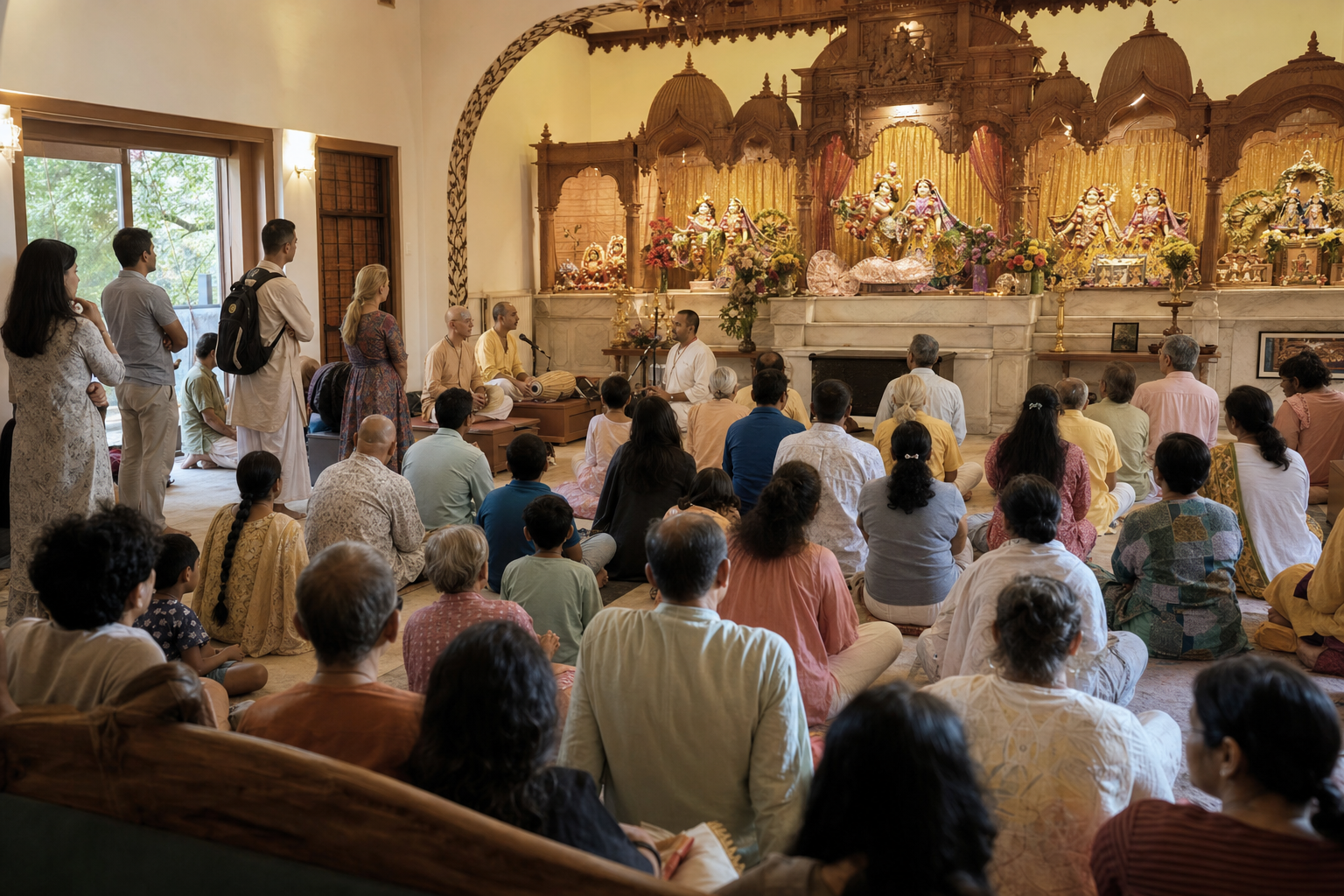
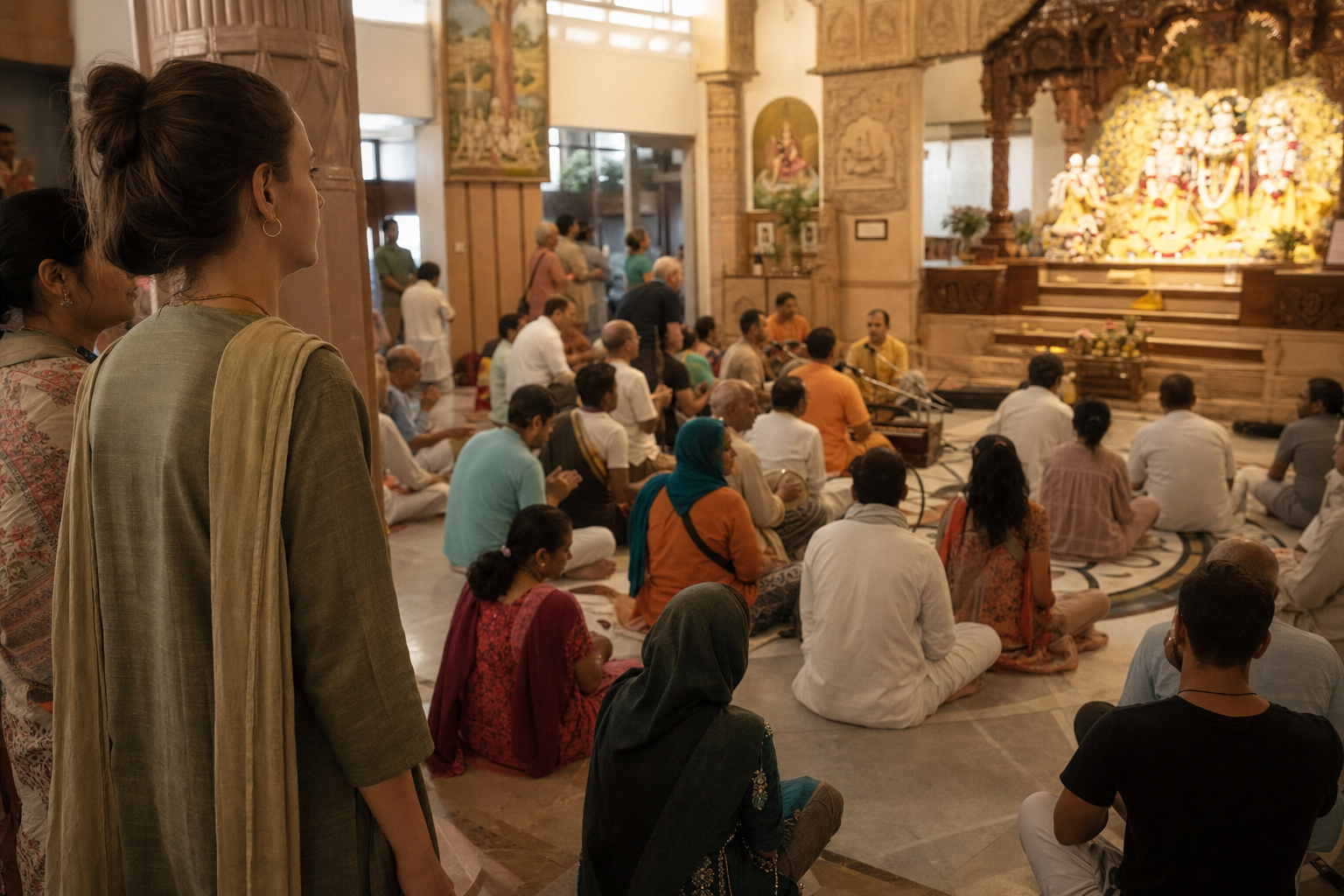
Kirtan is congregational chanting, often in a call-and-response form. The leader offers a line and the congregation repeats it. Instruments, rhythm and movement support remembrance; they are not there merely to produce a musical performance.
If you know the response, chant it. If you do not, listen until its pattern becomes clear. Pronunciation can improve through attentive repetition, so do not mumble rapidly just to keep pace. You may also stand quietly and listen. What matters is whether your attention follows the holy name rather than wandering toward the people around you.
Darshan asks you to look with devotional attention
Darshan is more than viewing sacred images as objects. In the devotional setting, it means approaching the Deities with reverence and making yourself available to the Divine presence. That changes how you look. Instead of scanning decorations and immediately reaching for a camera, stop and give the encounter your undivided attention.
You do not need to manufacture an emotional experience. Notice the impulse to hurry, analyse or compare, and let it settle. Offer a prayer in words natural to you, or simply remain present. A quiet, honest moment of attention is more substantial than an elaborate gesture performed for appearance.
Arati is an offering, not a spectacle
During arati, sacred articles such as a lamp may be offered to the Deities while the congregation chants. The movement has ritual purpose. Keep pathways clear, avoid holding a phone above other worshippers and watch how the congregation receives any offered element. If you are unsure what to do, allow others to proceed and follow only when the action is clear.
Prasada should be received with care
Prasada is food offered to Krishna and then shared. Receive it as sanctified food, not as a restaurant sample or an entitlement attached to attendance. Follow the serving arrangements, take only what you can finish and leave the eating area as orderly as you found it.
Its sacred status does not identify its ingredients. If you have an allergy or another serious dietary restriction, ask an appropriate member of staff about ingredients before eating; do not infer that a vegetarian preparation is automatically safe for you. If reliable confirmation is unavailable, the safe choice is not to consume the uncertain item.
First-visit questions you may be reluctant to ask
Do I have to join every chant and gesture?
No. Join what you understand and can do sincerely. During an unfamiliar response or ritual action, attentive observation is a valid way to learn. Do not interrupt worship to ask for a running explanation; save detailed questions for a volunteer or devotee who is free to speak afterward.
What if I am not Hindu or not an ISKCON devotee?
You should not pretend to hold an identity or commitment that you do not claim. Enter as a respectful guest, observe the temple’s instructions and participate only to the degree that is honest for you. If you are unsure whether a particular event or area has attendance conditions, confirm that with the Manor before travelling.
May I photograph the Deities or the worship?
Do not assume permission. Check current signage or ask a volunteer, because rules may differ by place, occasion and part of the programme. Even where photography is allowed, put worship before image-making: avoid flash, do not obstruct another person’s darshan and never photograph a stranger closely without consent.
What should I do if I make a mistake?
Correct it quietly when you notice it. Move out of a pathway, lower the phone, stop an inappropriate conversation or ask where an item belongs. A brief, sincere correction usually shows more respect than a long explanation that draws further attention away from worship.
Carry one part of Sunday into the coming week
A temple visit can produce a temporary sense of elevation because the setting supports attention: the sacred space, congregational chanting and visible devotion all point in the same direction. Your ordinary week will not organise itself that way. If you want the Sunday to bear fruit, choose a practice that remains possible when the atmosphere changes.
Before leaving, decide what you will carry home. You might chant the Hare Krishna maha-mantra at a regular point in your day, read a small portion of Vaishnava teaching, offer your food prayerfully or protect a quiet period from your phone. Make the practice definite enough that you will know whether you did it, but modest enough that you can continue without depending on a special mood.
Also identify the moment that held your attention most strongly. Was it the congregational response, the darshan, the arati, the prasada or the conduct of another devotee? Do not turn that moment into a demand that every future visit feel the same. Treat it as a clue to the form of bhakti that currently helps you become attentive.
Then choose your next step while the visit is still clear in your mind. Return for worship, ask a sincere question or establish the home practice you selected. A Sunday at Bhaktivedanta Manor becomes spiritually useful when it changes how you meet Monday.

References
