
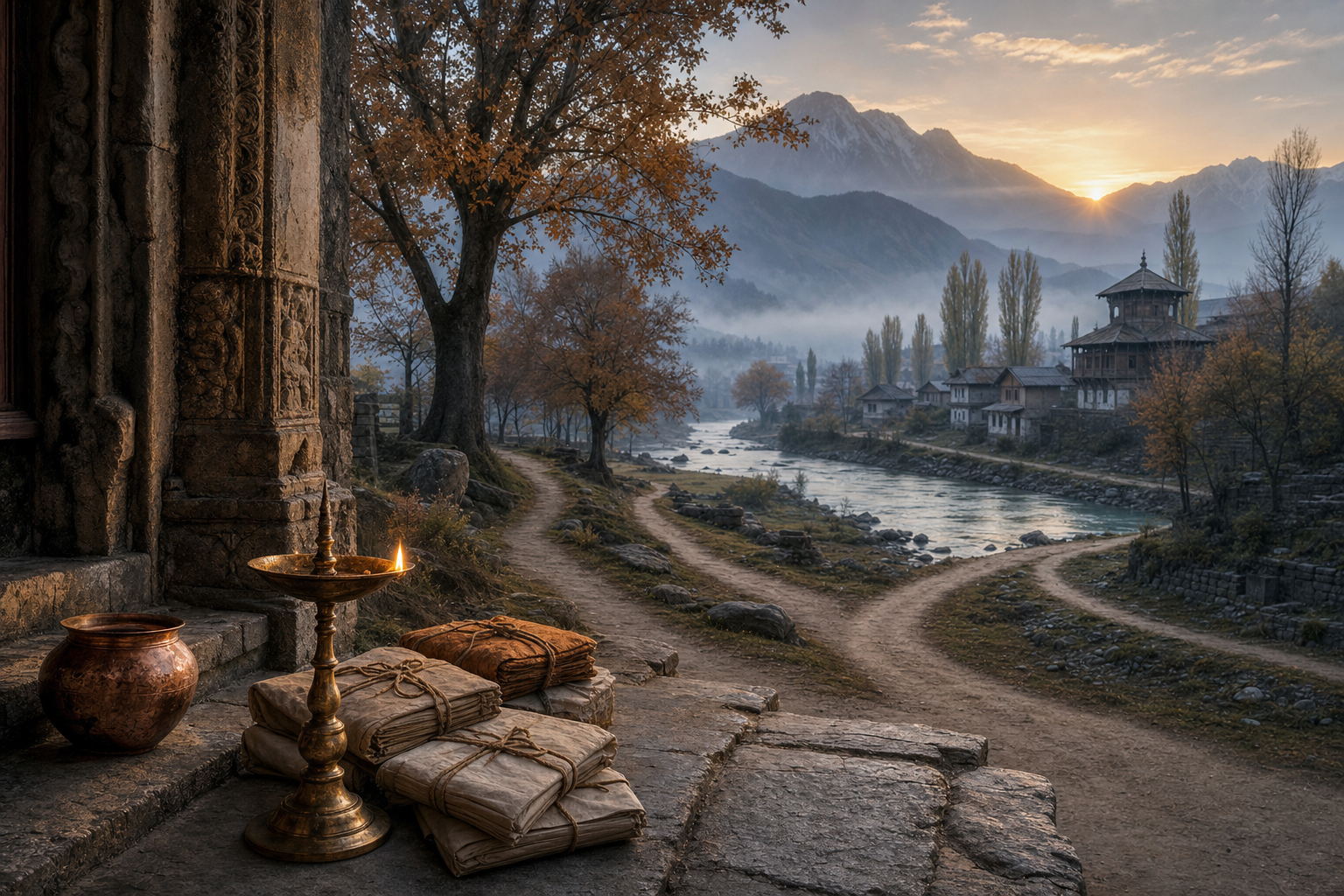
Kashmir’s Hindu heritage is carried not only by old structures or remembered dates, but also by institutions, rituals, family testimony and arguments over what deserves public recognition. The history of Vivekananda Kendra Nagdandi and the competing memories of 13 July 1931 illuminate two sides of that inheritance: continuity created through sustained stewardship, and suffering obscured when a complex past is compressed into a single political narrative.
Read together, the two accounts show that preservation requires more than celebration. It depends on institutional succession, documentary discipline and a willingness to acknowledge state repression, communal violence and minority vulnerability without turning history into collective blame.
Key takeaways
- Nagdandi demonstrates how a small hermitage can become a durable carrier of heritage when spiritual practice is joined to community stewardship, land, succession and public service.
- The history of 13 July 1931 contains more than one morally significant event: demonstrators were killed by Dogra state forces, while Hindu civilians and their property were subsequently attacked.
- Recognising the political and economic grievances behind the anti-Dogra movement does not excuse communal punishment of Kashmiri Pandits, who were a minority rather than the ruling dynasty.
- Disputed dates, land figures and conspiracy claims should be preserved as questions for research instead of being converted into convenient certainties.
- Credible remembrance distinguishes perpetrators from communities and documented events from later political interpretation.
Nagdandi as a living archive of Hindu continuity
The Nagdandi profile places the ashram near Achabal in Anantnag district and describes it as several institutions at once: a place of spiritual retreat, a residential campus, a centre of cultural memory, a platform for service and a site of modern horticultural work. That combination matters because it gives heritage a continuing social function. A shrine or memorial can preserve a location; a functioning institution can also preserve habits, relationships and responsibility.
According to that account, Swami Ashokananda, born Deenabandhu Mukherjee, arrived in Kashmir in 1932. His itinerary reportedly included Kathleshwar Mandir in Srinagar, Nandkeshwar temple at Sumbal and a period of seclusion near the Krishenganga river. The narrative then places him in the wooded Achabal area, where he built three mud huts separately used for residence, cooking and meditation. The spare arrangement is significant: Nagdandi began with disciplined spiritual practice, not with a large institutional plan.
The hermitage became durable through participation by devotees and supporting families. The profile associates members of the Ogra, Katjoo, Dhar and Tarozdar families with its early circle and reports that supporters from Achabal, Anantnag and Srinagar later contributed land. Nag-Panchami came to be observed as the ashram’s foundation day. Through such recurring observance, an origin story ceased to be only a biographical memory and became something successive participants could enact.
Institutional succession was equally important. The Nagdandi article reports that Shree Ramkrishna Mahasammelan Samiti was formed as the work expanded. It also describes a later transition connected with Eknath Ranade, while carefully noting that Vivekananda Kendra was formally founded in 1972. References to Ranade as a Kendra leader during the 1960s therefore project a later institutional identity backward. The account says Swami Ashokananda made a will in 1970, attained nirvana in 1971 and was commemorated through a samadhi on the grounds. In the article’s interpretation, the combination of reverence for the founder and management beyond his lifetime helped the institution endure political violence, displacement and the practical difficulties of maintaining a residential centre in Kashmir.
Why uncertainty is part of responsible preservation
Nagdandi’s history also demonstrates why heritage writing should disclose discrepancies rather than smooth them away. The supplied narrative places Swami Ashokananda’s appearance in the Achabal area in 1941, while institutional materials cited by the Nagdandi article use 1937. Those dates might refer to different stages of arrival, occupation or organisation, but the profile says that no primary deed or contemporaneous diary examined for the article resolved the difference.
The reported land record presents a similar problem. One institutional figure refers to roughly 100 kanals, while a later field report cited in the article refers to 87 kanals. The article also corrects a published conversion of 100 kanals, explaining that a Jammu and Kashmir government reference equates it with 12.5 standard acres, or approximately 5.06 hectares, rather than 12 hectares. Without the underlying revenue records, it does not claim to settle whether the figures concern different parcels, boundaries or stages of demarcation.
These are not minor editorial inconveniences. Foundation dates, land transfers and succession documents help establish how a religious site acquired legitimacy and survived. Preserving uncertainty directs attention toward the evidence still needed: deeds, wills, resolutions, correspondence, visitor registers, photographs and oral testimony. The Nagdandi profile specifically points to the importance of recovering the experiences of women, workers and neighbouring residents as well as those of prominent patrons. Heritage becomes more credible when its archive is broader than its institutional legend.
13 July 1931 and the collision of public memories
If Nagdandi represents memory sustained through institutional continuity, 13 July 1931 represents memory divided by public commemoration. The article on the anniversary reports that many displaced Kashmiri Hindus observe it as Black Day, remembering attacks on Hindu civilians, homes, shops and livelihoods. It contrasts this with the prominent Muslim remembrance of demonstrators killed by Dogra state forces outside Srinagar Central Jail and of the day as a landmark in resistance to autocratic rule.
Neither memory makes the other event disappear. The 13 July account treats the police firing, the deaths among demonstrators and the attacks on Hindu property as widely recorded components of the history. Its central corrective is therefore not to replace one exclusive narrative with another, but to restore the parts that selective commemoration has separated. State violence against a protesting population and communal violence against an exposed minority require distinct judgments, even when they occur within the same historical sequence.
The political background makes that distinction essential. The article traces Dogra sovereignty to 1846 and describes a princely state with concentrated monarchical authority and limited representative participation. It reports that Muslim grievances included poverty, indebtedness, taxation, unequal educational access, limited government employment and restricted political rights. It also notes that the Glancy Commission later treated several grievances as requiring reform. The anti-Dogra movement consequently had substantive political and social foundations.
Yet Kashmiri Pandits were not interchangeable with the Hindu dynasty. As the article stresses, they were a small minority. Although some held visible positions in education and administration, the community was neither uniform nor collectively responsible for government policy. Attacking Hindu civilians converted opposition to a state into punishment of people selected through communal identity. A historically serious account can recognise legitimate demands for reform while refusing to make those demands an alibi for violence against neighbours.
Chronology further restrains retrospective storytelling. The anniversary article reports that educated Muslim networks, including the Reading Room Party, were active before the disturbances, but that the All Jammu and Kashmir Muslim Conference was established only in 1932. The party therefore could not have directed the events of July 1931 as an already constituted organisation. It was renamed the National Conference in 1939. These distinctions do not remove the influence of activists or emerging leaders; they prevent later organisational identities from being imposed upon a movement that the source describes as involving preachers, educated activists, local notables, crowds and people reacting to immediate events and rumours.
Evidence can protect memory from political misuse
Both histories expose the same editorial danger: an institution or political movement can acquire a cleaner retrospective story than the available evidence supports. At Nagdandi, that temptation appears in inconsistent establishment dates, imprecise land conversions and the retrospective use of an organisational title. In the history of 1931, it appears in narratives that isolate either state firing or anti-Hindu violence while suppressing the other.
The anniversary account also distinguishes documented events from more ambitious allegations. It acknowledges that Maharaja Hari Singh adopted a notably nationalist posture at the First Round Table Conference in 1930 and that imperial authorities could exert indirect pressure in princely India. However, it treats claims that British officials designed the July upheaval or planted particular agents as propositions requiring direct archival proof. Local discontent did not need to be invented by an imperial conspiracy, while the existence of local grievances does not rule out colonial intervention where evidence may establish it.
This hierarchy of confidence strengthens rather than weakens Kashmiri Hindu memory. A case grounded in demonstrable attacks, traceable documents and carefully attributed testimony is less vulnerable than one tied to every later allegation. The same standard should govern institutional history: received accounts deserve preservation, but legal succession, landholding and foundation chronology ultimately require the relevant records.
Accuracy also places a boundary around moral responsibility. Naming anti-Hindu violence does not assign inherited guilt to every Kashmiri Muslim, just as acknowledging autocratic rule does not make every Kashmiri Hindu an agent of the Dogra state. Collective blame reproduces the reasoning through which vulnerable civilians become substitutes for rulers, parties or perpetrators. Contested memory becomes more honest when it identifies actions and actors as precisely as the evidence permits.
From inherited memory to a usable public record
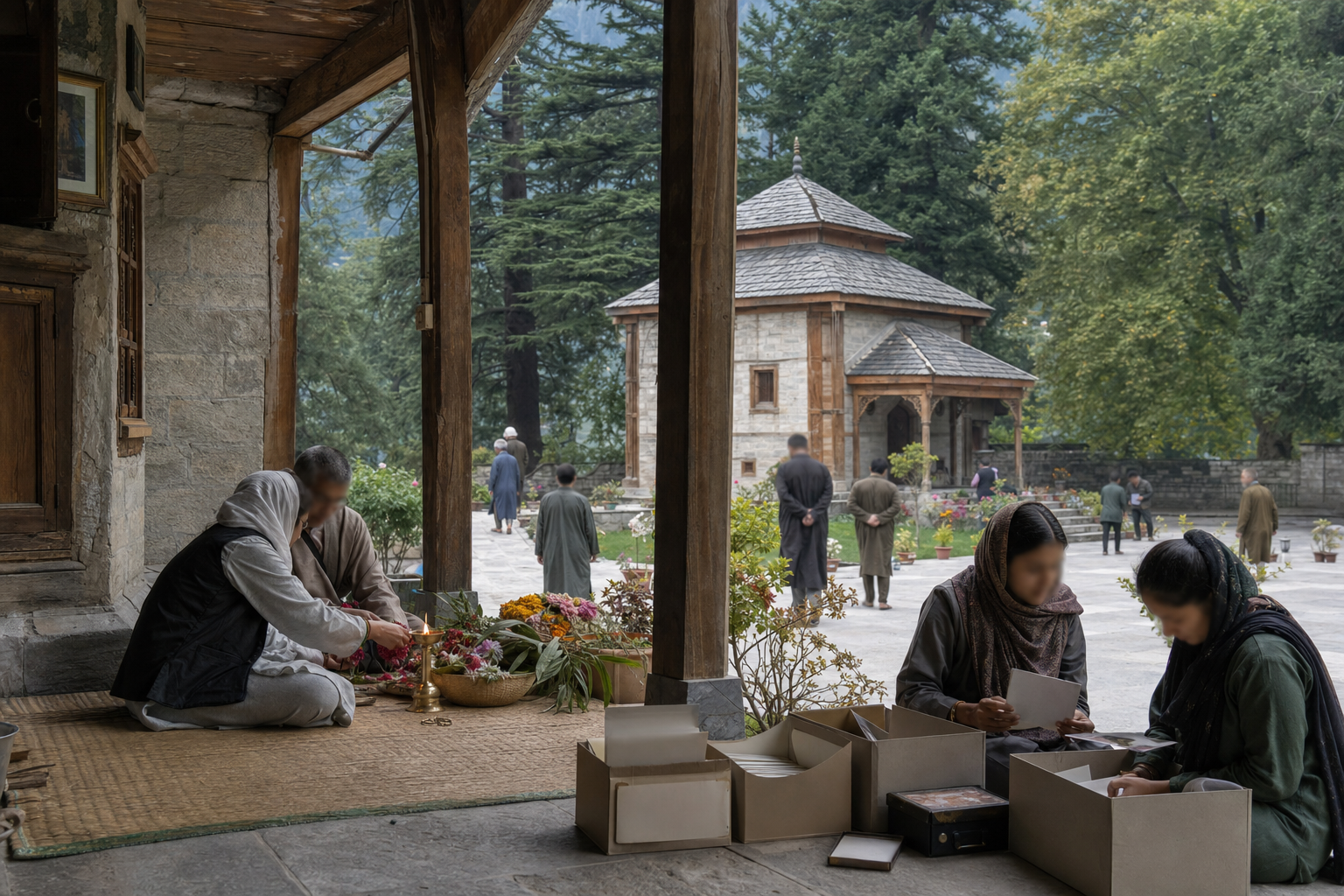
The next stage of preservation should connect living practice with accessible documentation. Institutions such as Nagdandi can strengthen their continuity by cataloguing records, identifying the provenance of photographs and recollections, and recording testimony from participants whose work rarely enters formal histories. Commemorations of 1931 can similarly distinguish confirmed events, contemporary records, later testimony and unresolved claims, allowing readers to understand why conclusions carry different degrees of confidence.
Such work need not force Kashmir’s communities into a single emotional interpretation. It can instead establish a fuller evidentiary field in which spiritual perseverance, demands for political reform, state coercion and Hindu civilian suffering all remain visible. A durable public memory will depend on institutions willing to preserve what is cherished, document what is disputed and leave genuinely unresolved questions open for future research.

References
- DharmaRenaissance Blog – Inside Nagdandi: How Vivekananda Kendra Sustains Heritage and Hope in Kashmir
- DharmaRenaissance Blog – 13 July 1931 in Kashmir: The Painful History Behind Kashmiri Hindu ‘Black Day’