
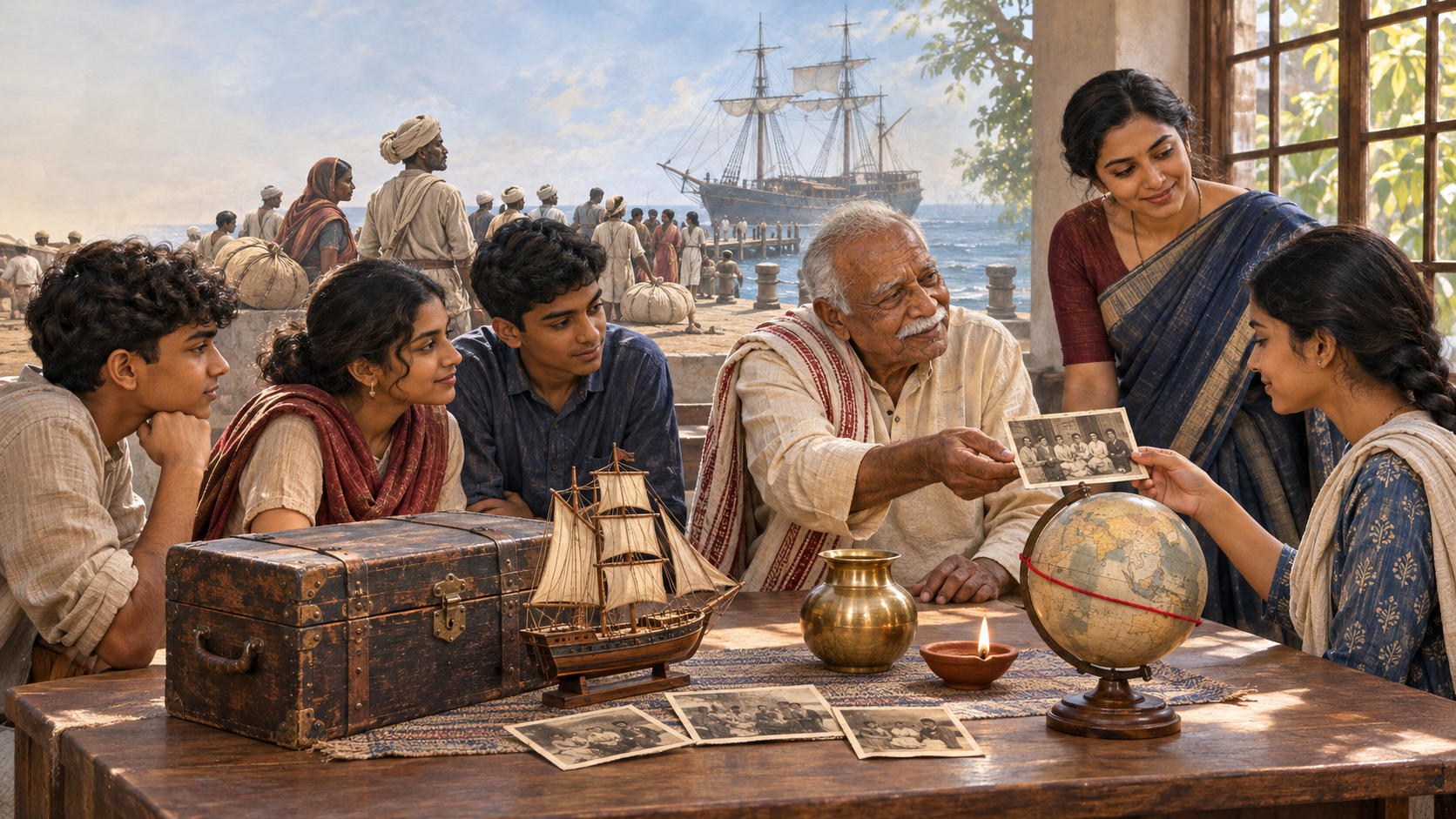
If you grew up hearing the word girmit but received only fragments of the story, you are not alone. A ship name, an ancestral village, a Bhojpuri expression, a Hindu observance, or a grandmother’s memory may have survived while the historical structure connecting them disappeared from view.
Good Girmitiya education repairs that break. It should help you explain how indentureship worked, why Bharatiyas crossed the kala pani, what they endured, and how their descendants built communities across several oceans. It should also give families, teachers, and cultural organisations a practical way to preserve what remains.
Begin with a route, a contract, and a human being
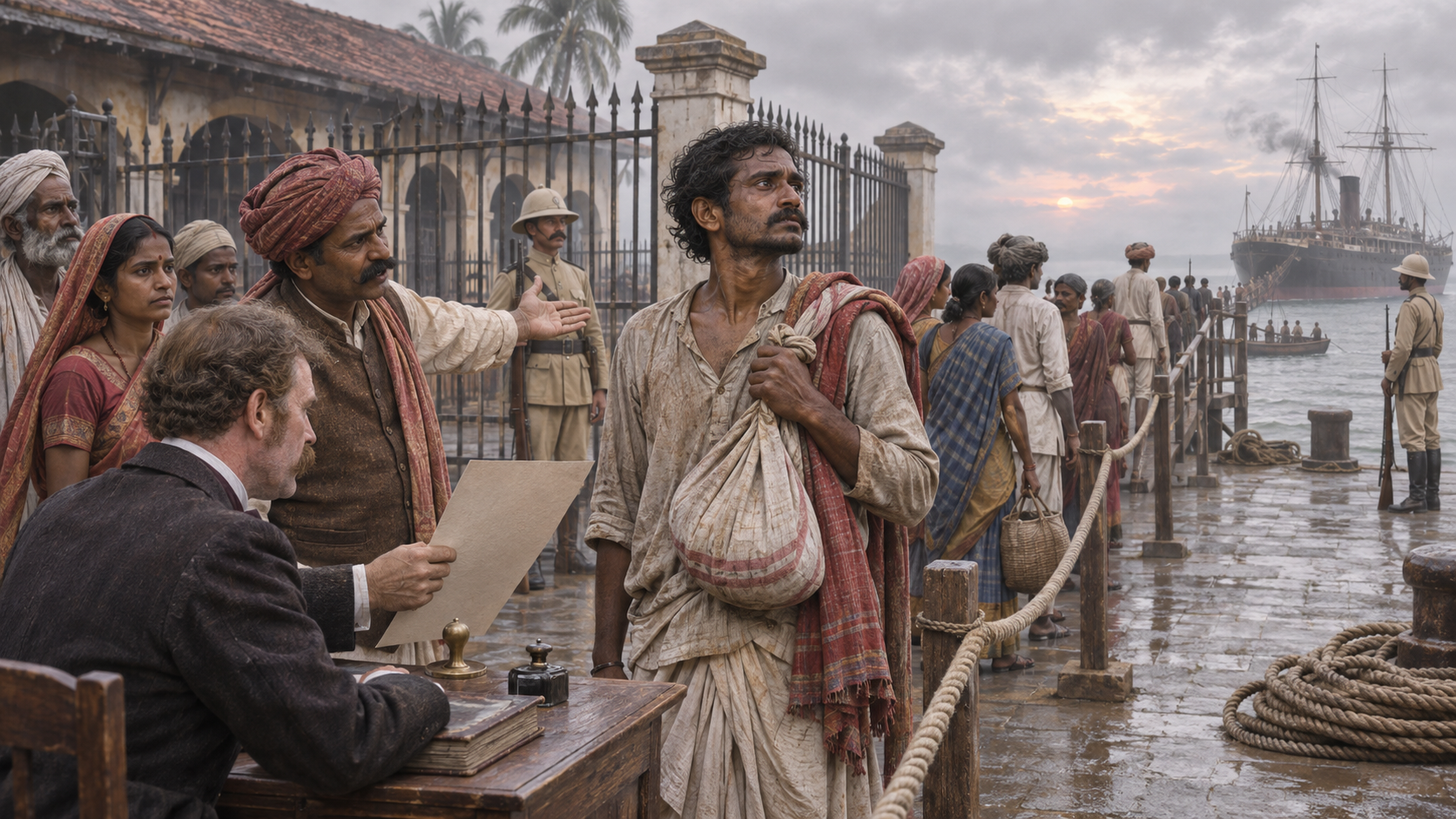
Do not begin with a festival display or a generic lesson about multiculturalism. Begin with the system. Between 1834 and 1917, more than one million Bharatiyas were transported under indenture to plantation colonies across the British Empire, including Mauritius, Guyana, Trinidad and Tobago, Suriname, South Africa, and Fiji.
The contract was called an agreement. In the speech of the labourers, that became girmit, and the people bound by it became Girmitiyas. That linguistic change is an excellent teaching doorway: an English legal instrument entered Bharatiya speech, but Bharatiyas named and remembered the experience in their own voice.
Put a map beside the word. Mark Kolkata, Mauritius, Guyana, Trinidad, Suriname, South Africa, and Fiji. Then place the first dated events on the map: 36 Indian labourers sailed from Kolkata to Mauritius on 2 November 1834, while the Whitby and Hesperus reached Guyana in 1838. The map turns an apparently local family story into a connected history of Bharat, empire, oceanic travel, and plantation labour.
Numbers should establish scale without swallowing the individual. More than 500,000 Indians were brought to the Caribbean between 1838 and 1917, including nearly 150,000 to Trinidad and 240,000 to Guyana. After presenting those totals, return immediately to a person: What might a recruit have known about the destination? What relationships were broken by departure? What new dependencies awaited on a plantation? Which name, prayer, song, food, or bodily practice could still be carried?
This sequence matters. A route gives geographic clarity. A contract reveals the machinery. A person restores moral scale. If you omit any one of the three, the lesson becomes either a migration chart, a legal abstraction, or an isolated tale of suffering.
Institutional placement also affects what students notice. At the University of the West Indies, Indian indentureship has appeared within broader survey teaching such as the history of the West Indies since 1830. A survey course can provide context, but treating indentureship mainly as a subtopic makes it harder to examine its demographic, cultural, religious, and intergenerational consequences in sufficient depth. Ask where the subject sits in your own curriculum: at the centre of social formation, or in a brief unit after the supposedly main story has been told?
Hold coercion and agency in the same historical frame
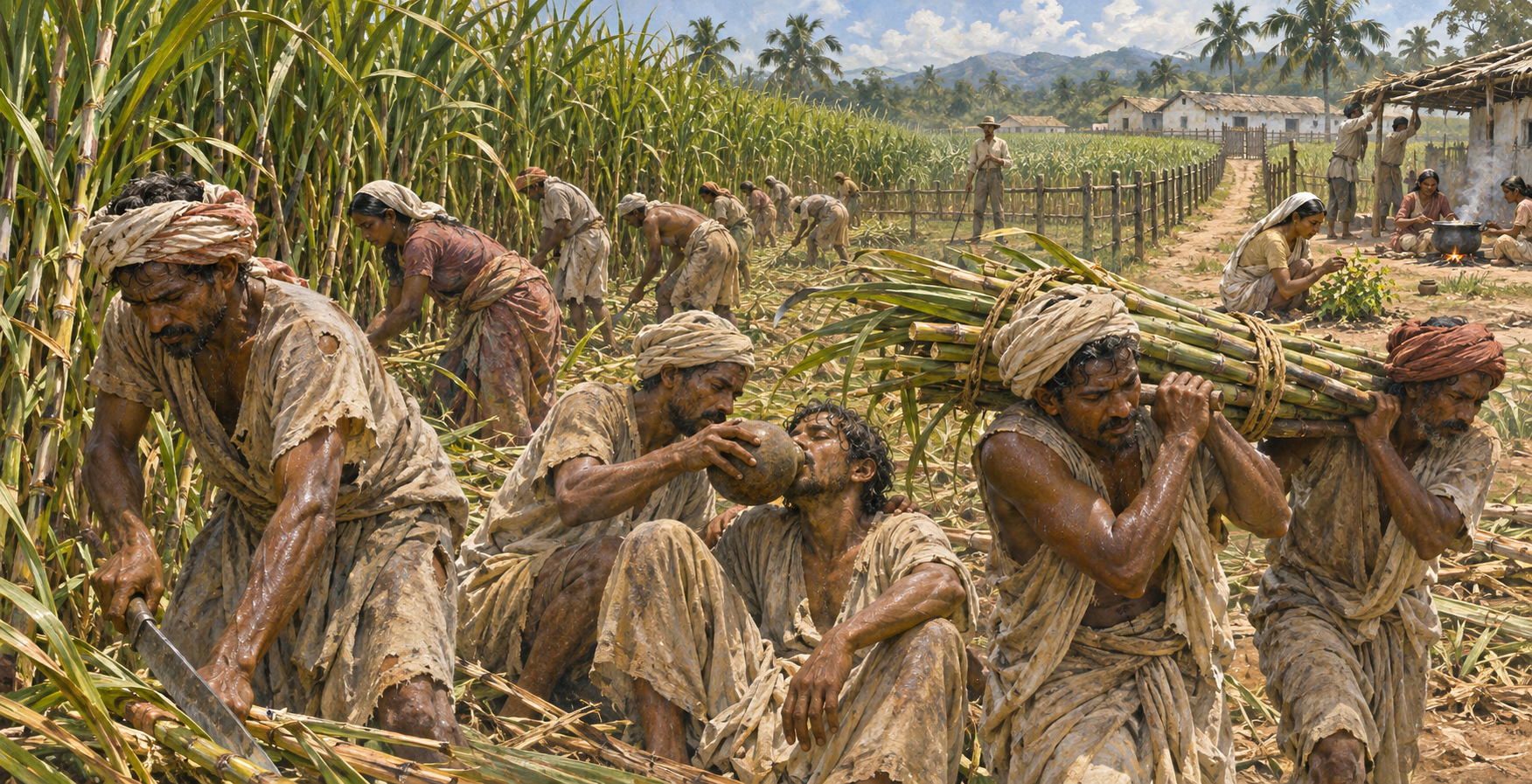
The hardest classroom question is often the simplest: Was indentureship slavery? A useful answer begins by refusing two distortions. It was not an ordinary story of free workers calmly choosing better jobs abroad. It should not be taught as though every feature of chattel slavery and contractual indenture were identical either.
Indentured labourers signed contracts, but signatures alone do not prove meaningful freedom. Poverty and economic pressure in India shaped recruitment, while plantation life imposed exploitation, dependency, discipline, displacement, and social marginalisation. Both slavery and indentureship belong in the history of unfree labour. Comparison is necessary; careless equivalence is not.
Hugh Tinker’s influential 1974 description of indenture as a new system of slavery gives students one major interpretation to test. Instead of asking them to repeat the label, give them three analytical questions:
- What did the contract formally promise? Separate the legal form from the conditions under which consent was obtained.
- What power did a labourer possess after arrival? Look for practical freedom, dependency, punishment, mobility, and the ability to resist.
- What changed after the contract ended? Trace the continuing effects in land, work, status, family life, religion, and public memory.
This framework lets students evaluate the phrase rather than inherit a slogan. It also prevents the contract from becoming an alibi for exploitation.
Agency needs equal care. Girmitiyas were acted upon, but they were never merely passive material in an imperial system. They formed households, negotiated gender relations, sustained religious life, developed new cultural forms, and resisted discrimination. Mahatma Gandhi’s struggles against discrimination affecting Indians in South Africa belong in this wider history, but famous political leadership should not displace the less visible choices made inside families and settlements.
When you teach agency, do not turn survival into proof that the system was acceptable. A community’s capacity to rebuild does not excuse the conditions that made rebuilding necessary. The accurate sentence contains both truths: Girmitiyas endured an exploitative labour order, and they became makers of enduring societies.
Teach Dharma and culture as evidence, not decoration
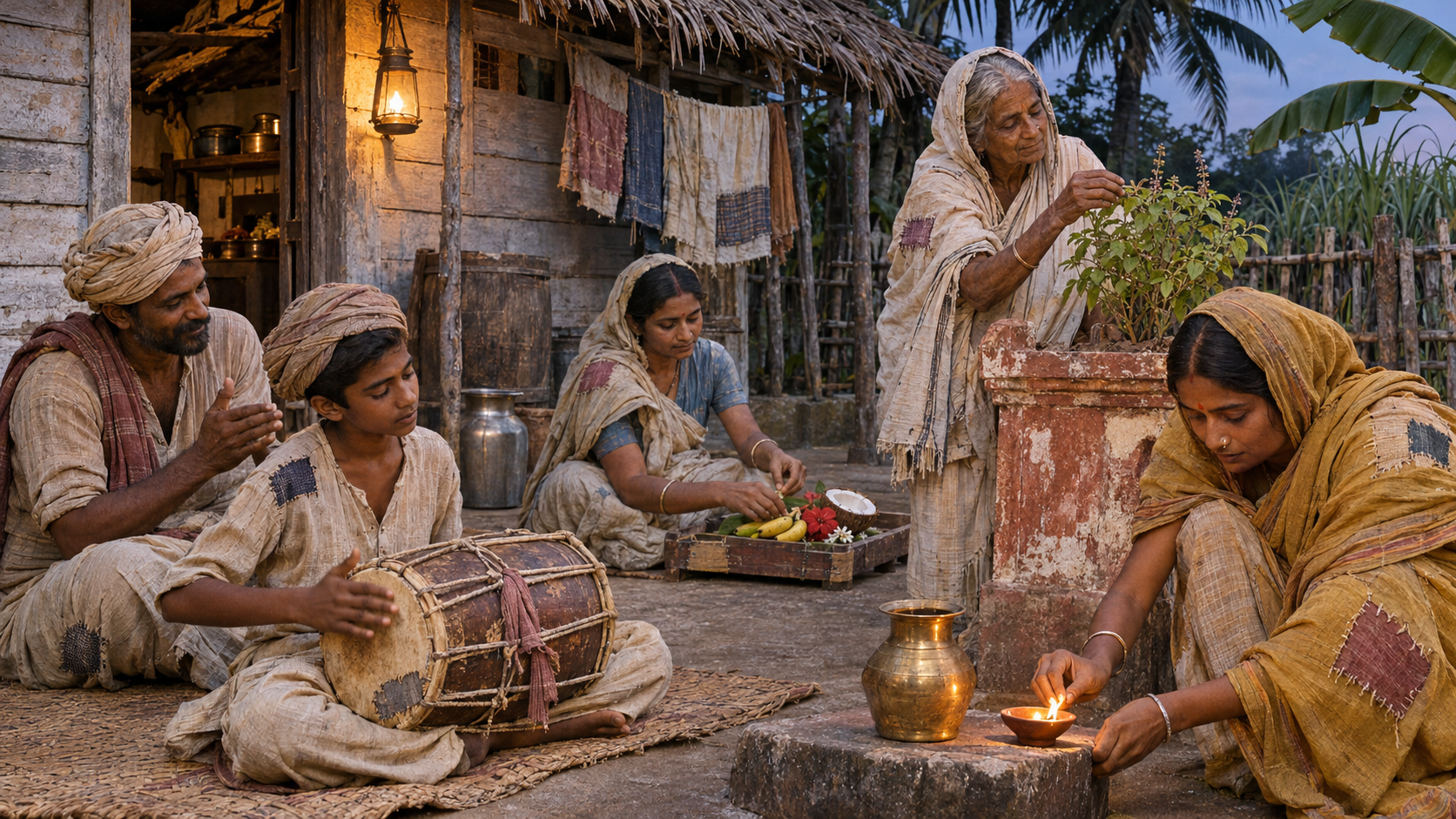
Girmitiya culture is often placed at the end of a lesson, after the supposedly serious economic history. Students see food, music, clothing, and festivals as colourful additions. Reverse that hierarchy. Cultural practices reveal how displaced people organised time, memory, duty, kinship, and belonging.
Indentureship produced demographic change and helped carry agricultural products, cuisine, chutney, music, and religious practices into new social environments. These were not sealed packages transferred unchanged from Bharat. Communities selected, adapted, combined, and reinterpreted what they could preserve.
For a Dharmic history lesson, ask what work a practice performed. Did it maintain a sacred calendar? Did it transmit a story when formal schooling did not? Did it create obligations among households? Did it give a community a language for birth, marriage, death, courage, or grief? Did an image of Saraswati connect learning in a Caribbean setting to a longer civilisational memory?
This method avoids two mistakes. The first is to portray descendants as incomplete copies of people in India. The second is to describe every inherited custom as timeless and unchanged. Girmitiya communities belong within Bharatiya civilisational history precisely because continuity and creative adaptation operated together.
Gender belongs inside this account, not in a separate optional chapter. The decades between 1917 and 1947 included important negotiations over gender and community formation. Visual culture later became another field in which descendants reworked identity. The 2008 film Coolie Pink and Green, as well as work associated with Aayub Muhammad, James Isaiah Budoo, and Shastri Maharaj, shows how art can interpret inherited history rather than merely illustrate it.
The body can also function as an archive. Godna, a traditional tattooing practice found among Indo-Caribbean women, carried memory through skin, sensation, morality, and social belonging. Indentureship therefore remained present in bodies and practices long after the formal contracts had ended. If you include godna in a lesson, do not present women as exotic specimens. Ask what the practice meant to its bearers, who interpreted that meaning, and how gender shaped what could be remembered publicly.
A strong cultural assignment chooses one practice – a bhajan, ceremony, recipe, family name, tattoo, musical form, or sacred image – and follows it through four questions: What came from Bharat? What changed in the new place? What social need did it meet? What does it mean to descendants now? That is cultural history, not a heritage-day display.
Use a six-part learning sequence that produces evidence
You do not need to wait for an entire university programme. A school, mandir, community association, reading circle, or family can build a serious Girmitiya unit around six connected tasks.
- Define the system. Teach agreement, girmit, indentureship, plantation, recruitment, and unfree labour. Ask students to distinguish a contractual form from genuinely free consent.
- Map the movement. Mark origin, port, colony, and later diaspora. Include Mauritius, Guyana, Trinidad and Tobago, Suriname, South Africa, and Fiji so the history is not mistaken for a single-island event.
- Build the chronology. Anchor it with 1834, the 1838 arrivals in Guyana, the end of recruitment in 1917, and the post-indentureship period. Students should see that the cultural and political consequences continued after the contracts stopped.
- Examine power and response. Put economic pressure, plantation exploitation, discrimination, resistance, household formation, and community institution-building on the same page. Require evidence for both coercion and agency.
- Read a cultural archive. Analyse one religious practice, oral account, artwork, food tradition, song, or embodied practice. Treat it as evidence of historical adaptation rather than as entertainment.
- Produce a public result. Create an annotated map, a small exhibition, a recorded family history, a timeline, or a searchable register. Every claim should carry a name, date, location, evidence type, and confidence level where available.
The sixth task is crucial. Students remember more when their work becomes useful to someone else. A timeline displayed in a mandir, a family recording returned to an elder, or a carefully indexed local register also strengthens the community’s historical infrastructure.
Assessment should reward distinctions, not just recall. Can the learner explain why a contract may coexist with coercion? Can they connect a plantation route to a present-day diaspora? Can they distinguish documented fact, family memory, and interpretation? Can they discuss religious continuity without pretending culture was frozen in 1834? Those are better measures of understanding than memorising a ship list alone.
The ideal institutional result is not one commemorative lesson each year. It is a connected curriculum in which Girmitiya history informs the study of empire, labour, Bharat, the Caribbean, Africa, the Pacific, religion, gender, art, and diaspora. That placement reflects the subject’s actual reach.
Turn family memory into a careful community archive
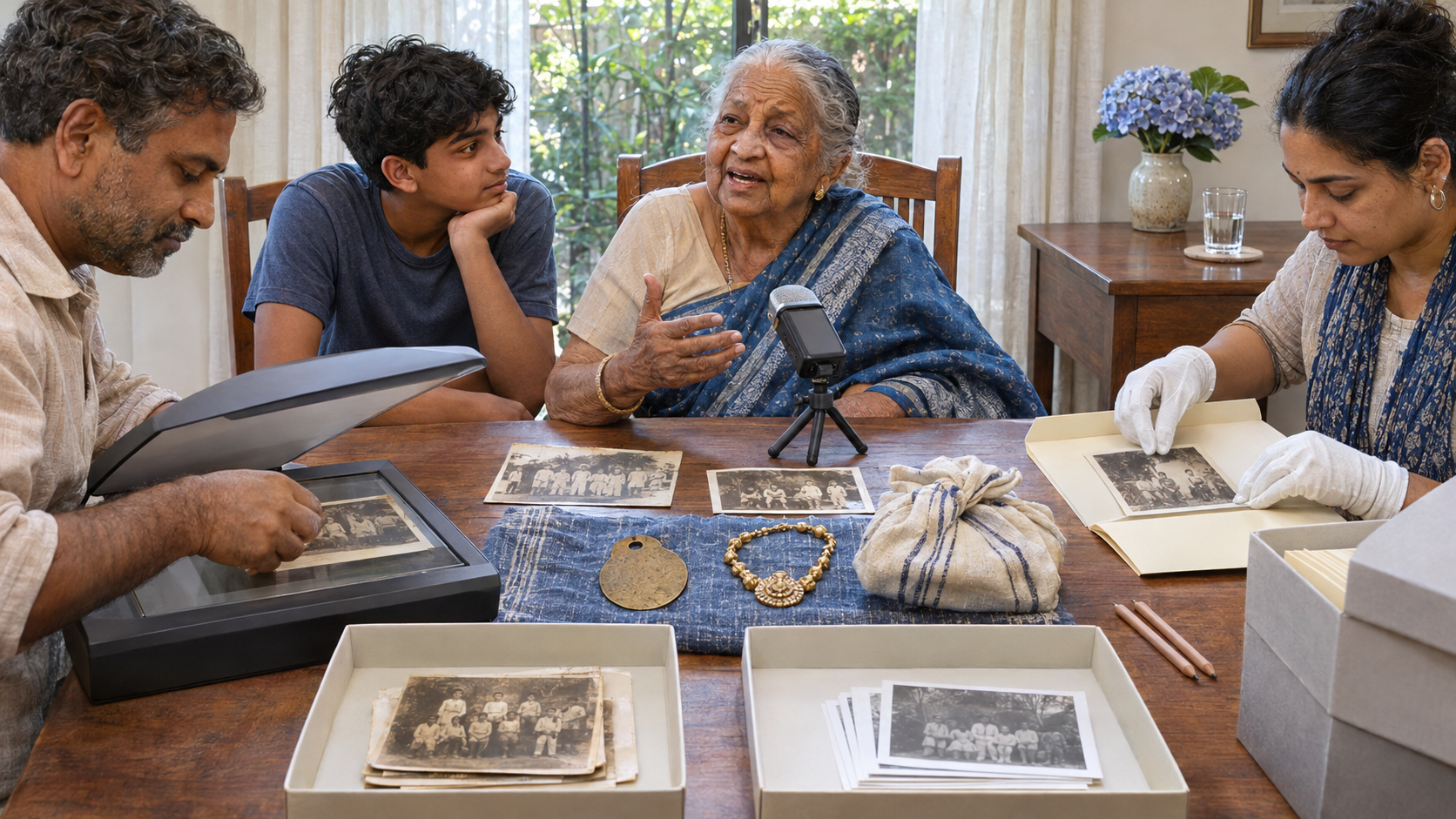
For many descendants, the first archive is a living person. Begin there, but do not treat recollection as a perfect transcript. Oral memory is evidence with its own strengths: it preserves pronunciation, relationships, emotion, ritual knowledge, local meanings, and details that an official register may never record.
Interview around objects and practices rather than asking only, “What do you know about indenture?” Place a photograph, cooking vessel, prayer book, musical instrument, piece of jewellery, name list, or festival memory on the table. Specific prompts usually open more doors:
- Which ancestor first carried this name, and were there other spellings?
- What place in India was associated with the family, and who supplied that information?
- Which language or expressions did the elders use?
- Which vrata, puja, song, story, or funeral custom was considered especially important?
- Who taught the practice, and what changed between generations?
- Which details are remembered directly, and which were heard from someone else?
Record provenance beside every answer. A useful family-history sheet has fields for the person’s name, name variants, relationship, location, approximate or exact date, ship or estate if known, the evidence supporting the entry, the informant, and a confidence note. Write “family recollection” when that is what you have. An honest uncertainty is more valuable than a confident invention.
Ask permission before recording, publishing, or uploading personal material. Let the speaker decide whether sensitive family information may be shared. Keep the original file, a backup, and a plain transcript. Give the family a copy. If a word is unclear, preserve the audio and mark the uncertainty instead of silently replacing it.
Oral histories become much more powerful when connected to records. International databases, quantitative analysis, and efforts to identify ancestral villages can link descendants in the Caribbean, North America, the United Kingdom, Suriname, and elsewhere. Locating ancestral villages in India has become an important goal, but matching must be disciplined: name spellings can vary, family stories can compress generations, and a plausible resemblance is not yet proof.
Community organisations can help by using one shared data structure. If every local project records names, variants, dates, locations, ships, estates, evidence types, and permissions in the same way, separate family fragments can eventually become a connected archive. Schools can contribute transcriptions. Universities can support preservation and analysis. Temples and cultural groups can identify ritual and linguistic knowledge that bureaucratic records overlook.
Key takeaways
- Teach Girmitiya history through a route, the contractual system, and an individual life; none is sufficient alone.
- Place indentureship within the history of unfree labour without erasing the distinctions between labour systems.
- Treat Dharma, food, music, art, gender, and bodily practices as historical evidence rather than decorative heritage.
- Separate documented fact, oral memory, and interpretation in every family or classroom project.
- Make learning produce something durable: an annotated map, transcript, timeline, register, or community exhibition.
You can begin with one elder, one object, and one map. Record what is known, mark what remains uncertain, and return a usable copy to the family or community. That small act moves Girmitiya history from occasional commemoration into intergenerational education.
References

Leave a Reply
You must be logged in to post a comment.