
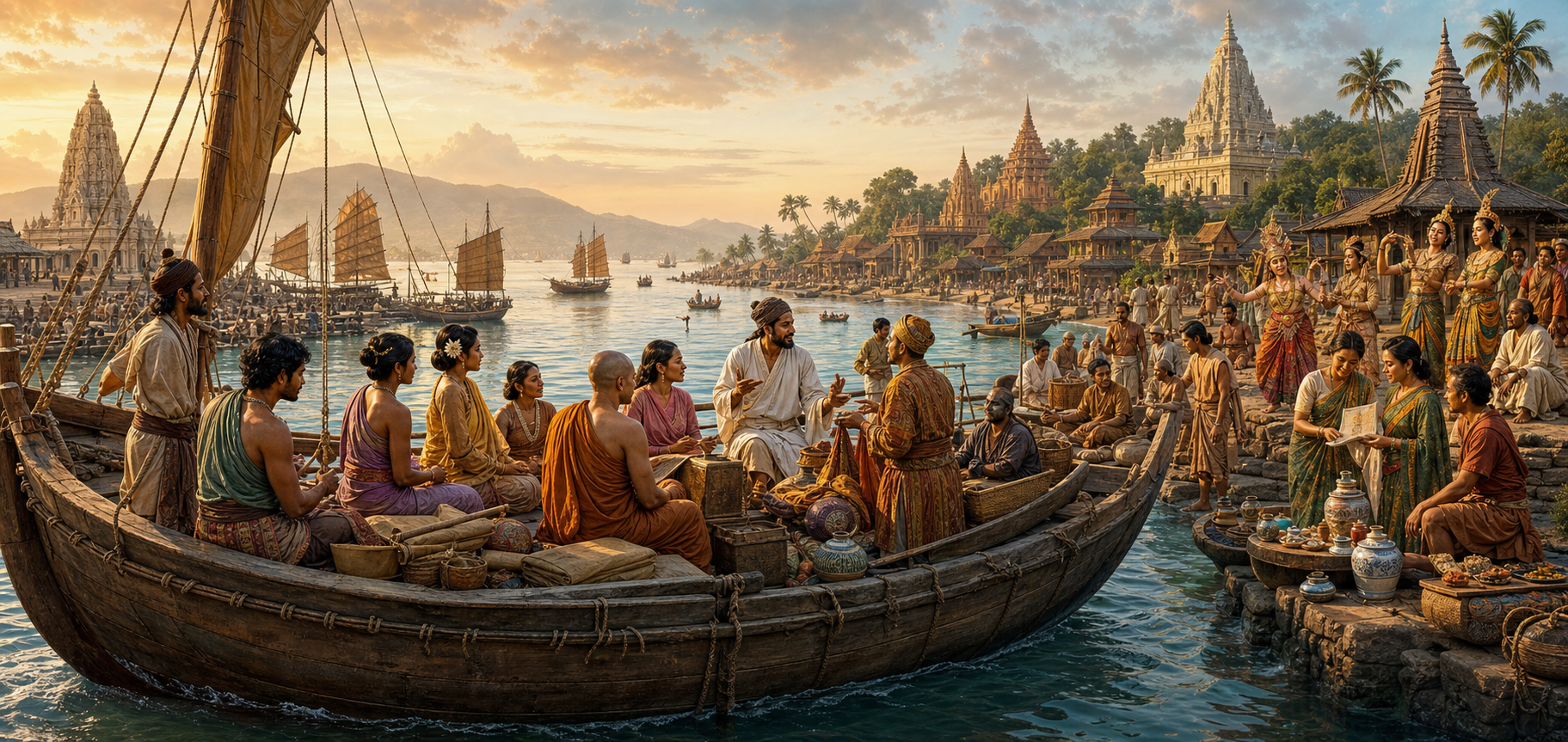
If you are trying to explain why a Cambodian temple evokes Mount Meru, why scripts across Southeast Asia bear Indic ancestry, or why the Ramayana lives in Thai, Khmer, Lao, Malay and Javanese forms, saying that “India influenced Asia” is not enough. It tells you neither how the culture travelled nor what Asian communities did with it.
A more accurate answer begins with routes, carriers and local choices. Merchants, monks, scholars, ritual specialists, rulers, artisans and performers moved ideas through connected ports and learning centres. Local societies then translated those ideas into their own languages, institutions and sacred landscapes. Once you know what evidence to look for, you can describe Bharat’s contribution without reducing the rest of Asia to either a passive recipient or an untouched world.
Key takeaways
- Begin with networks, not modern political maps. Monsoon navigation, commercial ports, merchant guilds and monastic centres connected the Bay of Bengal, mainland Southeast Asia and the Indonesian archipelago.
- Do not treat a shared deity, word or artistic motif as sufficient proof by itself. The stronger case comes from several kinds of evidence appearing together: inscriptions, scripts, trade goods, calendars, institutions, temple plans and literary adaptations.
- Transmission was not the same as duplication. Khmer, Cham, Javanese, Balinese, Thai, Lao and Malay communities selected, translated and recomposed Indic materials for local purposes.
- Exchange, religious teaching and patronage explain the prevailing pattern better than conquest does. That general pattern should still acknowledge military exceptions, including Rajendra I’s campaign against Srivijaya in 1025 CE.
- “Dharmic” should not collapse several traditions into one timeline. Hindu court and temple cultures, Buddhist monastic networks and Jain mercantile ethics had related but distinguishable carriers and institutions.
Follow the people and institutions that carried culture
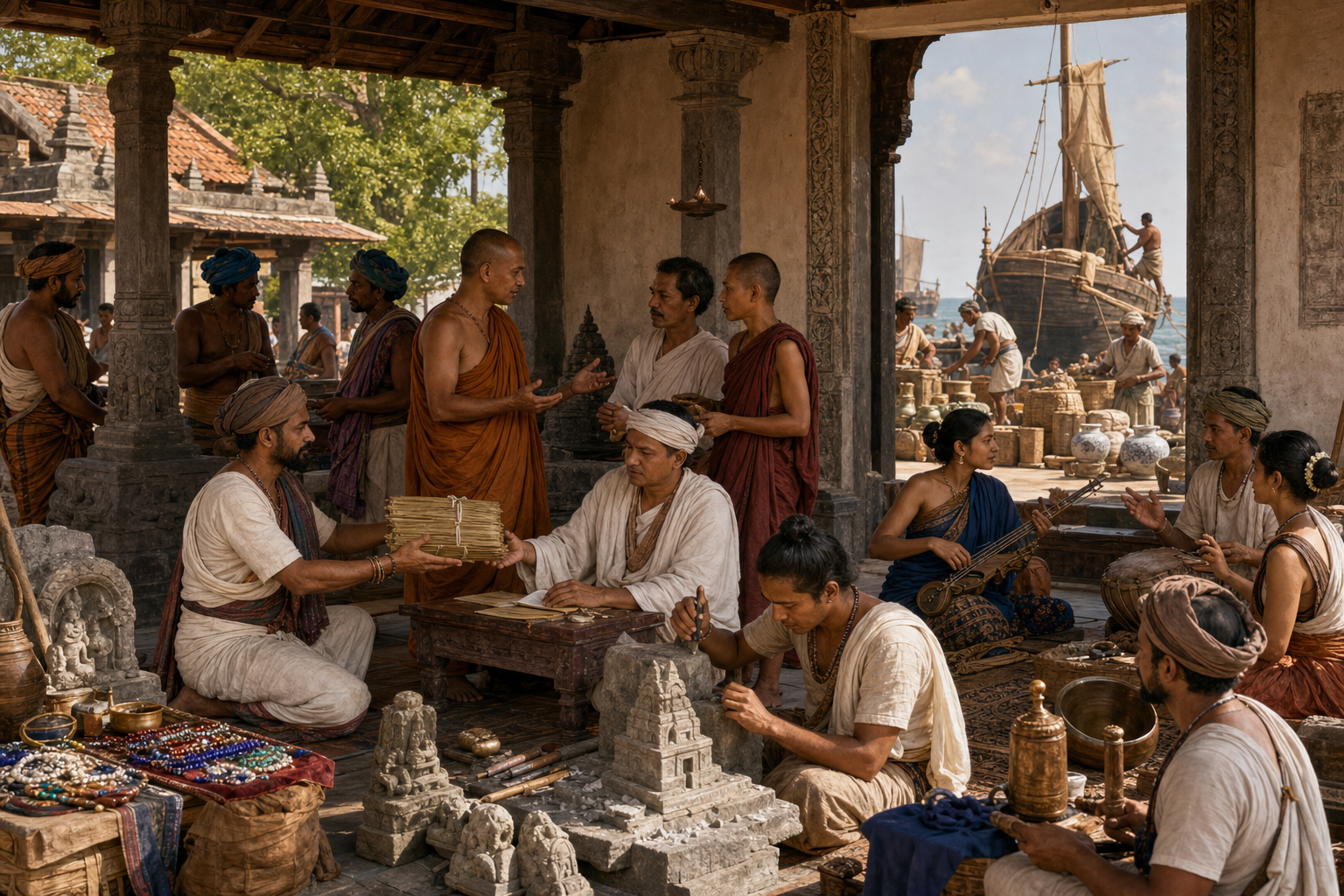
Ideas do not cross an ocean by themselves. The first practical question is therefore not “Where do these symbols resemble India?” but “Who could have carried them, along which route, and who maintained them after arrival?”
Direct monsoon-assisted voyages were operating by at least the first century BCE. Ports such as Tamralipti, Kaveripattinam, Arikamedu and Sopara connected with eastern centres including Oc Eo, the Bujang Valley, Takuapa, Kedurang and Barus. Finds such as Indian Rouletted Ware, South Asian coinage, and carnelian and agate beads make those routes materially visible. The ports matter because they reveal the infrastructure within which religious specialists, texts, languages and techniques could travel repeatedly rather than through a single legendary journey.
| Carrier or institution | What could travel with it | Evidence to examine |
|---|---|---|
| Merchant guilds | Goods, contracts, accounting practices, ethical norms and patronage for temples or rest-houses | Tamil guild inscriptions associated with Ayyavole 500 and Manigramam, including records at Lobu Tua and near Takuapa |
| Monks and scholastic centres | Texts, Sanskrit and Pali learning, Vinaya training, ordination lineages, meditation disciplines and methods of debate | Pilgrimage itineraries, monastic records and connections among Nalanda, Srivijaya and other teaching centres |
| Courts and ritual specialists | Royal vocabulary, calendrical systems, legal concepts, consecration practices and models of sacred kingship | Sanskrit inscriptions, legal digests, chronicles, calendars and temple foundations |
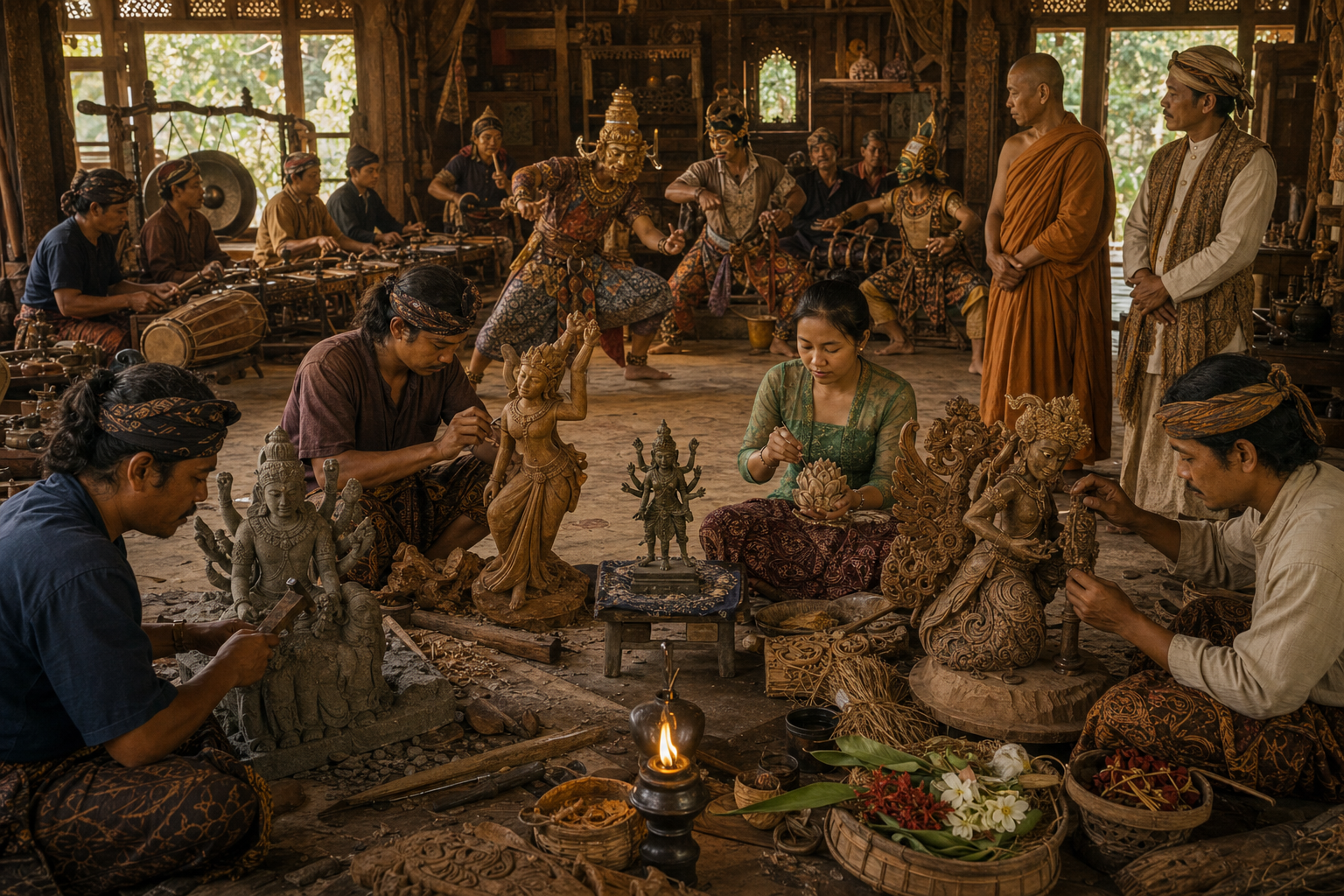
| Artisans and performers | Iconographic forms, architectural plans, epic narratives, dance vocabularies and ritual technologies | Temple layouts, sculpture, murals, theatre traditions and regional retellings of the epics |
The guild evidence is especially useful because it joins commerce to community life. Ayyavole and Manigramam did not merely move merchandise. Their overseas presence created durable settings for contracts, worship, hospitality and patronage. Cosmopolitan ports could bring Hindu, Buddhist and Jain merchants into the support of shrines, schools and rest-houses. That is a more convincing mechanism of cultural continuity than the vague claim that ideas simply “spread.”
Buddhist learning moved through similarly concrete institutions. In the seventh century CE, Yijing studied Sanskrit grammar and Vinaya in Srivijaya while travelling toward the Ganges plain. His itinerary shows a multi-centred Asian scholarly world: a monk could prepare in Sumatra, pursue advanced learning in Bharat, and carry that training onward. Nalanda was an eminent centre, but it belonged to a circulation system rather than functioning as the sole point from which knowledge radiated.
Use that model when you encounter a shared custom or vocabulary. Identify the port, court, monastery, guild or artistic community capable of sustaining it. A carrier turns visual resemblance into a historical explanation.
Read scripts, calendars, temples and epics as different layers

No single object can bear the entire argument for Dharmic cultural transmission. A script records one kind of connection; a temple plan records another. Their convergence is what makes a regional pattern persuasive.
Script reveals training and institutional prestige
Sanskrit and Pali served religious and administrative functions across much of the region. The Vo Canh record near present-day Nha Trang is among the earliest Sanskrit inscriptions in Southeast Asia. Later, Pallava-Grantha and related South Asian writing traditions contributed to the formation of Khmer, Mon and Kawi, while Thai developed through a line connected with Old Khmer. Farther northeast, Japanese Shingon and Tendai traditions preserved Siddham characters for writing bīja mantras.
Keep three things separate when you use this evidence: script, language and purpose. A community can adapt a writing system without adopting an Indian spoken language. A Sanskrit royal inscription may demonstrate learned prestige, patronage or ritual authority; by itself, it does not prove that the surrounding population was replaced. Ask who commissioned the inscription, what language it records and what public function it performed.
Calendars reveal knowledge put to work
Calendrical borrowing reaches beyond ornament. Forms of the Saka era, the Chulasakarat era beginning in 638 CE, lunar-solar reckoning, nakshatra lists and astronomical methods associated with the Sūrya Siddhānta entered regional practices. Indic month names, zodiacal terms and the selection of auspicious moments helped courts and temples coordinate ceremonies, chronicles and agricultural or mercantile schedules.
When a borrowed system organizes dates, obligations or seasonal work, it has moved from cultural prestige into institutional use. Look for repeated dates in inscriptions, the structure of chronicles and the timing of ceremonies. These can tell you more about long-term adoption than a single imported object can.
Temples show cosmology becoming local geography
Angkor Wat, Angkor Thom, Prambanan and My Son incorporated ideas such as mandala organization, Mount Meru cosmology, axial planning and consecration. Yet none should be read as an Indian building transplanted intact. Their scale, materials, political functions and relationships with local ancestor and nature traditions belong to the societies that built them.
Angkor Wat began as a Vaishnava cosmogram associated with a royal funerary temple and was later incorporated into Theravada practice. That sequence demonstrates continuity through reinterpretation. It is more informative than assigning the monument one permanent religious label.
At Prambanan, a monumental Shaiva complex stood in a landscape that also included major Buddhist sanctuaries such as Borobudur and Sewu. At My Son, Cham temples and Sanskrit inscriptions joined Shaiva and Vaishnava ritual life to regional lineages and authority. These settings caution you against imagining Hindu and Buddhist histories as sealed, mutually exclusive blocks. Sacred landscapes could hold several traditions near one another and could change affiliation over time.
Epic retellings reveal adoption through change
The Ramayana and Mahabharata did not survive across Asia as museum objects. They entered public memory through recitation, dance, theatre, painting and court literature. The Reamker in Khmer, Ramakien in Thai, Phra Lak Phra Lam in Lao, Hikayat Seri Rama in Malay and Kakawin Ramayana in Old Javanese belong to this history, as does Javanese and Balinese wayang kulit.
Variation is therefore evidence, not damage. A changed name, emphasis or performance setting can show that a community made the narrative intelligible within its own moral and aesthetic world. If you describe every difference from a Sanskrit telling as corruption, you miss the mechanism that gave the epic a durable Asian life.
Avoid the false choice between denial and cultural ownership
Discussions of Bharat’s influence often become trapped between two unsatisfactory positions. One erases the Indic connections because local societies transformed what they received. The other claims every connected Asian achievement as an Indian possession. Neither position handles the evidence well.
- Instead of saying, “India created Southeast Asian civilization,” say that particular Southeast Asian courts, monasteries and communities adopted identifiable Indic languages, texts, ritual systems or techniques and developed them into local institutions.
- Instead of saying, “The resemblance is only coincidental,” test the resemblance against inscriptions, routes, chronology, terminology and evidence of institutions capable of transmission.
- Instead of treating a Sanskrit inscription as proof of population replacement, state the narrower conclusion it supports: someone with access to Sanskrit learning commissioned, composed or preserved that record for a particular purpose.
- Instead of assigning a temple one unchanging identity, trace its foundation, patronage, ritual use and later reuse. Angkor Wat’s Vaishnava and Theravada phases make that distinction necessary.
- Instead of calling every connection peaceful, distinguish the dominant mechanism from known exceptions. The Chola attack on Srivijaya in 1025 CE belongs in the history, but one military episode does not account for the many centuries of scripts, monasteries, guilds, calendars and locally adapted epics.
“Indianization” can be useful shorthand only if you define what it means in the case at hand. Does it refer to Sanskrit epigraphy, a form of kingship, an Agamic consecration, a Ramayana performance, a calendar or a legal vocabulary? Without that precision, the word hides the very process it is supposed to explain.
There is no need to diminish Bharat’s contribution in order to respect Asian agency. Local adaptation does not cancel transmission; it shows that transmission succeeded. Nor does acknowledging an Indic origin make a Khmer temple, a Thai epic or a Javanese performance less authentically Khmer, Thai or Javanese. Cultural inheritance can have a traceable origin and a genuinely local life at the same time.
Use this six-question method when you evaluate a claim
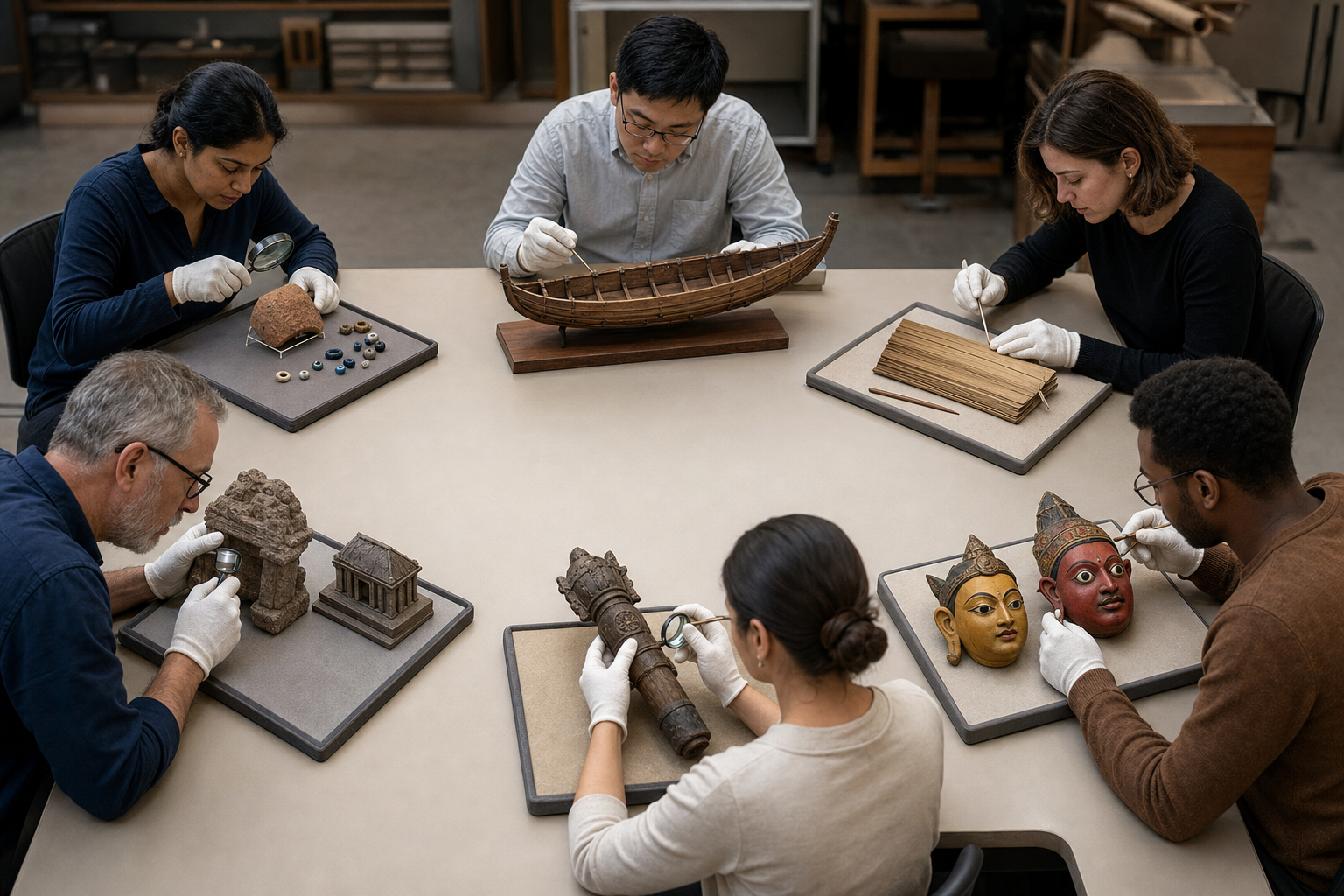
You can apply the following method to a temple, inscription, performance, calendar or claim circulating online. It keeps the conclusion proportional to the evidence.
- What is the exact place and period? “Asia” and “ancient times” are too broad. Name the kingdom, port, region or religious centre and place it within a defensible chronology.
- What precisely travelled? Identify whether the claim concerns a script, language, deity, narrative, ritual, legal idea, astronomical method, commercial practice or architectural principle. Do not bundle them together merely because all have an Indic association.
- Who could have carried it? Look for a merchant guild, monastic lineage, travelling scholar, court, ritual specialist, artisan group or performance community. If no plausible carrier can be identified, keep the claim tentative.
- What kind of evidence survives? Separate archaeology, inscriptions, texts, linguistic descent, art-historical comparison and later tradition. Then ask whether more than one category supports the proposed connection.
- What did the receiving community change? Record the local language, materials, political purpose, religious combination, performance form or sacred geography. Those changes explain why the transmitted element endured.
- What does the evidence not establish? A shared form does not automatically prove conquest, mass migration, political subordination or an unchanged doctrine. State the narrowest conclusion the material securely supports before advancing a wider interpretation.
Consider Angkor Wat as a worked example. Its cosmological plan and Vaishnava foundation support a strong claim about Khmer adoption of Indic sacred concepts and ritual knowledge. Its monumental Khmer execution, royal purpose and later Theravada life demonstrate local authorship and transformation. Those facts support cultural relationship; they do not require you to imagine Cambodia as a political extension of India.
For your own notes, create six fields: place and date, transmitted element, probable carrier, surviving evidence, local transformation, and limit of the conclusion. Fill them before you repeat a civilizational claim. You will quickly notice which arguments rest on connected evidence and which depend only on visual resemblance or pride.
The next time you encounter an Indic script in an overseas inscription, a form of the Ramayana on an Asian stage, or Mount Meru embodied in a temple, resist the urge to claim or dismiss it immediately. Trace the route, name the institution and look closely at the local transformation. That is how shared Dharmic heritage becomes a history you can defend rather than a slogan you can only repeat.