
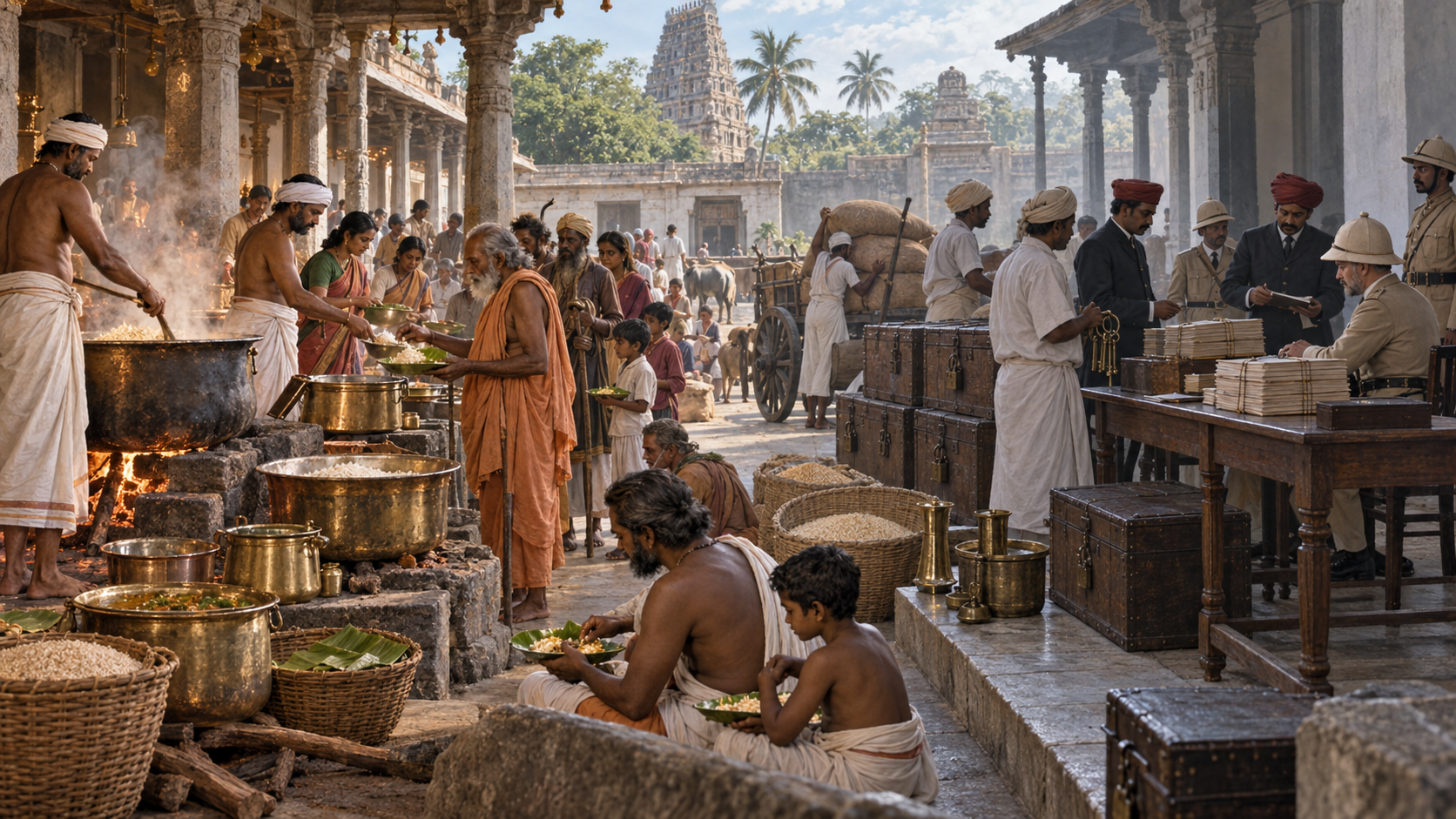
If you are trying to understand how a civilisation known for feeding pilgrims, guests, ascetics and people in distress came to be portrayed as dependent on official relief, do not begin with a supposed failure of Hindu compassion. Follow the institutions that made compassion dependable.
The decisive questions are practical: Who controlled the endowments? Who kept the kitchens running? Who decided whether feeding a hungry person was dharma or a social problem? Once you ask those questions, colonial disruption looks less like the modernisation of charity and more like a transfer of resources, authority and moral legitimacy.
The first loss was the institution behind the meal
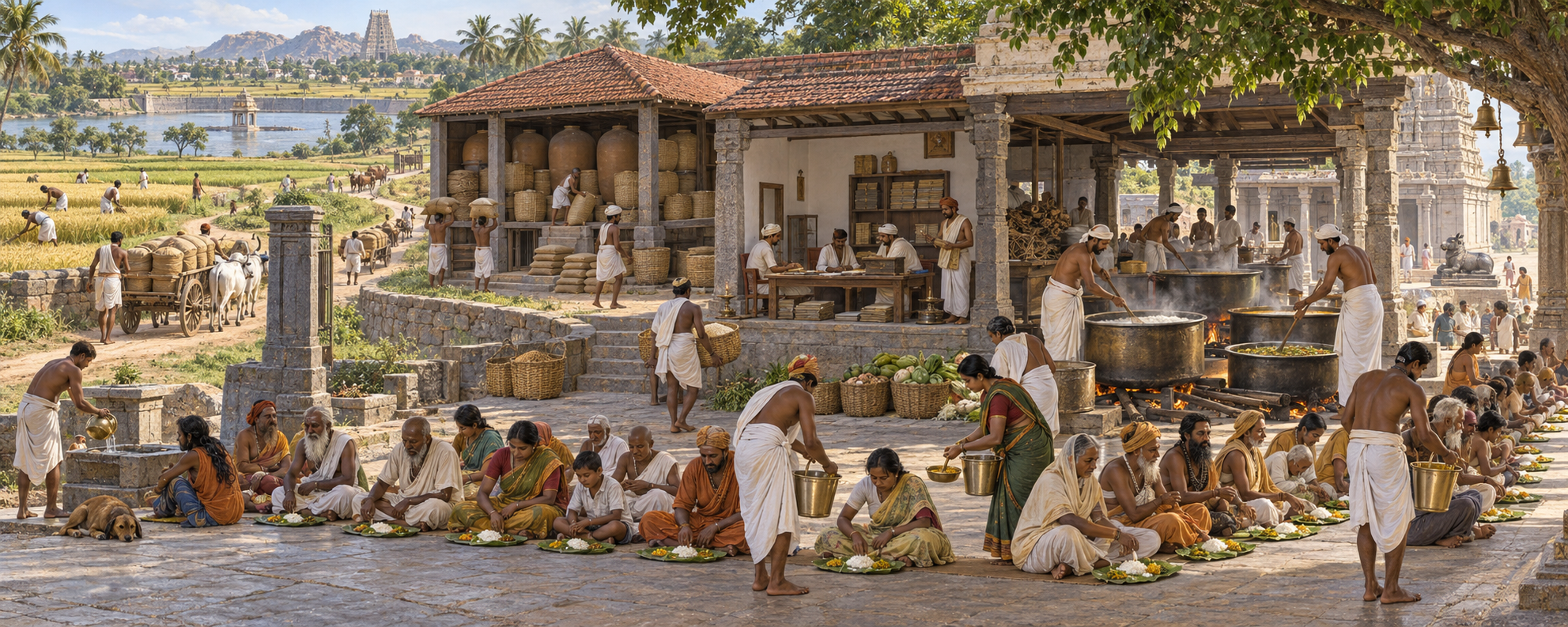
Annadanam is often translated simply as the gift of food. That translation is accurate but incomplete. In practice, it belongs to a larger Dharmic relationship among the giver, the recipient, the institution and the community that sustains the offering. Food is not merely a commodity handed to an administrative category called the poor. Feeding is itself a duty, and the person who receives food does not have to be reduced to a social failure before that duty becomes valid.
This distinction explains why an endowment matters. A spontaneous donation may feed people once. An endowment can support recurring expenditure, allowing an institution to procure food, maintain a kitchen and continue serving when public attention moves elsewhere. It turns generosity from an occasional sentiment into durable capacity.
In the Mysore kingdom, Governor-General Wellesley’s administration reduced endowments given to Hindu charitable institutions from 855,000 to about 200,000 lakh rupees in the figures available to us. If both figures are read on the same basis, that is a decline of about 77 percent. The wording of the unit is ambiguous, so it should not be converted into a modern monetary value without checking the underlying records. The proportion and direction of the reduction are the responsible points to retain.
A cut of that scale does more than shrink a charitable budget. It weakens the entire chain behind the visible meal:
- The institution loses recurring purchasing power.
- The kitchen becomes more dependent on irregular gifts or official permission.
- Local people lose a dependable place through which to fulfil the duty of food-giving.
- Recipients become more exposed to scarcity because the customary provider has been weakened.
- The public gradually forgets that the earlier capacity ever existed.
The last effect is especially important. If a government first diminishes an institution and later points to unmet need as evidence that society cannot care for its own, the resulting dependency is misdescribed as an original cultural defect. You should therefore distinguish the visible crisis from the prior destruction of the system that once absorbed part of that crisis.
This does not require romanticising every precolonial institution or claiming that hunger never existed. Annadanam was not proof that every person was always fed. The narrower and more defensible point is that Hindu society possessed organised, culturally legitimate mechanisms for feeding people, and reducing their endowments reduced their capacity to act.
Relief bureaucracy changed the moral meaning of hunger
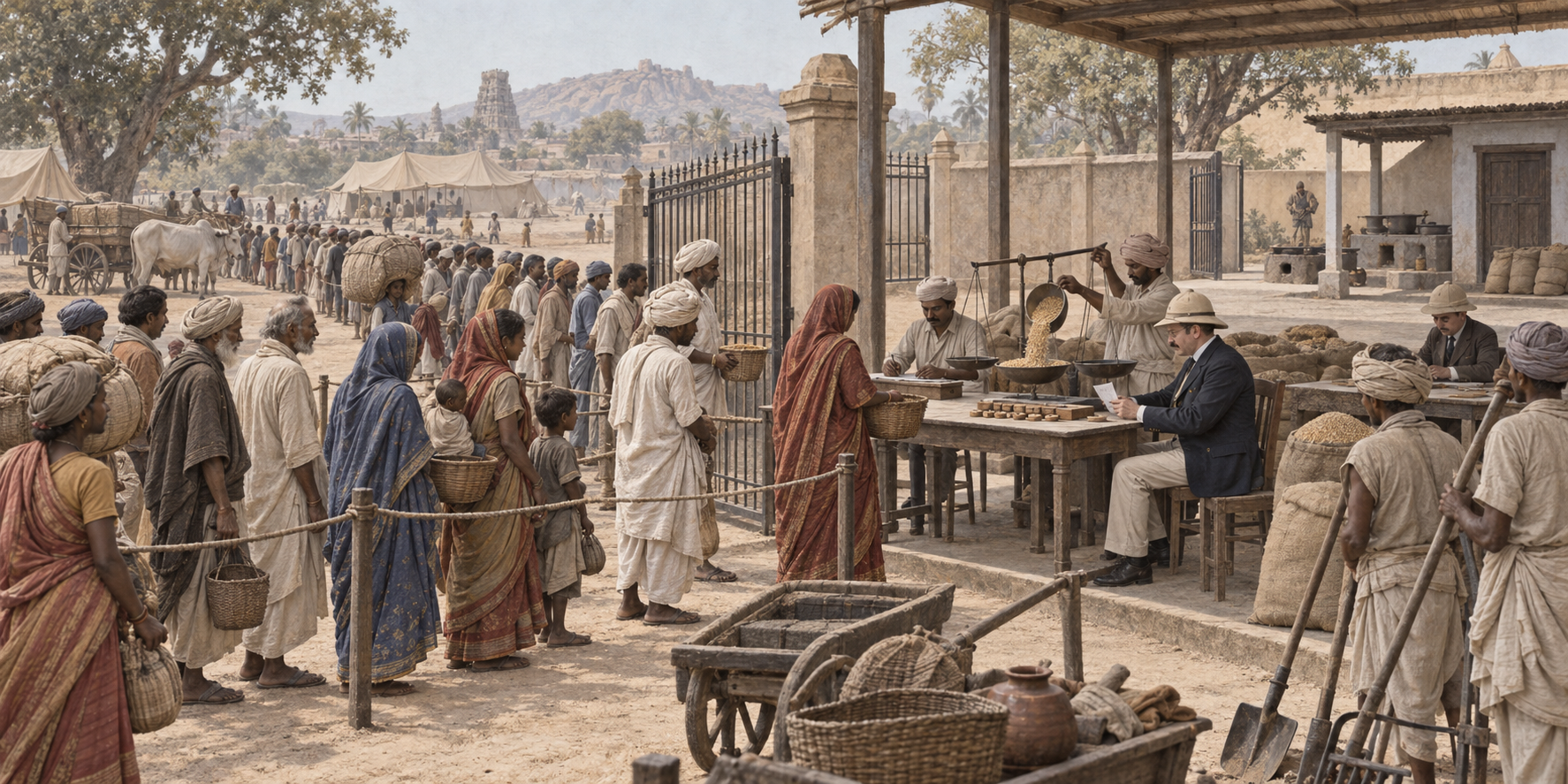
Colonial policy did not merely weaken one method of provision and leave its meaning untouched. It elevated a different moral framework. Under the older Dharmic relationship, feeding could be intrinsically worthy. Under a bureaucratic relief model, aid became something to regulate, justify and withhold according to official classifications.
In 1880, British famine administration acquired an elaborate bureaucracy through the famine report and the relief machinery built around it. Administration during a famine is not inherently objectionable; coordination, storage and distribution can be necessary. The deeper problem begins when emergency administration displaces community capacity and then claims exclusive authority to decide which forms of compassion are responsible.
The Dharmic criticism is not that the famine bureaucracy necessarily printed the exact sentence that Annadanam is unethical. It is that the system operated from a moral suspicion of food-giving outside its approved relief discipline. Unconditional feeding could be recategorised as indiscriminate, dependency-producing or socially harmful. A sacred duty was thus judged through assumptions foreign to the tradition that sustained it.
| Question | Annadanam as a living institution | Colonial relief as an administrative system |
|---|---|---|
| Why is food given? | Feeding is a duty with religious and social value. | Relief is an official response to a classified emergency. |
| Who authorises it? | Communities and charitable institutions act through customary responsibility. | Administrators determine rules, eligibility and acceptable provision. |
| What sustains it? | Endowments, recurring gifts and community participation. | State-controlled allocations and bureaucratic machinery. |
| How is the recipient seen? | As a person within a moral relationship of giving and receiving. | As an applicant, relief case or member of an eligible category. |
| What is the main danger? | Insufficient resources, weak governance or failure to uphold the duty. | Dependency on distant authority and exclusion by administrative rules. |
These are contrasting institutional tendencies, not a claim that every traditional kitchen was generous or every public official was callous. The value of the comparison is that it reveals a change in who held moral jurisdiction. The state was no longer merely helping to feed people. It was increasingly defining what counted as legitimate help.
Cultural authority shifted alongside financial authority. By 1829, William Bentinck could express approval as English-educated Hindus moved closer to British manners and outlook. A section of the colonial-educated elite consequently learned to assess its own customs through European categories. Annadanam could then be dismissed from inside Indian society as backward rather than defended as a serious institution requiring sound governance and adequate resources.
This is how colonial judgment becomes durable. Coercion begins the change, but imitation preserves it. Once influential Indians repeat the coloniser’s contempt for indigenous practices, an externally imposed hierarchy starts to look like domestic common sense.
The description of India as a nation of beggars should be read in that institutional sense, not as an insult aimed at Indians experiencing hunger. A person becomes dependent on relief when independent means of support have been removed or made ineffective. The moral failure lies in manufacturing that dependency and then blaming the dependent person for it.
Key takeaways for reading this history
- Annadanam was sustained by institutions and endowments, not by goodwill alone.
- Reducing a charitable endowment damages recurring capacity even when occasional donations continue.
- Colonial relief transferred authority from Dharmic communities to an administrative system that classified both need and acceptable assistance.
- The rejection of Annadanam was cultural as well as financial; colonial education helped European judgments circulate among Indians themselves.
- Dependency created after institutional disruption must not be mistaken for an inherent defect in Hindu society.
Use five questions to test any account of colonial charity
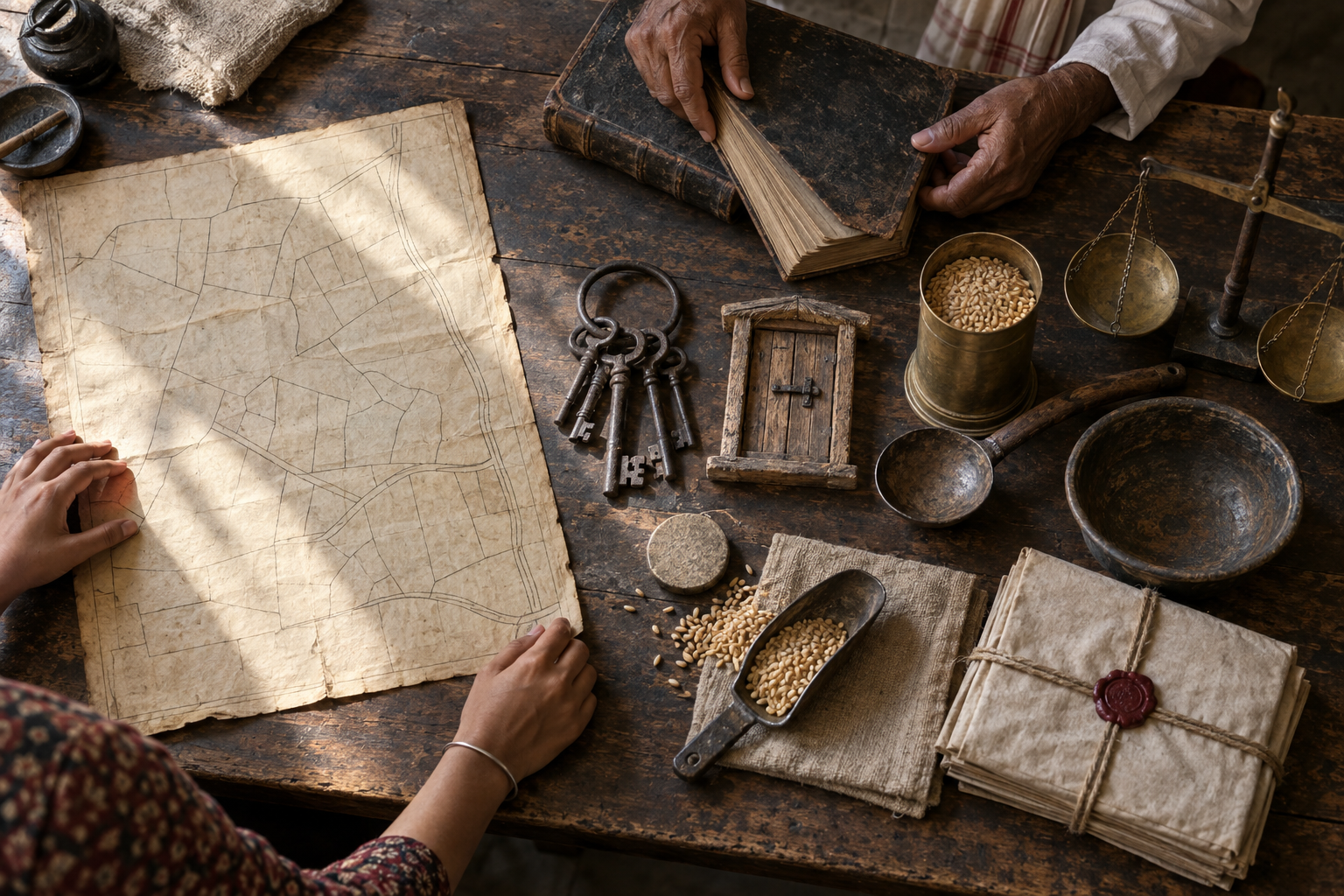
You do not have to choose between uncritical nostalgia and uncritical praise of colonial administration. Use a disciplined test whenever you encounter the claim that British rule introduced organised charity or modern famine relief.
- What existed before the official intervention? Look for endowments, kitchens, religious institutions, community obligations and recurring forms of food-sharing. If the story begins only when the colonial office appears, it may have hidden the institutions that were already working.
- What happened to the underlying assets? A new relief programme does not compensate automatically for a cut to a permanent endowment. Ask whether revenue, land, funds or control were reduced, redirected or made dependent on the state.
- Was the replacement continuous or temporary? Emergency relief and everyday charitable capacity solve different problems. A famine code may organise a crisis while doing nothing to restore a community kitchen that once served people throughout the year.
- Which moral standard judged the older practice? Terms such as indiscriminate charity and dependency are not neutral. Ask why the act was condemned, whose assumptions defined responsible giving and whether the recipient’s dignity was considered.
- Which part is fact, interpretation or continuity claim? Keep the layers separate. An endowment figure is a numerical claim. The damage to Annadanam is an institutional interpretation. The proposition that independent India retained a colonial framework is a continuity claim requiring legal and administrative tracing.
The fifth question prevents both exaggeration and evasion. In the Mysore example, the reported fall from 855,000 to about 200,000 supplies a direction and a proportional scale, but the ambiguous currency wording does not support a confident modern valuation. In the 1880 example, the creation of a relief bureaucracy is distinct from the Dharmic judgment that its operative assumptions were hostile to Annadanam. Each deserves examination on its own terms.
The claim of continuity into independent India deserves the same care. Similar language or procedures may indicate inheritance, but resemblance alone is not enough. To evaluate a present rule, trace its administrative ancestry, identify what has been amended and examine whether it still treats autonomous food-giving as suspect. That method produces a stronger decolonial case than repeating a conclusion without showing the chain.
Also watch for a common rhetorical substitution. The statement that the colonial state created famine relief machinery does not answer whether colonial action had already weakened local resilience. Creation and destruction can occur in the same regime. Counting only the institution created by the state while ignoring the institutions it diminished gives you a false balance sheet.
Rebuild durable capacity rather than ceremonial charity
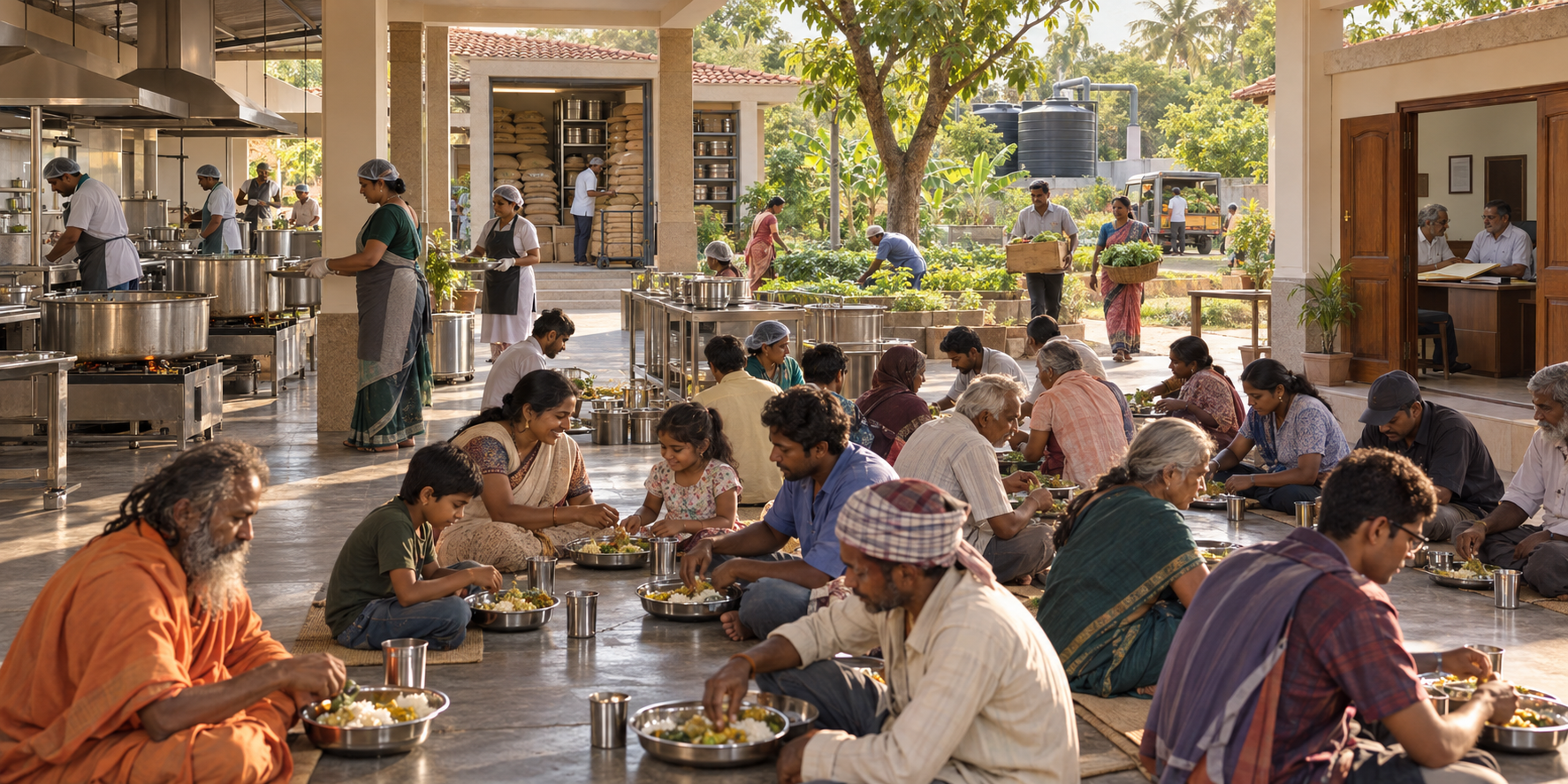
This history matters most when it changes what you support now. Restoring Annadanam does not mean recreating an imagined past or treating every existing institution as beyond scrutiny. It means rebuilding the combination that colonial disruption weakened: durable resources, local responsibility, competent administration and a Dharmic understanding of the recipient.
If you donate to or volunteer with a temple, matha, gurdwara, Jain institution, Buddhist vihara or community kitchen, ask practical questions before judging the programme by the size of a festival meal:
- Is the kitchen recurring? A large annual event is visible, but dependable service through ordinary and difficult periods is the better measure of institutional strength.
- Where does the operating money come from? Distinguish a durable fund or recurring donor base from a last-minute appeal. Both may be useful, but they provide different levels of resilience.
- Who is accountable for the resources? Look for clear governance, understandable accounts and a defined responsibility for food quality, procurement and service.
- Does access preserve dignity? Avoid systems that force people to perform humiliation, display poverty or submit to unnecessary moral judgment in exchange for a meal.
- Is Annadanam taught as well as performed? Volunteers and younger donors should understand why food-giving is dharma, not merely a publicity exercise or an imitation of institutional philanthropy.
- Does measurement strengthen the duty? Record continuity, use of funds and actual service, but do not allow reporting categories to replace the human relationship at the heart of the practice.
A durable fund can help protect recurring service, but do not create restricted funds or alter the objects of a charitable trust casually. Charity, trust and tax rules vary by jurisdiction. Institutions should use qualified legal and accounting advice before changing how assets are held or how donated money may be spent.
Public relief and community charity also need not be enemies. During a large crisis, state coordination may be indispensable. The mistake is allowing official relief to erase autonomous Dharmic capacity. A resilient society keeps both: competent public emergency systems and strong local institutions able to act from duty before, during and after a declared emergency.
You can begin with one institution. Ask how its food programme is funded, whether it can operate beyond special occasions and how recipients are treated. Then help it build recurring capacity, preserve transparent records and teach the meaning of Annadanam to the next generation. That is a concrete way to reverse the colonial pattern: not by remembering charity as a lost ornament, but by restoring it as living social infrastructure.
References
- DharmaRenaissance Blog – How British Colonialism of India Created a Nation of Beggars
