
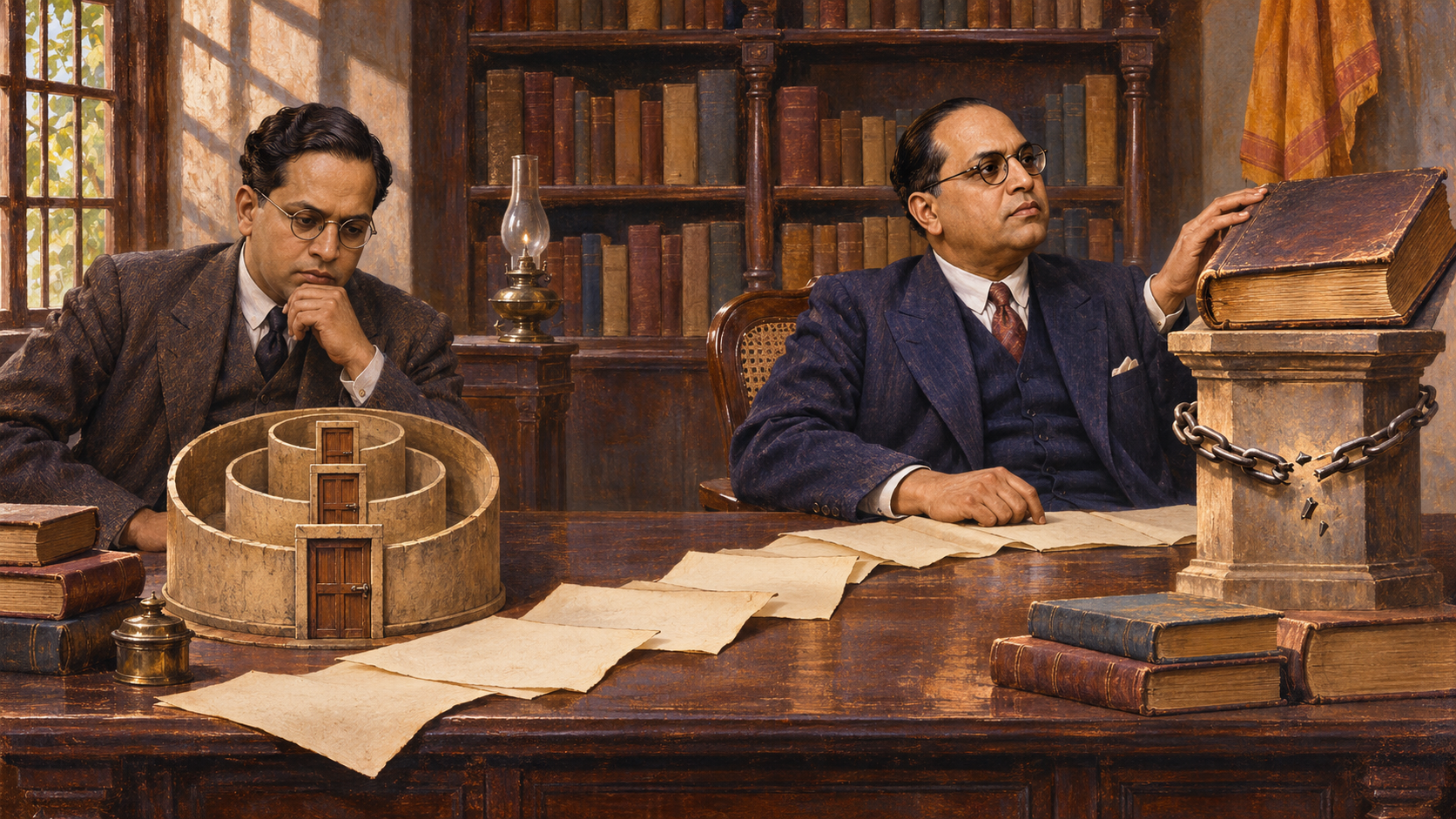
If you have been handed one Ambedkar quotation as proof that caste is either entirely a social custom or entirely a product of Hindu scripture, pause. Ambedkar himself did not keep one diagnosis unchanged.
You can understand the change without canonising him, dismissing him, or turning the question into a loyalty test. Separate three issues: how caste reproduces itself, what gives it moral authority, and what reform must confront. That distinction reveals both the real discontinuity in Ambedkar’s thinking and the limits of the claim that he simply contradicted himself.
From endogamy and imitation to an attack on scriptural authority

In 1916, at the age of twenty-five, Ambedkar presented caste primarily as a system of enclosed marriage circles. Endogamy – marrying within the group – was the mechanism that kept a caste separate. He argued that the arrangement spread through imitation rather than through a single act of imposition. He even called the claim that Brahmins had imposed caste on everyone else “incorrect in thought and malicious in intent”.
That early diagnosis placed social practice before theological justification. Scripture did not create the mechanism; it came later to legitimise or embellish an established arrangement – to “gild the pill,” in Ambedkar’s memorable phrase. Whatever one thinks of the historical adequacy of this explanation, its structure is clear: caste persists because communities police marriage boundaries, and the pattern can spread when other groups imitate a closed and prestigious model.
Twenty years later, Ambedkar’s emphasis was markedly different. In the undelivered 1936 address prepared for a reform association in Lahore, he treated the authority of Hindu sacred tradition as the decisive obstacle. He described Hindu society as “a myth” and urged reformers to “apply the dynamite to the Vedas”. The centre of gravity had moved from explaining a social mechanism to prosecuting the religious order believed to sustain it.
The remedies therefore changed as well. If endogamy and imitation are central, reform must alter family decisions, kinship sanctions and the social rewards attached to group closure. If scriptural authority is the root, reform must break that authority. Those are not interchangeable programmes, even when both are directed against caste hierarchy.
The timing supplies important context. Ambedkar made his Yeola declaration in 1935 that he would not die a Hindu, before composing the 1936 address. His religious departure and his sharpened attack on Hindu authority therefore belonged to the same period. But sequence alone cannot establish that he invented an argument merely to justify leaving. It establishes alignment between his intellectual turn and his religious decision, not the private motive behind either one.
The two diagnoses can be partly reconciled, but not made identical

The easiest response is to choose one Ambedkar and discard the other. That is also the least illuminating response. A better reading asks whether he was answering different questions.
Endogamy answers the question, “By what recurring act does caste reproduce itself?” Scriptural sanction answers another question: “Why do people regard inherited distinctions as legitimate or binding?” A practice can originate socially, reproduce through marriage and later acquire religious authority. In that limited sense, the two explanations can coexist.
That reconciliation has a boundary. If the later claim means that scripture originally produced caste, it conflicts with the earlier sequence in which social closure came first and theological justification followed. If it means only that scriptural prestige later protected caste within Hindu society, the conflict is reduced. The distinction turns on what “root cause” is supposed to mean: historical origin, continuing mechanism, moral justification or political obstacle.
Ambedkar never supplied the completed synthesis that would settle the matter. In 1944, he said that he had intended to recast the later argument so that it would absorb the earlier one, but had abandoned the task for lack of time. That uncompleted plan to merge the two analyses shows at minimum that their relationship needed further work. Readers should not pretend that the work was done.
The most defensible conclusion is therefore precise. Ambedkar retained his opposition to caste, but he revised the causal emphasis and radicalised the remedy. Some parts of the revision can be understood as a shift from social reproduction to ideological legitimation. Other parts remain in genuine tension. “Ambedkar changed his mind” is accurate; “everything he wrote is mutually consistent” is not. Yet “nothing he wrote can be trusted” does not follow either.
Caste outside Hindu society tests the strongest scriptural claim
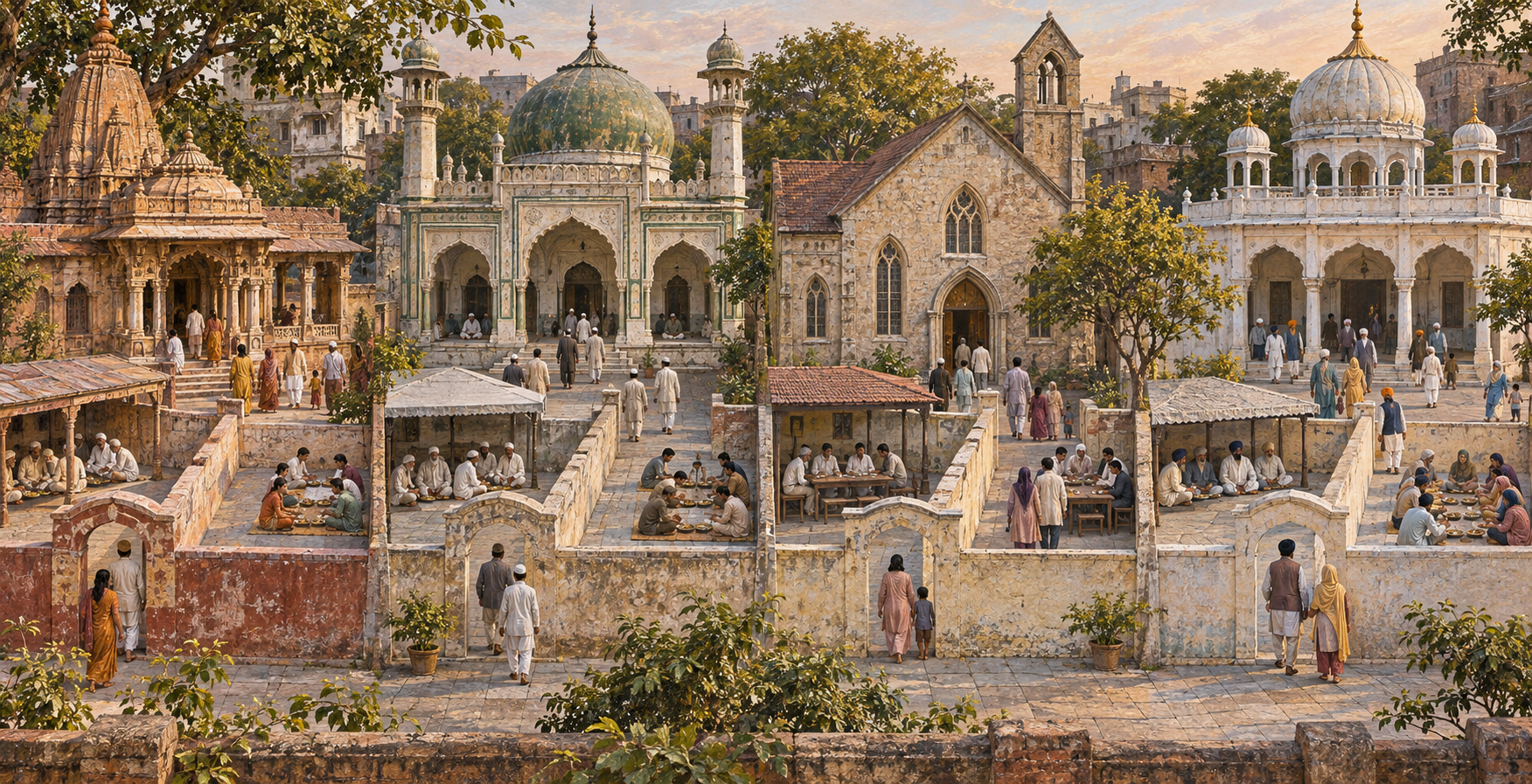
Ambedkar also acknowledged that caste distinctions persisted among Muslims, Christians and Sikhs even though their scriptures did not command such an arrangement. That concession matters because it allows you to test different claims instead of debating the word “scripture” in the abstract.
First, it weakens the claim that Hindu scripture is a necessary cause of every caste formation. If caste can survive in communities governed by other religious authorities, something besides Hindu sacred teaching must be capable of reproducing it.
Second, it does not prove that religious authority is irrelevant within Hindu society. A belief need not be the universal or original cause of a practice to reinforce that practice in a particular community. Hindu texts, interpretations or customary authorities could be invoked to defend caste even if similar divisions elsewhere arose through inherited social habits.
Third, the concession warns against treating conversion as an automatic social cure. A person can adopt a different theology while families continue to police marriage, ancestry, status and association. If the mechanism is carried through kinship and community memory, changing religious affiliation does not by itself dismantle it.
This is where the early emphasis on endogamy regains practical force. Ask who may marry whom, what happens when a couple crosses a caste boundary, and whether families confer or withdraw acceptance on the basis of birth. Those questions reveal the operating mechanism more reliably than a community’s formal declaration that caste has no place in its theology.
Key takeaways for reading Ambedkar without turning him into an oracle
- Identify the question before quoting the answer. Origin, reproduction, legitimation and remedy are different questions. A statement about one does not automatically settle the others.
- Read 1916 and 1936 in their own argumentative settings. The younger Ambedkar was constructing a social explanation centred on endogamy and imitation. The later Ambedkar was demanding radical reform and attacking the authority he believed obstructed it.
- Do not hide the revision. Ambedkar moved from denying a simple Brahminical imposition theory to making Hindu scriptural authority a central target. Calling this merely a change of vocabulary understates it.
- Do not infer private motive from chronology alone. The 1935 vow provides relevant context for the 1936 attack, but it cannot by itself prove insincerity or fabrication.
- Test broad claims against non-Hindu cases. The persistence of caste among Muslims, Christians and Sikhs challenges any explanation that makes Hindu scripture the sole necessary cause.
- Judge propositions, not sacred personalities. Respect for Ambedkar’s struggle against caste does not require treating every stage of his analysis as infallible. Criticising an inconsistency does not erase the injustice he opposed.
A Dharmic answer has to reform conduct, not merely win an argument

If you are defending Hindu Dharma, the 1916 analysis offers a strong reason to reject sweeping claims that scripture mechanically created every caste boundary. It does not offer permission to ignore birth-based exclusion. A tradition is not vindicated merely because a hostile causal theory is incomplete.
Begin where the mechanism operates. A family that denounces caste discrimination in public but threatens ostracism over an inter-caste marriage is preserving endogamy at the decisive point. A community that speaks of spiritual equality while sorting participation, fellowship or dignity by birth is doing the same work through other means. Reform has to reach those decisions rather than stopping at declarations.
Then examine claims of scriptural authority one by one. When someone invokes a verse, commentary or inherited rule to defend birth-based inferiority, ask for the exact claim, its context and the authority assigned to it. Do not accept the vague assertion that “the scriptures demand it.” But do not answer a specific discriminatory interpretation with the equally vague claim that Dharma can never be misused. The relevant task is to distinguish spiritual teaching from the social interests attached to it.
Finally, apply the same standard outside Hindu society. If caste-like closure continues after conversion, call it what it is. Otherwise, criticism of Hindu society becomes a sectarian weapon rather than a serious attempt to remove inherited hierarchy.
You do not have to choose between accepting Ambedkar’s later indictment wholesale and dismissing him because his analysis changed. Use the tension as a diagnostic tool. Challenge exaggerated attacks on Dharma, confront discriminatory practice inside Dharmic communities, and keep asking which mechanism a proposed reform will actually change.
References

Leave a Reply
You must be logged in to post a comment.