
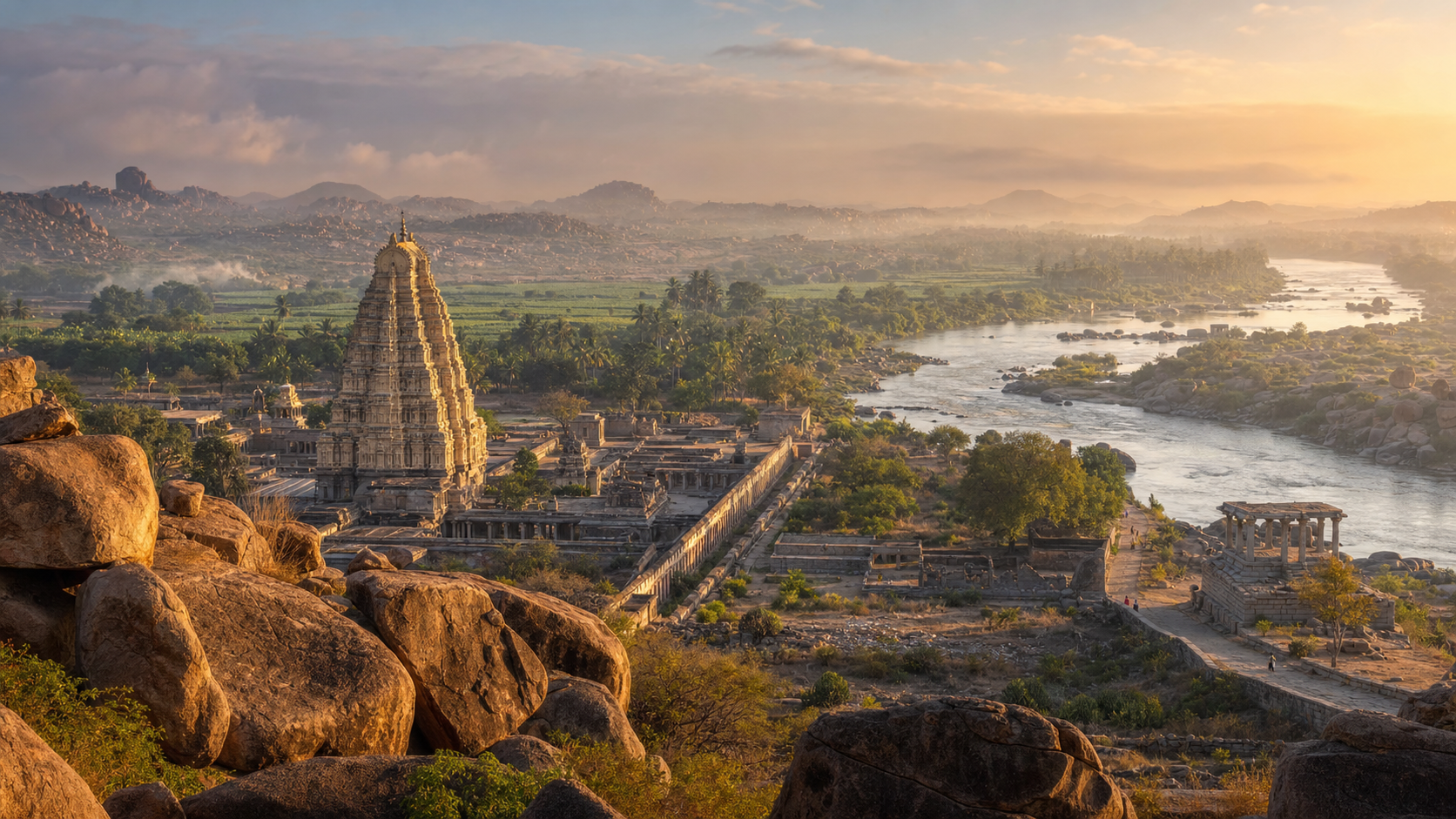
If you arrive at Hampi asking only which ruins you should see, you are starting one layer too late. The quickest way to misunderstand the place is to treat its temples, boulder hills, bazaars and broken royal structures as separate attractions.
Read Hampi in sequence instead: as the remembered landscape of Kishkinda, as a sacred centre shaped by Pampa and Virupaksha, as the capital of Vijayanagara, and as a wounded tirtha whose meaning still places obligations on visitors. That sequence will help you notice why the city arose here, what its builders accomplished and what responsible preservation must protect.
Read Pampa before you read the palaces
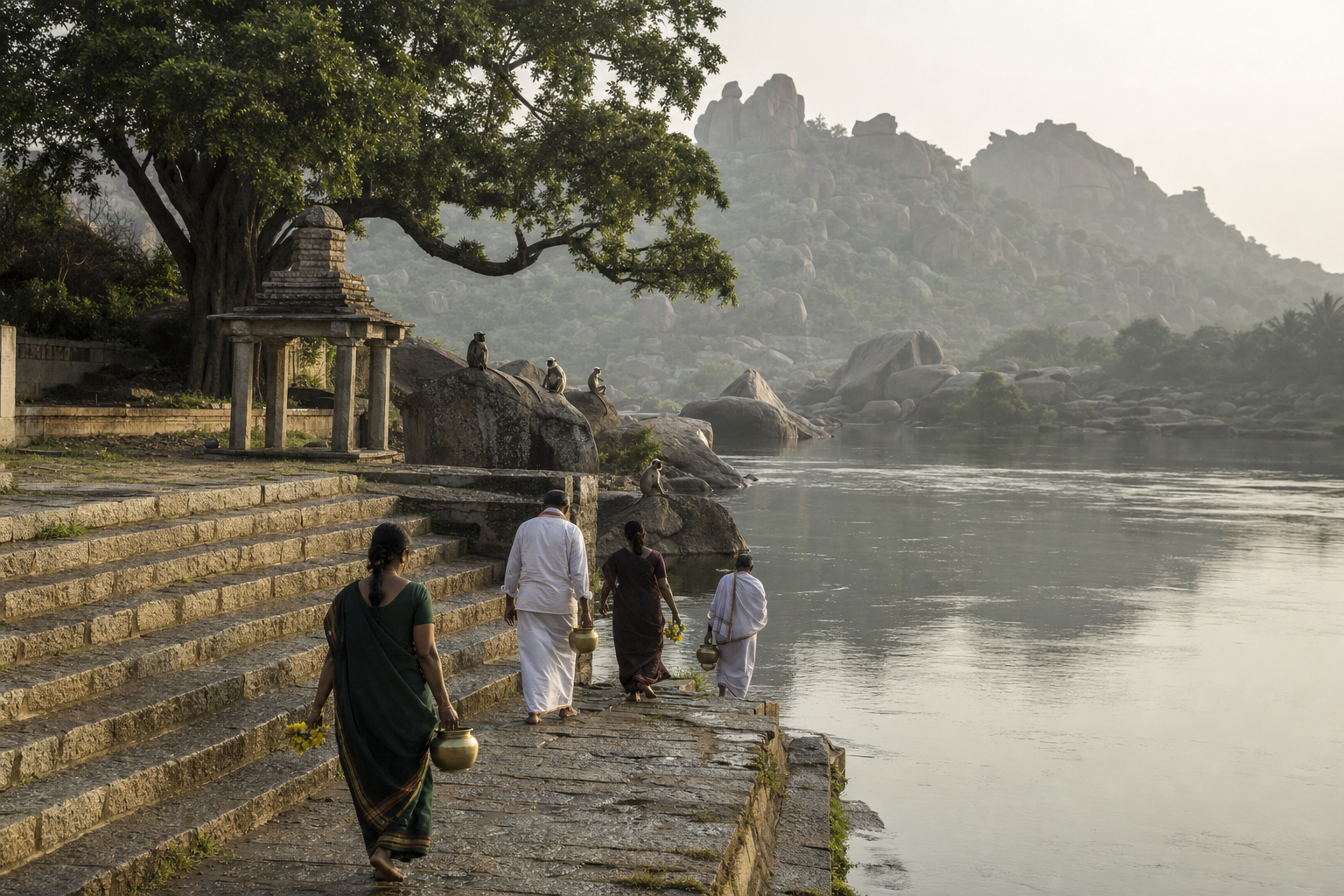
Hampi’s history does not begin with an imperial foundation. In living Indian tradition, the Tungabhadra valley belongs to the sacred geography of the Ramayana: Pampa, Kishkinda, Hanuman, Sugriva, Rama and Lakshmana are remembered through its waters, caves, hills and groves. The landscape is therefore more than scenery surrounding an archaeological zone. It carries narrative memory.
The Kishkinda Kanda is unusual among the Ramayana’s major books because its name is the name of a place. That detail tells you how closely action and geography are joined. Near Pampa, Rama’s remembrance of Sita deepens; the meeting with Hanuman prepares the alliance with Sugriva; and the narrative turns towards the search that will eventually lead south to Rameswaram and Lanka. Pampa is not a decorative pause in the story. It is an emotional and strategic hinge.
Valmiki’s descriptions, especially the account associated with the seventy-third chapter of the Aranya Kanda, dwell on lotus-bearing waters, wildlife, hillocks, caves and abundant vegetation. When you encounter Hampi’s granite masses and water-shaped spaces, compare what you see with that literary environment. The comparison turns an apparently severe landscape into a field of relationships: water below rock, shelter within hill, cultivated space beside wilderness and memory attached to natural form.
You should still keep two kinds of claim distinct. Tradition’s identification of the region with Kishkinda is not the same thing as archaeological proof for every modern landmark label. You do not have to collapse sacred memory into a material dating exercise, nor must you pretend that every popular identification carries equal evidentiary weight. Ask what a place means within the tradition, what the text actually describes and what the surviving terrain allows you to notice. That is a more serious approach than either credulous tourism or automatic dismissal.
Before concentrating on individual monuments, orient yourself through three questions: Where is the water that sustains the landscape? Which hills and shrines carry Ramayana memory? How does the Virupaksha-Pampa sacred axis give the wider region coherence? Once you have those bearings, the imperial city will no longer look as though it appeared arbitrarily among picturesque rocks.
Vijayanagara turned sacred geography into statecraft
The choice of this region as an imperial capital joined sanctity, terrain and political purpose. The memory of Kishkinda, the holiness of Pampa and the Virupaksha tradition gave the capital a civilizational centre. Granite ridges offered a landscape that could be fortified. The river and associated hydraulic works supported settlement and cultivation. Vijayanagara did not place religion on top of an otherwise neutral city; it developed an imperial city within a landscape that already possessed sacred meaning.
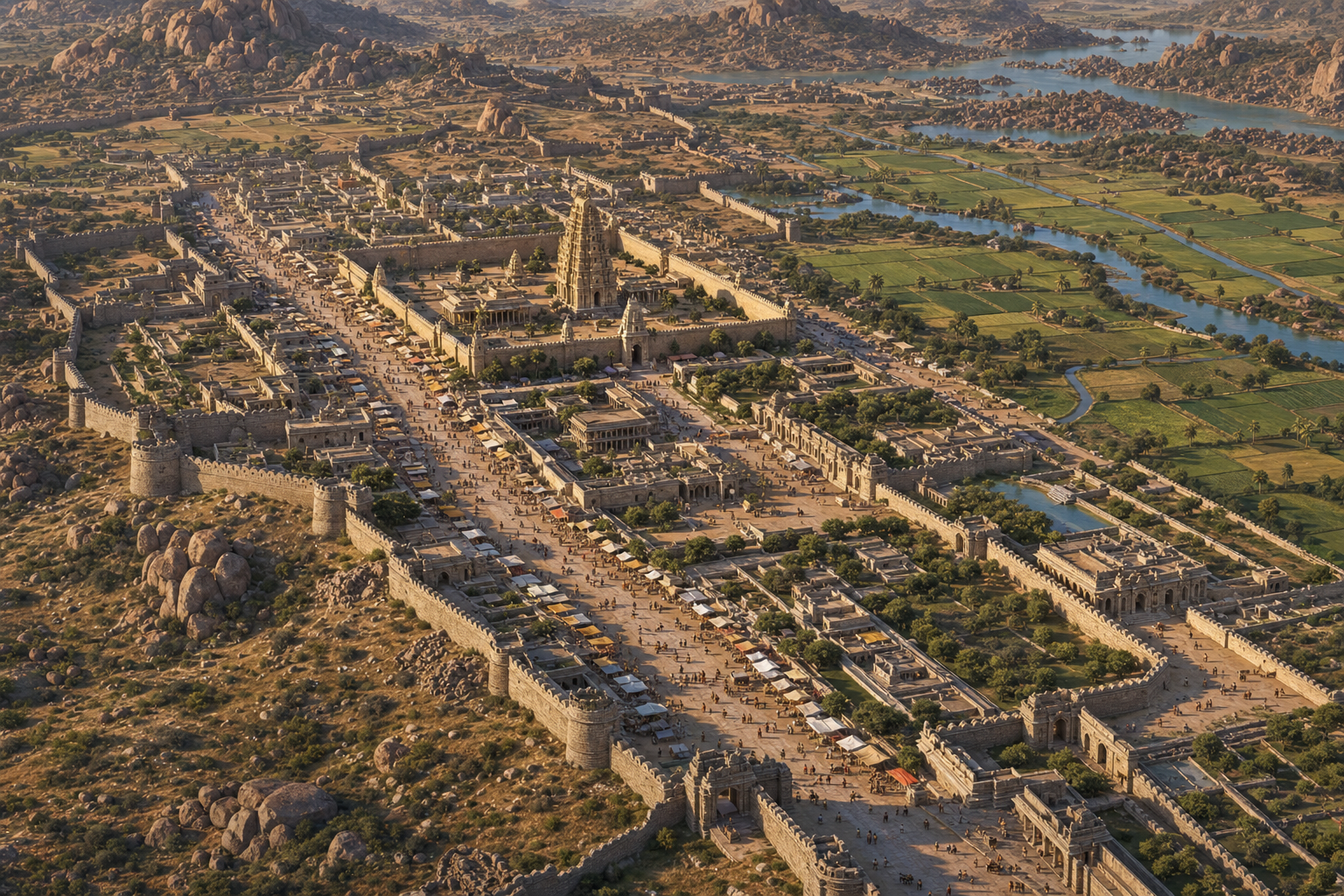
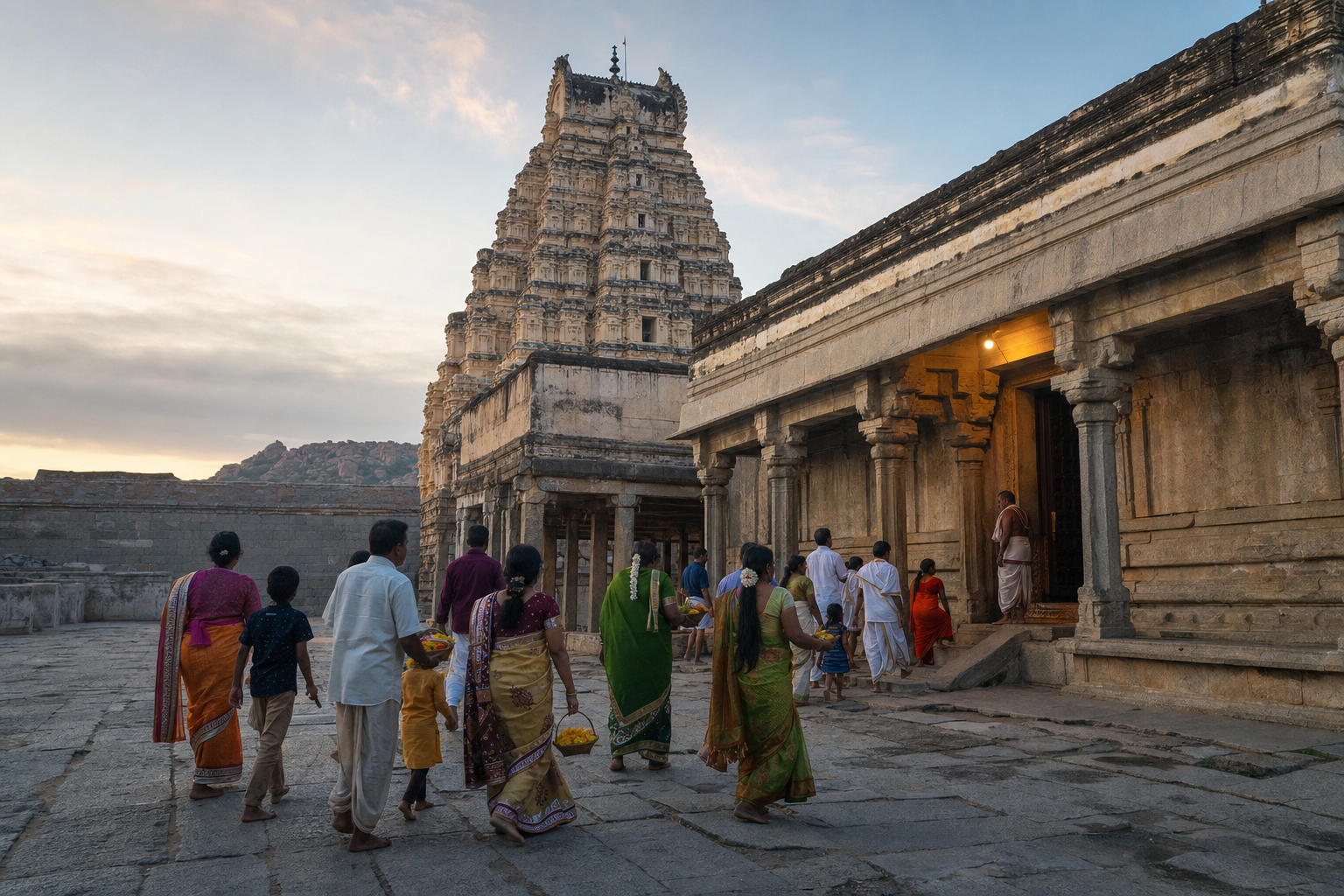
This is why temple and state should not be separated when you read Hampi. Its temples, mantapas, market streets, canals, aqueducts and fortified ridgelines belonged to one urban organism. Ritual processions required avenues. Temples participated in social and economic life. Water management made dense settlement possible. Fortifications used the topography rather than treating it as an obstacle. Markets brought everyday exchange into spaces ordered by sacred and royal institutions.
That urban organism was neither small nor isolated. Niccolo de’ Conti, Abdur Razzaq, Domingo Paes and Fernao Nunes encountered a city whose scale, administration and commercial vitality impressed visitors from different worlds. Its economic connections reached across Indian Ocean and Mediterranean circuits towards Persia, China, Lisbon and Venice. Hampi therefore corrects a lazy opposition that still distorts Indian history: a self-consciously Hindu imperial centre did not have to be commercially closed or culturally timid.
When you walk beside a bazaar avenue, do not imagine only rows of modern souvenir stalls projected into the past. Look for the relationship among the street, its adjoining structures, the temple axis and the movement of large numbers of people. When you encounter a canal, tank or aqueduct, do not treat it as a minor engineering curiosity. It is evidence of the planning that allowed ritual, commerce, agriculture, military security and domestic life to occupy the same capital.
This joined-up reading also clarifies Vijayanagara’s larger historical role. Its rulers consolidated a powerful southern polity during a period of severe conflict and political instability elsewhere in the subcontinent. The capital’s brilliance was not merely ornamental. Prosperity, administration, military power, religious patronage and control of infrastructure reinforced one another. Hampi’s sacred identity gave the state legitimacy and orientation; imperial capacity gave sacred institutions protection, resources and monumental expression.
The destruction changed how every surviving stone must be read
The Battle of Talikota in 1565 ended more than a contest among rulers. Aliya Rama Raya fell, the victorious Deccan coalition entered the capital, and a prolonged sack devastated Vijayanagara. The destruction attacked the material and symbolic centre of a rival power. South India did not subsequently produce another Hindu empire of comparable scale, giving the fall consequences far beyond the abandoned capital.
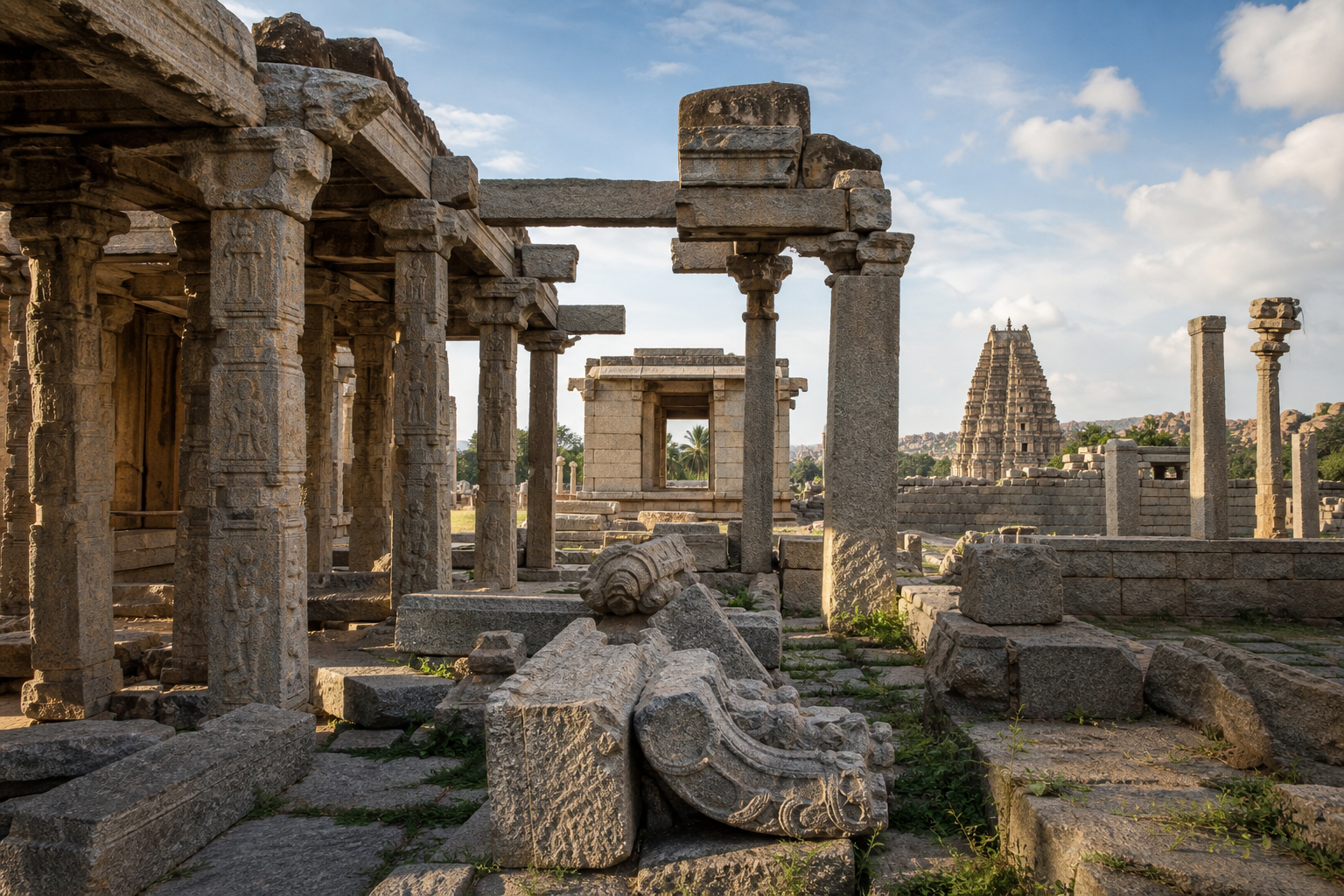
Not every broken element at Hampi should be assigned casually to one event. Weathering, reuse, neglect and later intervention all complicate ruined places. Yet it would be equally misleading to turn the capital’s condition into a vague story of time passing. The historical narratives and physical evidence of destruction make catastrophe central to any honest reading of the site.
The scale helps correct what your eyes can otherwise underestimate. Historical and archaeological surveys place the wider city at approximately 236.46 square kilometres. The core capital zone covered roughly 42 square kilometres and contains about 1,600 surviving monument remains. Those remains are extensive enough to overwhelm a visitor, but they are still fragments of a metropolis. Hampi is not a complete city that happens to lack roofs. It is a surviving fraction of a much larger political, economic and sacred system.
This distinction changes what you notice. An empty stretch may register the disappearance of an urban connection rather than the absence of anything important. A damaged shrine may represent interrupted worship as well as lost sculpture. A broad avenue without its crowds, goods, ceremonies and institutions preserves dimensions but not the full life once organised there. The Kannada remembrance Halu Hampi, or desolate Hampi, carries this awareness of civilizational loss more accurately than romantic photographs of picturesque ruins can.
The deepest breach was therefore not only architectural. A sacred place loses something when it can no longer recollect and express its purpose through living norms. Walls can be stabilised while the surrounding culture is trivialised. A monument can remain photographable while its ritual ecology is weakened. Hampi asks you to distinguish preservation of objects from preservation of meaning.
Visit Hampi as a pilgrim-student, not a monument collector
You do not need to arrive on a formal pilgrimage to behave with the attentiveness of one. You need an order of seeing and a few firm limits. The following sequence is interpretive rather than a claim about the fastest physical route; local access conditions and your point of arrival may require a different itinerary.
- Begin with the sacred frame. Learn the relationship among Pampa, Kishkinda, Anjanadri and Virupaksha before treating the imperial monuments as isolated masterpieces. Even a short reading from the relevant Ramayana episodes will give the hills and water narrative depth.
- Read the city as a system. At each major precinct, identify the temple or royal focus, the route by which people approached it, the adjoining market or gathering space, the nearest water infrastructure and the surrounding defensive terrain. This prevents monument-by-monument fatigue and reveals why structures occupy their particular places.
- Make room for absence. Do not hurry past damaged or empty areas merely because they offer fewer photographs. Ask what activity would have connected the surviving elements and how the sack of the capital altered that relationship.
- Return to the living landscape. End your reading with the river, hills and sacred associations rather than with the fall alone. Vijayanagara was destroyed as a capital, but Hampi did not cease to be a tirtha-kshetra. That continuity is the reason its future cannot be managed as ordinary recreational real estate.
The need for limits is not theoretical. Since the mid-2000s, an expanding backpacker circuit linking Goa, Gokarna and Hampi encouraged unauthorised resorts, homestays and shacks in parts of the region. Virupapura Gaddi, popularly repackaged as Hippie Island despite its proximity to the Virupaksha sacred complex and its own devata sites, became associated with party culture, illegal construction and substance use. A court-ordered closure followed in 2020.
The lesson is not that visitors or local livelihoods are the problem. Tourism can support families, guides, craftspeople and transport providers. The problem begins when the visitor economy is allowed to rewrite the meaning of the place it depends on. A sacred precinct cannot be governed as though demand for nightlife, intoxicants or unrestricted construction automatically overrides ritual norms and ecological capacity.
Your own conduct is a small but real part of that economy. Choose lawful accommodation rather than rewarding encroachment. Use guides who can explain sacred, hydraulic and political history instead of offering only photo stops. Keep intoxicants, loud entertainment and casual profanity away from the tirtha. Reduce noise and waste around shrines, riverbanks and hills even when no barrier or sign orders you to do so. Pay local people fairly, but do not treat their need for income as permission to demand whatever a tourist market can purchase.
Ecological claims require the same discipline. Reports of declining monkey numbers concern specific pockets of the Kishkinda landscape; they do not by themselves establish a measured decline across the whole region or identify one proven cause. Habitat fragmentation, changing human-animal interactions and management measures all warrant investigation. Support habitat protection and rigorous surveys, but do not turn an uncertain baseline into a confident story for social media.
If you participate in heritage advocacy, judge proposals by concrete tests. Do they place sacred precincts ahead of nightlife development? Do they set visitor-capacity limits for peak periods? Do they act against illegal construction and narcotics without criminalising lawful local livelihoods? Do they restore riverine and hill ecosystems? Do temple institutions, local panchayats, scholars, monastic voices and trained heritage managers share responsibility? Do interpretation centres explain the continuum from Kishkinda to Vijayanagara through texts, inscriptions, archaeology, music, bhajan, harikatha and dance?
Research and preservation must also work together. Epigraphic digitisation can keep inscriptions accessible. Hydraulic mapping can show how canals, tanks and aqueducts sustained the capital. Archaeological documentation can record structures before further deterioration. Intangible-heritage recording can preserve ritual memory, oral knowledge and performance traditions. The strongest training programmes will teach conservators both scientific method and the Dharmic meanings carried by sacred space.
The wider Dharmic vocabulary offers a sound ethic for this work: ahimsa towards living beings and habitats, tapas as restraint, seva as service and reverence for tirtha as inherited responsibility. Hindu, Buddhist, Jain and Sikh traditions remain distinct; stewardship does not require flattening those distinctions. It requires recognising that sacred geography forms people through disciplined conduct, not merely through admiration.
Key takeaways
- Hampi is best understood in layers: Kishkinda’s remembered landscape, the Pampa-Virupaksha sacred centre, Vijayanagara’s imperial city and the wounded tirtha that survives both conquest and commercial pressure.
- Sacred identity and imperial planning were mutually reinforcing. Temples, bazaars, waterworks, processional spaces and fortifications formed one urban system.
- The approximately 1,600 surviving remains belong to a core zone of roughly 42 square kilometres within a much larger estimated city. What survives should never be mistaken for the whole metropolis.
- The sack following Talikota in 1565 was a political and civilizational rupture, not simply the picturesque decay of an old city.
- Responsible visitors choose lawful services, respect ritual boundaries, limit noise and waste, avoid intoxicant culture in the tirtha and learn how natural and built features relate.
- Successful conservation must protect living sanctity, local livelihoods, ecology and historical evidence together. Saving masonry while surrendering the meaning of the place is not enough.
Before you go, read the Kishkinda episodes, choose a lawful place to stay and give your first attention to Pampa, Virupaksha and the surrounding sacred terrain. Then enter the imperial city with four things in view: worship, water, commerce and defence. Hampi will stop looking like a collection of ruins and begin to disclose the civilization that made those stones intelligible.
References
