
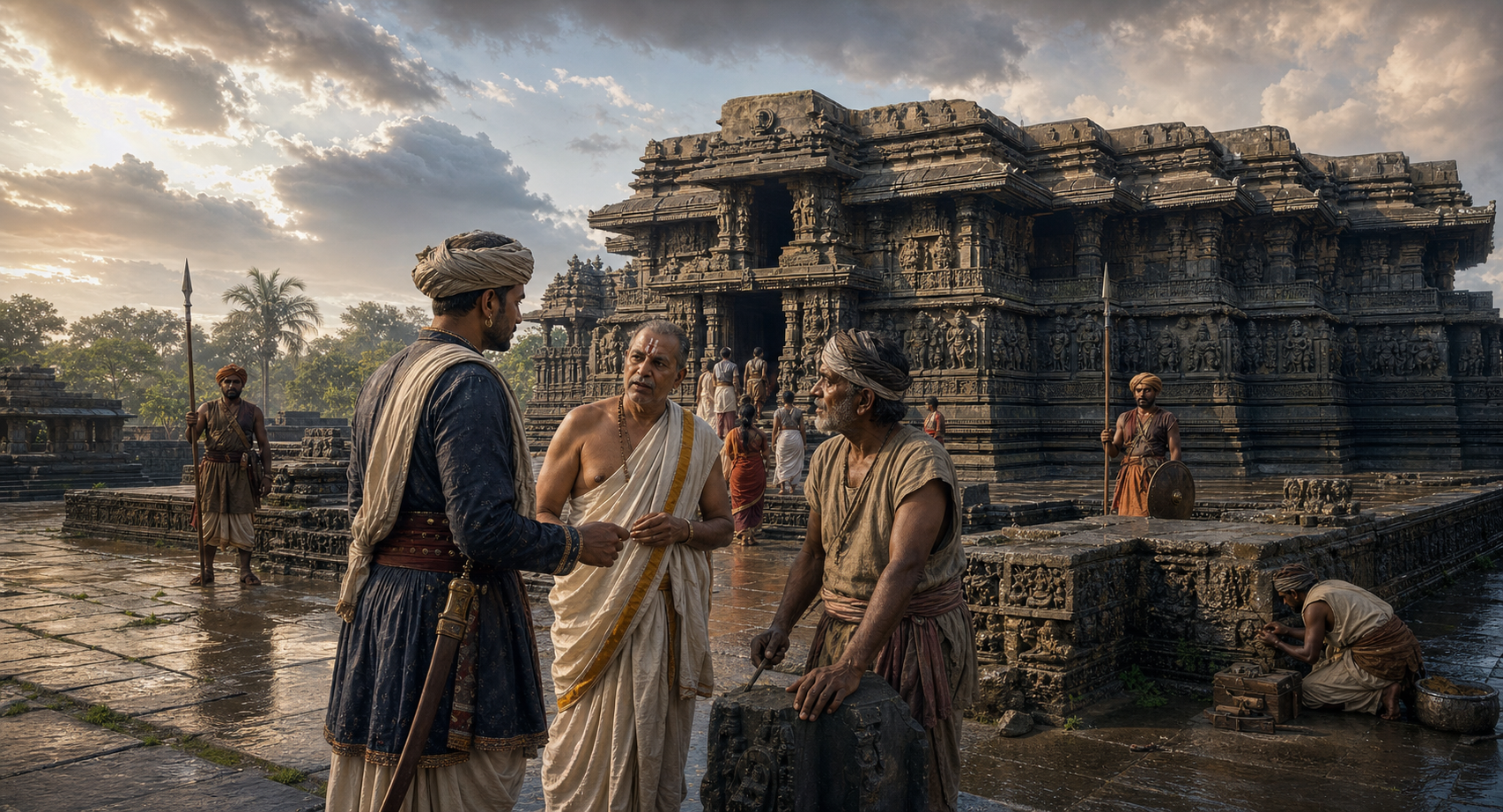
If you are trying to decide whether a temple project is genuine stewardship or merely an impressive renovation, look beyond the proposed construction. Who will protect the site, preserve worship, retain skilled people, support the surrounding community, and remain accountable after the ceremonial reopening?
Gunda Daṇḍanātha’s service under Harihara II offers a demanding answer. At Belur, military defence did not end with the removal of an immediate threat. It led to political stabilisation and the restoration of a damaged sacred institution. That sequence gives you a practical standard for judging heritage work now: protect what is vulnerable, restore what gives it life, and build the conditions for continuity.
Why Gunda’s office matters as much as his victory
Little survives about Gunda’s birth, family, or early life. His historical outline comes instead from two inscriptional appearances, at Channapattana in 1395 CE and Belur in 1397 CE, during the reign of Harihara II, who ruled from 1377 to 1404 CE. That scarcity is revealing. Gunda was remembered chiefly through office, service, and public acts rather than through an elaborate personal biography.
Daṇḍanātha and the related title Daṇḍanāyaka identified more than a battlefield commander. Such officers could carry responsibility for forts, territorial administration, revenue, trade routes, and local order alongside military command. You should not force this position into a single modern category such as general, governor, or minister. Its importance lay precisely in joining functions that modern institutions often divide.
In the 1395 Channapattana setting, Gunda appears as the senior minister Gundappa Daṇṇāyaka Odeyar during a grant made at Malaur-sthala to Kaliyappa-Setti, the senior merchant of Horapattanagiri. The transaction was carried out through an administrative formation described as the “Eighteen country,” meaning eighteen districts. This does not establish every detail of Gunda’s jurisdiction, but it does place him inside the ordinary machinery of grants, merchants, territorial authority, and local administration.
That matters because durable kingdoms are not defended only at their borders. Merchants must be able to transact, authorities must be recognisable, and decisions must pass through institutions people can use. Put Gunda’s commercial-administrative role beside his military reputation and you can see the Vijayanagara logic: the officer who confronted an external threat was also expected to sustain the internal order that made recovery possible.
Gunda’s relationship with Harihara II was framed through the trusted service of Sumantra to Daśaratha and the Rāma–Māruti relationship. These comparisons belong to the elevated language of praśasti, or royal eulogy; they are not literal measurements of policy or personality. They do, however, disclose the expected moral shape of office. Power was meant to be disciplined by loyalty, competence, and service to a dharmic sovereign purpose.
The Vijayanagara sequence was protection, stability, then renewal
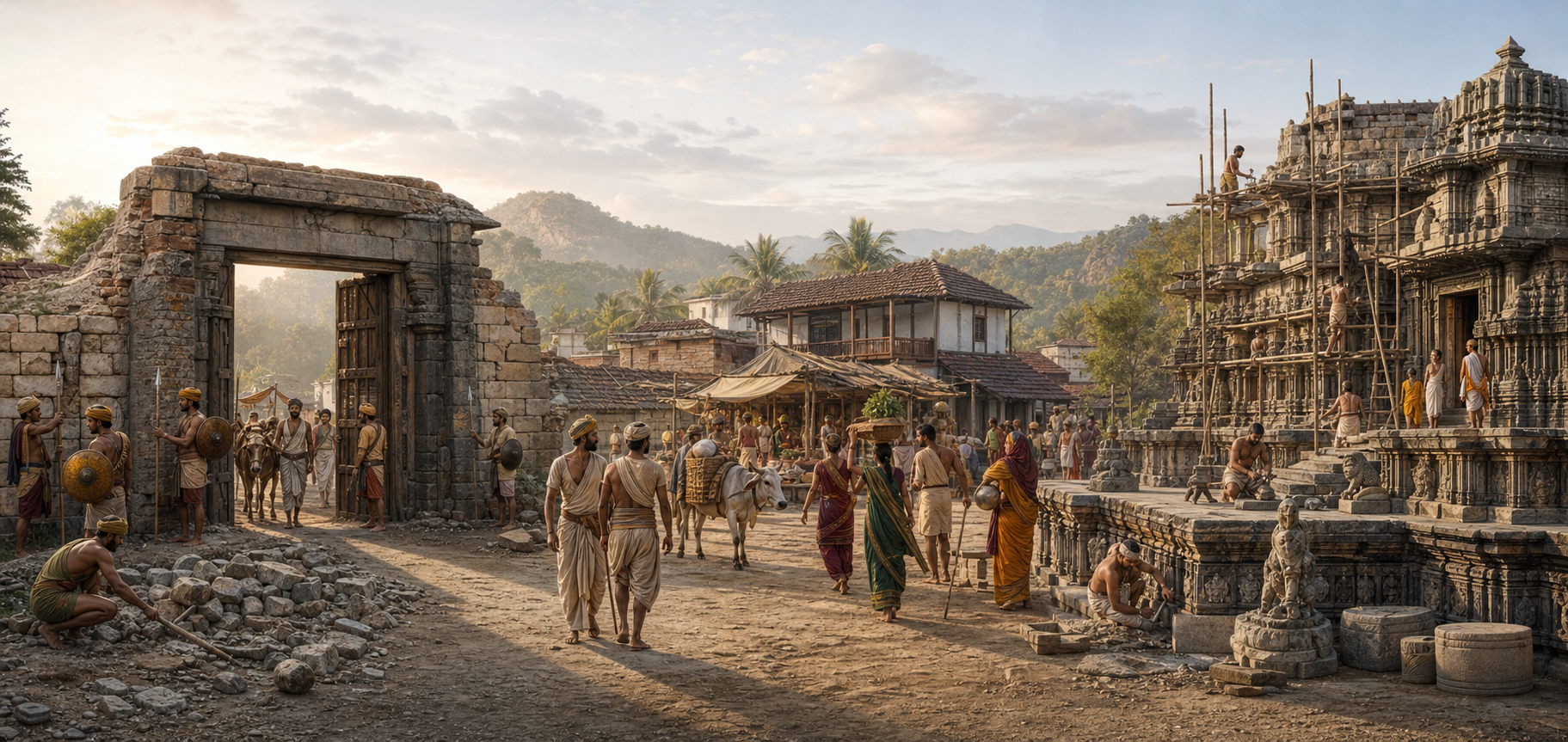
The crisis at Belur unfolded amid renewed Vijayanagara–Bahmani hostilities. Tāj-ud-dīn Fīrūz Shāh ascended the Bahmani throne at Gulbarga in 1397 CE. Within the Vijayanagara commemoration of the conflict, Salar Gangu of Gulbarga receives blame for an assault on the Chennakeshava Temple in which the principal door was burned and a tower was brought down. This is the Vijayanagara side of a contested frontier war, so its description of the enemy and the scale of victory require the restraint appropriate to martial praise.
The central sequence is nevertheless clear. Gunda receives credit for defeating the immediate invading force, carrying the counteroffensive into hostile territory, and marking success with jaya-stambhas, or pillars of victory. He then sought and obtained Harihara II’s approval to restore the damaged temple. The campaign’s remembered endpoint was not punishment. It was the renewed security and sacred life of Belur.
Protection came first. Conservation cannot proceed while a place remains exposed to continuing attack or disorder. In a modern setting, that principle normally means lawful site security, controlled access, fire and disaster preparation, accurate documentation, and an authority capable of responding when a threat appears. The medieval military setting should not be copied literally; the underlying duty to prevent repeat damage should.
Stability came next. Removing an attacker does not automatically reopen roads, restore confidence, settle administrative responsibilities, or reconnect a temple town to trade. Gunda’s civil role matters here. Vijayanagara could link military action with the territorial and commercial administration required after the clash had ended.
Restoration followed through recognised authority. Gunda did not treat the damaged temple as a private trophy. Royal sanction placed the work within public responsibility. For you, the modern question is equally concrete: who owns the decision, who approves interventions, who carries professional responsibility, and who will answer for maintenance after the visible work is finished?
This order corrects a common failure in heritage advocacy. Public attention often concentrates on the photogenic repair while site protection, institutional authority, and long-term operation remain vague. Belur’s recovery points in the opposite direction. A repaired gateway has limited value if the institution behind it remains insecure or unable to function.
Restoring Belur meant more than rebuilding a doorway
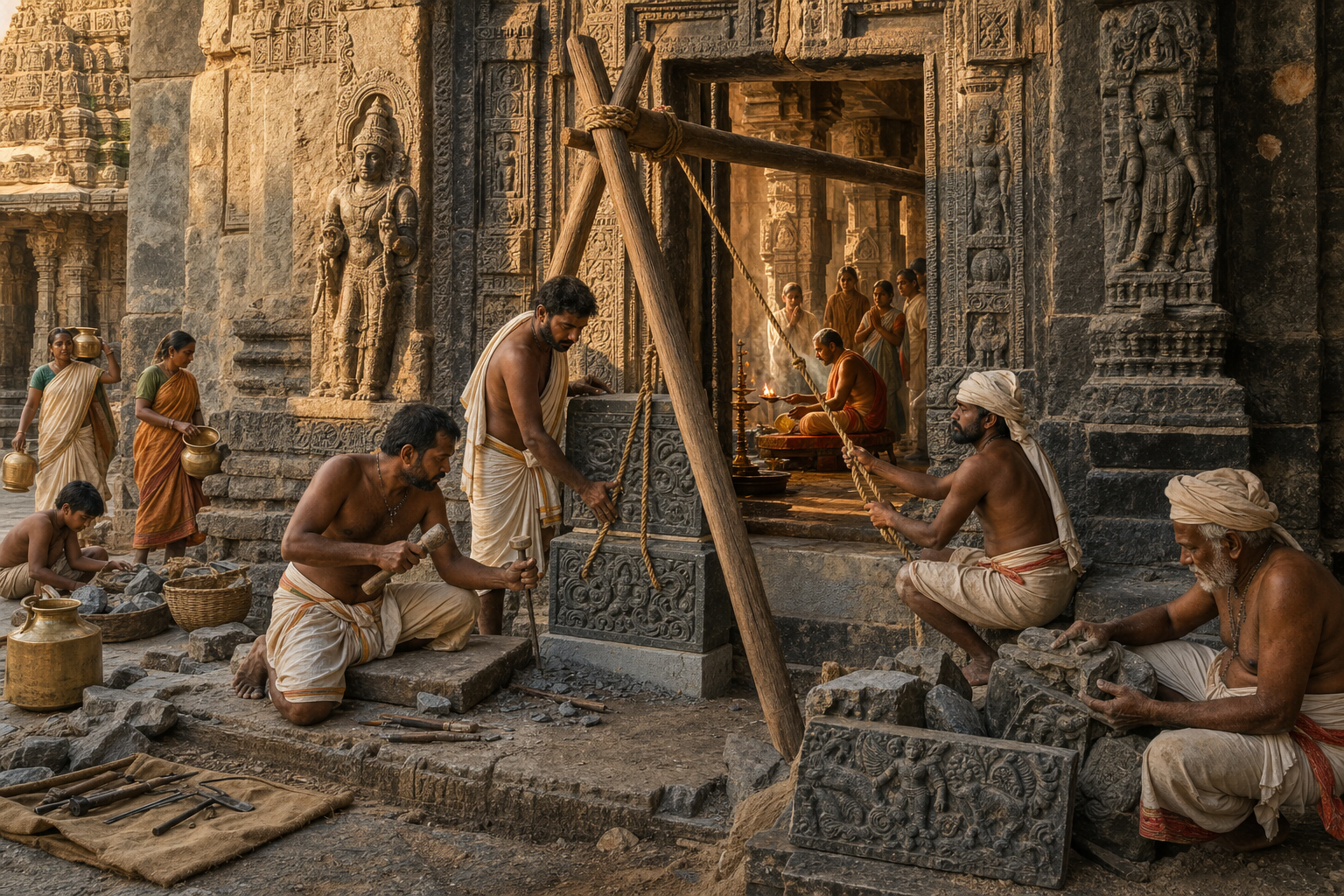
Chennakeshava was already an inherited monument when Vijayanagara assumed responsibility for its recovery. Founded under the Hoysalas, the Belur complex is distinguished by its star-shaped platform, lathe-turned pillars, finely worked soapstone, layered friezes, and narrative sculpture. Its architectural and sculptural sophistication depended on organised artisanal knowledge, not just an isolated act of royal patronage.
The cross-dynastic character of the restoration deserves attention. Vijayanagara did not have to originate a monument in order to accept responsibility for it. The temple came from an earlier political order, but its sacred importance and living place in the region survived that change. Heritage stewardship therefore meant custodianship of a civilisational inheritance, not branding everything with the reigning dynasty.
The first layer was physical fabric. The burned door and damaged tower required material intervention. At a monument shaped by specialised stonework and a coherent sculptural programme, repair cannot be judged only by whether a missing element has been replaced. You must ask whether the intervention respects the surviving fabric, form, material, workmanship, and visual relationships of the whole complex.
The second layer was sacred function. A temple is not complete merely because visitors can enter it again. Ritual cycles, temple personnel, offerings, festivals, and the ordinary rhythm of worship turn architecture into a living institution. Where those functions have been interrupted, a project that repairs masonry but cannot reactivate sacred life has completed only part of the work.
The third layer was human capability. Complex monuments depend on people who know how to maintain them: ritual specialists, administrators, artisans, suppliers, and custodians. If a project treats these people as temporary labour around a permanent building, it reverses the real relationship. The structure survives because knowledge and responsibility survive.
The fourth layer was the temple town. Damage to a major sanctuary affects patrons, craft networks, merchants, pilgrims, and the exchanges clustered around the sacred precinct. The 1395 merchant grant is relevant precisely because it prevents us from imagining Gunda only on a battlefield. The administrative world that supported trade and the military world that protected Belur belonged to the same system of governance.
A comprehensive understanding of restoration must hold these layers together. The surviving evidence does not provide an itemised account of every ritual endowment, artisan payment, or commercial measure associated with Gunda’s intervention, so those details should not be invented. It does support a stronger institutional conclusion: restoring a major temple required more than repairing the most visible evidence of attack.
How to read martial praise without losing the history
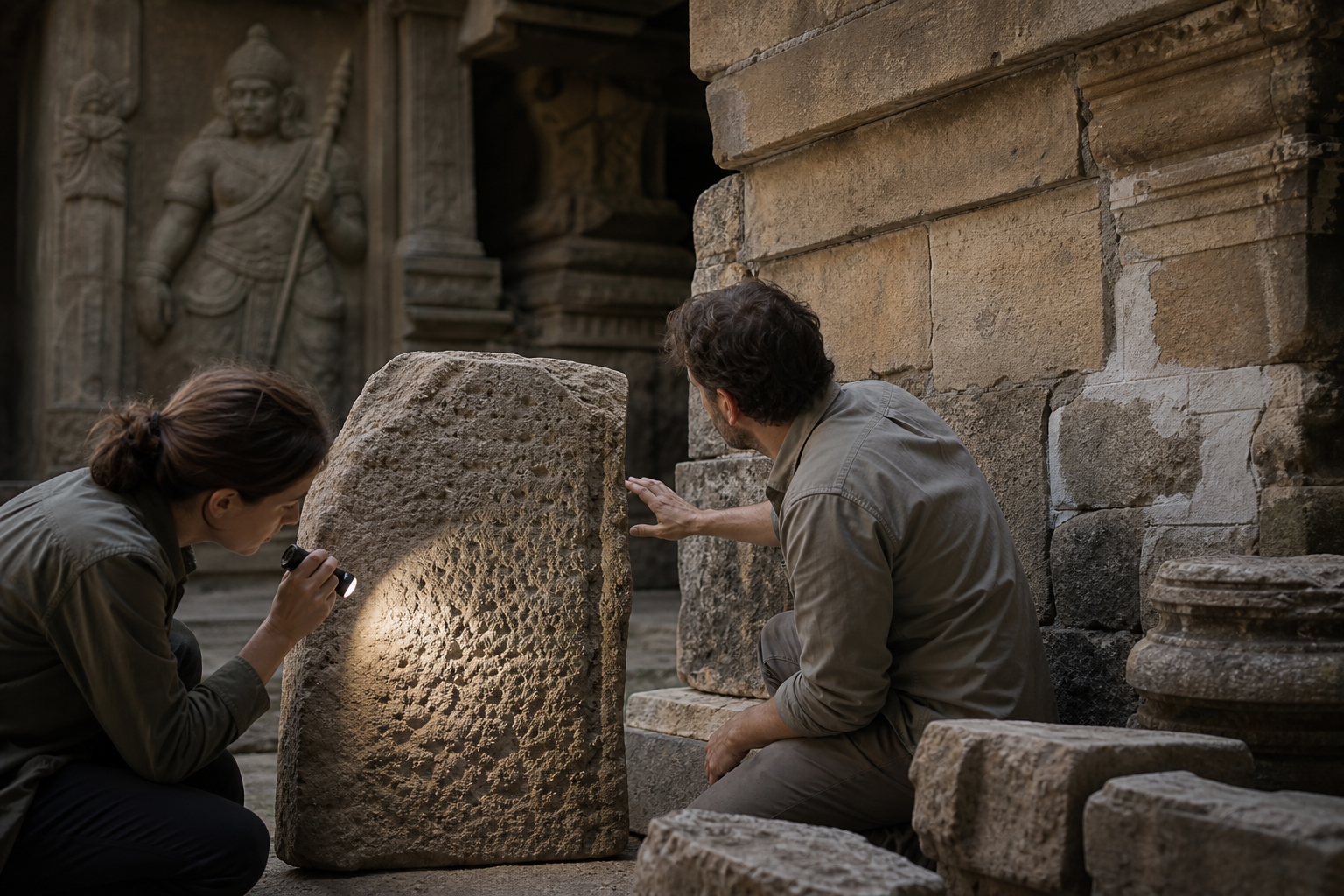
Royal praise in the praśasti mode was never a neutral campaign report. Magnification was part of its purpose. Enemies could be rendered through conventional hostility, victories could be enlarged through martial imagery, and officials could be aligned with exemplary figures from sacred narrative. Treating every flourish as literal fact produces brittle history.
Dismissing the whole commemoration as propaganda produces an equally serious error. Names, dates, titles, places, administrative units, grants, damaged structures, and sanctioned acts of restoration can preserve usable historical anchors even when their surrounding language is celebratory. Your task is to separate the anchor from the amplification.
| Level of claim | What you can responsibly say | What requires restraint |
|---|---|---|
| Firm inscriptional anchors | Gunda held high office under Harihara II; he appears in a 1395 grant context; temple damage, conflict, and restoration belong to the 1397 Belur commemoration. | Do not turn a surviving reference into a complete biography or a full administrative ledger. |
| Celebrated military action | Gunda receives credit for repelling the threat, campaigning against the enemy, and marking victory with jaya-stambhas. | The precise scale, route, and tactical details cannot be reconstructed from martial praise alone. |
| Institutional interpretation | His combined civil and military standing reveals a model in which defence, order, commerce, and temple restoration could be connected. | Do not claim that every supporting measure was personally directed by Gunda unless it is specifically attested. |
| Modern stewardship lesson | Protection, authorised repair, living practice, skilled people, and local continuity should be planned as one programme. | This is a reasoned application of the historical pattern, not a medieval conservation manual. |
This calibrated method improves both history and advocacy. Write that Gunda “receives credit in the Belur commemoration” for the counteroffensive when the claim comes through eulogistic language. You can speak more directly about the dated office, named locations, administrative setting, reported damage, and royal sanction while still acknowledging that corroboration is desirable wherever further evidence exists.
The distinction also protects heritage from becoming a vehicle for careless rhetoric. You do not need to erase the attack on Chennakeshava, soften its seriousness, or detach it from the political conflict. You do need to preserve the limits of the evidence. A pro-Dharma account becomes stronger, not weaker, when it refuses claims that the available record cannot carry.
Key takeaways: a five-part stewardship test
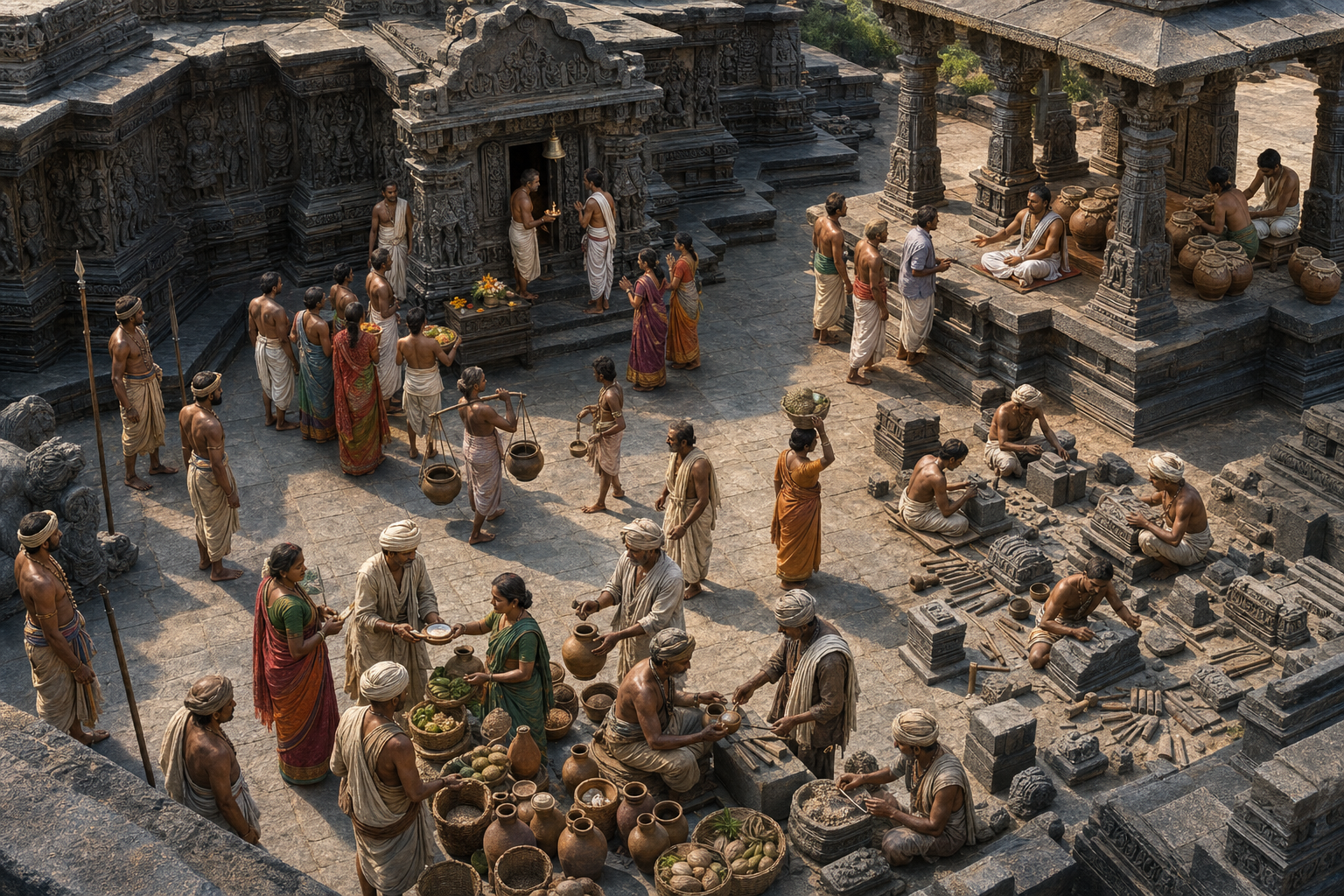
- Establish the historical anchor. Record the date, place, nature of the damage, responsible authority, and known intervention. Keep those concrete elements separate from praise, accusation, symbolism, and later inference.
- Secure continuity before announcing reconstruction. Identify who protects the site, controls access, authorises work, documents change, and responds if the same vulnerability returns. A launch date is not a security plan.
- Define restoration as a living outcome. State which forms of worship, ritual rhythm, custodial practice, and community use must remain possible. If these disappear, physical completion can still amount to institutional failure.
- Protect the human and economic ecosystem. Map the artisans, temple personnel, administrators, merchants, patrons, and local services on which continuity depends. Include them in the operating plan rather than treating them as incidental beneficiaries.
- Name one accountable steward across the handoffs. Specialists can divide the work, but someone must remain responsible for the connection between protection, conservation, sacred function, local administration, and maintenance.
This is the practical force of joining kṣātra with seva. Kṣātra is the capacity and duty to protect; seva turns that protection toward service, repair, and continuity. Protection without renewal leaves a guarded ruin. Renewal without protection leaves a vulnerable institution. Gunda’s remembered career holds the two obligations together.
The wider dharmic relevance does not require you to flatten Hindu, Buddhist, Jain, and Sikh institutions into one custodial form. Their doctrines, authorities, and sacred practices differ. The shared civic principle is narrower and more useful: a community preserves Dharma not only through belief, but by caring competently for the places, people, knowledge, and routines through which sacred life continues.
When the next temple-restoration proposal reaches you, ask for a one-page continuity plan before judging the rendering. It should identify what must be protected, which living practices must continue, who has authority over the work, and who remains responsible after reopening. If those answers are missing, the project is not yet a stewardship programme. It is still only a construction proposal.
References
